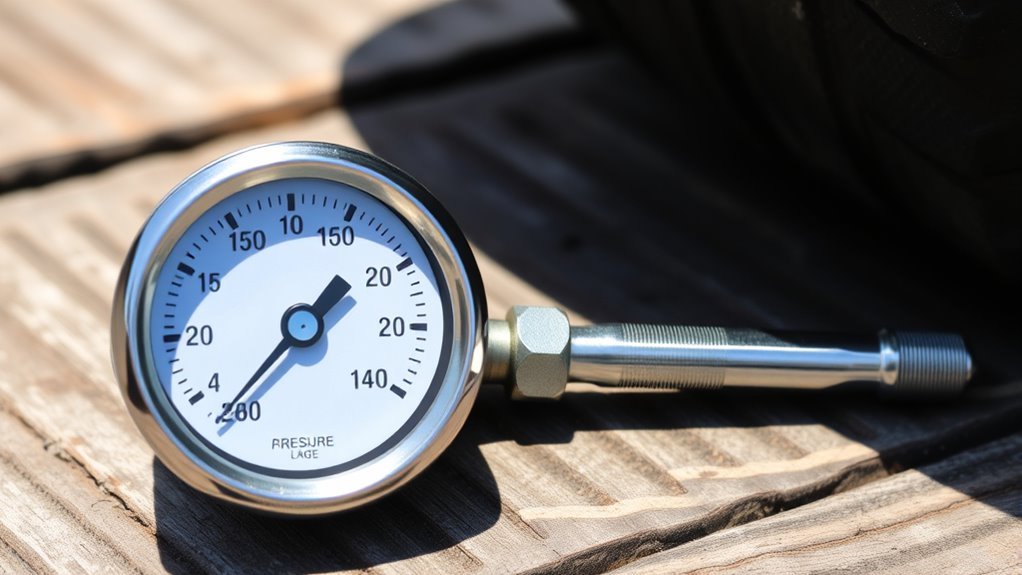
To read an analog tire pressure gauge, first attach the gauge to the tire valve stem for a tight seal. For dial gauges, wait for the needle to stabilize on the dial to note the pressure. With stick gauges, push firmly until it fully extends. Always check the manufacturer’s recommended PSI for accuracy. Be cautious of common mistakes like incorrect angles or air loss. Stay with us for essential tips on maintaining your gauge’s accuracy.
How Do Analog Tire Pressure Gauges Work?
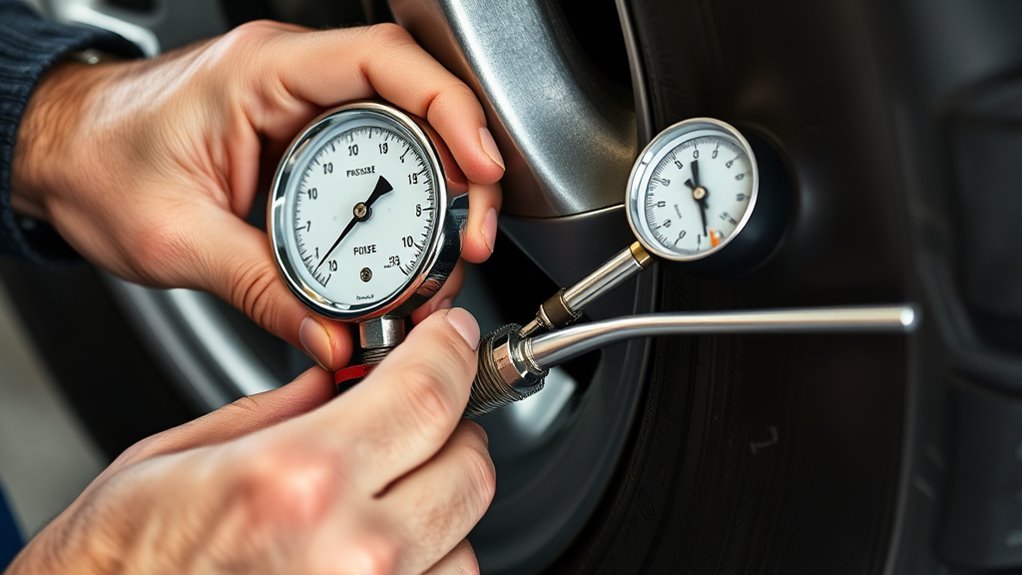
Analog tire pressure gauges operate based on mechanical principles, utilizing components like a Bourdon tube or diaphragm. When you connect the gauge to the valve stem, the air pressure inside the tire causes the flexible element to move. This movement translates to pressure measurements displayed on the dial, typically in PSI (pounds per square inch). Analog gauges are known for their durability since they don’t depend on batteries or electronic components, guaranteeing reliable long-term use. However, accurate readings depend on proper calibration; periodically test your gauge against a known standard to maintain precision. Always verify a tight seal over the valve stem to prevent air leakage, which can compromise the accuracy of your readings.
Using Dial and Stick Gauges: Step-by-Step
After understanding how analog tire pressure gauges function, you can confidently proceed to use them effectively. To use a dial gauge, first, open the tire valve and firmly attach the gauge to the valve, ensuring a tight seal to prevent air leaks. Wait for the needle to stabilize before noting the pressure reading in PSI. For stick gauges, remove the valve cap and press the gauge onto the valve stem, allowing it to extend fully for an accurate reading. Familiarize yourself with the scale; dial gauges are generally easier to read. Always double-check the pressure against the manufacturer’s recommended PSI found in your owner’s manual or on a sticker inside the driver’s door jamb for ideal safety and performance.
Common Mistakes to Avoid With Analog Gauges
Many users make critical errors when reading analog tire pressure gauges that can lead to inaccurate measurements. To guarantee you’re getting the right pressure and maintaining peak tire performance, avoid these common mistakes:
- Neglecting Calibration: Always check that your gauge is calibrated. An uncalibrated gauge can yield unreliable readings, risking your safety.
- Pressing Too Hard: Don’t press the gauge firmly against the valve stem. This may cause air loss, resulting in a lower than actual pressure reading.
- Incorrect Viewing Angle: Always read the gauge at eye level to prevent parallax errors. Viewing from an angle can distort the reading and affect accuracy.
Dial vs. Stick Gauges: Key Differences Explained
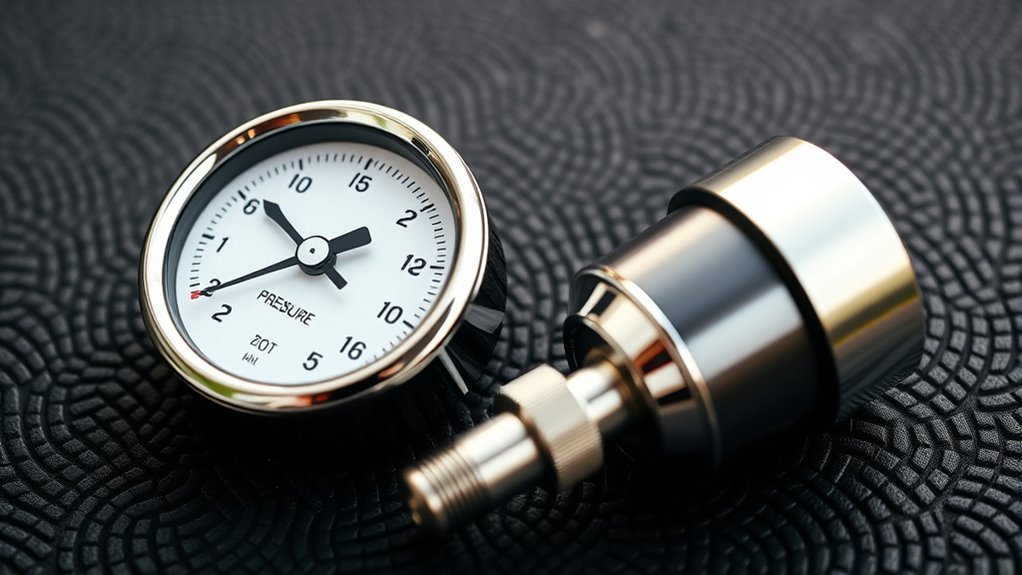
When choosing between dial and stick gauges for measuring tire pressure, understanding their key differences can enhance your experience and accuracy.
| Feature | Dial Gauges | Stick Gauges |
|---|---|---|
| Reading Method | Mechanical needle on a dial | Linear scale, pencil-like |
| Accuracy | Generally more precise | Often less accurate |
| Ease of Use | Requires two hands | Operable with one hand |
| Compactness | Bulkier, less portable | Compact and lightweight |
| Lighting Conditions | Harder to read in low light | Easier to read in low light |
Ultimately, your choice hinges on user preference for accurate readings, ease of use, and specific vehicle needs, as both gauge types measure tire pressure in PSI.
How to Keep Your Tire Pressure Gauge Accurate: Tips You Need
Choosing the right type of tire pressure gauge, whether a dial or stick model, is just the start; maintaining its accuracy is equally important for safe driving. Follow these tips to guarantee your gauge provides accurate readings:
- Calibration: Periodically check your tire pressure gauge against a known accurate gauge to confirm it’s calibrated.
- Storage: Store your gauge in a cool, dry place to protect it from extreme temperatures and moisture that can affect performance.
- Inspection: Regularly inspect your gauge for wear, damage, or leaks, especially in rubber seals and connections.
Use your gauge consistently under similar conditions and remember to replace batteries in digital models as needed. For mechanical gauges, avoid dropping or mishandling them to preserve accuracy over time.
Frequently Asked Questions
How to Read an Analog Tire Pressure Gauge?
To read an analog tire pressure gauge accurately, guarantee proper gauge calibration, avoid common mistakes, and understand PSI levels. Consider seasonal pressure changes for best tire maintenance, maximizing performance and safety by using gauges correctly.
How to Read a Dial Pressure Gauge?
To read a dial pressure gauge, guarantee proper gauge calibration. Attach it firmly, wait for needle stabilization, and interpret the reading accurately at eye level. Avoid common mistakes for effective tire maintenance and safety. Store gauges correctly.
How to Use a Dial Tire Pressure Gauge?
To use a dial tire pressure gauge, attach it securely to the valve stem, read the stable needle position, and compare it against recommended levels. Regular checks enhance tire safety, lifespan, and driving performance amidst seasonal changes.
Is 40 PSI Too High for 35 PSI?
Forty PSI’s like wearing shoes two sizes too small for your vehicle—it hinders performance and safety. Stick to 35 PSI for proper inflation, ensuring ideal tire lifespan, fuel efficiency, and compliance with safety standards.
Conclusion
Now that you know how to read both dial and stick analog tire pressure gauges, you’re equipped to keep your tires in prime condition. But what happens if you ignore tire pressure maintenance? A simple oversight could lead to decreased fuel efficiency or even a blowout. Don’t let inattention jeopardize your safety. Stay vigilant, regularly check your tire pressure, and maintain your gauge for accurate readings. The road ahead is unpredictable—be prepared for whatever comes your way.