Last updated: July 14, 2026 | Scope: U.S.-market Toyota RAV4 models. AWD equipment and system names may differ in other markets.
Every new 2026 U.S.-market Toyota RAV4 with AWD uses Electronic On-Demand AWD, which powers the rear axle with a dedicated electric motor. The two mechanical systems, Dynamic Torque Control AWD and Dynamic Torque Vectoring AWD with Rear Driveline Disconnect, apply to 2025-and-earlier gas RAV4 models. Each system improves traction automatically, but the hardware and torque-control methods differ.
Quick Answer
A current 2026 RAV4 AWD uses a dedicated rear electric motor. Sensors monitor wheel speed, throttle, steering, and vehicle movement, then add rear-wheel torque during starts, acceleration, cornering, or slippery conditions. Gas RAV4 models through 2025 may instead use a mechanical driveshaft and coupling. Select older gas trims add rear torque vectoring and driveline-disconnect hardware.
Key Takeaways
- The 2026 U.S. RAV4 lineup uses hybrid and plug-in-hybrid powertrains. Current AWD models use an independent rear electric motor.
- Dynamic Torque Control AWD is a mechanical, front-biased system used on gas RAV4 models in earlier model years.
- Dynamic Torque Vectoring AWD can send up to 50% of engine torque rearward and distribute rear torque between the left and right wheels.
- Rear Driveline Disconnect uses dog clutches to stop unnecessary rear-driveline rotation during low-demand driving.
- Many 2013–2018 gas RAV4 AWD models include an AWD Lock button that requests a 50:50 split below about 25 mph.
- AWD improves launch traction and stability, but it does not replace suitable tires, safe speed, or proper maintenance.
Which RAV4 AWD System Does Your Vehicle Have?
Start with the model year and powertrain. An AWD badge alone does not tell you whether the vehicle has standard mechanical AWD, rear torque vectoring, or an electric rear motor. Toyota changed the available systems across model years and trims.
| Model example | AWD type | Rear-drive hardware | What to know |
|---|---|---|---|
| 2026 RAV4 Hybrid AWD | Electronic On-Demand AWD | Dedicated rear electric motor | Toyota lists 89 lb-ft of rear-motor torque for the AWD hybrid system. |
| 2026 RAV4 Plug-in Hybrid | Electronic On-Demand AWD | Dedicated rear electric motor | AWD is standard on U.S. plug-in-hybrid models. |
| 2025 RAV4 Hybrid or Plug-in Hybrid | Electronic On-Demand AWD | Independent rear electric motor | No mechanical driveshaft connects the front powertrain to the rear axle. |
| 2025 gas LE, XLE, or XLE Premium AWD | Standard mechanical AWD | Transfer unit, driveshaft, coupling, and rear differential | Controls front-to-rear torque automatically. |
| 2025 gas Limited AWD | Dynamic Torque Vectoring AWD | Mechanical AWD with rear left/right control and driveline disconnect | Can send up to 50% of engine torque rearward. |
| 2024 Adventure or TRD Off-Road | Dynamic Torque Vectoring AWD | Mechanical AWD with Rear Driveline Disconnect | Designed for stronger rear torque control on rough or slippery roads. |
| Other years and trims | Varies | Check the exact build | Use the owner’s manual, original window sticker, or VIN-based build record. |
Toyota’s official 2025 RAV4 information, 2024 RAV4 specifications, and 2026 RAV4 technical overview confirm these examples.
[Products Worth Considering]

These universal clip-on towing mirrors help expand rear visibility and reduce blind spots when towing with trucks, SUVs, RVs, and trailers. A rainproof molded guard helps keep the mirror surface clearer in wet or snowy conditions, while the adjustable swivel joint and secure clamps provide a stable, customizable view. Tool-free installation and included storage bag make them convenient for travel and everyday towing use.

This front windshield sunshade is designed to help keep your Toyota RAV4 cooler by reducing heat buildup after parking in direct sunlight. It blocks most UV rays to help protect your dashboard, seats, and steering wheel from sun damage, while the accordion folding design makes it easy to set up, store, and transport. Built with a durable triple-laminate construction and a silver reflective surface, it offers practical everyday sun protection for compatible RAV4 models.

Upgrade your vehicle interior with Skechers Memory Foam front seat covers designed for comfort, protection, and a clean custom look. The memory foam contours to your body to help relieve pressure, while the cooling Lycra top layer adds breathability for a more comfortable drive. Built with a form-fitting design and airbag-compatible stitching, these covers suit most cars, trucks, vans, and SUVs.
How to Identify Your System in a Few Minutes
- Confirm the powertrain: A Hybrid or Plug-in Hybrid AWD model uses an electric rear motor.
- Check the model year: All new 2026 U.S. RAV4 AWD systems are motor-driven Electronic On-Demand AWD systems.
- Check the trim: Mechanical torque-vectoring AWD was limited to select gas trims in earlier model years.
- Read the original documents: Look for “Dynamic Torque Vectoring AWD,” “Rear Driveline Disconnect,” or “Electronic On-Demand AWD” on the window sticker or build sheet.
- Do not rely on the rear badge: A basic AWD badge does not identify the internal hardware.
How 2025-and-Earlier Gas RAV4 Dynamic Torque Control AWD Works
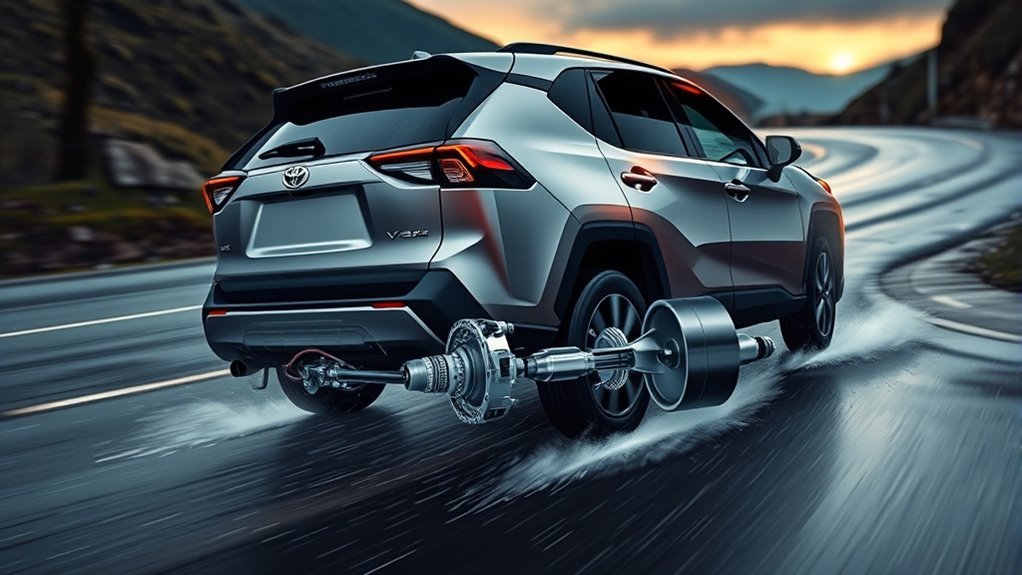
Dynamic Torque Control AWD is a front-biased mechanical AWD system used on gas RAV4 models in earlier model years. During low-demand cruising, the system can direct engine torque to the front wheels. It can then add rear-wheel torque during starts, acceleration, cornering, uphill driving, or slippery conditions.
Toyota describes Dynamic Torque Control AWD as a system that continually monitors driving inputs and manages torque between the front and rear axles. Toyota’s fourth-generation documentation states that front-to-rear distribution could vary from 100:0 to 50:50. The system used vehicle speed, steering, throttle, and yaw information to decide when rear assistance was useful. You can review Toyota’s Dynamic Torque Control explanation and its 2013 RAV4 technical overview.
Note: Mechanical gas-model AWD is now used-RAV4 information in the U.S. market. Toyota moved the 2026 RAV4 lineup to hybrid and plug-in-hybrid powertrains, with Electronic On-Demand AWD available or standard depending on grade.
Affiliate disclosure: AutoReviewNest may earn a commission from qualifying purchases made through links on this page, at no extra cost to you.
The Three Main RAV4 AWD Systems
| System | Common use | How it sends rear power | Best for |
|---|---|---|---|
| Dynamic Torque Control AWD | Gas RAV4 AWD models in earlier model years; branding and controls vary | Mechanical driveline with an electronically controlled coupling | Daily driving, rain, light snow, and maintained gravel roads |
| Dynamic Torque Vectoring AWD | Select gas trims through 2025, including documented Adventure, TRD Off-Road, and Limited applications | Mechanical driveline with rear left/right torque control and Rear Driveline Disconnect | Cornering control, rough roads, snow, and light off-pavement use |
| Electronic On-Demand AWD | RAV4 Hybrid and RAV4 Plug-in Hybrid, including current 2026 AWD models | Independent rear electric motor | Efficiency, responsive rear torque, commuting, and changing weather |
[Products Worth Considering]

This portable roadside emergency car kit helps drivers stay prepared with essential tools for common breakdowns and unexpected roadside situations. It includes jumper cables, a tow strap, a flashlight, a rain poncho, gloves, and a first aid kit, all stored in a durable zippered case for easy access and organization. With included roadside assistance coverage, it adds extra peace of mind for commuters, new drivers, and road trips.
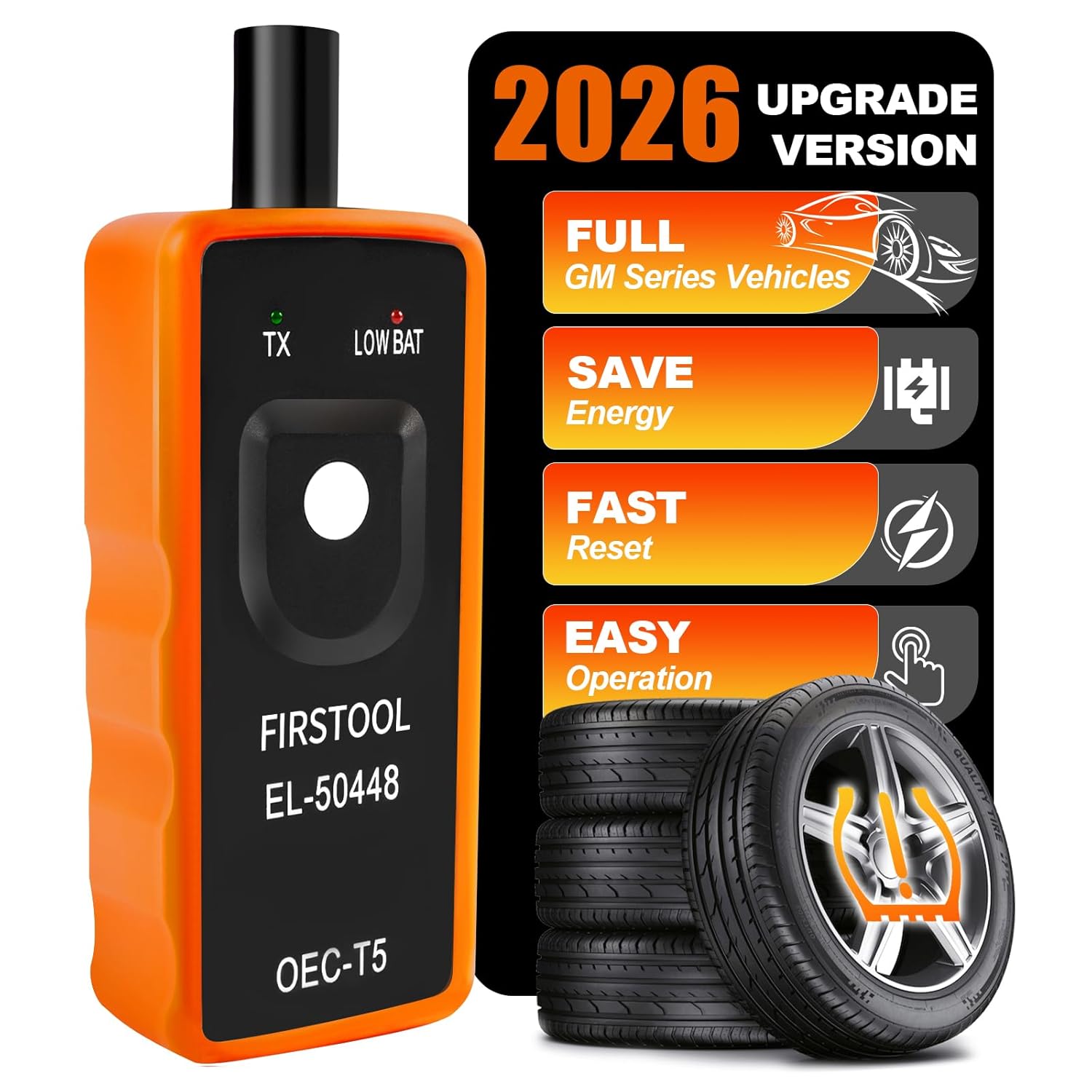
This EL-50448 TPMS relearn tool helps quickly activate and reset tire pressure sensors so your vehicle’s monitoring system stays accurate after tire rotations, sensor replacement, or seasonal tire changes. Designed for many GM-related vehicles and compatible with common 315 and 433 MHz TPMS systems, it offers simple one-button operation and reliable performance for clearing warning lights and relearning sensor positions.
How Basic RAV4 AWD Sends Power Front-to-Rear
On gas RAV4 models with Dynamic Torque Control AWD, the front wheels can handle steady, low-demand cruising. When the control system calls for more traction or stability, an electronically controlled coupling sends engine torque through the driveshaft to the rear differential.
Normal operation is automatic. The system can add rear torque before obvious wheelspin, so rear-wheel contribution during acceleration or cornering does not mean the system is stuck or malfunctioning.
Which Sensor Inputs Trigger RAV4 AWD?
Dynamic Torque Control uses driving information rather than waiting for the vehicle to become completely stuck. Toyota has documented inputs including vehicle speed, steering speed and angle, throttle angle, and yaw rate.
- Starting from a stop: Rear torque can reduce front-wheel spin.
- Accelerating: AWD can spread driving force across both axles.
- Cornering: Rear assistance can reduce the load on the front tires.
- Snow, rain, or gravel: The system can add rear torque when available grip falls.
- Steady cruising: Rear involvement can be reduced to limit driveline loss.
Does the RAV4 Have an AWD Lock Button?
Many 2013–2018 gas RAV4 AWD models have an AWD Lock button. Toyota states that this mode requests a fixed 50:50 front-to-rear torque split at speeds up to about 25 mph. Above that speed, the system returns to automatic AWD control.
AWD Lock is intended for low-speed slippery or loose conditions. It does not add low-range gearing, create a truck-style locked transfer case, or turn the RAV4 into a traditional 4WD vehicle. Confirm the operating instructions in the manual for your exact model year before using it. Toyota documents this behavior in its 2013 RAV4 introduction and 2018 RAV4 overview.
How the Electronically Controlled Coupling Engages
The basic mechanical AWD system uses an electronically controlled coupling near the rear differential. When the controller requests rear assistance, the coupling transfers torque through the rear differential to the rear wheels.
The RAV4 does not have a manual low-range lever or driver-managed locking center differential. Even on models with AWD Lock, the vehicle automatically returns to normal control above its low-speed operating range.
Is the RAV4 AWD Torque Split Always 50:50?
No. Dynamic Torque Control can vary its front-to-rear distribution instead of remaining locked at 50:50. Toyota documented a 100:0 to 50:50 operating range for the fourth-generation system. Dynamic Torque Vectoring AWD can also send up to 50% of engine torque to the rear, then distribute that rear torque between the left and right wheels.
Most RAV4 AWD operation is automatic and variable. A 50:50 split is a maximum or low-speed Lock-mode condition on applicable mechanical systems, not the permanent normal setting.
What Does Torque Vectoring Do in the RAV4?
Dynamic Torque Vectoring AWD is the more advanced mechanical system offered on select gas RAV4 trims through the 2025 model year. It controls how much engine torque reaches the rear axle and can distribute that rear torque between the left and right wheels.
Toyota states that the system can direct up to 50% of engine torque to the rear wheels. It can then send more of that rear torque toward the side where it can support traction or cornering. Toyota documented the system on the 2024 Adventure and TRD Off-Road and on the AWD-equipped 2025 Limited. See Toyota’s 2024 RAV4 information and 2025 RAV4 overview.
How Torque Vectoring Supports Cornering Grip
When a vehicle turns, the inside and outside wheels follow different paths and carry different loads. Rear torque distribution can help the RAV4 use available grip more effectively instead of treating both rear wheels identically in every situation.
- It can support a more stable response when accelerating through a turn.
- It can direct rear torque toward the side with more usable grip.
- It can help reduce front-tire loading and understeer.
- It provides more detailed rear-axle control than basic front-to-rear AWD.
How Brake-Based Traction Control Helps
Selective braking is not the mechanism that makes Dynamic Torque Vectoring AWD distribute rear torque. It is a separate traction- and stability-control tool. If a wheel spins too freely, brake control can slow that wheel and help the vehicle use the grip available at the other wheels.
On supported hybrid and plug-in-hybrid models, Trail Mode coordinates AWD, brake control, and drive-force control. Toyota describes it as providing behavior similar to a virtual limited-slip differential on rough or uneven surfaces. It is still not a mechanical locking differential.
Basic AWD Versus Rear Torque Distribution
Basic Dynamic Torque Control mainly manages torque between the front and rear axles. Dynamic Torque Vectoring AWD adds control within the rear axle, allowing the vehicle to vary how rear torque is shared between the left and right wheels.
Pro Tip: Do not assume every gas AWD RAV4 has torque vectoring. Check the original window sticker or VIN-based build record for the exact phrase “Dynamic Torque Vectoring AWD with Rear Driveline Disconnect.”
How Rear Driveline Disconnect and Dog Clutches Reduce Drag
Dynamic Torque Vectoring AWD can include Rear Driveline Disconnect. When rear drive is unnecessary, Toyota says ratchet-type dog clutches can stop the rear-axle driveshaft from rotating. This reduces avoidable driveline movement during steady, low-demand driving.
| Condition | System action | Driver benefit |
|---|---|---|
| Steady cruising | Rear driveline can disconnect | Less unnecessary driveline rotation |
| Low traction demand | Rear drive remains disengaged until useful | Balances efficiency and AWD readiness |
| Slippery surface | Rear driveline reconnects as required | Improved launch traction and stability |
| Cornering under power | Rear torque can be varied left to right | More precise rear-axle control |
The system has more clutches and control hardware than basic mechanical AWD. Diagnosis and fluid-service decisions should therefore follow service information for the exact model year and trim rather than a generic RAV4 schedule.
RAV4 Hybrid Versus Mechanical AWD: How Are They Different?
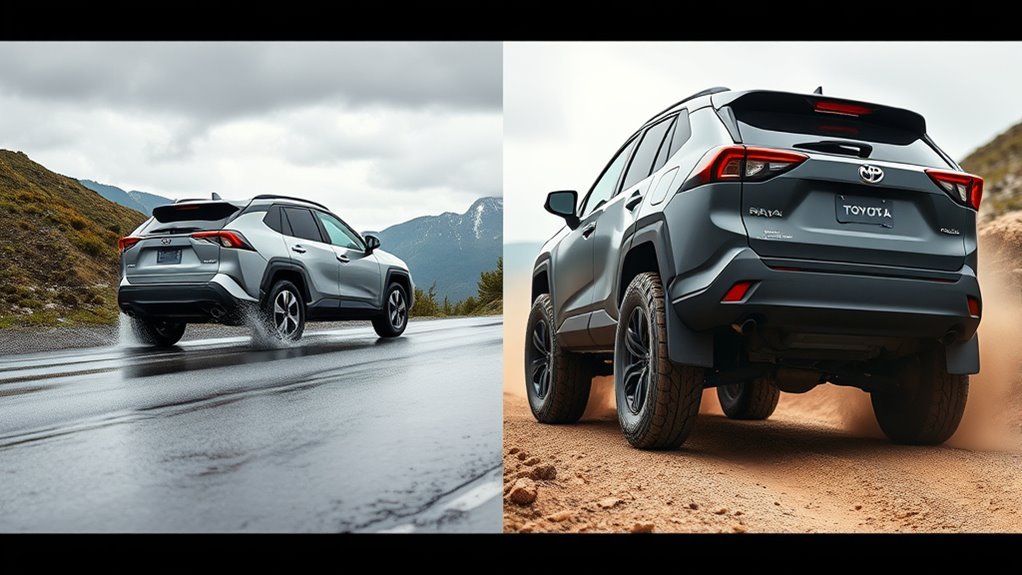
The RAV4 Hybrid and RAV4 Plug-in Hybrid use Electronic On-Demand AWD. A separate electric motor drives the rear axle, so the vehicle does not need a mechanical driveshaft connecting the front powertrain to the rear wheels.
How Does the Hybrid RAV4 Drive the Rear Wheels?
The controller sends electrical commands to the rear motor based on wheel speed, throttle, steering, vehicle speed, and other operating conditions. Toyota says the current system can preemptively add rear driving force during starts, respond to front-wheel slip, and support cornering stability.
For 2026, Toyota lists a dedicated rear motor-generator, called MGR, on AWD models. The standard hybrid rear motor produces 89 lb-ft of torque, while the plug-in-hybrid rear motor is listed at 91 lb-ft. These are rear-motor figures, not total vehicle torque ratings. Toyota provides the details in its 2026 RAV4 technical release.
Electronic rear drive responds without engaging a mechanical front-to-rear coupling. The available rear torque still depends on vehicle speed, traction-battery conditions, control limits, drive mode, and the grip available at the tires.
Mechanical Rear-Drive Path on Gas RAV4 Models
Gas RAV4 AWD systems through 2025 use a mechanical path to the rear wheels. Depending on the system, that path includes a transfer unit, driveshaft, electronically controlled coupling, rear differential, and possibly torque-vectoring and disconnect clutches.
This setup does not include a truck-style low range. For used buyers, the mechanical system may be desirable when the exact trim offers Dynamic Torque Vectoring AWD. New 2026 buyers choose between front-wheel drive and Electronic On-Demand AWD on supported hybrid grades, while U.S. plug-in-hybrid models use AWD.
RAV4 AWD Engagement: Sensors, Drive Modes, and Triggers

Current RAV4 AWD operation is automatic. Mechanical systems also operate automatically during normal driving, although some older models add a low-speed AWD Lock button. The controller decides when rear-wheel assistance can improve acceleration, stability, or traction.
- Wheel speed: Helps identify unexpected differences in tire rotation.
- Throttle input: Shows how much acceleration the driver is requesting.
- Steering input: Helps predict cornering demand before obvious wheelspin occurs.
- Yaw and vehicle movement: Help the stability systems compare the intended path with actual movement.
- Vehicle speed: Affects the amount and type of rear assistance the system can provide.
- Brake and traction control: Can reduce wheelspin and support usable grip at other wheels.
What Can the AWD or Torque Monitor Show?
On RAV4 models equipped with an AWD or torque-allocation display, the graphic may show rear contribution during starts, stronger acceleration, cornering, or changing road conditions. That is normal operation and does not necessarily mean the vehicle detected a major skid.
The graphic is an operating indicator, not a diagnostic test. If the display behaves differently from normal and an AWD, ABS, traction-control, or hybrid warning appears, have the vehicle scanned rather than judging the fault from the animation alone.
Some gas AWD RAV4 models include Multi-Terrain Select, with modes such as Mud & Sand and Rock & Dirt. Hybrid and plug-in-hybrid models may use Trail Mode instead. Available modes vary by year and trim, so use the manual for your exact vehicle.
Warning: RAV4 AWD can improve acceleration and stability on a slippery road, but it does not create extra braking grip on ice. Tire condition, following distance, and speed remain critical.
What Does RAV4 AWD Improve in Real Driving?
The clearest benefit is stronger launch traction when road grip changes. Rear assistance can help the vehicle start on a wet hill, continue through moderate snow, or reduce front-wheel spin on gravel and loose surfaces.
Dynamic Torque Vectoring AWD adds more detailed rear control when cornering or when the two rear tires have different levels of grip. Electronic On-Demand AWD can add rear-motor torque during starts and respond electronically as driving conditions change.
AWD cannot compensate for worn, unsuitable, or badly inflated tires. Braking and cornering still depend heavily on the contact between each tire and the road.
What Will RAV4 AWD Not Do?
RAV4 AWD is designed mainly for road use, changing weather, gravel, and light off-pavement driving. It still operates within the limits of the tires, ground clearance, cooling capacity, and available traction.
- It is not low-range 4WD: The RAV4 does not have a two-speed transfer case.
- AWD Lock is not a differential locker: On applicable older models, it requests a low-speed torque split but does not add low-range gearing.
- It does not replace winter tires: AWD mainly helps the vehicle accelerate and maintain momentum.
- It is not intended for extreme off-roading: Deep ruts, large rocks, steep breakover angles, and prolonged wheelspin can exceed its design.
- It cannot overcome excessive speed: Ice, standing water, and abrupt steering can overwhelm any drivetrain.
- It needs compatible tires: Significant differences in tire size, construction, pressure, or wear can affect traction-control and driveline operation.
RAV4 AWD Maintenance: Mechanical Versus Electric Rear Drive
Mechanical gas-model AWD and hybrid electric-rear-drive AWD do not have identical service points. Always follow the maintenance guide and repair information for the exact model year, powertrain, and trim.
Mechanical Gas AWD
- Inspect the transfer unit, driveshaft, rear differential, couplings, and related seals.
- Use only the specified fluid type and service procedure for the exact model.
- Investigate vibration, binding, leaks, or new driveline noise promptly.
- Confirm whether the vehicle has basic AWD or Dynamic Torque Vectoring AWD before ordering parts.
Hybrid and Plug-in-Hybrid AWD
- The rear axle uses an electric motor-generator and rear transaxle assembly instead of a front-to-rear driveshaft.
- Hybrid-system, rear-motor, ABS, and traction warnings require compatible diagnostic equipment.
- Inspect the rear assembly and seals according to Toyota’s model-specific schedule.
- Do not apply mechanical gas-AWD fluid instructions to a hybrid rear-drive unit.
For service-specific information, see the RAV4 differential and transfer-case fluid guide. That guide should be used only after confirming which drivetrain your RAV4 has.
Which RAV4 AWD Setup Should You Choose?
[Products Worth Considering]

【Precise Fit for Refresh 2026 RAV4】Compatible with 2026 Toyota RAV4 Plug-in Hybrid (SE/Woodland/XSE/GR SPORT) & 6th Gen RAV4 Hybrid (LE/SE/XLE Premium/Woodland/XSE/Limited) center console front passenger dashboard location. Tailored to match updated interiors precisely.
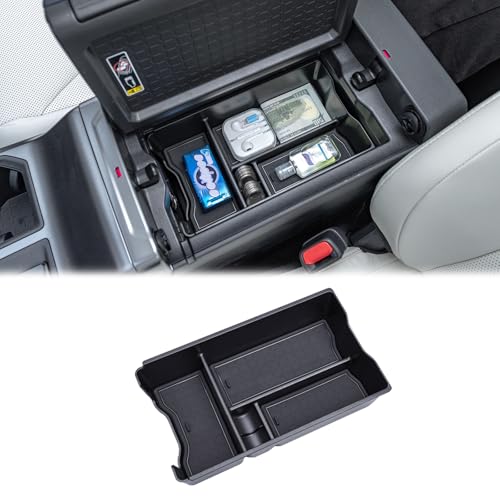
Precise fit: The Console Organizer Tray is specifically designed for the 2026 2027 RAV4 Hybrid (LE/SE/XLE Premium/Woodland/XSE/Limited) & 2026 RAV4 Plug-in Hybrid (SE/Woodland/XSE/GR SPORT). According to the original vehicle armrest box design, it will not affect the opening and closing of the armrest box.

Black-Blue Finish Design:The black-blue exterior matches the original interior color,letting the bag integrate perfectly with your trunk.
Buying a New 2026 RAV4
New U.S. RAV4 buyers no longer choose between mechanical and electric-rear-drive AWD. Toyota’s 2026 lineup is hybrid and plug-in hybrid. Hybrid grades may offer front-wheel drive or Electronic On-Demand AWD depending on trim, while plug-in-hybrid models use AWD.
- Mostly urban driving: Compare FWD and AWD hybrid grades based on weather, hills, efficiency, and budget.
- Rain, snow, or steep roads: Electronic On-Demand AWD adds rear-motor assistance without a mechanical driveshaft.
- Light trail access: Consider a grade with suitable tires, ground clearance, and terrain-focused equipment rather than choosing by AWD badge alone.
- Plug-in capability: The RAV4 Plug-in Hybrid combines standard AWD with external charging and stronger system output.
Buying a 2025-or-Earlier Used RAV4
- Basic all-weather commuting: Standard mechanical AWD or Hybrid Electronic On-Demand AWD is generally sufficient.
- More detailed rear control: Look for the exact Dynamic Torque Vectoring AWD wording.
- Older low-speed Lock mode: Many 2013–2018 gas AWD models include an AWD Lock button.
- Rough-road priorities: Verify the trim’s tires, suspension, drive modes, and ground clearance in addition to AWD type.
For a broader cost and traction comparison, read the RAV4 AWD vs FWD guide. When buying used, the original window sticker or VIN-based build record is more reliable than the rear hatch badge.
Driving and Care Tips to Maximize RAV4 AWD Lifespan
Good AWD care begins with compatible tires, correct inflation, scheduled rotation, leak inspections, and prompt diagnosis of warning messages. The exact fluid and inspection points depend on whether the vehicle has mechanical AWD or an electric rear motor.
- Keep all four tires compatible: Use the specified size and construction, with reasonably even wear across the set.
- Rotate tires on schedule: Rotation helps control uneven wear and rolling-diameter differences.
- Check pressure when tires are cold: Use the vehicle placard rather than the maximum pressure on the tire sidewall.
- Inspect the correct rear-drive hardware: Mechanical gas AWD and hybrid electric rear drive require different procedures.
- Use terrain modes only when appropriate: Follow the model-specific instructions for AWD Lock, Mud & Sand, Rock & Dirt, Snow, or Trail Mode.
- Avoid prolonged aggressive wheelspin: It can build heat in tires, brakes, motors, couplings, and driveline components.
- Respond to warning lights: Diagnose AWD, ABS, traction-control, and hybrid-system warnings promptly.
Pro Tip: After a tire is damaged, ask the shop to measure all four tread depths and confirm Toyota’s replacement requirements for your exact drivetrain before replacing only one or two tires.
Frequently Asked Questions
How does RAV4 AWD do in snow?
RAV4 AWD can improve launch traction and help the vehicle maintain momentum in light to moderate snow. Tire condition and type remain critical for braking and cornering. Use winter or severe-snow-rated tires when local conditions justify them.
Does Toyota have a good AWD system?
Toyota’s RAV4 AWD systems are well suited to everyday all-weather driving. Dynamic Torque Control manages front-to-rear power, Dynamic Torque Vectoring adds rear left-to-right control, and Electronic On-Demand AWD powers the rear axle with an electric motor.
Is RAV4 AWD always on?
The AWD controller remains active, but the vehicle does not use a permanent fixed 50:50 torque split. Rear contribution changes with acceleration, steering, vehicle speed, available grip, and system conditions. Some mechanical systems can reduce or disconnect rear-drive operation during low-demand cruising.
Does the 2026 RAV4 use mechanical AWD?
No current U.S.-market 2026 RAV4 AWD model uses the older gas-model mechanical driveshaft system. Toyota’s 2026 AWD hybrid and plug-in-hybrid models use Electronic On-Demand AWD with a dedicated rear electric motor.
Does the RAV4 have an AWD Lock button?
Many 2013–2018 gas RAV4 AWD models have an AWD Lock button. Toyota states that it requests a 50:50 front-to-rear split below about 25 mph and then returns to automatic AWD operation. Current models do not use that older mechanical Lock-mode setup.
What is the difference between RAV4 AWD and 4WD?
RAV4 AWD automatically varies rear assistance for roads, changing weather, gravel, and light off-pavement driving. Traditional 4WD commonly adds driver-selectable high and low ranges, heavier-duty transfer-case hardware, or locking differentials for more difficult terrain. The RAV4 does not have low-range 4WD.
Which RAV4 AWD system is best?
For a new 2026 RAV4, Electronic On-Demand AWD is the only AWD architecture offered in the U.S. lineup. Among used gas models, Dynamic Torque Vectoring AWD offers the most detailed rear torque control. Basic mechanical AWD remains suitable for normal rain, snow, and commuting.
How can I tell which AWD system my RAV4 has?
Check the model year, powertrain, trim, original window sticker, owner’s manual, or VIN-based build record. Hybrid and plug-in-hybrid AWD models use an electric rear motor. Do not rely only on the AWD badge because it does not identify basic mechanical AWD versus Dynamic Torque Vectoring AWD.
Conclusion
The Toyota RAV4 AWD system depends on the vehicle’s model year, powertrain, and trim. Every current 2026 U.S. RAV4 with AWD uses Electronic On-Demand AWD and a dedicated rear electric motor. Gas RAV4 models through 2025 may use standard mechanical AWD or Dynamic Torque Vectoring AWD with Rear Driveline Disconnect.
Identify the exact system before applying maintenance advice or comparing capability. Use the owner’s manual, original window sticker, or VIN-based build record, then match your tires and driving choices to the conditions you actually face.
Sources
- Toyota Support: What Is Dynamic Torque Control?: core definition of Toyota Dynamic Torque Control AWD.
- Toyota USA Newsroom: 2013 RAV4 Technical Overview: sensor inputs, 100:0 to 50:50 distribution, electromagnetic coupling, and AWD Lock behavior.
- Toyota USA Newsroom: 2018 RAV4: fourth-generation Dynamic Torque Control and low-speed AWD Lock details.
- Toyota USA Newsroom: 2024 RAV4: Adventure and TRD Off-Road Dynamic Torque Vectoring AWD configuration.
- Toyota USA Newsroom: 2025 RAV4: gas AWD availability, torque vectoring, driveline disconnect, and hybrid Electronic On-Demand AWD.
- Toyota USA Newsroom: 2025 RAV4 Plug-in Hybrid: Trail Mode and integrated AWD, brake, and drive-force control.
- Toyota USA Newsroom: 2026 RAV4: fully electrified U.S. lineup, rear-motor AWD operation, system inputs, trim availability, and rear-motor specifications.
- Toyota 2025 RAV4 Warranty and Maintenance Guide: scheduled maintenance and inspection guidance.