Last updated: July 22, 2026 · Source checked against Toyota technical material, Toyota maintenance guidance, and official VIN recall tools.
If your Camry’s engine fan runs constantly, first note when it runs. A fan that starts with a cold engine while the climate system is fully off points toward an engine coolant temperature signal, wiring, fan-controller, fuse, relay, or control-command fault. A fan that runs while engine temperature rises points toward a real cooling-system problem. Operation only with the A/C or windshield defrost active may be a normal cooling request.
The symptom-based checks below apply broadly to Toyota Camrys, but component locations and fan-control architecture vary by model year, engine, and hybrid status. Confirm those details before testing or replacing electrical parts.
Quick Answer
If your Camry’s engine fan runs constantly, check the cold coolant level and visible leaks first. Then record whether the fan runs from a cold start, only with A/C or defrost, during overheating, or after shutdown. Scan coolant-temperature data and compare the commanded fan status with what the fan actually does. Do not assume every Camry uses a removable fan relay; some use a cooling-fan ECU or another model-specific control layout.
Key Takeaways
- Confirm the Camry’s model year, engine, and gasoline-versus-hybrid powertrain before electrical testing.
- Use the fan’s timing to narrow the cause: cold start, A/C or defrost use, overheating, or post-shutdown operation.
- Check coolant level and leaks only after the engine and cooling system are fully cold.
- Compare scan-tool fan command with actual fan operation before replacing a sensor, relay, fan ECU, or fan assembly.
- Do not pull an unidentified fuse or relay, unplug the fan as a driving fix, or use a universal coolant-bleeding method.
- Stop driving if the temperature rises abnormally, steam appears, coolant leaks, engine power drops, or an overheating warning appears.
Why Does Your Camry Engine Fan Run Constantly?
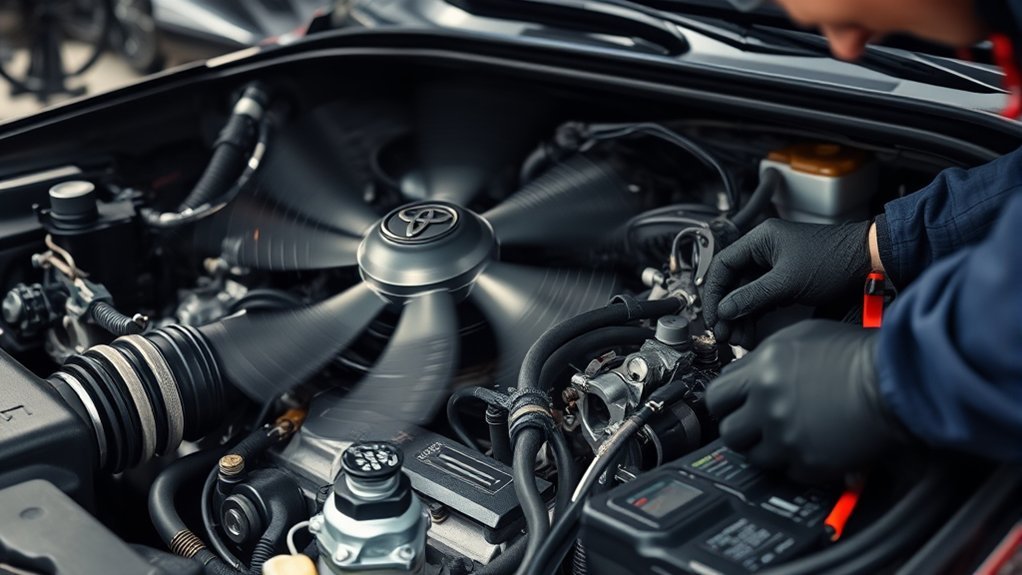
A Camry radiator fan can stay on because the engine control system is deliberately requesting cooling or because the power side of the fan circuit is no longer switching off. The most useful first clue is not the sound alone. It is the exact operating pattern.
If the fan starts immediately after a true cold start with the A/C and windshield defrost off, check for implausible engine coolant temperature data, a disconnected sensor, damaged wiring, stored faults, or a fan-controller problem. If the fan runs only when the climate system requests condenser airflow, its operation may be commanded normally.
If scan data shows the engine control module commanding the fan, diagnose why that request exists. Possible inputs include coolant temperature, climate-system demand, pressure data, or protective fail-safe logic. If the scan tool shows the fan command off while the fan continues running, focus on the fan ECU or power stage, a relay if the vehicle is equipped with one, shorted wiring, or an incorrect prior repair.
At a Glance
Use the pattern below as a first-pass guide. It narrows the system to test but does not prove that a part has failed.
|
What you notice |
Likely area to check |
Next safe step |
|---|---|---|
|
Fan runs from a cold start with climate controls off |
ECT data, sensor connector, wiring, stored fault, fan ECU, or control circuit |
Read trouble codes, cold-start temperature data, and commanded fan status before replacing parts. |
|
Fan runs only with A/C or windshield defrost active |
Normal condenser airflow request or climate-system input |
Set the climate system fully off and compare the fan behavior again. |
|
Fan runs briefly after a hot drive, then stops |
Possible commanded heat-management operation |
Record the conditions and confirm that it stops without battery drain or warning lights. |
|
Fan continues after shutdown and risks draining the battery |
Fan ECU, power stage, relay if equipped, shorted wiring, or control fault |
Do not disable the cooling system for driving. Arrange scan-based electrical diagnosis. |
|
Fan runs while the temperature rises |
Low coolant, leak, restricted flow, thermostat, radiator, pump, or heat-transfer problem |
Stop driving safely, power the vehicle off, and let the cooling system become fully cold. |
For a broader explanation of the radiator, thermostat, pump, coolant loop, and airflow path, see the Camry cooling system guide.
What Should You Check Before Testing the Fan Circuit?
Before opening the hood, confirm the Camry’s model year, engine, and whether it is a gasoline or hybrid model. Use the Toyota owner’s manual library to select the information for the exact vehicle.
Park on level ground, set the parking brake, power the vehicle off, and keep hands, clothing, tools, and test leads away from the fan blades. An electric cooling fan can start without warning when the control system requests it.
- Wait for a fully cold system: Do not open a radiator cap, pressurized reservoir cap, or cooling-system fitting while hot.
- Check the reservoir: Confirm the cold coolant level is within the range specified for the vehicle.
- Look for leak evidence: Check for wetness, dried residue, staining, a sweet odor, damaged hoses, or puddles. Do not identify coolant specification by color alone.
- Turn the climate system fully off: Include A/C and windshield-defrost modes before deciding the fan is operating without a climate request.
- Record the pattern: Note ambient conditions, cold or warm engine, climate settings, warning lights, gauge behavior, shutdown timing, and whether the battery has discharged.
Warning: Never remove a hot cooling-system cap. Pressurized coolant and steam can cause severe burns. Do not reach near the radiator fan merely because the engine is off.
Camry Hybrid Note
This guide concerns the under-hood radiator and condenser fan. A Camry Hybrid also has a separate high-voltage battery cooling fan and intake system. Toyota service material identifies an HV battery cooling-fan intake filter on 2018–2020 Camry Hybrid models. Do not touch orange cables, high-voltage connectors, or battery components. See Toyota’s HV battery cooling-system bulletin for the distinction.
How Do You Diagnose a Camry Fan That Stays On?
Do not begin by unplugging the ECT sensor, buying a relay, or probing connectors at random. Diagnose the command side and the power side separately.
- Capture the operating conditions: Confirm whether the engine is cold or warm, whether A/C or defrost is active, whether the fan continues after shutdown, and whether temperature or warning indicators are abnormal.
- Read diagnostic trouble codes: Record all current, pending, and history codes before clearing anything. Temperature-signal, climate-pressure, fan-control, power-supply, or communication faults may change fan operation.
- Check cold-start data: Before startup after a cold soak, compare engine coolant temperature with intake-air temperature and surrounding conditions. A clearly implausible value can point toward a sensor, connector, wiring, or data problem. Use Toyota’s model-specific limits for the final test.
- Compare command with operation: Read the scan-tool fan command or related active data when available. Command on with the fan running means the control system is requesting cooling. Command off with the fan still running points toward the fan controller, power circuit, relay if equipped, wiring, or an incorrect prior repair.
- Inspect visible wiring: Look for loose plugs, damaged locks, corrosion, fluid contamination, rubbed insulation, heat damage, rodent damage, or aftermarket splices.
- Use the correct wiring diagram: Perform voltage, resistance, continuity, or active tests only with the connector views, terminal numbers, precautions, and specifications for the exact Camry.
An infrared thermometer may help reveal broad temperature differences across a radiator or hose, but it does not directly validate the dash gauge or ECT sensor. Hose-surface temperature, scan-tool coolant temperature, and the instrument display are different measurements.
Electrical warning: Do not back-probe, jumper, or continuity-test a module circuit without the correct service procedure. An incorrect test can spread terminals, short a circuit, or damage a controller.
[Products Worth Considering]

This engine coolant thermostat with seal is designed to help maintain proper engine temperature and support efficient cooling system performance. It is compatible with a wide range of Toyota, Lexus, Ford, Chevrolet, Mitsubishi, Scion, and Pontiac models, making it a versatile replacement choice for many vehicles. With included seal and durable metal-and-rubber construction, it offers a convenient fitment solution for cooling system repairs and maintenance.
This front wiper blade set is designed as a direct replacement for select Toyota Corolla and RAV4 models, helping restore clear visibility in rain and road spray. Built for smooth, quiet performance with an easy plug-and-play installation, it includes both blades needed for the front windshield and is made to support dependable everyday driving.

This cabin air filter replacement helps keep the air inside your vehicle cleaner and fresher for driver and passengers. Designed for broad fitment across Toyota, Lexus, Subaru, and Mazda models, it supports improved HVAC performance and includes soda and carbon filtration for odor reduction. It is a practical maintenance part with a recommended replacement interval for continued cabin comfort.
How Does the Coolant Temperature Sensor Affect Fan Operation?
The engine coolant temperature sensor supplies temperature data used by the engine control system. That data can affect fan requests, fuel control, cold-start behavior, warning logic, and other engine functions.
What the ECT Signal Tells the Control Module
The control module does not simply wait for one fixed dash-gauge position. It evaluates coolant-temperature data with other operating inputs. An implausibly high reading, an open circuit, a disconnected sensor, or a lost signal may cause protective fan operation.
A fan that starts immediately on a cold engine does not prove the ECT sensor itself is defective. The connector, terminals, wiring, power or ground reference, stored faults, and control module data must also be considered.
How a Bad Signal Changes the Diagnosis
If the scan tool reports a temperature that is not plausible for a fully cold engine, inspect the sensor circuit before replacing the fan assembly. If the temperature data is plausible but the control module is still commanding the fan, investigate the other inputs and faults that can request fan operation.
If the fan command is off but the fan remains powered, the ECT signal is less likely to be the direct cause. Shift the diagnosis toward the fan ECU or power stage, a relay if fitted, power wiring, or prior modifications.
What Symptoms Can Accompany an ECT Fault?
- Fan operation on a cold engine: The fan begins running before extra airflow should be needed.
- Implausible scan data: Reported coolant temperature does not fit a cold-soak or warmed-engine condition.
- Warning light or stored code: The control system detects a temperature-signal or circuit problem.
- Poor starting or fuel economy: Incorrect temperature data can affect engine control.
- Overheating despite fan operation: A separate coolant-flow, pressure, leak, radiator, thermostat, or pump fault may still be present.
How Do Fan Relays, Fuses, and the Fan ECU Affect Operation?
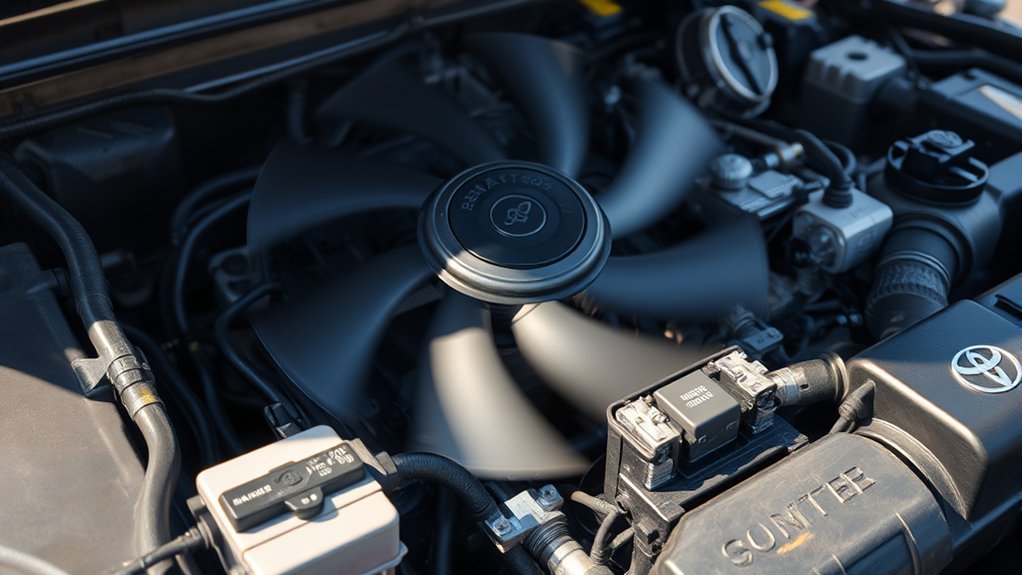
Do not assume every Camry fan circuit is controlled by one removable relay. Toyota technical instructions for certain 2020 Camrys show a cooling-fan ECU on the radiator-fan shroud. The document concerns an engine-ECU service campaign, not a diagnosis of every constant-fan complaint, but its component illustration confirms why the vehicle’s exact control layout must be identified before parts are removed. See the Toyota technical instructions hosted by NHTSA.
[Products Worth Considering]

This Rhino USA recovery tow strap is built for reliable vehicle pulling and towing in flat recovery situations. Made from durable polyester with reinforced loop ends, it is designed to help secure safe connection points while resisting wear, abrasion, and stress during recovery use. It is a practical choice for off-road recovery, roadside assistance, and general towing needs.

These microfiber wax applicator pads are designed for smooth, even application of waxes, polishes, protectants, and dressings on cars and other surfaces. Each pad combines absorbent microfiber with a sponge core for flexibility and control, while stitched edges help reduce scratching during use. They are machine washable and reusable, making them a practical choice for car detailing, interior cleaning, and fine polishing tasks.

Part Number Fitment: 89257-30060, 89257-30070, 89257-30080, 8925730060, 8925730070, 8925730080, 591-69168, 499300-3290, FCM111
What Can Keep Electrical Power Applied to the Fan?
- Fan ECU or power-stage fault: An electronic fan controller may continue driving the motor after the command is removed.
- Stuck relay, if equipped: A relay identified in the model-specific circuit may remain closed internally.
- Shorted or modified wiring: A power wire, control wire, aftermarket splice, or prior repair may bypass normal control.
- Incorrect control request: The engine control system may intentionally command the fan because of temperature data, climate demand, a stored fault, or fail-safe logic.
- Connector contamination or damage: Corrosion, coolant residue, water entry, heat, or loose terminals can disturb the control signal.
Use the under-hood fuse-box legend and the repair information for the exact VIN and powertrain. Do not install a universal relay kit or substitute a relay based only on physical appearance.
How Should You Inspect Fan-Control Wiring?
Begin with a visual inspection while the vehicle is powered off and cool. Check the harness near the radiator, fan shroud, coolant-temperature sensor, fuse box, and any visible controller connector.
Look for cuts, melted insulation, rubbed-through sections, broken connector locks, green or white corrosion, overheated terminals, rodent damage, and non-factory splices. Do not force a connector apart or insert oversized meter probes into a terminal.
Electrical measurements should follow the exact Toyota wiring diagram. Disconnecting a module or checking continuity without the prescribed setup can produce a false result or damage the circuit.
How Do You Test the Fan Control Circuit Safely?
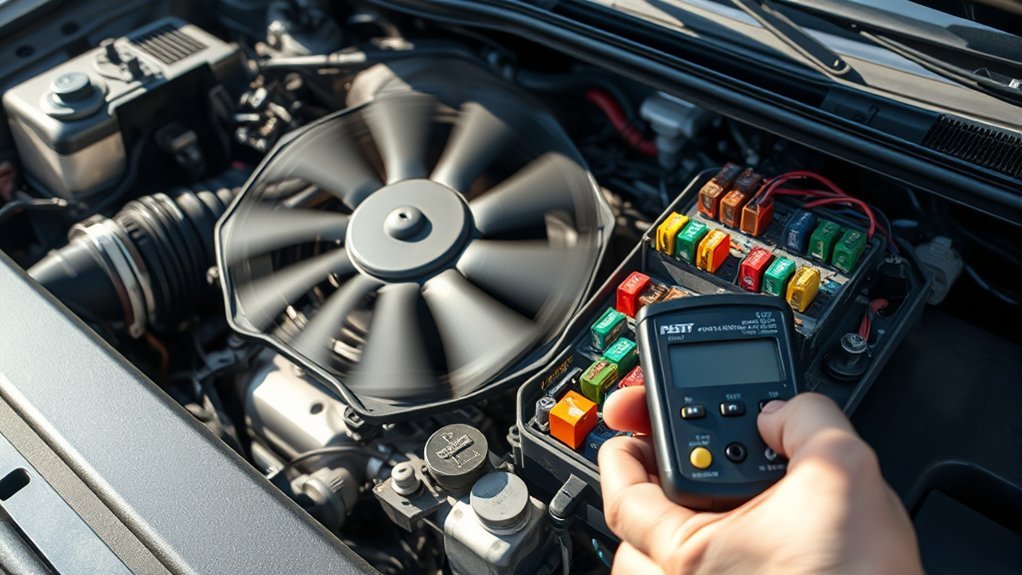
Use this order to avoid replacing a good part:
- Identify the circuit: Confirm whether the vehicle uses a removable relay, fan ECU, integrated controller, or a combination of components.
- Read fan command data: Determine whether the control system is requesting fan operation when the symptom occurs.
- Inspect fuses and connectors: Use the fuse-box label and service information. Look for heat damage, looseness, corrosion, or an incorrect fuse.
- Perform directed electrical tests: A qualified person can verify power, ground, control signal, and circuit integrity using the specified connector terminals and test conditions.
- Replace only the confirmed fault: Match the exact part number, connector, rating, calibration requirements, and vehicle application.
- Verify the repair: Recheck codes, live data, fan command, actual fan response, climate-system operation, and engine temperature through the operating conditions that originally caused the symptom.
Pro tip: Photograph fuse-box covers and connectors before disassembly, but do not rely on a photo instead of the model-specific diagram and terminal information.
[Products Worth Considering]

[Vehicle Fitment]: ①Compatible with Lexus ES350 2007-2018 V6 3.5L, GS300 2005-2006, GS350 2007-2011 V6 3.5L, GS350 2013-2018 V6 3.5L, GS430 2005-2007 V8 4.3L, Camry 2007-2018 V6 3.5L, Avalon 2005-2019 V6 3.5L, Avalon 2013-2019 L4 2.5L, Highlander 2009-2018 L4 2.7L, Highlander 2008-2018 V6 3.5L

Vehicle Fitment- Automotive replacement engine fans for Toyota Camry 2.5L 2010-2011,for Toyota Venza 2.7L 2009-2016

Compatible with Toyota Avalon 2005-2018, Camry 2007-2017, Highlander 2008-2019, RAV4 2006-2018, Sienna 2004-2020, Venza 2009-2016.
Can Low Coolant Make a Camry Fan Run Constantly?
Low coolant can make the engine run hotter, introduce air into the cooling system, or interfere with reliable temperature sensing. The fan may then run more often because the control system sees high or implausible temperature data. Low coolant does not prove the fan circuit is defective.
Check the reservoir only after the engine and cooling system are fully cold. Look for wetness, dried deposits, hose damage, loose connections, radiator damage, pump-area leakage, or coolant on the ground. A falling level means the source of the loss must be found instead of repeatedly topping off the reservoir.
Toyota’s 2020 Camry maintenance guide specifies Genuine Toyota Super Long-Life Coolant or a similar coolant that meets Toyota’s stated chemistry. Use the specification for the exact model and do not choose coolant by color alone or mix unknown types.
For emergency actions when the temperature rises or steam appears, follow the Camry overheating safety guide.
How Should You Monitor Engine Temperature?
Watch the temperature gauge, warning messages, engine-power changes, coolant odor, and cabin-heater behavior. A fan that runs constantly does not guarantee that the engine is protected from overheating.
- Normal display and no warnings: Record the fan pattern and arrange diagnosis before repeated operation wears the fan or drains the battery.
- Rising gauge or temperature warning: Move to a safe location, power the vehicle off, and let it become fully cold.
- Steam or active coolant leakage: Stay clear of the hood area until the steam stops and arrange roadside help.
- Scan-tool monitoring: Use live coolant-temperature and fan-command data to determine whether the control request matches the physical fan behavior.
- After cooling-system service: Follow the exact refill and air-removal procedure for the model year and powertrain. Do not apply a universal bleeding method.
An infrared thermometer can support a professional diagnosis by showing broad heat patterns, but it should not be used as a direct substitute for ECT data or Toyota’s service specifications.
When Should You Get Professional Help?
Arrange professional diagnosis when the fan runs from a cold start with the climate system off, continues after shutdown, repeatedly drains the battery, blows a fuse, or returns after a sensor or relay has already been replaced.
Stop driving and request roadside help if the engine overheats, steam appears, coolant leaks actively, cabin heat suddenly turns cold while the temperature rises, engine power drops, or a high-temperature warning remains on.
A technician can compare fan command with actual operation, perform bidirectional fan tests when supported, inspect A/C pressure inputs, test the ECT circuit, verify the fan ECU or relay layout, and check power and ground under the correct load.
Do not assume a common symptom is automatically covered by a recall or campaign. Check the vehicle’s 17-digit VIN through the Toyota recall and service-campaign lookup and the NHTSA recall lookup tool.
How Can You Prevent Repeat Fan and Cooling Problems?
Check the cold coolant level at regular service intervals and investigate any repeated loss. Inspect hoses, the reservoir, visible wiring, connectors, radiator fins, and the condenser area for leakage, damage, corrosion, or blocked airflow.
Use the coolant specification and service interval listed for the exact Camry. Keep unknown fluids and universal stop-leak products out of the system unless Toyota service information specifically permits their use.
Do not replace a thermostat, water pump, sensor, fan assembly, relay, or controller based only on constant fan noise. Confirm the failed system first. See the separate guides on Camry thermostat operation and Camry water-pump symptoms when the diagnosis points toward coolant-flow or temperature-control problems.
Frequently Asked Questions
How Much Does It Cost to Fix an Engine Fan?
The cost depends on what failed. Diagnosis may identify a connector, fuse, sensor circuit, relay if equipped, fan ECU, fan assembly, wiring repair, coolant leak, thermostat, radiator, or pump problem. Ask the shop to document trouble codes, live data, fan-command results, and the confirmed failed component before approving replacement parts.
What Causes the Fan to Keep Running When the Car Is Off?
A short run after a hot drive or heavy climate-system use may be a commanded cooling cycle. Prolonged operation can result from a fan ECU or power-stage fault, a stuck relay if the vehicle uses one, shorted wiring, incorrect temperature data, another control input, or an earlier wiring modification. Investigate operation that continues after the vehicle has cooled or threatens to drain the battery.
What Are Signs of a Bad Cooling Fan Relay?
On a Camry equipped with a removable cooling-fan relay, a relay that sticks closed can keep the fan powered, while a failed-open relay can prevent operation. However, not every Camry uses a simple relay-only design. Confirm the exact fan circuit and compare commanded fan status with actual operation before condemning a relay.
Can You Drive If the Engine Fan Runs Constantly?
Do not assume constant fan operation makes the car safe to drive. A short trip may be possible only when the temperature display is normal, no warning is present, coolant is not leaking, and there is no steam, hot odor, or loss of power. Stop immediately if temperature rises or any overheating sign appears. Arrange diagnosis soon even when the gauge remains normal.
Can Low Coolant Make the Fan Run Constantly?
Yes. Low coolant can cause higher engine temperature, introduce air, or produce unreliable temperature conditions, leading to more fan operation. Check the reservoir only when fully cold, find the reason for any repeated loss, and use the coolant specification listed for the exact Camry.
Can a Bad Thermostat Make the Fan Run All the Time?
A thermostat that restricts coolant flow can cause engine temperature to rise and make the fan run more often. A thermostat stuck open more commonly causes slow warm-up or low operating temperature rather than directly powering the fan nonstop. Use coolant-temperature data and model-specific testing before replacing the thermostat.
Can I Unplug the Fan Relay to Stop the Noise?
Do not use fuse, relay, fan-ECU, or fan-connector removal as a driving fix. Disabling the fan can allow the engine or A/C system to overheat, and pulling an unidentified component can affect other circuits. Use disconnection only when the exact service procedure calls for it and the vehicle will not be driven in that condition.
Conclusion
A Camry engine fan that runs constantly should be diagnosed by its timing and control command, not by replacing the most familiar part. Start with the model year, engine, hybrid status, cold coolant level, visible leaks, and climate settings. Then compare scan-tool fan command with actual fan operation.
If the control module is requesting the fan, find the temperature, climate, fault, or fail-safe input behind that request. If the command is off but the fan remains powered, inspect the model-specific fan ECU, power stage, relay if equipped, wiring, and prior repairs. Stop driving when temperature rises, steam appears, coolant leaks, or a warning remains active.