
Last updated: August 17, 2026
Most Toyota Camry water pumps are replaced because testing confirms a problem, not because the odometer reaches one fixed mileage. Toyota maintenance schedules set coolant-service intervals, but they do not call for automatic water-pump replacement at a universal mileage. A pump can remain in service beyond 100,000 miles when it stays dry, quiet, stable, and able to circulate coolant normally.
Inspect the pump when coolant service is due. Replace it when diagnosis confirms an active leak, rough bearing or pulley, poor coolant circulation, overheating caused by the pump, or an electrical fault on an electric pump. On a Camry with a timing belt, confirm whether the pump is driven by or exposed during that engine’s timing-belt procedure before coordinating the repairs.
Quick Answer
- Wait: Do not replace a quiet, dry Camry water pump only because the odometer reaches 100,000 miles.
- Inspect: Use scheduled coolant service as a checkpoint for leakage, bearing condition, pulley play, coolant level, and circulation.
- Replace: Approve replacement when testing confirms an active leak, bearing failure, poor circulation, or an electrical pump fault.
- Dry pink residue does not automatically prove pump failure. Wet residue, fresh drips, or a falling coolant level point to an active leak.
- On hybrids, P0A93 concerns the separate inverter cooling circuit. It does not by itself diagnose the engine water pump.
Safety warning: Stop driving if the temperature stays high, steam appears, coolant pours out, or the vehicle enters reduced-power mode. Never remove a radiator or pressurized coolant cap while the system is hot.
This guide was checked against Toyota maintenance documents, Toyota technical service bulletins, Camry-specific diagnostic references, and repair-cost estimators.
What’s in This Guide
Camry Water Pump Lifespan
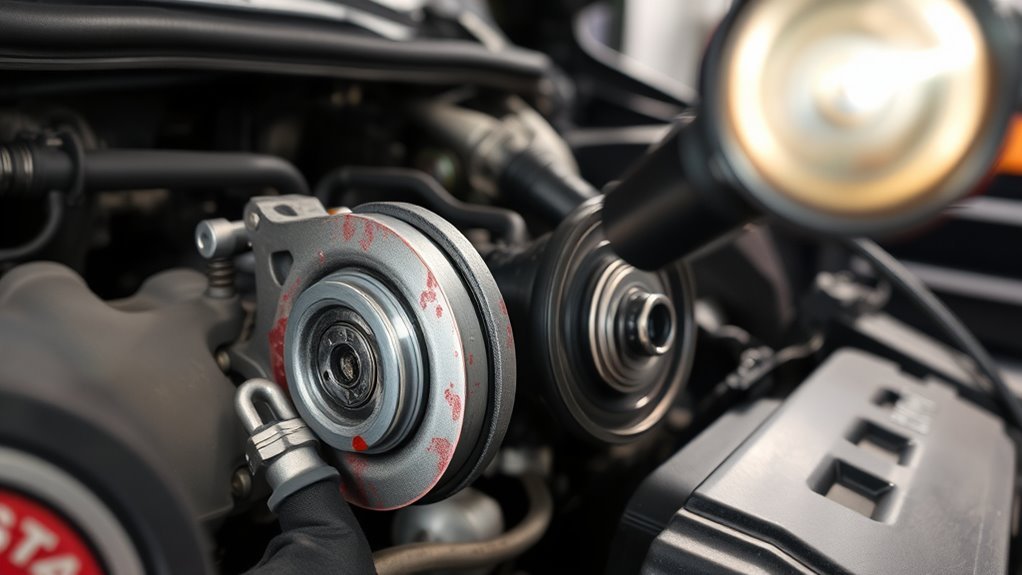
A Toyota Camry water pump can last beyond 100,000 miles, but its actual life depends on the model year, pump design, coolant condition, heat exposure, installation quality, and driving history. Toyota does not publish one automatic replacement mileage that applies to every Camry water pump.
Independent repair estimators and owner forums often cite specific numbers as a rule of thumb — figures anywhere from roughly 60,000 to 150,000 miles show up across different sources. Those ranges come from aggregated repair and forum data, not a Toyota-published limit, and they vary partly because they mix mechanical and electric pump designs, driving conditions, and coolant maintenance history. Treat any single number you see elsewhere as a rough average for that source’s dataset, not a deadline for your specific Camry.
Many Camry maintenance guides list the first engine coolant replacement at 100,000 miles or 120 months, followed by shorter coolant-service intervals. That makes the 100,000-mile service a useful time to inspect the pump, hoses, thermostat area, belt condition, coolant level, and coolant quality.
The coolant schedule is not a water-pump replacement schedule. Keep a pump in service when it remains dry, quiet, stable, and able to circulate coolant normally. Replace it when testing confirms an active leak, rough bearing, excessive pulley play, poor circulation, overheating, or an electrical failure.
Quick Recommendation: Replace, Inspect, or Wait?
| What You See | Best Action | Why It Matters |
|---|---|---|
| No leaks, no noise, stable coolant level and temperature | Wait and inspect during routine service | A pump that passes inspection does not need automatic replacement. |
| Near 100,000 miles with no symptoms | Inspect the pump and service coolant if due | This is a useful cooling-system checkpoint, not a pump-replacement deadline. |
| Dry pink or red residue with no fresh moisture or coolant loss | Clean the area, document the coolant level, and recheck | Toyota guidance for applicable non-electric pumps recognizes that dry residue can result from temporary seal discharge and does not automatically require pump replacement. |
| Wet residue, fresh drips, a puddle, or falling coolant level | Diagnose promptly and replace the pump if it is the active source | An active leak can lower coolant volume and cause overheating. |
| Confirmed rough pump bearing or excessive pulley play | Avoid further driving and arrange prompt repair | A failing bearing can seize, damage a belt, cause leakage, or stop proper circulation. |
| Steam, an overheating warning, or temperature that stays high | Shut the vehicle off and arrange towing | Continued driving can cause rapid engine or hybrid-system damage. |
| P0A93 on a Camry Hybrid | Diagnose the inverter cooling circuit | P0A93 concerns the separate inverter cooling system, not the engine water pump. |
| P261B, P26CB71, or another coolant-pump code | Confirm the complete code, powertrain, wiring, pump operation, and applicable Toyota bulletin | A code identifies a failed system test, but it does not always prove that the pump itself must be replaced. |
Use the table as a decision guide, not as a substitute for model-specific diagnosis. If the engine temperature rises, steam appears, or coolant is actively pouring out, stop driving and arrange towing or professional help.
[Products Worth Considering]

This engine water pump kit is designed to help maintain reliable cooling performance across a wide range of compatible Toyota, Lexus, Scion, and Pontiac vehicles. Built with aluminum and tested for leak-free operation, it offers a direct replacement solution that supports engine efficiency and long-term service life. The kit includes a professional water pump and gasket for a convenient installation-ready repair.

This coolant electric water pump is designed as a replacement for select Toyota vehicles, helping maintain proper engine cooling performance and reliable temperature control. Built to OE specifications, it offers fitment support for compatible Avalon, Camry, and RAV4 models with 2.5L L4 engines. It also includes cross-reference part numbers for easier matching and comes with after-sales support for covered defects.
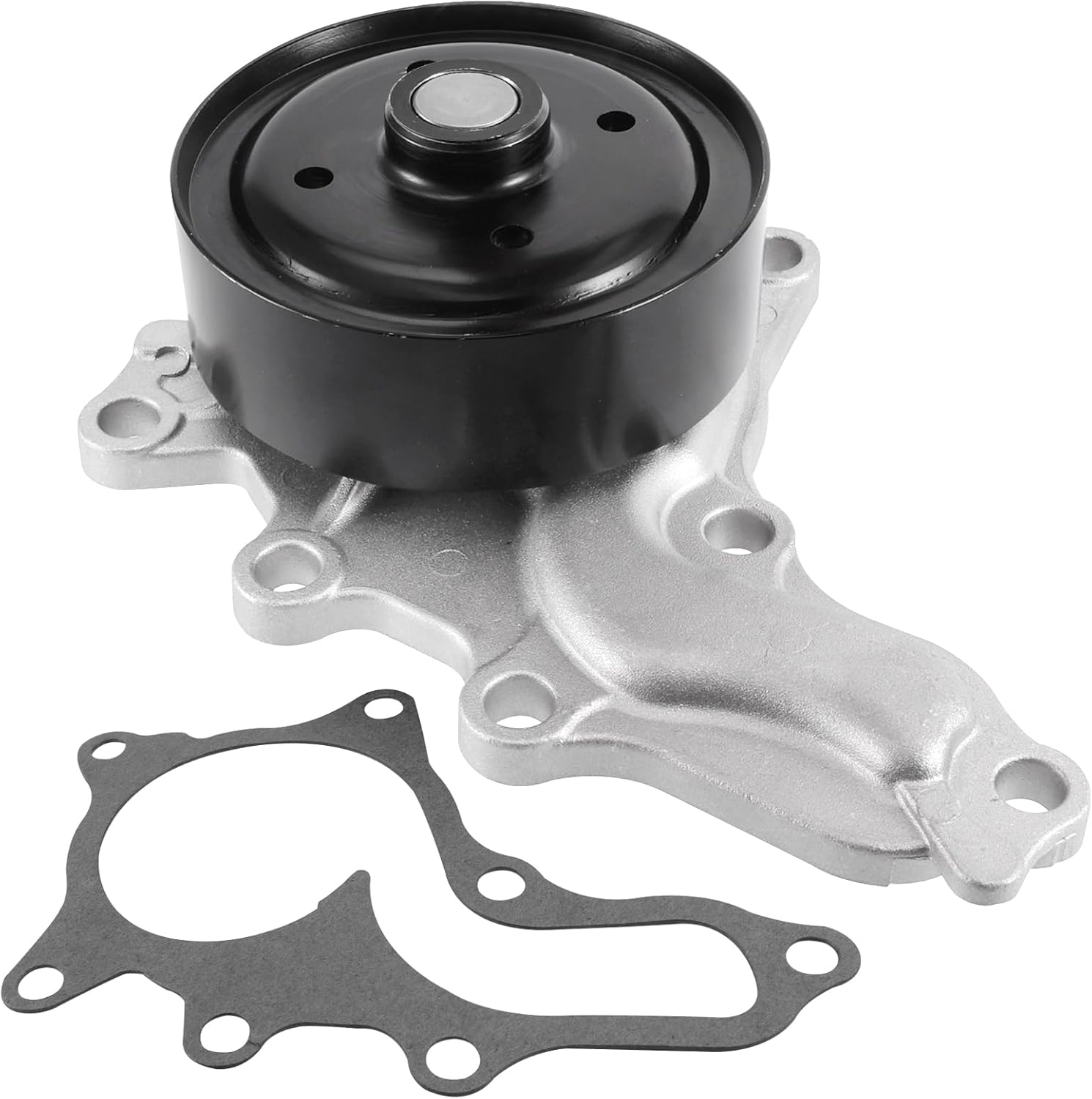
This AW6252 water pump is designed for a wide range of Toyota, Scion, and Lexus applications, helping maintain reliable engine cooling across compatible models. It features case hardened bearings for durability, a graphite-impregnated gasket for a secure seal, and 100% function and leakage testing for dependable performance. Built in TS16949 certified facilities, it offers a strong replacement option backed by service support.
Check Your Camry Type First
Confirm the model year, engine, and powertrain before planning a water-pump repair. Older Camry engines may use a timing belt, while many later engines use a timing chain. Some Camrys use a mechanical engine pump, and some later four-cylinder models use an electric engine water pump.
Use your VIN-specific owner information or repair estimate to identify the engine. Ask the shop whether your Camry uses a mechanical engine pump, an electric engine pump, and, on a hybrid, a separate inverter coolant pump.
| Pump or Circuit | First Diagnostic Priority | Do Not Assume |
|---|---|---|
| Mechanical engine water pump | Check for an active wet leak, coolant loss, bearing roughness, pulley play, belt contamination, and circulation | Dry residue alone does not prove the pump has failed. |
| Electric engine water pump | Record complete codes, inspect power and ground, check wiring and connectors, command the pump where supported, and confirm flow | A pump-related code does not automatically prove the pump motor is defective. |
| Hybrid inverter coolant pump | Check the inverter reservoir, coolant movement, wiring, connectors, pump operation, and inverter-cooling codes | P0A93 does not identify the engine water pump. |
This distinction changes the diagnosis and labor. On a timing-belt engine, coordinate pump replacement only when the exact engine procedure shows that the pump is driven by or exposed during the belt service. Timing-chain and electric-pump models should be judged mainly by symptoms, active-leak testing, scan data, electrical checks, and circulation tests.
Do Not Confuse the Engine Pump With the Inverter Pump
A Camry Hybrid can have more than one coolant circuit. The engine cooling circuit controls engine temperature. The inverter cooling circuit removes heat from high-voltage power electronics and uses its own coolant flow path and electric pump.
A Camry Hybrid diagnostic reference defines P0A93-346 as “Inverter Cooling System Performance” and describes the inverter cooling system as independent of the engine cooling system. Diagnosis should check the inverter coolant level, inverter reservoir, coolant movement, wiring, connector, cooling fan, radiator, and inverter coolant pump.
P261B is the generic OBD-II description “Coolant Pump ‘B’ Control Circuit Range/Performance.” The physical pump represented by “B” can vary by vehicle configuration, so confirm the Camry year, engine, circuit, wiring diagram, and Toyota diagnostic procedure before replacing a pump.
Toyota T-SB-0323-17 covers qualifying early-production 2018 Camrys with the A25A-FKS four-cylinder engine and P26CB71, “Electric Water Pump Speed Stuck.” The bulletin applies only to listed vehicles produced before Toyota’s production-change VINs. It directs technicians to check ECM calibration and may call for an ECM software update rather than immediate pump replacement.
If P26CB71 is absent or the latest calibration is already installed, the bulletin directs technicians back to the applicable repair-manual diagnosis. The bulletin does not call for automatic ECM replacement.
Camry Water Pump Failure: Top Signs
Watch for an active coolant leak, repeated coolant loss, rough bearing noise, pulley play, overheating, weak circulation, warning messages, and pump-related trouble codes. One symptom can have several possible causes, so confirm the source before buying parts.
[Products Worth Considering]

This professional water pump kit is designed as a direct OE replacement for select Toyota and Lexus 3.5L V6 vehicles, helping restore reliable engine cooling performance. Built to strict quality standards and tested for leak-free operation, it includes the necessary gasket for easier installation and a secure fit. It offers a practical upgrade for drivers seeking dependable cooling system maintenance and long-lasting performance.

This coolant thermostat is a direct replacement designed for a wide range of Toyota, Lexus, and Scion vehicles. It helps maintain proper engine temperature, supports reliable cooling system performance, and installs easily without special tools or programming. Built to meet OEM standards, it offers durable, stable operation and dependable fitment for compatible models.

This A-Premium serpentine belt drive kit is designed for compatible Toyota Camry, RAV4, and Scion tC models with a DOHC 2.5L L4 engine. It includes a serpentine belt and belt tensioner to help maintain smooth engine operation, reduce noise, and support reliable power transfer. Built for dependable replacement performance, it also comes with a one-year unlimited-mileage guarantee for added peace of mind.
Does Pink Crust Mean the Water Pump Is Bad?
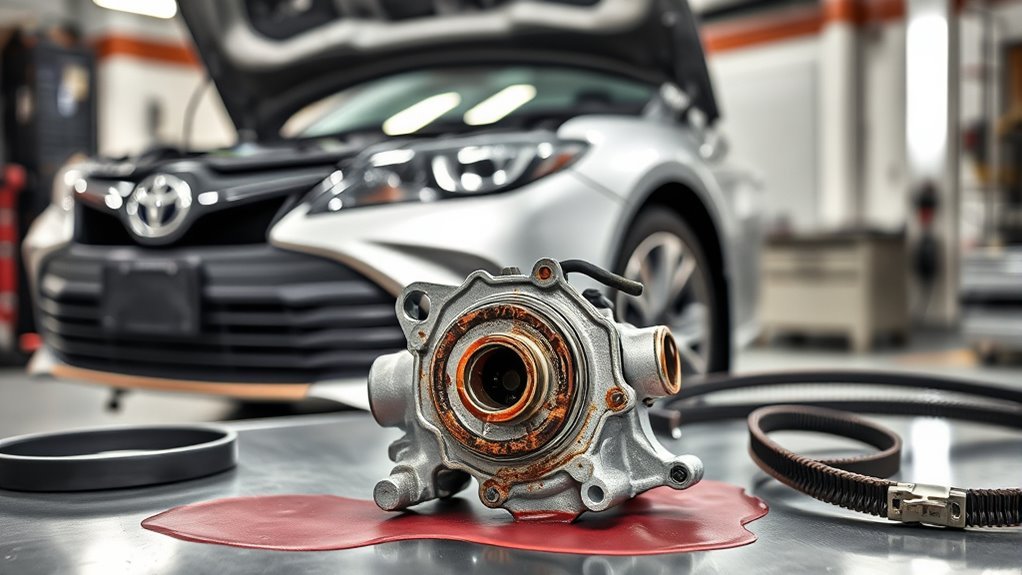
Pink or reddish residue usually comes from dried Toyota coolant. However, dry residue alone does not automatically mean the water pump must be replaced.
Toyota T-SB-0103-20 covers applicable non-electric pumps and lists 2018-2021 Camry among the included vehicles. This bulletin was later reissued and expanded as T-SB-0055-24 (June 2024), which carries the same dry-versus-wet diagnostic guidance forward and extends its applicability through 2025 model-year Toyota vehicles. The bulletin distinguishes temporary dry residue from an active wet leak. A small amount of coolant can pass through the mechanical-seal area, help cool and lubricate the sliding seal surface, and evaporate. The remaining deposit may be dry even though the pump is not currently leaking.
With the engine fully cold, place a clean, dry paper towel against the deposit. If the towel remains dry and the coolant level stays stable, clean the area and monitor it. If the towel picks up fresh coolant, the reservoir level falls, or drips appear, arrange an active-leak diagnosis.
The bulletin’s dry-versus-wet principle is useful, but diagnosis should still follow the repair information for the exact model year and pump. Electric pumps may require scan, wiring, voltage, command, and circulation tests rather than a mechanical-seal inspection.
Also inspect nearby hoses, clamps, the thermostat housing, coolant-control components, and adjoining surfaces. Coolant can travel across the engine and make another component look like the source.
What Does Grinding or Whining Mean?
A grinding, growling, or high-pitched whine that changes with engine speed can point to bearing wear in a mechanical water pump. Similar sounds can come from a belt tensioner, idler pulley, alternator, air-conditioning component, or another accessory.
Do not place hands, loose clothing, or handheld tools near a moving belt or cooling fan. A technician can isolate the sound and check whether the pump pulley has excessive free play or fails to rotate smoothly.
Replace the pump promptly when diagnosis confirms rough bearings, excessive movement, or noise coming directly from the pump. Avoid further driving with a confirmed failing pump bearing because it can damage a belt, create an active leak, seize, or stop proper circulation.
Overheating, Low Coolant, or Steam
Overheating is the most urgent warning sign. If the temperature gauge rises, a warning appears, steam comes from the engine bay, or coolant drops again after a proper cold refill, stop driving as soon as it is safe.
Do not continue driving to “make it home” while the temperature stays high. Severe overheating can damage the head gasket, cylinder head, engine, and hybrid components.
A weak water pump is only one possible cause. Low coolant, a stuck thermostat, failed cooling fan, blocked radiator, leaking hose, trapped air, damaged cap, or coolant-control-valve problem can produce similar symptoms. See the site’s Camry cooling-system guide for an overview of how these parts work together.
What Else Can Mimic a Bad Water Pump?
- Hose, clamp, or radiator leak: Coolant can run toward the pump and make the pump appear wet.
- Thermostat or thermostat-housing fault: Restricted flow or leakage can cause overheating near the same area.
- Cooling-fan failure: The engine may run hot in traffic even when the pump works normally.
- Air trapped after coolant service: An air pocket can reduce circulation and heater output.
- Radiator-cap or reservoir problem: Pressure loss can push coolant out or prevent proper recovery.
- Coolant-control or bypass-valve fault: Some later Camrys can develop leaks or circulation problems outside the pump.
Use the Camry coolant-leak guide when the source is not clearly at the pump.
Why Camry Pumps Fail: Mechanical vs Electric
Camry water-pump failures depend on the pump design. A mechanical pump commonly develops bearing, mechanical-seal, gasket, pulley, or impeller trouble. An electric pump can fail through its motor, internal electronics, power supply, wiring, connector, control logic, blockage, or trapped air.
- Mechanical engine pump: Check for an active wet leak, falling coolant level, excessive pulley play, rough rotation, belt contamination, bearing noise, and overheating.
- Electric engine pump: Scan for codes, review commanded versus actual operation where supported, inspect connectors and wiring, and confirm coolant circulation before replacing the pump.
- Hybrid inverter pump: Diagnose the separate inverter circuit when P0A93 or an inverter-overheat warning appears. Do not assume the engine pump caused the inverter-cooling fault.
Match the diagnosis to the pump and coolant circuit fitted to the vehicle. Mileage or one generic symptom is not enough to identify the failed part.
Inspecting Leaks, Pink Crust, and Bearing Noise
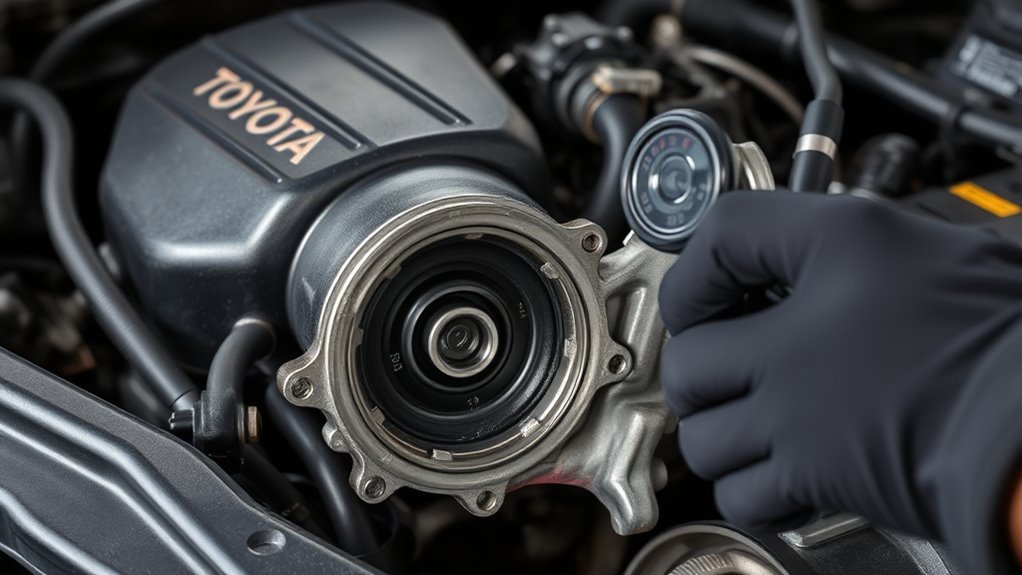
Safety warning: Never remove the radiator cap or a pressurized coolant-reservoir cap when the engine or hybrid system is hot. Hot coolant can spray under pressure and cause serious burns.
- Start cold. Park on level ground, turn the vehicle off, and let the cooling system cool fully.
- Check the correct reservoir. On a hybrid, identify the engine and inverter reservoirs before interpreting the level.
- Record the level. Note whether the coolant is between the marked limits and whether it drops over several cold checks.
- Inspect the pump area. Look for fresh wetness, dry pink residue, splatter, staining, or an active drip.
- Use the dry-paper-towel test on an applicable mechanical pump. Blot the residue while the system is cold. A dry towel supports cleaning and monitoring; fresh coolant on the towel indicates a current leak.
- Check nearby components. Inspect hoses, clamps, the thermostat housing, control valves, and surfaces above the pump.
- Use cardboard overnight. Place clean cardboard under the engine bay to help identify the location and color of a drip.
- Do not probe moving parts. Have a technician check pulley play, bearing smoothness, and noise with appropriate equipment.
- Scan electric-pump models. Record the complete code, including any suffix, and check for applicable Toyota bulletins before replacing the pump.
If the deposit stays dry and the coolant level remains stable, clean the area and monitor it. If the paper towel becomes wet, coolant drops, or a drip continues, arrange a pressure test and source confirmation.
When to Replace: Preventive vs Urgent Actions
Replace the Camry water pump when diagnosis confirms an active leak, rough bearing, excessive pulley play, poor circulation, overheating caused by the pump, or an electrical failure that prevents an electric pump from operating correctly.
Preventive replacement is most reasonable when the exact engine procedure already exposes the pump during timing-belt service. It is not the same as replacing every good pump at a preset mileage.
Should You Replace the Pump Preventively?
- Confirm whether the Camry has a timing belt, timing chain, mechanical engine pump, or electric engine pump.
- Ask whether the pump is driven by or exposed during the planned timing-belt repair for that exact engine.
- Review whether the pump is original, actively leaking, noisy, rough, or already exposed.
- Compare the added parts and labor cost with the cost of repeating the access work later.
On a timing-chain or electric-pump Camry that remains dry, quiet, and normal in testing, replacement based only on mileage usually provides less benefit.
Which Signs Require Towing?
Stop driving and arrange towing when the temperature stays high, coolant pours out, steam appears, the engine runs roughly while overheating, the vehicle enters reduced-power mode, or a hybrid warning indicates an active overheat condition.
A stored code without overheating does not always require an immediate tow, but it still needs timely diagnosis. P0A93 should lead to the inverter cooling circuit. P261B should lead to model-specific coolant-pump testing. P26CB71 on a qualifying early-production 2018 four-cylinder Camry should also trigger a check for Toyota T-SB-0323-17, the production VIN range, and the installed ECM calibration.
Timing Belt Coordination
If the repair procedure for your Camry engine exposes or removes the water pump during timing-belt service, replacing both during one visit may reduce repeat labor. This advice does not apply equally to later timing-chain or electric-pump models.
- Consider coordination: The exact timing-belt procedure exposes the pump, and the pump is original, high-mileage, noisy, rough, or leaking.
- Consider waiting: The vehicle uses a timing chain or separate-access pump, and the pump passes leak, bearing, circulation, and electrical tests.
- Do not wait: The pump has an active leak, confirmed bearing failure, poor circulation, or an electrical failure that causes overheating.
How Much Does Toyota Camry Water Pump Replacement Cost?
A shop normally drains the relevant cooling circuit, removes the belt or access components, removes the old pump, prepares the sealing surface, installs the new pump and seal, refills the correct coolant, removes trapped air, and checks for leaks and normal circulation.
The process varies significantly by engine and pump design. Some mechanical pumps have relatively direct access. Other jobs require removal of additional components. Electric-pump diagnosis can add time because the technician may need to test pump command, voltage, ground, connectors, control logic, and coolant flow.
A model-specific procedure is safer than following a generic replacement tutorial. The related Toyota Tacoma water-pump replacement guide shows why access and bleeding steps can vary by engine, but it should not be used as a Camry repair procedure.
RepairPal’s estimator listed an average Toyota Camry water-pump replacement cost of $632-$815 and a 2026 Camry estimate of $836-$1,052 when this guide was checked in August 2026. These figures exclude location differences, taxes, fees, and related repairs.
Kelley Blue Book also notes that pump access, vehicle design, local labor rates, and electric-pump complexity can change the final cost. Ask for a written estimate tied to the VIN rather than relying on one national average.
| Cost Factor | What to Ask the Shop |
|---|---|
| Diagnosis | What test confirmed that the pump, rather than a hose, thermostat, valve, wiring fault, or calibration issue, caused the problem? |
| Parts | Is the quote for a Toyota, OEM-supplier, or aftermarket pump, and what warranty applies? |
| Labor | How many labor hours does this VIN and engine require? |
| Coolant circuit | Is the repair for the engine cooling circuit or the separate hybrid inverter circuit? |
| Coolant | Does the quote include the owner-manual-approved Toyota-compatible coolant and the model-specific bleeding procedure? |
| Related parts | Are seals, belts, tensioners, thermostat parts, hoses, or control valves included, and why are they needed? |
| Testing | Will the shop pressure-test the system, confirm circulation, clear codes, and verify that no air remains? |
| Software bulletins | Has the shop checked for applicable Toyota bulletins or calibration updates before replacing an electric pump? |
The written estimate should separate diagnosis, parts, labor, coolant, taxes, and any related repairs. Ask the shop to show the active leak, failed bearing test, circulation result, electrical fault, or bulletin that supports the recommendation.
[Products Worth Considering]

This coolant bypass valve is a direct replacement for select Toyota models, helping regulate coolant flow for stable engine temperature and dependable performance. Built from high-temperature, corrosion-resistant materials, it is designed to handle demanding driving conditions while supporting long-term durability. Its straightforward design also makes installation quick and hassle-free.

The OEMTOOLS coolant vacuum refill kit helps quickly refill a vehicle’s cooling system while removing trapped air that can lead to overheating and engine damage. It also performs vacuum leak tests to help confirm system integrity and reduce the chance of repeat repairs. With multiple bushings, adapters, and a tapered cone seal, it is designed for flexible use on many radiator and coolant bottle necks.

This engine coolant thermostat with seal is designed to help maintain proper engine temperature and support efficient cooling system performance. It is compatible with a wide range of Toyota, Lexus, Ford, Chevrolet, Mitsubishi, Scion, and Pontiac models, making it a versatile replacement choice for many vehicles. With included seal and durable metal-and-rubber construction, it offers a convenient fitment solution for cooling system repairs and maintenance.
What Should Be Verified After Replacement?
A completed repair should restore coolant retention, circulation, normal temperature control, and normal pump operation. Ask the shop to verify the following before the vehicle is returned:
- Correct circuit and coolant: The repaired engine or inverter circuit was refilled with the coolant specified for the exact Camry.
- Air removal: The model-specific bleeding procedure was completed and the heater or applicable circuit operates normally.
- No active leak: The sealing area, hoses, and nearby components remain dry during inspection or pressure testing.
- Normal circulation: The mechanical pump or commanded electric pump produces the expected coolant flow.
- Stable temperature: The vehicle reaches and maintains normal temperature during a controlled road test without steam, warnings, or abnormal fan behavior.
- No returning codes: Relevant codes are cleared after repair and do not return during the verification test.
After the vehicle cools completely, record the reservoir level again. Recheck it over the next several cold starts. A level that keeps falling, new residue, poor heater output, or another warning needs prompt follow-up.
Frequently Asked Questions
How Do I Know if My Toyota Camry Water Pump Is Bad?
Strong signs include an active wet coolant leak at the pump, repeated coolant loss, excessive pulley play, rough bearing noise, poor coolant circulation, overheating traced to the pump, or a confirmed electrical failure on an electric pump. Dry residue alone does not prove failure.
At What Mileage Should a Toyota Camry Water Pump Be Replaced?
Toyota does not specify one automatic replacement mileage for every Camry water pump. Many pumps remain in service beyond 100,000 miles. Use scheduled coolant service as an inspection checkpoint and replace the pump when symptoms and testing confirm failure.
Should I Replace the Camry Water Pump Before It Fails?
Preventive replacement makes the most sense when the exact timing-belt procedure for an applicable older engine already exposes the pump. For timing-chain and electric-pump models, replacement should usually depend on an active leak, bearing condition, circulation, codes, and electrical testing.
Can I Drive With a Leaking Camry Water Pump?
Do not continue driving when coolant is actively dripping, the level falls quickly, the temperature rises, or steam appears. A dry old deposit can be monitored after inspection, but an active leak can cause sudden coolant loss and severe overheating.
Is Dry Pink Crust Near a Camry Water Pump Always a Failure?
No. On an applicable mechanical pump, dry pink residue can come from coolant that passed through the mechanical-seal area and evaporated. Toyota guidance says dry residue alone does not require replacement. Fresh moisture, a wet paper-towel test, drips, or falling coolant level indicate an active leak.
How Much Does Toyota Camry Water Pump Replacement Cost?
RepairPal’s estimator, checked in August 2026, lists a Camry-wide average of $632-$815 and a 2026 Camry estimate of $836-$1,052. The actual total depends on the model year, engine, pump design, location, labor rate, coolant, and related repairs.
Do Toyota Camry Hybrids Have More Than One Coolant Pump?
They can have separate engine and inverter cooling circuits. The engine pump manages engine coolant flow, while the inverter pump cools high-voltage electronics. Confirm which circuit and pump produced the symptom or code before replacing parts.
What Does P0A93 Mean on a Camry Hybrid?
P0A93 means the inverter cooling system is not performing as expected. It concerns the separate inverter circuit rather than the engine water pump. Diagnosis should check inverter coolant level, flow, wiring, connectors, cooling components, and inverter pump operation.
Should the Thermostat Be Replaced With the Water Pump?
Not automatically. Replace the thermostat when testing shows that it is sticking, leaking, damaged, contaminated, or when the model-specific repair plan makes replacement reasonable because access overlaps. Ask the shop to explain the test result or labor benefit rather than approving it only as a routine add-on.
What Coolant Should Be Used After a Camry Water Pump Replacement?
Use the coolant specification listed for the exact model year, engine, and cooling circuit. Do not choose coolant by color alone. Confirm the owner-manual specification and whether the repair involves the engine or inverter circuit. See the Camry coolant type guide for additional selection guidance.
Can a Water Pump Last 300,000 Miles?
It can happen, but it is a best-case outcome rather than a maintenance plan. Coolant condition, heat cycles, pump design, seal condition, bearing wear, installation quality, and driving history all affect service life. Inspect the pump and replace it when testing shows failure.
Sources Used for This Guide
- Toyota 2024 Camry Warranty and Maintenance Guide: used to verify scheduled coolant-service timing and distinguish coolant maintenance from water-pump replacement.
- Toyota T-SB-0103-20, Water Pump Leak Inspection and Diagnostic Tips: used to verify the bulletin’s Camry applicability and the difference between temporary dry residue and an active wet leak. Reissued and expanded as T-SB-0055-24 (June 2024) to cover through 2025 model-year vehicles; the dry-versus-wet guidance is unchanged.
- Toyota T-SB-0323-17, MIL “ON” DTC P26CB71: used to verify the production-range and ECM calibration procedure for qualifying early-production 2018 four-cylinder Camrys.
- 2011 Camry Hybrid P0A93 diagnostic reference: used to verify the Camry-specific inverter-cooling-system definition and the separation between inverter and engine cooling circuits.
- RepairPal Toyota Camry Water Pump Replacement Cost Estimate: used for the Camry-wide replacement estimate and the model-year cost table.
- RepairPal 2026 Toyota Camry Water Pump Replacement Cost Estimate: used for the 2026 model-year estimate.
- Kelley Blue Book Toyota Camry Water Pump Replacement Guide: used to cross-check labor, access, and cost factors.
- Kelley Blue Book P261B OBD-II Code Guide: used to verify the generic “Coolant Pump B Control Circuit Range/Performance” description.
Conclusion
A Toyota Camry water pump does not need automatic replacement at one universal mileage. Use the 100,000-mile coolant-service area as a practical inspection checkpoint, then base the decision on active leakage, coolant loss, bearing condition, circulation, overheating, electrical tests, and model-specific codes.
Do not condemn a mechanical pump only because you find dry pink residue. Confirm whether the deposit is dry or wet, document the cold coolant level, and check nearby leak sources. On a hybrid, identify whether the problem involves the engine cooling circuit or the separate inverter cooling circuit.
Stop driving when the temperature stays high, steam appears, coolant pours out, or reduced-power warnings accompany an overheating condition. For a non-urgent code or minor residue, obtain a VIN-based diagnosis that checks Toyota bulletins before approving replacement. After repair, verify a stable cold coolant level, normal circulation, correct bleeding, no active leak, and no returning codes.




[…] by tracing coolant through the engine cooling system. The water pump moves coolant through the engine, radiator, heater hoses, heater core, and reservoir path. The […]