Editorial Team · Reviewed for accuracy · Last updated: July 15, 2026
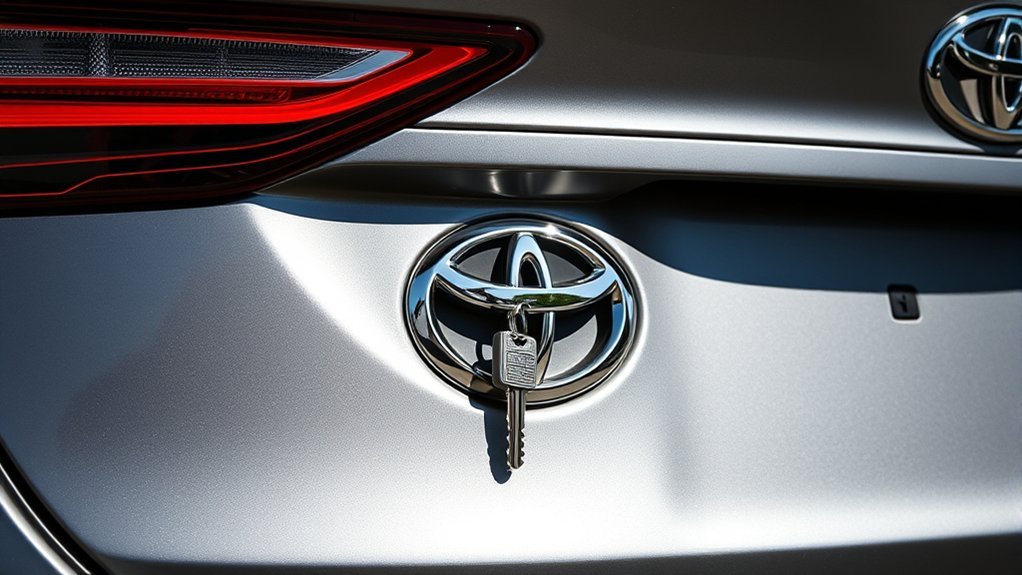
A dead Camry battery can block the electronic trunk release, but the safest backup method depends on which battery failed and which locks your model has. If only the key fob battery is dead, use the hidden mechanical key to enter the cabin and operate the normal trunk opener. If the vehicle’s 12-volt battery is dead, use an exterior mechanical trunk lock if equipped or restore power at the jump-start point specified in your owner’s manual. Do not assume you can fold the rear seats from the cabin because some Camry models place the seat-release levers inside the locked trunk.
Quick Answer
To open a Toyota Camry trunk with a dead battery, remove the mechanical key from the Smart Key first. Check whether your Camry has a mechanical trunk key cylinder and use it as directed in the owner’s manual. If the mechanical key only unlocks the driver’s door and the vehicle has no 12-volt power, open the hood and restore power through the model-specific jump-start point before using the cabin or exterior trunk switch. Use rear-seat access only when you have confirmed that the seat releases are reachable from the cabin.
Key Takeaways
- Identify whether the key-fob battery or the vehicle’s 12-volt battery has failed.
- Use the hidden mechanical key to unlock the driver’s door and, on models equipped for it, the trunk.
- Restore 12-volt power when your Camry relies on an electronic trunk release.
- Confirm the rear-seat release location before trying to enter the trunk through the cabin.
- Do not pry the trunk lid, force the seatbacks, or probe the lock with improvised tools.
What’s in This Article
- Before You Begin: Confirm What Failed
- Step 1: Identify Your Camry’s Backup Access Points
- Step 2: Use the Mechanical Key
- Step 3: Restore Power or Use the Model-Specific Release
- How to Be Ready for Battery Emergencies
- Dead Key Fob vs. Dead Vehicle Battery
- When to Seek Professional Help
- Frequently Asked Questions
Before You Begin: Confirm What Failed
Time required: Time varies by access method. Mechanical-key access may be immediate, while restoring power or arranging professional entry can take longer.
Start by identifying which battery has failed. A dead key-fob battery and a dead vehicle battery produce similar symptoms, but they do not disable the same features.
| What Failed | What May Still Work | Best First Step |
|---|---|---|
| Key-fob battery only | Vehicle electronics, cabin trunk opener, and powered exterior release | Unlock the driver’s door with the mechanical key, then use the normal trunk opener |
| Vehicle 12-volt battery | Mechanical door or trunk locks, if equipped | Use the mechanical trunk lock or restore power at the manual-specified jump point |
| Trunk latch, actuator, or wiring | Other vehicle electrical systems may operate normally | Stop treating it as a battery-only problem and diagnose the trunk release system |
Before you start, gather the items that can help you open the trunk without damage:
- Your Smart Key or mechanical key blade
- Your Toyota Camry owner’s manual or the correct digital manual
- A flashlight for checking lock cylinders and release locations
- An approved portable jump starter if the vehicle’s 12-volt battery is dead
Do not pry the trunk lid, force a key that will not turn, pull hard on trim, or push tools through the door seal. Those actions can damage the latch, lock cylinder, wiring, weather seal, glass, or paint.
Step 1: Identify Your Camry’s Backup Access Points
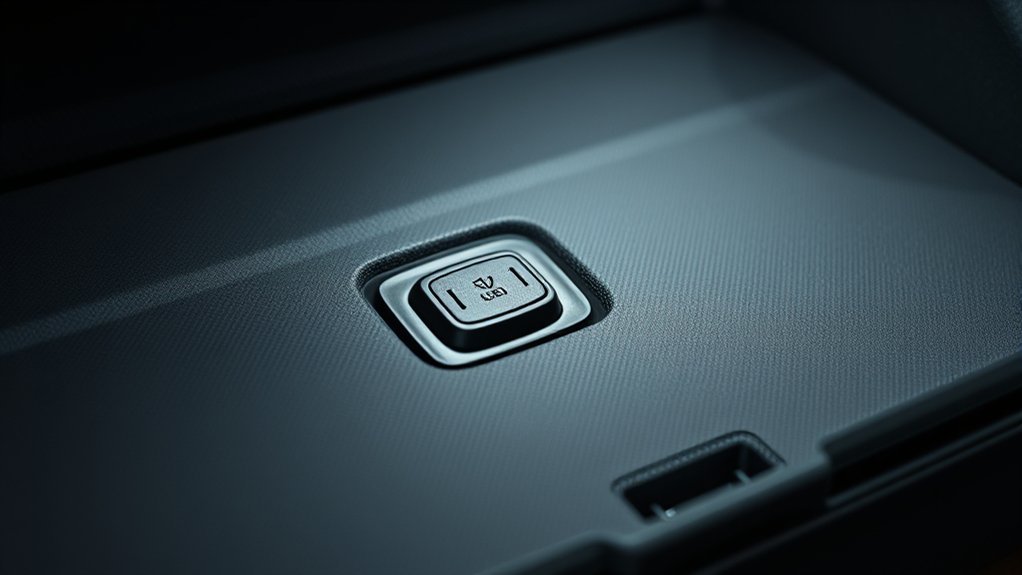
Before you pull any handle, identify which backup access features your Camry actually has. The locations and operating methods have changed across model years, trims, key systems, and markets.
- Find the mechanical key: Slide the release on the Smart Key and remove the metal key blade.
- Inspect the trunk for a key cylinder: Look around the trunk garnish, license-plate area, emblem area, and underside of the trunk lip. Use a cylinder only when your manual identifies it as the trunk lock.
- Locate the cabin trunk opener: It may be a lever or powered switch near the driver’s seat, lower dashboard, or floor area.
- Check for a trunk lockout: Some Camry configurations include a valet or luggage-security setting that can disable the cabin release.
- Confirm the rear-seat release location: Determine whether the seatbacks release from the cabin or only from inside the trunk.
2025 Camry note: Toyota’s 2025 Camry Quick Reference Guide shows the folding rear-seat release levers inside the trunk. On that design, you cannot release the seatbacks from the cabin to enter an already locked trunk.
The glow-in-the-dark emergency handle is also inside the trunk. It allows someone trapped in the trunk to escape, but it is not normally an outside access point.
[Products Worth Considering]

Fit for: for Toyota Camry 2002-2006; OE Number:6905206010

Replace Part Number: 45020-06-4, 45020064, 45020 06 4

Suitable vehicle: Trunk lid lock cylinder fit for Toyota Corolla 1.8L L4 2003 2004 2005 2006 2007 2008,Matrix 1.8L L4 2003 2004 2005 2006 2007 2008
Step 2: Use the Mechanical Key
The mechanical key works without either battery, but what it unlocks depends on the Camry’s design.
- Remove the metal key blade from the Smart Key.
- Use it to unlock the driver’s door. Some models place the door cylinder behind a removable handle cover, so follow the owner’s manual before removing the cover.
- If your Camry has a documented mechanical trunk lock, insert the key and turn it only in the direction specified by the manual.
- If the key unlocks only the door, enter the cabin and test the normal trunk opener only when the vehicle’s 12-volt electrical system still has power.
Do not force the mechanical key if it stops, bends, or will not rotate. The cylinder may be seized, the wrong key may have been supplied, or the trunk lockout may be engaged.
Warning: Do not probe a hidden key cylinder with screwdrivers, wire, or lockout tools. Damage to the cylinder or surrounding trim can turn a battery problem into a costly lock repair.
[Products Worth Considering]

[Fitment] OE Number:64600-AA020/64600AA020/64600-33091/6460033091. This trunk Latch Lock Actuator suit for Toyota Camry 2002-2006, please check make/mode/year before purchase.

VEHICLE FITMENT – Compatible with 2007, 2008, 2009, 2010 and 2011 Toyota Camry models equipped with the factory power/keyless-entry trunk release. Not intended for manual-latch configurations, 2006-and-earlier models or 2012-and-later models.

FUNCTION: The power trunk lid door actuator integrated with latch enables you to remotely lock or unlock your trunk. Once it is down, then you will have problem with opening and closing doors. A bad latch actuator is likely the problem. It should be checked regularly.
Step 3: Restore Power or Use the Model-Specific Release
If the mechanical key gets you into the cabin but the trunk release remains dead, the vehicle’s 12-volt system probably needs enough power to operate the electronic latch.
- Open the hood: Use the interior hood-release lever and secondary hood latch.
- Read the jump-start procedure: Find the instructions for your exact model year and powertrain. Do not assume the battery itself is the correct connection point.
- Locate the designated terminals: Use only the positive jump terminal and grounding point identified by Toyota for your model.
- Connect an approved power source: Follow the jump starter’s instructions and Toyota’s polarity and connection sequence.
- Operate the trunk release: Unlock the vehicle and try the cabin switch, exterior trunk switch, or key-fob button while temporary power is connected.
- Disconnect safely: Remove the power source in the sequence specified by the equipment and owner’s manual.
If the vehicle has power but the cabin release does nothing, check the manual for a valet, trunk-lockout, or luggage-security setting. On some designs, that feature intentionally disables the interior release.
If the latch clicks but the lid stays shut, apply light downward pressure to the trunk lid while another adult operates the release. Stop if the lid binds or requires force. The problem may involve latch alignment, an actuator fault, a stuck cable, or cargo pressing against the lid.
When the vehicle has normal electrical power but the trunk still will not open, use the separate Camry trunk latch troubleshooting guide to check the lockout setting, actuator, wiring, connector, and latch alignment.
Warning: Do not connect power to exposed wiring, the starter circuit, or an unidentified fuse-box terminal. Use only the connection points and sequence shown in the correct owner’s manual.
[Products Worth Considering]

Replace Part Numbers: 64606-06020, 64606 06020, 6460606020. This fuel door and trunk lid release lever is designed as an aftermarket replacement part for compatible vehicle applications. Please compare with your original part number before purchase.

Perfect Fitment: Check our product description to make sure our Trunk Lid Release Switch fit your vehicle.Compatible with Toyota Camry 2007-2009

Compatible for Toyota Camry 2007-2011
How to Be Ready for Battery Emergencies
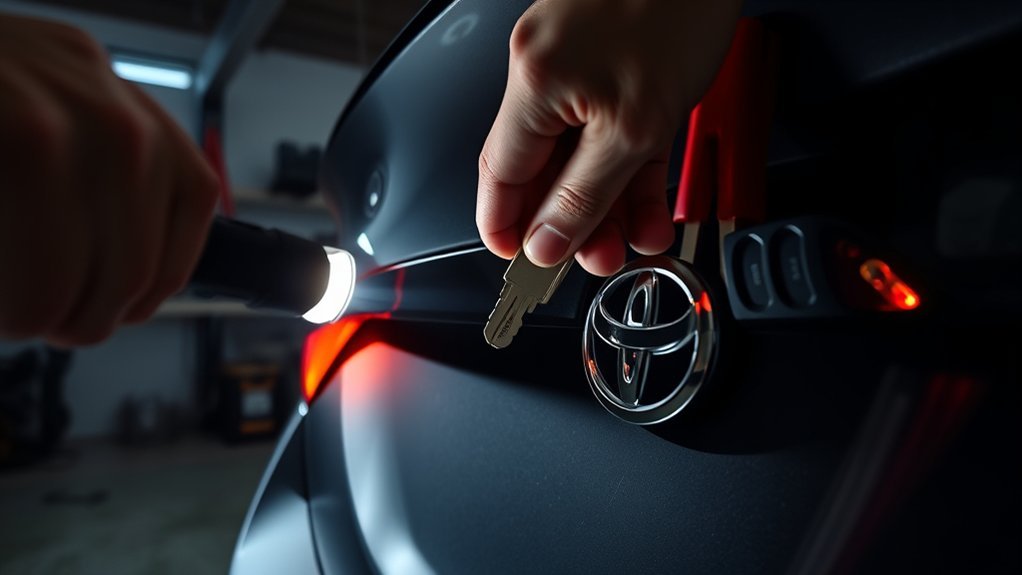
A dead battery causes less stress when you already know which mechanical locks, release switches, and jump-start points your Camry uses.
| Action | Purpose |
|---|---|
| Test the mechanical key | Confirm that it fits and turns before an emergency |
| Find any trunk key cylinder | Know whether the trunk has battery-free outside access |
| Check the rear-seat release location | Learn whether the seatbacks can be released from the cabin |
| Read the jump-start section | Identify the correct terminals and connection order |
| Keep a charged jump starter available | Restore enough power for electronic locks and releases |
Keep the owner’s manual in the glove box and save the correct digital manual on your phone. Avoid storing your only jump starter, spare key, or emergency tools in the trunk because you may not be able to reach them when the battery fails.
After you regain access, leave the trunk open until you diagnose or charge the 12-volt battery. Test the mechanical key, cabin release, exterior switch, and key fob before closing the trunk again.
What Is the Difference Between a Dead Key Fob and a Dead Camry Battery?
A key-fob battery powers the remote transmitter. The vehicle’s 12-volt battery powers the receivers, electronic locks, switches, and trunk-latch actuator. The failure symptoms can look similar, but the backup routes are different.
| Condition | Remote Trunk Button | Cabin Trunk Switch | Mechanical Key |
|---|---|---|---|
| Dead key-fob battery | Will not transmit normally | Should work when the vehicle has power and no lockout is active | Can provide backup door access and trunk access on equipped models |
| Dead vehicle 12-volt battery | Cannot operate the unpowered vehicle release | Usually cannot operate the electronic latch | Still operates compatible mechanical lock cylinders |
Note: Unlocking the driver’s door with the mechanical key does not restore power to an electronic trunk release. It only gives you cabin and hood-release access.
When to Seek Professional Help
Call a locksmith, roadside service, or Toyota dealer when the mechanical key will not turn, no approved jump-start point can be identified, the trunk lockout cannot be reset, or the latch clicks without releasing.
Get professional help instead of removing rear-seat trim or forcing the seatbacks. Some Camry seat releases are intentionally accessible only from inside the trunk, and damaging the seat structure or restraint components can create a safety problem.
If a child or person may be trapped inside the trunk, contact emergency services immediately. U.S. Federal Motor Vehicle Safety Standard No. 401 requires covered passenger cars to have an internal trunk-release mechanism so a trapped person can escape. The rule does not guarantee that the handle can be reached from outside a locked trunk.
A trained technician or locksmith can open the vehicle while reducing the risk of damage to the lock cylinder, latch, wiring, glass, paint, weather seals, and restraint components.
Frequently Asked Questions
Can you open a Camry trunk from outside with a dead battery?
Yes, when the Camry has a mechanical trunk key cylinder that works with the key blade. If the trunk release is electronic-only, you normally need to restore 12-volt power at the model-specific jump point before operating the release.
Does every Toyota Camry have a trunk keyhole?
No. Trunk-lock designs vary by model year, trim, key system, and market. Inspect the trunk and check the correct owner’s manual instead of assuming the mechanical key opens only the door or always opens the trunk.
Can you fold down the rear seats from inside a Camry with a dead battery?
Only when your Camry has seat-release controls reachable from the cabin. Toyota’s 2025 Camry Quick Reference Guide places the folding-seat release levers inside the trunk, so that model’s seatbacks cannot be released through the normal cabin procedure while the trunk is locked.
What if the cabin trunk release does not work?
First confirm that the vehicle has 12-volt power and that a valet, luggage-security, or trunk-lockout feature is not active. If the latch clicks but stays closed, stop forcing the lid and have the latch, actuator, cable, or alignment inspected.
Can a dead key-fob battery stop trunk access?
It can stop remote and proximity-based trunk opening. The hidden mechanical key can still unlock compatible mechanical locks, and the cabin trunk switch should remain available when the vehicle’s 12-volt system has power.
Can you reach the emergency trunk-release handle from outside?
Normally, no. The glow-in-the-dark handle is mounted inside the trunk for a person trapped in the compartment. You can use it only after you have legitimately gained access to the trunk interior.
Safety Disclaimer: This article is for informational purposes only and does not replace the instructions in your Toyota Camry owner’s manual or advice from a qualified automotive technician, locksmith, roadside service, or Toyota dealer. Do not force locks, seatbacks, trim panels, wiring, or latch parts.
Conclusion
The safest way to open a Toyota Camry trunk with a dead battery starts by identifying which battery failed. Use the mechanical key for door or trunk access when your model supports it. If the vehicle’s 12-volt battery is dead and the trunk release is electronic, restore power only through the jump-start procedure specified for your Camry. Do not rely on rear-seat access until you confirm that the release controls are reachable from the cabin.
Once the trunk opens, keep it open while you charge or diagnose the battery and test every release method. Call a locksmith, roadside service, or Toyota dealer when the key will not turn, the correct power connection cannot be identified, or the latch remains stuck.
References
- 2025 Toyota Camry Quick Reference Guide, Toyota Motor North America
- If the battery in the Smart Key dies, is there an alternate way to enter the vehicle?, Toyota Customer Service
- 49 CFR § 571.401, Standard No. 401, Interior trunk release, Electronic Code of Federal Regulations