
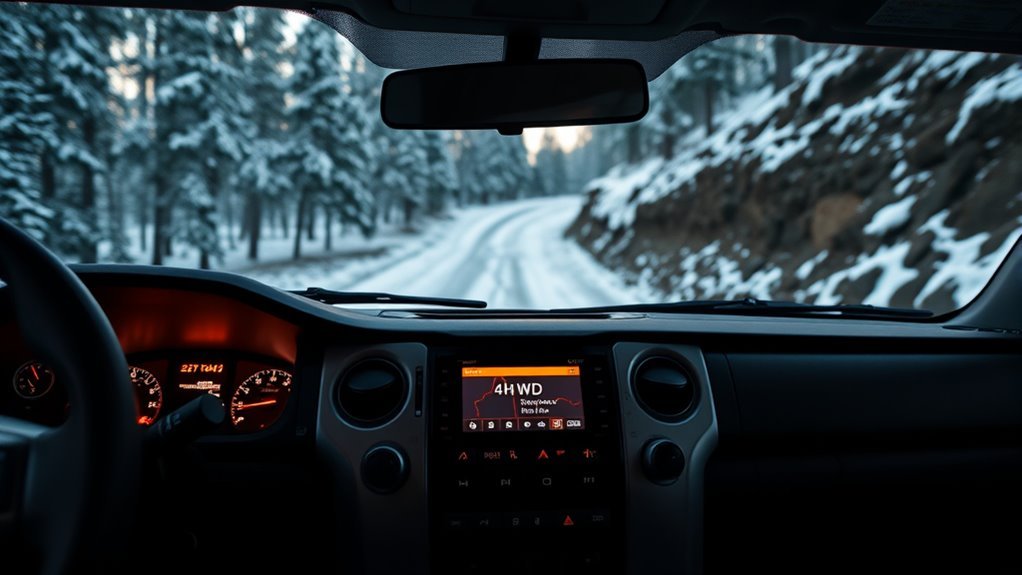
Use 4HI in a Toyota Tundra when you need extra traction while still moving at normal road or trail speeds on surfaces where the tires can slip, such as snow, ice, loose gravel, dirt, or sand. Use 4LO only when you need slow, controlled power for steep hills, deep mud, deep snow, sand, rocks, ruts, or careful engine braking downhill.
Quick Answer
Choose 4HI for slippery, loose, or snow-covered surfaces when you still need momentum. Choose 4LO for low-speed, high-torque work such as steep climbs, rocky trails, deep mud, deep snow, sand, or controlled descents. For dry pavement, keep the Tundra in 2H.
Key Takeaways
- 2H is the normal setting for dry pavement and everyday driving.
- 4HI adds traction for slippery or loose surfaces, but it is not for tight turns on dry pavement.
- 4LO multiplies torque for slow, difficult terrain and steep descents.
- Many recent Tundra manuals list 62 mph (100 km/h) as the maximum speed for shifting between 2H and 4H, but you should always drive slower when conditions are poor.
- To shift into or out of 4LO, stop fully, keep your foot on the brake, shift to Neutral, then select 4L/4LO.
At a Glance
| Time Required | Less than 1 minute once you know the steps |
| Difficulty | Easy, but 4LO requires a full stop and Neutral |
| Tools Needed | None |
| Cost | $0 |
Quick Decision: 4HI Or 4LO One-Line Rule

The simple rule is this: use 4HI when traction is the problem but you still need vehicle speed, and use 4LO when torque, crawling control, or engine braking is the problem. In a Tundra, 4HI is for surfaces that let the tires slip a little, such as snow, ice, loose gravel, dirt roads, or sandy trails. 4LO is for slow work, such as climbing a steep trail, pulling through deep mud, crawling over rocks, or easing down a rough descent.
| Mode | Best Use | Avoid |
|---|---|---|
| 2H | Normal dry pavement, commuting, highway driving | Deep snow, mud, sand, or loose climbs where rear tires spin |
| 4HI | Snow, ice, loose gravel, dirt, sandy roads, mild trails | Dry pavement, tight parking-lot turns, high-traction surfaces |
| 4LO | Steep climbs, deep mud, deep snow, sand, rocks, ruts, slow descents | Highway speeds, normal roads, fast trail driving |
Warning: Do not use part-time 4WD on dry pavement unless your owner’s manual specifically says your model and situation allow it. The front and rear driveline can bind because the system expects the tires to slip slightly on loose or slippery ground.
What 4HI Does
4HI, often shown as 4H or 4HI on the selector, sends power to both the front and rear axles through the transfer case. On many Tundras, this is a part-time 4WD system, so it is designed for low-traction surfaces rather than clean, dry pavement. It gives you more forward bite than 2H without the deep gear reduction of 4LO.
Increased Traction Front-To-Rear
When the rear tires start to spin on snow, ice, dirt, or loose gravel, 4HI helps by sharing drive force with the front axle too. That can make the truck feel more stable when accelerating, climbing a mild grade, or maintaining momentum through a slick section. The key is that the surface should allow some tire slip. If all four tires are gripping hard on dry pavement, the driveline can wind up and feel tight in turns.
| 4HI Benefit | Where It Helps | What To Remember |
|---|---|---|
| More forward traction | Snow, ice, loose dirt, gravel | It helps you move, but it does not shorten stopping distance like winter tires can |
| Better momentum | Slippery hills and packed trails | Use smooth throttle to avoid wheel spin |
| More stability under power | Low-traction roads and trails | Still slow down before turns and descents |
Higher-Speed Slippery Control
Use 4HI when you are on a long stretch of slick or loose surface and stopping to shift every few minutes would be impractical. Toyota’s recent digital Tundra manual says to reduce speed to less than 62 mph (100 km/h) when shifting between 2H and 4H. That number is a shift limit, not a promise that 62 mph is safe in snow, ice, rain, gravel, or mud. Match your speed to visibility, tire grip, traffic, and terrain.
Note: 4HI helps the Tundra accelerate and keep momentum on slick ground. It does not make the truck stop faster, change direction like it is on dry pavement, or cancel the need for proper tires.
Limited Torque Multiplication
4HI does not multiply torque the way 4LO does. It keeps the high-range gearing, so the truck can travel at normal low-to-moderate road and trail speeds while using both axles for traction. That makes it the right choice for packed snow, icy roads, loose gravel, dirt access roads, and mild off-road travel where you need steady speed more than crawling power.
When To Use 4HI: Examples And Speed Limits
Use 4HI when the road or trail is slippery enough that 2H causes wheel spin, but the situation does not require crawling. Good examples include hard-packed snow, icy rural roads, loose gravel roads, muddy access roads, sandy two-track trails, and moderate dirt climbs where momentum helps.
- Snow-covered road: Shift to 4HI before the rear tires start spinning, then drive smoothly and leave extra stopping distance.
- Gravel road: Use 4HI if the truck feels loose under throttle or the rear tires hop over washboard sections.
- Light mud: 4HI can help you maintain momentum if the mud is shallow and you are not crawling through ruts.
- Sandy trail: 4HI works for firmer sand where you need steady speed. If the truck bogs down, 4LO may be better.
- Steep snowy driveway: Try 4HI first if you can keep the truck moving gently without spinning.
For many late-model Tundras, Toyota lists less than 62 mph (100 km/h) for shifting from 2H to 4H and from 4H back to 2H. Older model years and different trims may have different selector wording or procedures, so check your exact owner’s manual through Toyota Owners Manuals and Warranties.
Pro Tip: Shift into 4HI before the truck is stuck, not after the tires have already dug holes. Smooth early engagement is easier on the drivetrain and gives you more control.
[Products Worth Considering]

These heavy-duty running board side steps are designed to improve access to your Toyota Tundra without reducing ground clearance. Built for Double Cab and CrewMax front door applications, they offer practical convenience for everyday entry, roof loading, and off-road use. The durable iron construction and easy no-drill installation make them a reliable upgrade for rugged driving.

These off-road traction boards are designed to help vehicles recover from mud, sand, and snow with reliable grip and easier ramp-up. Their double-sided diamond construction, cross-shaped teeth, and contoured ramps improve traction while the durable polypropylene build stays flexible in harsh conditions. Convenient mounting points, ergonomic handles, and a visible leash make them practical to carry, store, and retrieve when recovery is needed.

This dial type tire tread depth gauge helps you quickly check tread wear on motorcycles, cars, trucks, and buses with easy-to-read 1/32-inch increments. Its colorful zone markings make it simple to assess tire condition for safer driving in different weather, while the durable zinc cast body and legible dial provide dependable everyday use.
What 4LO Does

4LO, also shown as 4L or 4LO, uses low-range gearing in the transfer case. That gearing multiplies torque at the wheels and slows the truck’s response, giving you better control at very low speed. Toyota describes 4L as the mode for maximum power and traction, including steep hills, off-road driving, and hard pulling in sand, mud, or deep snow.
Low-Speed Torque Boost
Engage 4LO when you need the truck to crawl instead of rush. The lower gearing lets the engine stay in a stronger power range while the truck moves slowly. That helps you ease over rocks, climb a loose hill, pull through deep mud, or start from a stop in deep snow without stabbing the throttle.
Because 4LO makes the truck feel much stronger at low speed, throttle control matters. Use small pedal inputs and let the gearing do the work. Heavy throttle can still spin the tires, break traction, or shock the driveline.
Engine Braking Assistance
4LO is also useful downhill because the low gearing increases engine braking. On a steep dirt, rock, snow, or mud descent, that can help you control speed with lighter brake pressure. It is especially helpful when you want slow, steady movement instead of repeated hard braking.
- Use 4LO before a steep descent begins, not halfway down.
- Keep inputs smooth so the tires keep gripping.
- Use light braking as needed, but avoid locking the wheels on loose surfaces.
4HI is for traction with momentum. 4LO is for control with torque.
When To Use 4LO: Examples And Speed Limits
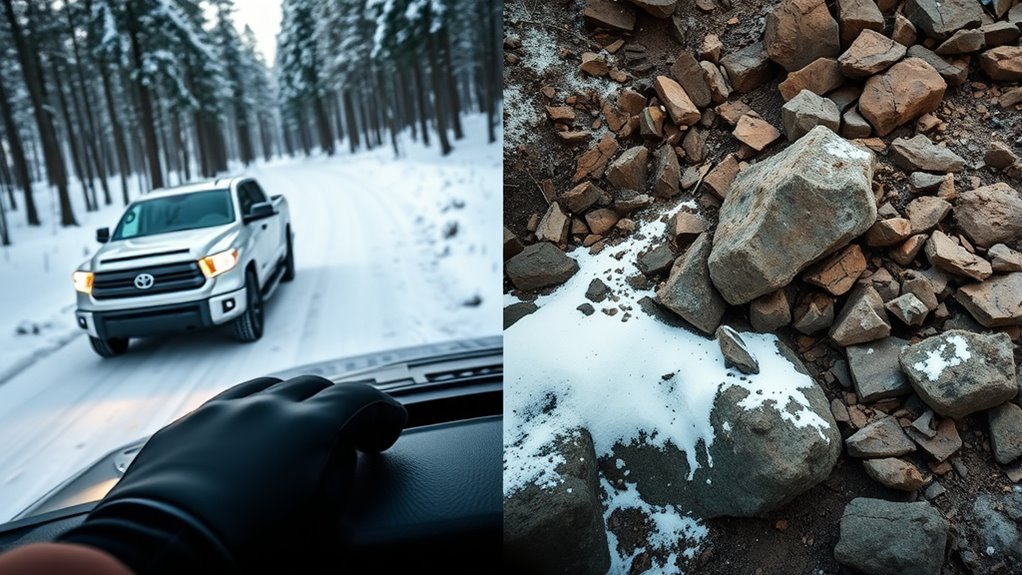
Use 4LO for situations where slow speed and high torque are more important than momentum. This is the mode for deep mud, deep snow, soft sand, steep climbs, rock crawling, washed-out trails, ruts, stump-filled paths, and controlled downhill crawling. It is not for highway driving, normal gravel-road cruising, or fast trail running.
- Deep mud or ruts: 4LO gives you controlled wheel speed so you can avoid digging deeper.
- Loose steep climb: 4LO lets you climb with less throttle and less wheel spin.
- Rocky trail: 4LO helps you crawl slowly without riding the brakes or surging forward.
- Soft sand: 4LO can help when the truck bogs down and needs torque more than speed.
- Steep descent: 4LO adds engine braking and reduces brake heat.
- Pulling or recovering at low speed: 4LO can help with controlled movement, but always use rated recovery points and safe recovery gear.
As a practical rule, keep 4LO speeds very low. Many drivers stay under about 10–15 mph in 4LO because the mode is meant for crawling, not cruising. If you need to go faster, the terrain likely calls for 4HI instead.
When To Stay In 2H
Stay in 2H for normal driving on dry pavement. That includes city streets, parking lots, dry highways, dry concrete, and most clean paved roads. 2H gives the best everyday drivability, avoids part-time 4WD binding, reduces unnecessary drivetrain load, and is the mode Toyota recommends for normal driving conditions.
You should also switch back to 2H when the slick section ends. For example, if a snowy road turns into dry plowed pavement, return to 2H when it is safe and the truck is traveling straight. If the system feels tight after driving in 4HI, drive slowly in a straight line and follow the owner’s manual procedure to shift back to 2H.
How To Shift Between 2H, 4HI, And 4LO Safely Step-By-Step
The exact selector design changes by model year, but the safe pattern is consistent: 2H to 4HI can usually be done while moving within Toyota’s listed speed limit, while 4HI to 4LO requires a full stop and Neutral. Always use your exact owner’s manual as the final authority.
[Products Worth Considering]

This Snap & Zap towing mirror set adds expanded rear visibility for safer towing on compatible Toyota Tundra and Sequoia models. The clip-on design installs easily with no tools or drilling, fits over the factory mirrors, and still allows the mirrors to fold without removal. It includes both driver and passenger side extensions and is molded to match the original mirror shape for a secure, OE-style fit.

These X-BULL recovery traction tracks help drivers get unstuck from sand, snow, mud, or ice with a stable U-shaped elastic design and a wavy ramp that makes tire entry easier. Built from reinforced nylon, they are flexible, impact-resistant, and designed to perform in extreme temperatures while providing reliable emergency traction for a wide range of vehicles.

These heavy-duty running boards are designed to improve access to your Toyota Tundra CrewMax while maintaining ground clearance for off-road use. Built from durable aluminum with a high weight capacity, they provide stable step-up support for daily driving, cargo loading, and outdoor adventures. The no-drill installation makes setup simple, and the included customer support adds extra peace of mind.
Shifting From 2H To 4HI
- Make sure the surface is slippery or loose enough to justify 4HI.
- Drive straight and reduce speed. Recent Toyota Tundra guidance lists less than 62 mph (100 km/h) for shifting between 2H and 4H.
- Ease off the accelerator.
- Select 4H/4HI using the front-wheel drive control switch.
- Confirm the 4H/4HI indicator has come on before relying on the system.
Shifting From 4HI Back To 2H
- Return to 2H when the road becomes dry, clean, or high-traction again.
- Drive straight and reduce speed below the manual’s listed shift limit.
- Ease off the throttle.
- Select 2H.
- Confirm the 4H/4HI indicator turns off.
Shifting From 4HI To 4LO
- Stop the Tundra completely.
- Keep your foot on the brake pedal.
- Shift the transmission to N or Neutral.
- Select 4L/4LO with the control switch.
- Wait for the 4L/4LO indicator to come on.
- Shift back into Drive or the needed gear and move slowly.
Shifting From 4LO Back To 4HI
- Stop completely.
- Keep the brake pedal pressed.
- Shift to Neutral.
- Select 4H/4HI.
- Wait for the 4L/4LO indicator to go off.
- Shift into Drive and continue carefully.
Warning: Do not try to shift into 4LO while moving. Toyota’s procedure requires a complete stop, brake pedal depressed, and the transmission in Neutral.
Driving Technique: Cornering, Throttle And Braking In 4HI Vs 4LO
Driving in 4HI or 4LO is not just about turning a dial. You also need to change how you steer, accelerate, and brake.
In 4HI
- Use wider turns: Tight turns on high-traction surfaces can create binding.
- Use smooth throttle: Sudden throttle can still spin the tires on snow, ice, mud, or gravel.
- Brake early: 4HI helps traction under power, but it does not erase stopping distance.
- Keep momentum sensible: Momentum helps in snow and sand, but too much speed makes recovery harder.
In 4LO
- Move slowly: Let low-range gearing do the work.
- Use tiny throttle inputs: A little pedal goes a long way in 4LO.
- Pick your line first: Look ahead and avoid sudden steering corrections on rocks or ruts.
- Use engine braking downhill: Let the gearing hold the truck back, then add light brake pressure as needed.
Common Mistakes, Troubleshooting And Tundra 4WD Maintenance
Most Tundra 4WD problems come from using the wrong mode for the surface, shifting incorrectly, ignoring tire condition, or skipping basic maintenance. The system is strong, but it still needs the right technique.
[Products Worth Considering]

The JACO ElitePro Digital Tire Pressure Gauge delivers shop-grade accuracy with a clear digital readout, making it easy to maintain proper tire pressure for safer driving and better performance. Built with rugged brass and steel components, a protective guard, and a flexible air hose, it is designed for reliable use across cars, trucks, motorcycles, bikes, RVs, and trailers. The lock-on display, built-in bleeder valve, and bright backlit screen add convenience in any lighting condition.

The ETENWOLF T300 digital tire pressure gauge delivers accurate readings across a wide pressure range, making it ideal for cars, trucks, and other vehicles. It is built to perform reliably in extreme temperatures and features replaceable AAA batteries plus an LED light for easier checks in low-light conditions. Designed for durability, it can withstand tough use while maintaining dependable performance.

This replacement bed cleat tie down anchor kit restores secure cargo management for compatible Toyota truck bed rail systems. Designed to match OEM dimensions and fit, these anchors help keep gear, tools, and luggage firmly in place during daily hauling. Built for dependable use in demanding pickup truck conditions, the kit offers a practical replacement for worn factory tie-downs.
Common Mistakes
- Using 4HI on dry pavement: This can cause driveline binding, tire scrub, noise, and extra wear.
- Waiting until you are stuck: Shift into 4HI or 4LO before momentum is gone.
- Driving too fast in 4LO: 4LO is for controlled crawling, not speed.
- Forgetting to shift to Neutral for 4LO: Recent Tundra procedures require a full stop, brake pedal, and Neutral.
- Ignoring tire pressure and tread: The 4WD system cannot make worn or badly inflated tires grip like good tires.
- Mixing tire sizes or unevenly worn tires: Different rolling diameters can add stress to the drivetrain.
If The Tundra Will Not Shift Out Of 4WD
If the Tundra feels stuck in 4HI or the indicator keeps flashing, do not force the selector or keep making tight turns on dry pavement. Try these safe checks first:
- Drive slowly in a straight line.
- Ease off the throttle and try the shift again.
- If safe, stop, shift to Neutral, and reselect the desired mode.
- Check that all tires are the same size and properly inflated.
- If the indicator keeps flashing, warning messages appear, or noises continue, stop using 4WD and have the truck inspected.
Maintenance Tips
- Follow Toyota’s scheduled maintenance guide for drivetrain fluid inspection and replacement intervals.
- Check for transfer case, front differential, and rear differential leaks after off-road use.
- Rinse mud and packed snow from suspension and driveline areas after trail driving.
- Inspect tires for uneven wear, damage, and correct cold inflation pressure. The NHTSA tire safety guide also recommends using the vehicle placard or owner’s manual for correct tire pressure.
- Cycle 4WD occasionally on a safe, low-traction surface if the truck rarely uses it, following the owner’s manual procedure.
Frequently Asked Questions
When should I use 4H and 4L in a Toyota Tundra?
Use 4H/4HI for slippery or loose surfaces when you still need momentum, such as snow, ice, gravel, dirt, or mild sand. Use 4L/4LO for low-speed torque and control, such as steep hills, deep mud, deep snow, soft sand, rocks, ruts, or controlled descents.
What mph should you turn 4HI on in a Tundra?
For many recent Toyota Tundra models, Toyota lists less than 62 mph (100 km/h) for shifting between 2H and 4H. That is the shift limit, not a safe-speed guarantee. On snow, ice, mud, gravel, or sand, drive much slower when traction or visibility is poor.
Can I use 4HI on dry pavement?
No, not in normal part-time 4WD use. Dry pavement usually gives the tires too much grip, which can cause driveline binding when the front and rear axles cannot release speed differences through tire slip. Use 2H for dry pavement.
Can I use 4HI in rain?
Use caution. Light rain on clean pavement may still provide too much traction for part-time 4WD, especially in tight turns. 4HI makes more sense when the road is also snowy, icy, slushy, muddy, flooded enough to cause tire slip, or covered with loose material. When in doubt, follow your owner’s manual.
Do I have to be in Neutral to shift into 4LO?
Yes. Recent Toyota Tundra procedures require you to stop completely, keep the brake pedal depressed, shift the transmission to Neutral, and then select 4L/4LO. Use the same stop-and-Neutral procedure when shifting back from 4LO to 4HI.
Is 4LO good for towing?
4LO can help with very low-speed pulling on loose or steep terrain, such as moving a trailer slowly up a dirt grade or out of soft ground. It is not for normal road towing. For paved-road towing, use the drive mode and towing guidance in your owner’s manual.
Conclusion
Remember the one-line rule: 4HI is for slippery surfaces with momentum, and 4LO is for slow terrain with torque. Use 2H for normal dry pavement. Use 4HI for snow, ice, gravel, dirt, and mild mud or sand when the tires need help but you still need speed. Use 4LO for steep, deep, rough, or technical terrain where slow control matters more than pace. Shift correctly, avoid dry-pavement binding, and let the Tundra’s gearing work instead of forcing it with throttle.
Sources
- Toyota Owners: 2025 Tundra Four-Wheel Drive System — official 2H, 4H, and 4L use cases and shifting procedure.
- Toyota Owners: 2025 Tundra Hybrid Four-Wheel Drive System — official hybrid-model 4WD mode descriptions and shifting guidance.
- Toyota Owners Manuals And Warranties: Tundra — official source for model-year-specific owner’s manuals and warranty guides.
- Toyota Owners: 2025 Tundra Maintenance Requirements — scheduled maintenance and general maintenance guidance.
- NHTSA Tire Safety — tire pressure, tire ratings, and tire maintenance safety information.

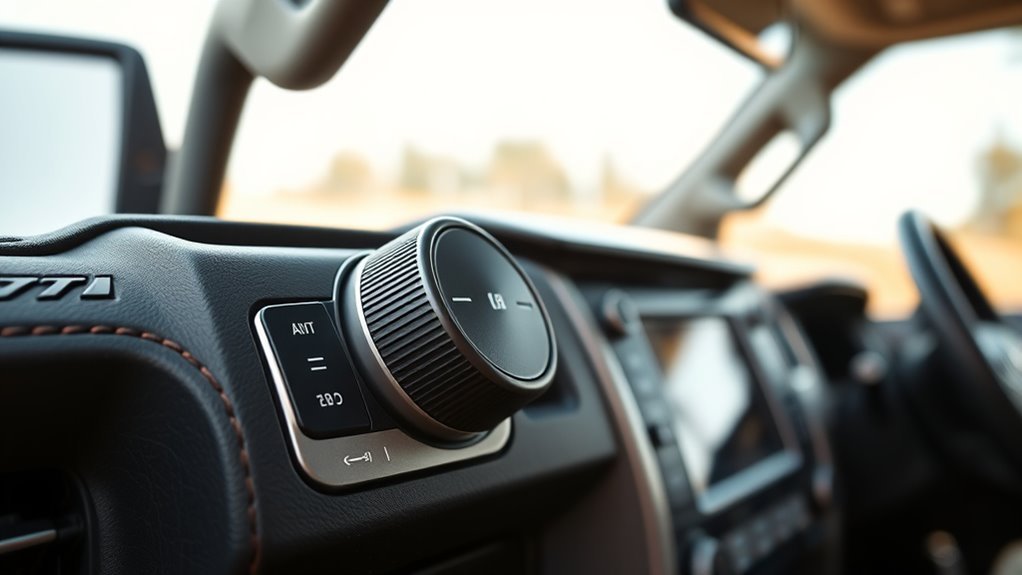
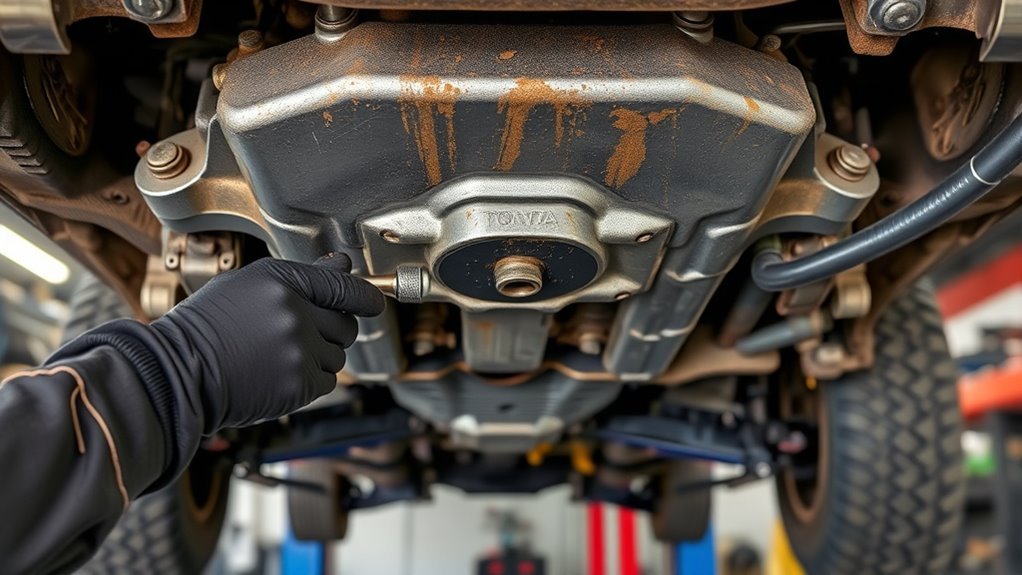

[…] described in the owner’s manual, not ordinary paved travel. See the site’s guide to when to use 4HI vs. 4LO for a separate explanation of low-range […]