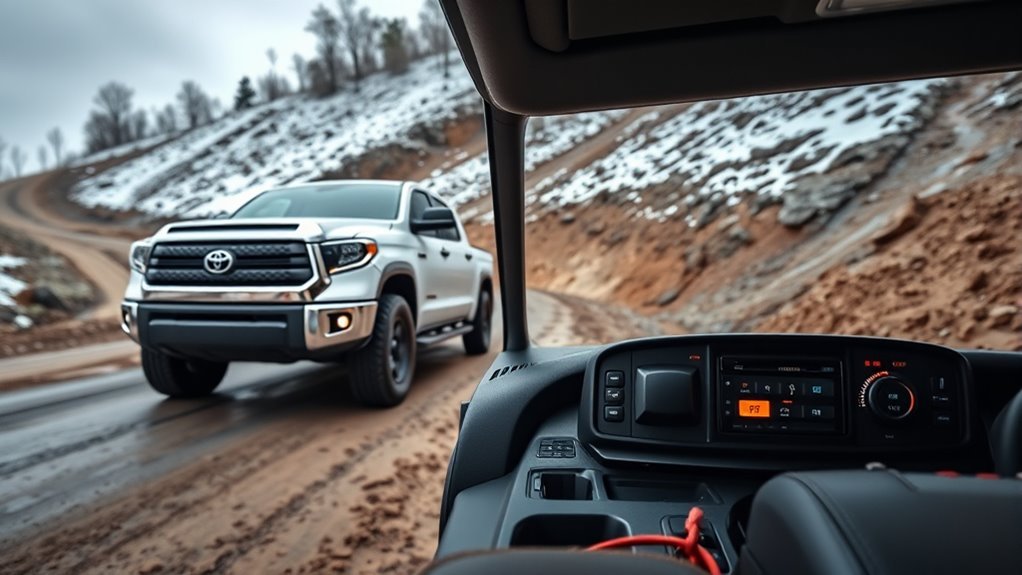
Use 2WD on your Tundra for daily city and highway driving, light towing, and predictable routes to save fuel and reduce maintenance. Switch to 4WD when roads are snowy, icy, muddy, soft, or steep, or when you’re heading onto unpaved trails, remote campsites, or steep inclines that need extra traction and control. Engage 4WD before you get stuck, and keep recovery gear handy; keep going for practical tips on systems, pros, and trip prep.
Quick Decision Rubric: Pick 2WD or 4WD for Your Tundra
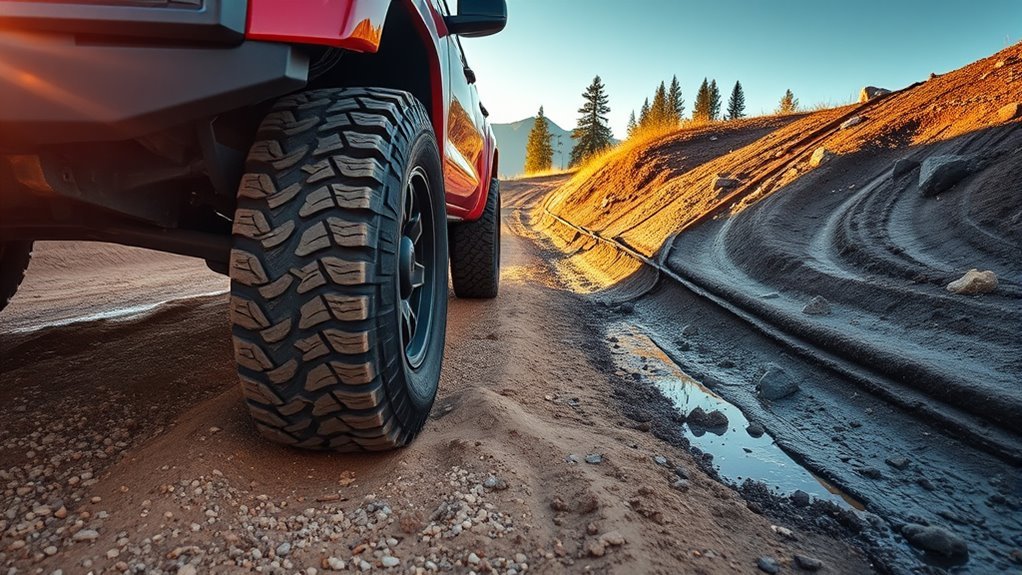
Need help choosing 2WD or 4WD for your Tundra? Use this quick decision rubric to free yourself from uncertainty. If you commute in the city, face mild weather, and want lower running costs, pick 2WD — its 2WD benefits include better fuel efficiency and fewer maintenance components, so you keep money and time for what matters. Choose 4WD when you regularly encounter snow, mud, steep hills, or unpaved trails; it gives added traction and control that preserves your access and autonomy in wild places. Factor cost: 4WD typically adds about $3,500 and can slightly reduce towing capacity, so weigh that against planned usage. Ask: how often will you need off-road access or winter traction? If rarely, 2WD suffices. If frequently, 4WD prevents site-access problems and safety compromises. Decide based on climate, habits, and freedom to go where you want.
How Tundra 2WD and 4WD Differ: Systems, Pros, Cons
When deciding between Tundra 2WD and 4WD, focus on how their systems change real-world performance and ownership: you’ll weigh simplicity and economy against traction and capability. The 2WD advantages show up in everyday use—better fuel economy, lighter weight, smaller turning radius, and simpler maintenance. 4WD brings enhanced traction for off-road, snow, and mud, but it’s heavier and needs more upkeep. Consider your region and driving habits: choose freedom from complexity or freedom to go anywhere.
Weigh simpler, cheaper 2WD for daily driving against heavier, more capable 4WD for rough roads and bad weather.
- 2WD: simpler drivetrain, fewer components to service, lower running costs.
- 2WD: improved urban handling and fuel efficiency for daily liberation.
- 4WD: superior traction and control on rough terrain and in severe weather.
- 4WD drawbacks: added weight, higher maintenance frequency, and complexity.
Decide pragmatically: if you rarely face adverse terrain, the streamlined 2WD saves money and hassle; if you chase exploration or live where roads bite, 4WD earns its keep.
When to Drive 2WD (Daily, Fuel, Towing)
If your driving stays mostly in town, on highways, or through mild weather, stick with 2WD—it’s cheaper to buy, easier to maintain, and uses less fuel than a 4WD Tundra. Choose 2WD for urban driving to maximize fuel efficiency and minimize maintenance costs; the simpler drivetrain means fewer parts to service and a lower chance of mechanical issues. You’ll save about $3,500 up front versus 4WD and keep saving at the pump and in shop bills. Assess towing needs honestly: 2WD handles light towing and everyday hauling reliably, so don’t pay for capabilities you won’t use. If your routes are predictable and you value liberation from extra expense and complexity, 2WD gives you freedom—lower ownership cost, straightforward upkeep, and better mileage. Reserve 4WD for conditions that truly demand it. Use 2WD when daily use, economy, and modest towing are your priorities.
When to Use 4WD on a Tundra (Snow, Mud, Steep, Camping)
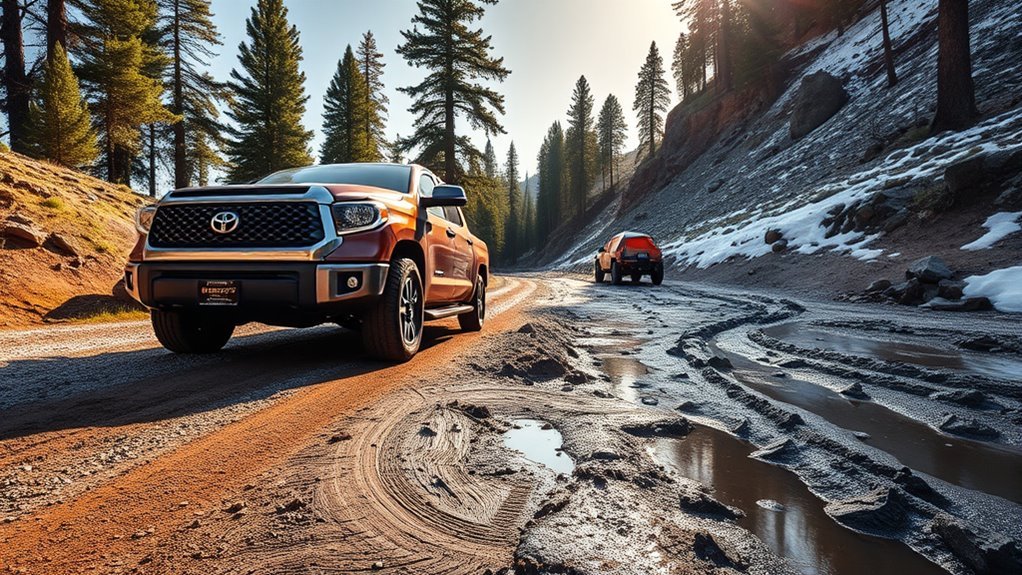
Although you’ll mostly drive in 2WD, switch your Tundra into 4WD for slippery, soft, or steep terrain to maintain traction and control. Use 4WD when snow traction matters—engage it before you hit icy patches so you don’t lose momentum. Flip to 4WD in deep mud or soft ground to gain mud stability and avoid a no-wheel-drive stall. On steep climbs or descents, 4WD gives balanced torque to all wheels, helping you ascend or descend with confidence. For remote camping and long unpaved approaches, 4WD keeps you moving over rutted roads and loose surfaces.
- Snow: engage early to preserve control and reduce risk.
- Mud: use 4WD to distribute power and prevent bogging.
- Steep slopes: rely on 4WD for grip and predictable handling.
- Remote camping roads: switch to 4WD for dependable access.
Choose 4WD to free yourself from terrain limits and keep travel plans flexible and safe.
Trip Checklist & Recovery Gear: Prepare 2WD or 4WD for Off‑Trail
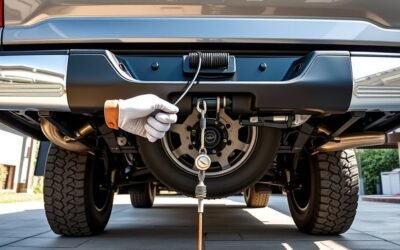
Because terrain can change fast, you should assemble a trip checklist and recovery kit that matches whether you’re using 2WD or 4WD. Start trip preparation by evaluating the route, weather, and load (including any small travel trailer). For mild trails or urban jaunts in 2WD, pack essential recovery gear: traction boards, a shovel, heavy-duty tow straps, and a compact winch or snatch block. In adverse weather or steep, muddy terrain favor 4WD and add a full-size recovery kit, high-lift jack, extra tow points, and gloves. Always include vehicle supplies: spare tire, tire repair kit, portable air compressor, fluids, and basic tools. Create a checklist that lists tasks (check weather, tire pressure, trailer tongue load) and supplies so you can verify readiness quickly. Train with your gear before you need it. Confidence on the trail comes from deliberate trip preparation and the right recovery gear, freeing you to explore without needless risk.
Frequently Asked Questions
Is It Better to Keep Your Truck in 4WD or 2WD?
You should keep it in 2WD for daily driving to enjoy 2WD advantages like better fuel efficiency, lower maintenance costs, and smoother driving performance; switch to 4WD for weather impact, off road capability, tougher terrain conditions, towing capacity needs.
Conclusion
You’ve got the tools — choose 2WD for smooth, economical daily runs and light towing; flip to 4WD when the road gets temperamental: snow’s whisper, mud’s grip, steep trails or soft sand. Pack recovery gear, check tire pressure, and know your Tundra’s limits before you wander off the beaten path. Staying sensible keeps you moving; a little caution and the right drive mode turn potential mishaps into small, teachable detours.