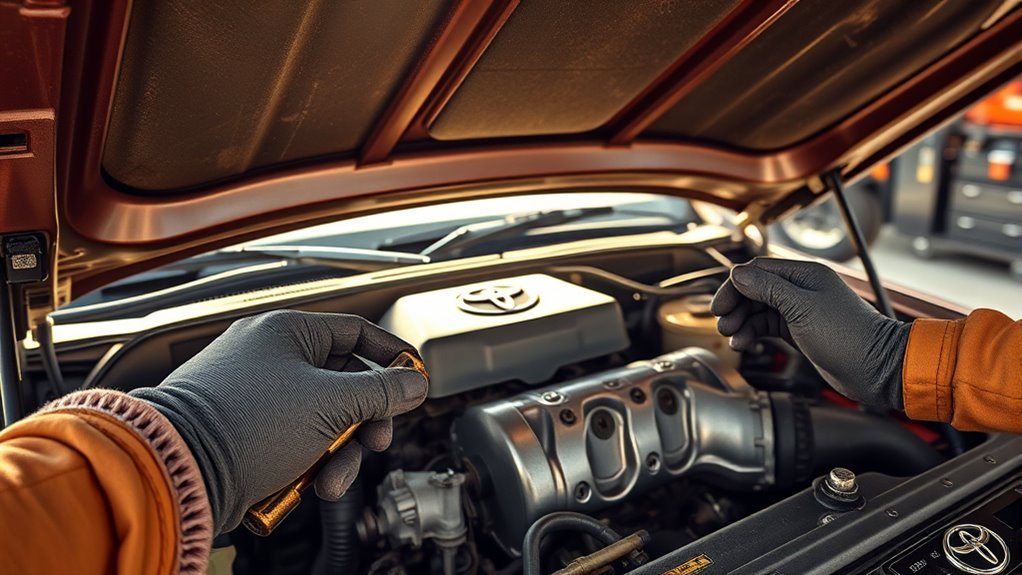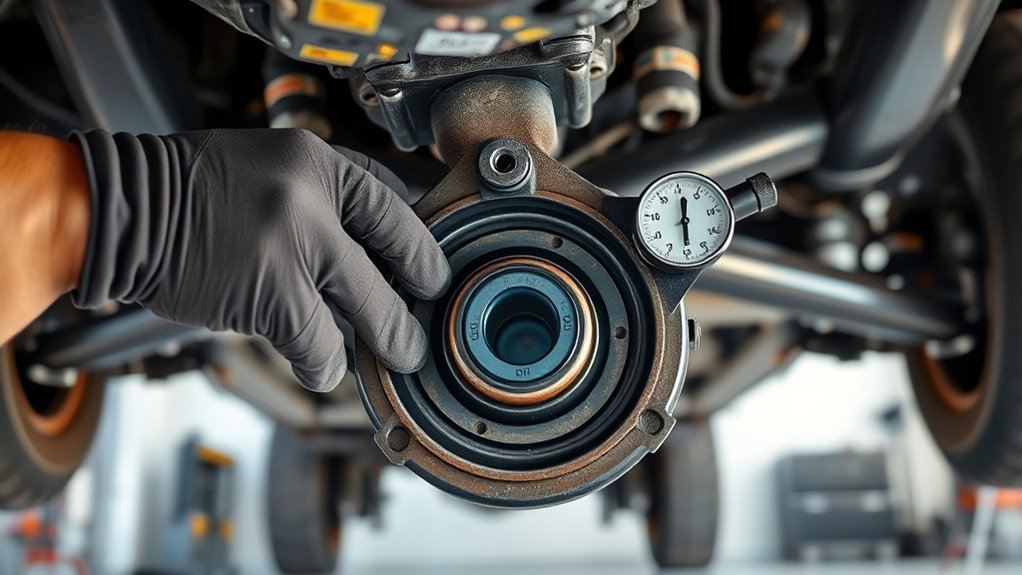
A Tacoma shake that shows up under throttle is not something to ignore. The fastest way to narrow it down is to compare when the vibration appears: accelerating, cruising, coasting, shifting, or clutch-in on a manual truck. A worn U-joint is a common driveline suspect, but tires, wheel balance, pinion angle, the center support bearing, and loose driveshaft hardware can feel similar.
Quick Answer
A bad Tacoma U-joint often causes a speed-linked vibration that gets worse under acceleration, plus clunks, squeaks, or visible play at the driveshaft. Road-test it safely, inspect each joint for rust dust, loose caps, missing snap rings, and axial play, then grease serviceable joints or replace any worn U-joint.
Key Takeaways
- A vibration that changes with throttle load is a driveline clue, not automatic proof that the rear U-joint is bad.
- Clunks when shifting from Drive to Reverse, squeaks at low speed, red rust dust, dry caps, or any joint play deserve immediate inspection.
- Never crawl under the truck with only a hydraulic jack holding it up; support it with properly rated stands on solid ground.
- Mark the driveshaft and flanges before removal so the shaft goes back in the same orientation.
- Lifted Tacomas may need driveline angle correction, not just new U-joints.
At a Glance
| Time Required | 30–60 minutes for diagnosis; 2–4 hours for U-joint replacement if you have the right tools |
| Difficulty | Moderate DIY; advanced if the joint is seized, the shaft needs balancing, or driveline angles must be corrected |
| Tools Needed | Wheel chocks, jack stands, safety glasses, pry bar, paint marker, socket set, torque wrench, grease gun, U-joint press or ball-joint press, and model-specific repair information |
| Cost | Low for inspection and greasing; higher for OEM joints, professional labor, balancing, or a custom shaft |
Warning: Do not work under a Tacoma supported only by a jack. OSHA’s jack standard says a raised load must be cribbed, blocked, or otherwise secured at once, so use properly rated jack stands, chock the wheels, and work on a flat, solid surface.
Confirm Tacoma U-Joint Vibration: Quick Driving Tests

Start with a controlled road test on a safe road where you can hold steady speeds without heavy traffic. Many driveline vibrations show up between about 30–50 mph, but the exact speed depends on tire size, axle ratio, road load, lift height, and which shaft is affected. Your goal is to see whether the shake follows vehicle speed, engine rpm, or torque load.
Drive at a steady speed, then add light throttle. If the vibration gets stronger under acceleration and fades when you lift off, focus on the driveshaft, U-joints, center support bearing, pinion angle, and flange hardware. On a manual Tacoma, depress the clutch briefly only when it is safe to do so; if the vibration changes when the engine is unloaded, that points toward a load-sensitive driveline issue. On an automatic, compare light throttle, steady cruise, coast, and gentle braking instead.
Note: A clutch-in or off-throttle test does not “prove” the rear U-joint is bad. It simply narrows the search. Tires, wheels, bent shafts, center bearings, pinion angle, transmission mounts, and differential issues can overlap.
What to Note While Driving: Speed, Throttle, Clutch, and Noise
Write down what the truck does instead of relying on memory. A short symptom log helps you avoid replacing parts that are not failed.
| What You Feel or Hear | Most Likely Area to Check | Why It Matters |
|---|---|---|
| Vibration worsens under throttle and eases when coasting | U-joints, driveshaft, pinion angle, axle wrap | Torque load can expose play, bind, or bad driveline geometry. |
| Clunk when shifting from Drive to Reverse or taking off from a stop | U-joints, slip yoke, flange bolts, differential backlash | A worn joint can rotate slightly before it takes load. |
| Squeak or chirp at low speed that changes with vehicle speed | Dry U-joint caps or needle bearings | A dry bearing can fail quickly once the grease is gone. |
| Vibration stays the same on or off throttle | Tires, wheel balance, bent wheel, wheel bearings | A speed-only shake often starts outside the driveline. |
| Shake mainly on deceleration or braking | Driveline angle, center bearing, brake rotors, tires | Some Tacoma driveline complaints are most noticeable while coasting, not accelerating. |
Also check whether the shake is felt in the seat, floor, steering wheel, or shifter. A steering-wheel shake is more often front tire, wheel, or front suspension related. A seat-and-floor vibration is more consistent with the rear driveline, rear tires, or driveshaft balance.
Inspect the Driveshaft and U-Joints: Visual and Hands-On Checks
Once the road test points toward the driveline, inspect the driveshaft and U-joints before ordering parts. Toyota refers to the driveshaft as the propeller shaft in its service information, and Toyota’s genuine parts catalog groups propeller shafts and universal joints as driveline components.
Look for these warning signs:
- Red-brown dust around a U-joint cap: often a sign that rust and dry bearing needles are wearing inside the cap.
- Loose or shifted bearing caps: the cap should sit squarely in the yoke with the retaining clip in place.
- Missing snap rings or clips: a cap that can walk out of the yoke can destroy the joint and yoke.
- Grease leakage, torn seals, or dry fittings: serviceable joints need grease; sealed joints must be replaced when worn.
- Dented shaft tube, missing balance weight, or heavy rust scaling: shaft imbalance can mimic a bad U-joint.
- Loose flange bolts: movement at the flange can create a clunk and vibration.
- Cracked center support bearing rubber on two-piece shafts: this can let the shaft move under load.
With the truck safely supported and the transmission in neutral, grab the driveshaft close to each U-joint. Push, pull, twist, and rock it while watching the caps and yokes. There should be no visible looseness. Rotate the shaft by hand and feel for roughness, tight spots, or binding. A U-joint can fail from stiffness as well as looseness, especially when dried grease has damaged the needle bearings.
Pro Tip: Use a bright paint marker before you unbolt anything. Mark the shaft, flange, yoke, and any center bearing spacers so the parts go back exactly where they came from.
[Products Worth Considering]
These custom-fit mud flaps are designed to help protect your Toyota RAV4 from mud, snow, dust, gravel, sand, and wheel debris while maintaining a clean, rugged look. Laser-scanned for a secure fit, they install easily using the vehicle's original mounting holes and included hardware. Built from durable materials, they offer dependable year-round protection for everyday driving and off-road conditions.

This battery terminal cleaning and repair kit helps restore worn or damaged top-post battery connections for cars, RVs, boats, and other vehicles. It includes lead shims for improving fit, stainless steel brushes for removing corrosion and debris, and fiber washers to help reduce future buildup and maintain a reliable electrical connection.

These low profile jack stands provide secure vehicle support for routine garage and repair work on most cars and small vehicles. Built with a welded steel frame, adjustable ratchet design, and wide base for stability, they offer dependable lifting support with a concave saddle for safer contact. The low minimum height and compact design make them a practical choice for many automotive maintenance tasks.
Remove, Mark, and Bench-Check the Driveshaft and U-Joints
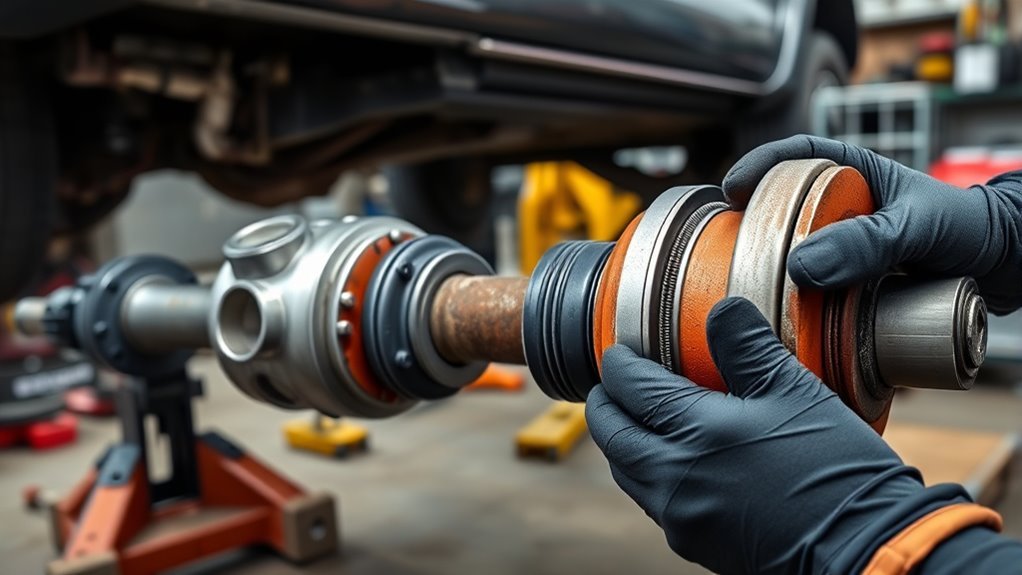
If the visual and hand inspection show play, stiffness, dry caps, or damaged hardware, remove the driveshaft for a bench check. Before removal, mark every mating surface. Matchmarks matter because a driveshaft is balanced as an assembly, and changing its orientation can bring back the vibration you are trying to fix.
Use the correct repair procedure and torque specs for your exact model year, drivetrain, cab, bed, and transmission. Toyota’s public owner manual page can help you find basic vehicle information, but repair procedures and torque specs should come from the Toyota Technical Information System or a professional service database. Do not guess on flange bolt torque.
On the bench, check each U-joint this way:
- Hold the shaft steady and move the yoke through its full range. It should move smoothly without notchiness.
- Rock the cross by hand. Any click, axial movement, or visible cap movement means the joint is worn.
- Inspect the yoke ears. Replace the shaft or yoke if the cap bore is stretched, cracked, gouged, or damaged by a failed joint.
- Check the snap-ring grooves. Rust, burrs, or debris can stop the new joint from seating correctly.
- Press the joint straight. A U-joint press or ball-joint press is better than hammering because it reduces the chance of bending the yoke.
- Verify free movement after installation. The joint should articulate smoothly without binding after the clips are installed.
A new U-joint that feels tight after the clips are installed is not “good enough.” Binding creates heat, vibration, and early bearing failure.
[Products Worth Considering]

This 9-piece torque wrench set gives DIYers and professionals a versatile way to tighten fasteners with confidence across bikes, motorcycles, cars, trucks, and industrial equipment. It includes three click torque wrenches, multiple adapters, dual-scale measurement, and clear audible feedback to help prevent overtightening. Built with durable materials and stored in a portable case, it is designed for precise, organized, and reliable use.
This multi-layer cabin air filter helps deliver cleaner, fresher air inside your vehicle while supporting efficient HVAC performance. Its close-meshed filtration helps reduce odors and airborne particles, and the easy-fit design makes replacement quick and simple. Designed for broad compatibility across many Toyota, Lexus, Subaru, and other select models, it is a practical maintenance upgrade for a healthier in-car environment.

COMPATIBILITY – Fits 1996-1997 Lexus LX450; 1998-2007 Lexus LX470; 2003-2007 Lexus LX470; 2003-2009 Lexus GX470; 2010-2019 Lexus GX460; 2010-2014 Lexus GX460; 2015-2019 Lexus GX460; 2008-2008 Lexus LX570; 2009-2015 Lexus LX570; 1984-2016 Toyota 4Runner; 3
Do Not Miss These Related Tacoma Driveline Causes
If the U-joints feel tight and have no play, keep diagnosing. Tacoma driveline vibration can come from several nearby parts:
Center Support Bearing on Two-Piece Shafts
Many Tacoma configurations use a two-piece rear driveshaft with a center support bearing. If the bearing rubber is torn, sagging, oil-soaked, or separated, the shaft can move under acceleration and cause a thump or shudder. Check the bearing mount, spacers, and bracket orientation before condemning the U-joints.
Driveshaft Balance and Damaged Tube
A missing balance weight, dented tube, packed mud, or heavy rust scale can cause a smooth-speed vibration even when the U-joints are fine. Clean the shaft before testing, inspect the tube closely, and have a driveline shop check balance if the vibration remains after the joints pass inspection.
Pinion Angle on Lifted Tacomas
A suspension lift changes the relationship between the transfer case, driveshaft, and differential pinion. Spicer’s driveline guidance says U-joint operating angles should be equal within about 1 degree and, for vibration-free performance, generally not larger than 3 degrees. If your Tacoma is lifted, measure the angles before blaming only the joint.
2025 Tacoma Front Driveshaft Recall Check
If you own a 2025 Tacoma or Tacoma Hybrid 4WD, check your VIN before doing paid driveline work. Toyota announced a recall on October 1, 2025 for certain 2025 Tacoma 4WD models because a front driveshaft joint part could deform or break while driving. Toyota said dealers would inspect the front driveshaft assembly serial numbers and replace affected assemblies at no charge. Check your VIN at Toyota’s recall lookup or NHTSA’s recall lookup.
Fix It: Grease, Replace Parts, or Upgrade to a One-Piece Driveshaft
Choose the repair based on what you found, not just on the symptom.
[Products Worth Considering]

Compatibility: Fits Rover 80 1959–1962, Rover 2000 1968–1973, and Rover 3500S 1969–1974; Land Rover Range Rover 1970–1974 and Land Rover (Series models) 1962–1974; and Ram Dakota 2011
Grease Serviceable U-Joints
If the joint has a grease fitting and no play, grease it with the correct chassis grease until fresh grease reaches the seals. Wipe away excess, rotate the shaft, and check that the joint still moves smoothly. Greasing can quiet a dry serviceable joint, but it will not repair worn needle bearings, damaged caps, or a loose yoke.
Replace Any U-Joint With Play, Bind, or Damage
Replace a U-joint if you find axial play, cap movement, missing clips, rough rotation, brinelling, red dust, or dry seized bearings. If one joint failed from age or lack of lubrication, inspect the others carefully while the shaft is out. Use the correct part for your exact Tacoma; 2WD, 4WD, cab, bed, transmission, and model year can change driveshaft and U-joint fitment.
Repair Damaged Yokes or Flanges
Do not press a new joint into a damaged yoke and call it fixed. If a failed joint has worn the yoke ears, enlarged a cap bore, or damaged the flange, the new joint may not stay centered. In that case, a yoke, flange, or complete shaft repair may be safer than replacing the joint alone.
Correct Driveline Angles on Lifted Trucks
For lifted Tacomas, a new U-joint may fail again if the driveline angle is wrong. Measure the transmission or transfer-case output angle, driveshaft angle, and pinion angle using a digital angle finder or a driveline angle tool. Spicer’s angle resources explain how to calculate U-joint operating angles and why high angles combined with rpm create vibration and reduce joint life.
Shims, carrier-bearing drops, pinion-angle correction, or a professionally built one-piece shaft may help, but each change has tradeoffs. A one-piece shaft is not automatically better for every Tacoma. It must be the correct length, diameter, balance, slip travel, and operating angle for the truck.
When to Stop Driving and Tow the Truck
Do not keep driving if the vibration is getting worse quickly or you find any of these signs:
- A loud bang, grinding sound, or repeated clunk from under the cab or bed
- Visible movement at a U-joint cap or flange
- A missing snap ring, cracked yoke, or cap walking out of the yoke
- A driveshaft that contacts the body, exhaust, crossmember, or fuel tank shield
- A failed center bearing letting the shaft sag or whip
- A recalled front driveshaft issue on an affected 2025 4WD Tacoma that has not been inspected
A failing driveshaft can damage the transmission, transfer case, differential, exhaust, brake lines, or floor. If the joint is visibly loose, towing is cheaper than a driveline failure on the road.
Frequently Asked Questions
Will a bad U-joint cause vibration?
Yes. A bad U-joint can cause vibration, especially under acceleration or load. It may also cause clunks, squeaks, red rust dust around the caps, or visible play when you twist the driveshaft by hand.
Will a bad U-joint make the gear shift vibrate?
It can. A worn U-joint can send vibration through the driveshaft, transmission, and shifter area. However, shifter vibration can also come from transmission mounts, engine mounts, clutch issues, tires, or driveline angle, so inspect before replacing parts.
Can I drive my Tacoma with a bad U-joint?
Only for a short, cautious trip if the vibration is mild and there is no visible play, clunking, missing clip, or loose cap. If the joint is loose, binding, or noisy, stop driving and repair it or tow the truck.
Should I replace one U-joint or all of them?
Replace any joint that has play, rust dust, roughness, damaged caps, or binding. If one joint failed from age or lack of grease, inspect the rest closely while the shaft is out. Replacing only the failed joint is acceptable if the others test clean.
Why does my lifted Tacoma vibrate after new U-joints?
A lift can change the U-joint operating angles. If the angles are too high or unequal, new joints may still vibrate. Measure the driveline angles, check the center support bearing, and correct the geometry before assuming the new parts are bad.
Conclusion
A Tacoma U-joint vibration is easiest to fix when you diagnose it in order: road-test the symptom, inspect the shaft, check each joint for play or bind, verify the center support bearing and flange hardware, and measure driveline angles on lifted trucks. Grease only helps a serviceable joint that is still tight and smooth. If you find play, damaged caps, missing clips, or rough movement, replace the U-joint and correct the cause before the vibration turns into a broken driveline.
Sources
- Toyota Owners Manuals and Warranties — model-year owner information and access path for official Toyota documentation.
- Toyota Technical Information System — official repair procedures, service information, and torque specifications by model and year.
- Toyota Genuine Propeller Shaft and Universal Joint Parts — confirms Toyota’s propeller shaft and universal joint driveline category.
- Spicer Driveline Operating Angle Calculator — backs up U-joint operating angle guidance and vibration risk.
- OSHA 1926.305 Jacks Standard — supports safe lifting, blocking, cribbing, and jack-use warnings.
- Toyota 2025 Tacoma Driveshaft Recall Announcement — supports the 2025 Tacoma 4WD front driveshaft recall note.