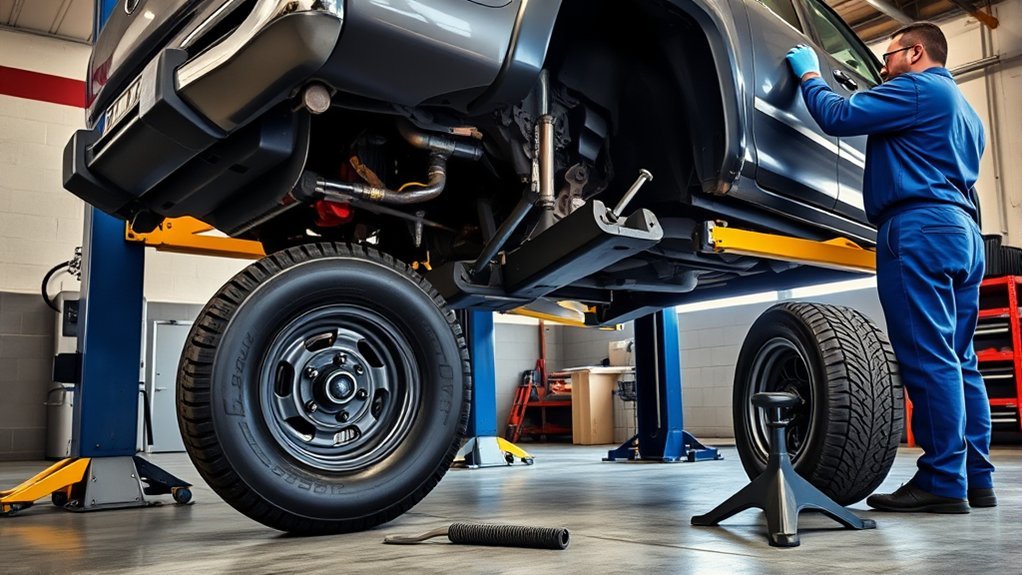
To rotate Toyota Tacoma tires safely, first confirm the maintenance interval, rotation pattern, jacking points, wheel-nut torque, and tire-pressure procedure for your exact model year and wheel setup. For a 2025 U.S.-market Tacoma, Toyota lists tire rotation at the 5,000-mile or six-month service intervals. Directional tires normally stay on the same side, while same-size non-directional tires should follow the pattern in the owner’s manual. Use rated jack stands at approved support points, torque the lug nuts with a calibrated torque wrench, set cold pressure from the driver’s door placard, and complete any TPWS initialization required by your manual.
Last updated: July 23, 2026 — model-year, torque, lift-support, tire-pressure, and schema guidance reviewed.
Quick Answer
To rotate Toyota Tacoma tires, identify your exact model year and tire type, choose the manual-approved rotation pattern, and make sure you have enough rated jack stands for that pattern. Park on solid level ground, chock the wheels, loosen the lug nuts, lift only at approved points, support the truck securely, inspect and move the tires, hand-thread the lug nuts, torque them to the model- and wheel-specific value, set cold tire pressure, and follow any TPWS initialization instructions in the owner’s manual.
Key Takeaways
- Toyota’s 2025 Tacoma maintenance chart lists tire rotation at the 5,000-mile or six-month service intervals, but you should use the guide for your exact model year.
- Choose the pattern before lifting. A same-side swap may be possible with two stands when approved support points allow it; a cross rotation generally requires three or four stands.
- Directional tires stay on the same side unless they are dismounted and remounted. Staggered tire sizes may prevent front-to-rear rotation.
- Do not rely on one universal Tacoma lug-nut torque number. The correct value can vary by model year, wheel material, and aftermarket hardware.
- After the rotation, check cold tire pressure, tread depth, damage, uneven wear, wheel seating, and the TPMS/TPWS status.
At a Glance
| Typical Time | Plan about 30–60 minutes if you know the lift points and have the correct stands |
| Difficulty | Moderate; supporting the truck safely is the most important part |
| Tools Needed | Floor jack, enough rated jack stands for the pattern, wheel chocks, lug wrench or breaker bar, calibrated torque wrench, tire pressure gauge, and gloves |
| Verify Before Starting | Model year or VIN, rotation pattern, jack and support points, wheel type, torque specification, tire direction, tire sizes, and TPWS procedure |
| Cost | $0 if you already own the tools; otherwise tool rental, tool purchase, or shop labor varies |
How Do You Rotate Toyota Tacoma Tires Step by Step?
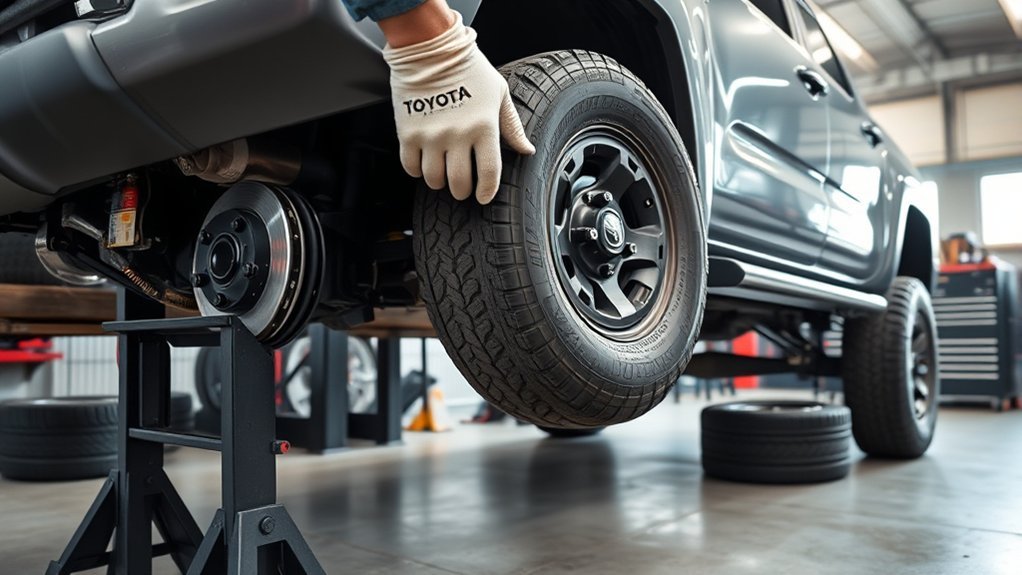
Before starting, open the tire-rotation, tire-pressure, and emergency-lifting sections in the manual for your exact Tacoma. Toyota’s 2025 Tacoma Warranty & Maintenance Guide lists scheduled maintenance every 5,000 miles or six months and includes tire rotation at those intervals. The rotation pattern, support points, torque, and TPWS steps may differ on another year, trim, wheel type, or aftermarket setup.
Model-Year Check: Use Toyota’s manual and warranty portal to select the correct model year. Verify the VIN when the truck has unusual factory equipment or when you are unsure which manual applies.
Warning: Never work under a Tacoma supported only by a jack. Use the approved lift and support points, work on solid level ground, use properly rated stands, and chock the wheels that remain on the ground. Do not improvise if your planned pattern requires more stands than you own.
- Park safely. Choose a flat, solid surface. Shift into Park for an automatic or into gear for a manual, set the parking brake, and place wheel chocks at the tires that will remain on the ground. Do not rely on the parking brake alone once the rear wheels are lifted.
- Identify the tire setup. Check all four sidewalls for size, direction arrows, “rotation” markings, and matching model information. Directional tires normally move front-to-back on the same side. Different front and rear sizes may prevent rotation.
- Choose the pattern and support plan. Use the pattern shown in the Tacoma manual unless the tire or wheel manufacturer requires a different approved pattern. A same-side swap may be possible one side at a time with two stands when the manual identifies suitable support points. A cross rotation generally requires three or four stands.
- Loosen the lug nuts before lifting. Break each lug nut loose about a quarter turn while the tire still touches the ground. Do not remove the nuts yet.
- Lift and support the Tacoma. Raise the truck only at the approved jacking points. Position rated stands at the approved support points, lower the truck onto them, and verify stability before removing a wheel. The hydraulic jack is not a substitute for a stand.
- Remove and inspect each wheel. Check tread depth, sidewall cracks, cuts, nails, bulges, exposed cords, cupping, feathering, and inner-edge wear. Uneven wear may indicate pressure, alignment, suspension, balance, or wheel-installation problems.
- Move the tires to their new positions. Follow the selected manual-approved pattern. Do not cross directional tires to the opposite side unless a tire professional dismounts and remounts them so they continue rotating in the intended direction.
- Inspect the mounting surfaces. Before reinstalling a wheel, make sure the hub and wheel mating surfaces are clean and that no stone, heavy rust scale, or other debris is trapped between them.
- Reinstall the wheels by hand. Hold each wheel flat against the hub and thread every lug nut by hand first. Snug the nuts lightly in a star or crisscross pattern so the wheel seats evenly.
- Lower and torque the wheels. Lower the truck until the tire has enough contact to prevent rotation, then use a calibrated torque wrench and the exact value for your model year, wheel type, and lug hardware. Do not use an impact wrench as the final torque measurement.
- Set cold pressure and check TPWS. Adjust all four road tires to the cold pressure on the driver’s door placard. Check a usable full-size spare separately. Then follow the manual if TPWS initialization or tire-position registration is required after rotation.
Pro Tip: Mark each starting position with chalk or painter’s tape—LF, RF, LR, and RR—before removal. Record the tread depth at each position so the next rotation shows whether one corner is wearing faster.
[Products Worth Considering]

Camco Trailer Aid Plus provides a 5 1/2-inch lift to make tandem tire changes on trailers and RVs easier and faster. Its strong polymer construction is lightweight, waterproof, rustproof, and built for dependable outdoor use, while the high weight capacity supports a wide range of trailer maintenance needs. Designed for convenient portability, it helps you change a flat without unloading cargo or horses.

These low profile jack stands provide secure vehicle support for routine garage and repair work on most cars and small vehicles. Built with a welded steel frame, adjustable ratchet design, and wide base for stability, they offer dependable lifting support with a concave saddle for safer contact. The low minimum height and compact design make them a practical choice for many automotive maintenance tasks.

This smart color coded tire tread depth gauge makes it easy to check tread wear at a glance with clear red, yellow, and green ranges. Calibrated from 0 to 1 inch in 1/32 inch increments, it helps you quickly assess tire condition for safer driving and timely replacements. The pocket clip design makes it convenient to carry and use on trucks, motorcycles, cars, and other passenger vehicles.
What Tools Do You Need to Rotate Tacoma Tires?
You need a hydraulic floor jack, wheel chocks, a lug wrench or breaker bar, a calibrated torque wrench, a tire pressure gauge, and enough rated jack stands for the rotation pattern. A same-side rotation and a cross rotation do not always require the same number of stands. Determine the pattern before loosening a wheel.
The emergency jack supplied with the truck is intended for roadside wheel changes, not as a support for maintenance work. Never count the hydraulic jack as one of the stands, and never place any part of your body beneath a truck until it is resting securely on approved support points.
A torque wrench is essential for final tightening. Lug nuts that are too loose can back off, while excessive torque can damage studs or wheel hardware and make later removal difficult. Toyota’s official 2024 Tacoma maintenance data, for example, lists different wheel-nut torque values for steel and aluminum wheels. That example shows why you should not carry one torque number across every Tacoma generation or aftermarket wheel.
Keep a tire pressure gauge nearby so you can set the tires to the pressure shown on the driver’s door label after the rotation. Toyota’s digital manual section on tire inflation pressure reinforces using the vehicle’s specified pressure rather than the maximum molded into the tire sidewall.
[Products Worth Considering]

This EL-50448 TPMS relearn tool helps quickly activate and reset tire pressure sensors so your vehicle’s monitoring system stays accurate after tire rotations, sensor replacement, or seasonal tire changes. Designed for many GM-related vehicles and compatible with common 315 and 433 MHz TPMS systems, it offers simple one-button operation and reliable performance for clearing warning lights and relearning sensor positions.
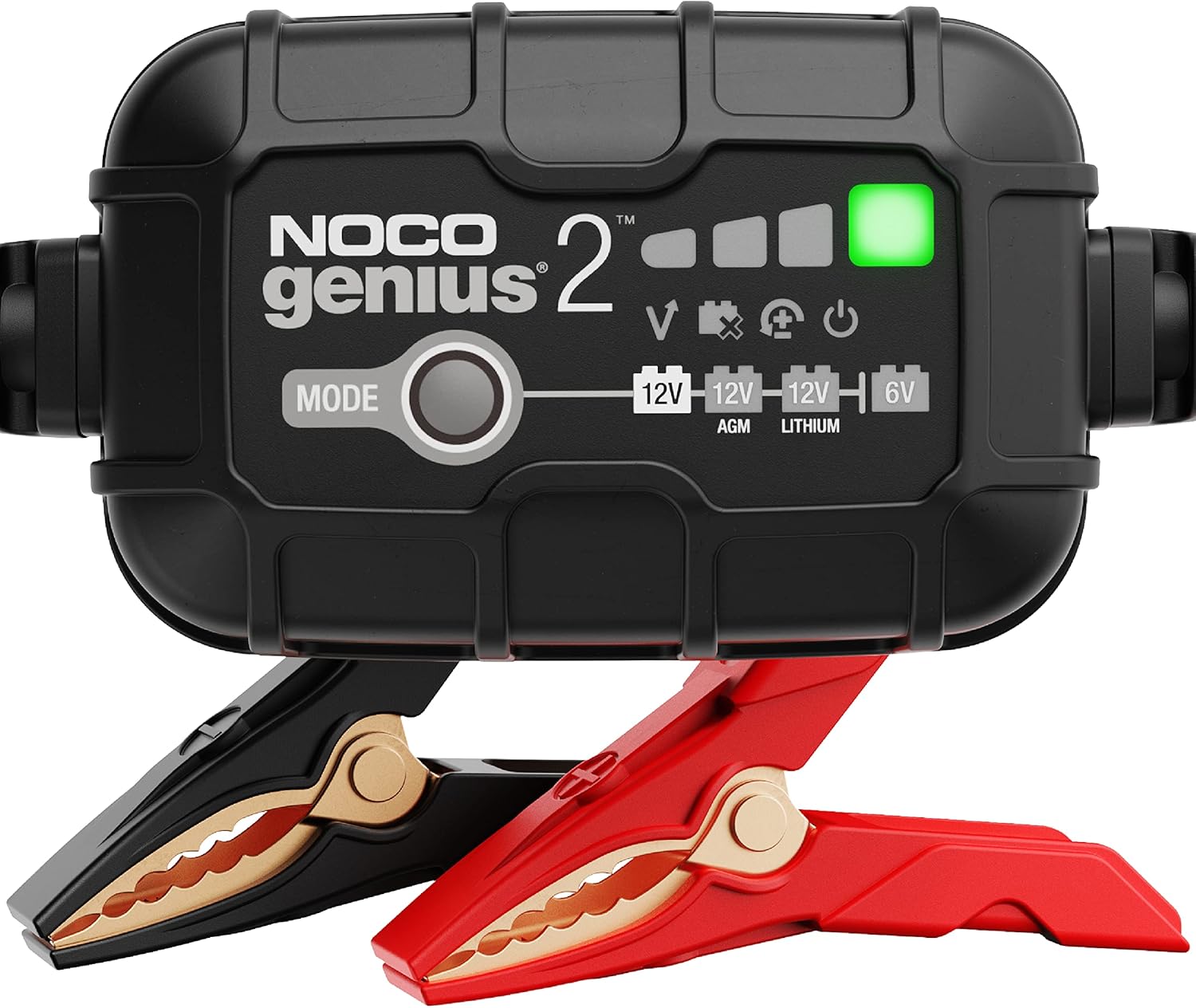
The NOCO GENIUS2 is a compact, all-in-one smart charger that automatically charges, maintains, and restores 6V and 12V lead-acid and lithium batteries. It features temperature compensation, overcharge protection, pulse desulfation, and Force Mode for reviving deeply discharged batteries, making it ideal for long-term battery care across many vehicle types. Designed for safe indefinite connection, it helps extend battery life and keep batteries ready to go.
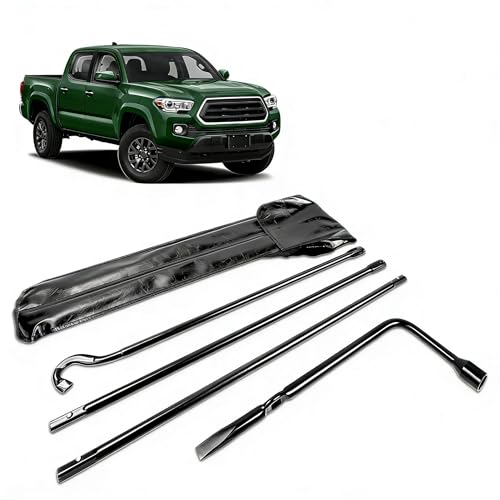
【Applicable Models】:Compatible with 2005-2022 Tacoma
Which Tire Rotation Pattern Should a Toyota Tacoma Use?
The correct Tacoma tire rotation pattern depends on the model year, tire sizes, tire direction, wheel compatibility, and the instructions from Toyota and the tire manufacturer. Do not select a pattern based only on the truck being rear-wheel drive or four-wheel drive. The owner’s manual for the exact setup takes priority.
| Pattern | How It Works | Best For |
|---|---|---|
| Front-to-rear, same side | Front left swaps with rear left, and front right swaps with rear right. | Directional tires and Tacoma manuals or tire instructions that keep each tire on the same side. |
| Rearward cross | Rear tires move straight forward; front tires cross to the opposite rear positions. | Same-size, non-directional tires when Toyota and the tire manufacturer permit the pattern. |
| Five-tire rotation | A matching full-size spare enters the sequence so all five tires share wear. | Only when the spare matches the road tires and the manual or tire manufacturer provides an approved five-tire pattern. |
Plan the lifting method around the pattern. A front-to-rear same-side swap may be completed one side at a time with two rated stands if the approved support points allow it. A rearward-cross pattern generally requires three or four stands because tires must move between sides. If you cannot support the required positions securely, have a shop perform the rotation.
Note: Do not assume a standard four-tire pattern is correct when the Tacoma has staggered sizes, directional mud-terrain tires, aftermarket beadlock-style wheels, mismatched wear, or a temporary spare.
[Products Worth Considering]
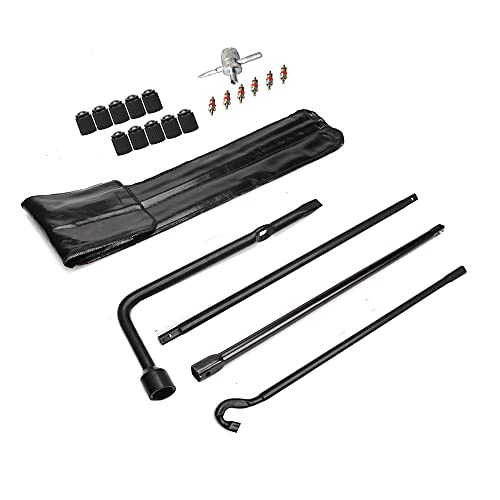
Premium OEM Upgraded Quality Spare tire tool: Stable strong rustproof automotive grade steel,tubing instead of soil designed made it more light,not only stong but also convenient.

Durable construction - made of tough, durable materials and coated with corrosion-resistant finish,and material testing to ensure a quality fit and long service life

Comes as a 4 piece set, for changing your spare tire
Why Does Tire Rotation Matter on a Toyota Tacoma?
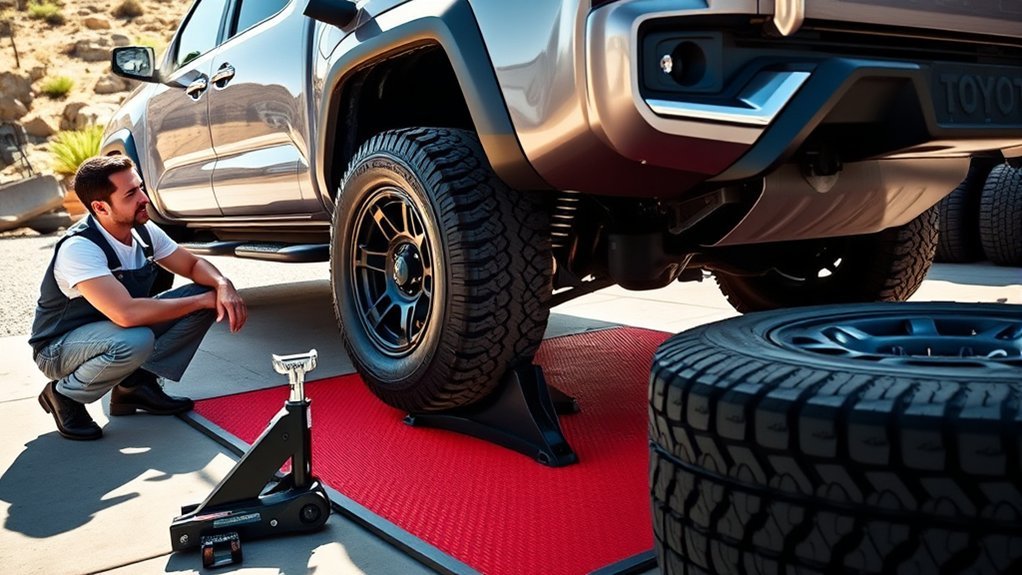
Regular rotation helps distribute the different loads placed on each Tacoma tire. The front tires steer and carry much of the braking load. The rear tires may see more drive torque, payload stress, towing load, and off-road traction demand. Moving the tires between approved positions can reduce front-to-rear tread differences and reveal damage before it causes a failure.
Federal guidance: The National Highway Traffic Safety Administration advises following the vehicle manufacturer’s instructions and, when rotation is recommended, rotating every 5,000–8,000 miles or sooner if uneven wear appears. The model-year Tacoma maintenance guide remains the more specific source for your truck.
- More even tread wear: Rotation can reduce shoulder wear, cupping, feathering, and large front-to-rear tread differences.
- More consistent handling: Similar tread depths across the set can support more predictable braking, cornering, and wet-road behavior.
- Better use of tire life: Even wear helps prevent one or two tires from reaching their replacement limit much earlier than the rest.
- Earlier problem detection: Removing the wheels gives you a chance to find nails, cracks, sidewall bulges, mounting debris, worn brake parts, or abnormal wear patterns.
How Often Should You Rotate Toyota Tacoma Tires?
Follow the Toyota Warranty & Maintenance Guide for your exact model year. For the 2025 Tacoma, the maintenance chart lists tire rotation at 5,000 miles or six months, whichever comes first. Do not substitute a generic interval when the factory schedule provides a model-specific one.
| Driving Situation | What to Do |
|---|---|
| Normal road use | Use the mileage or time interval in the model-year maintenance guide. |
| Frequent towing or heavy payloads | Inspect tread depth and pressure more often and rotate earlier if a clear wear difference develops. |
| Gravel or off-road use | Inspect for cuts, impacts, packed mud, missing wheel weights, and irregular wear after demanding trips. |
| Cupping, feathering, or rapid edge wear | Do not rely on rotation alone. Diagnose pressure, alignment, balance, suspension, or tire damage. |
How Do You Keep Tacoma Tires in Good Condition?
Tire rotation works best as part of a broader maintenance routine. Check all tire pressures when the tires are cold and compare them with the Tire and Loading Information label on the driver’s door jamb. Do not use the maximum pressure molded into the sidewall as the normal inflation target for factory-size tires.
Use a tread-depth gauge when possible. NHTSA states that tires should be replaced when tread reaches 2/32 of an inch and explains that the built-in treadwear indicators or penny test can reveal when that limit has been reached. Measure several points across each tire because an inner or outer shoulder may wear faster than the center.
Inspect the sidewalls for cracks, cuts, bubbles, exposed cords, punctures, and impact damage. Do not continue normal driving on a tire with a bulge, exposed cord, or rapid air loss. Have it inspected by a qualified tire professional.
Also check for missing wheel weights, packed mud, bent wheels, and looseness in steering or suspension parts. Rotation can move an existing problem to a different corner, but it does not correct an imbalance, alignment fault, damaged tire, or worn component.
What Should You Check After Rotating Tacoma Tires?
Before driving, confirm that every wheel sits flat against the hub, every lug nut has been hand-started and torqued in a crisscross sequence, and every tire is set to the correct cold pressure. Complete any model-specific TPWS initialization only after the pressures are correct.
- Confirm final torque: Use the exact specification for the model year, wheel type, and lug hardware. Follow any re-torque instruction supplied by an aftermarket wheel manufacturer.
- Check cold pressure: Use the driver’s door placard. Check a matching full-size spare separately if it is part of your maintenance plan.
- Review the TPMS/TPWS status: If your manual requires initialization after rotation, complete that procedure. Do not initialize the system merely to hide an unresolved low-pressure condition.
- Watch the warning-light behavior: A steadily illuminated light commonly indicates low pressure. A light that flashes for about a minute and then stays on may indicate a TPMS malfunction that needs diagnosis.
- Test drive at low speed: Stop if you feel new vibration, hear clicking, or notice strong pulling. Recheck wheel seating and torque before continuing.
New vibration after a rotation may come from an imbalanced or damaged tire, uneven tread wear, mud or debris on the wheel, a missing balance weight, a wheel that is not seated flat, or loose or incorrectly torqued hardware. Do not assume the vibration will disappear on its own.
Frequently Asked Questions
How often should you rotate tires on a Toyota Tacoma?
Follow the Warranty & Maintenance Guide for your exact model year. For the 2025 Tacoma, tire rotation is listed at the 5,000-mile or six-month service intervals. Inspect more often when you tow, haul, drive off-road, or notice uneven wear.
What is the best tire rotation pattern for a 4×4 Tacoma?
Use the pattern shown in the owner’s manual for your exact tire setup. Same-side front-to-rear rotation is used when the manual or directional-tire design requires it. A rearward cross may be suitable for same-size, non-directional tires only when Toyota and the tire manufacturer permit it.
Can you rotate Tacoma tires with two jack stands?
A same-side front-to-rear swap may be possible one side at a time with two rated stands if the Tacoma manual identifies suitable lift and support points. A cross rotation generally requires three or four stands. Never leave the truck supported only by the hydraulic jack or improvise an unsafe support point.
Can I include the spare tire in a Tacoma tire rotation?
Only include the spare when it is a compatible full-size road tire and wheel that matches the other tires in size, type, load rating, direction, and condition, and when the manual or tire manufacturer provides a five-tire pattern. Do not include a temporary or mismatched spare.
What torque should Tacoma lug nuts be tightened to?
Use the value listed for the exact Tacoma model year, wheel material, and lug hardware. Toyota’s official 2024 Tacoma data, for example, lists different specifications for steel and aluminum wheels. Do not carry those figures over to another year or aftermarket wheel, and do not use an impact wrench as the final torque measurement.
Do you need to reset TPMS after rotating Tacoma tires?
The required procedure depends on the model year and TPWS configuration. First set every tire to the cold pressure on the driver’s door placard. Then follow the owner’s manual if it instructs you to initialize the system or register the new tire positions after rotation.
Do I need an alignment after every tire rotation?
No. Rotation alone does not normally require an alignment. Have the alignment checked if the Tacoma pulls, the steering wheel is off-center, the tread shows feathering or one-sided wear, or the truck recently struck a curb, pothole, or trail obstacle.
Conclusion
Rotate Toyota Tacoma tires at the interval in the maintenance guide for your exact model year, using the pattern shown for your tire setup. Choose the pattern before lifting so you know how many stands are required. Support the truck only at approved points, inspect every tire, clean the mating surfaces, hand-start the lug nuts, apply the correct final torque with a torque wrench, and set cold pressure from the door placard. Finish by completing any required TPWS procedure and making a careful low-speed test drive.
Sources
- Toyota 2025 Tacoma Warranty & Maintenance Guide — maintenance interval, tire rotation schedule, and inspection guidance.
- Toyota Manuals and Warranties: Tacoma — official model-year manual and warranty-guide access.
- Toyota Tacoma Digital Manual: Tire Inflation Pressure — cold tire-pressure checking and adjustment reference.
- Toyota Tacoma Digital Manual: Maintenance Data — model- and wheel-specific wheel-nut torque example.
- NHTSA TireWise — tire pressure, tread depth, tire rotation, TPMS, recalls, and maintenance guidance.
- Michelin Tire Rotation Guide — directional-tire and rotation-pattern guidance.
- Castrol Tire Rotation Guide — stand-count and rotation-pattern planning.
- Bridgestone Tire Replacement Guidance — tread inspection, uneven wear, and replacement guidance.