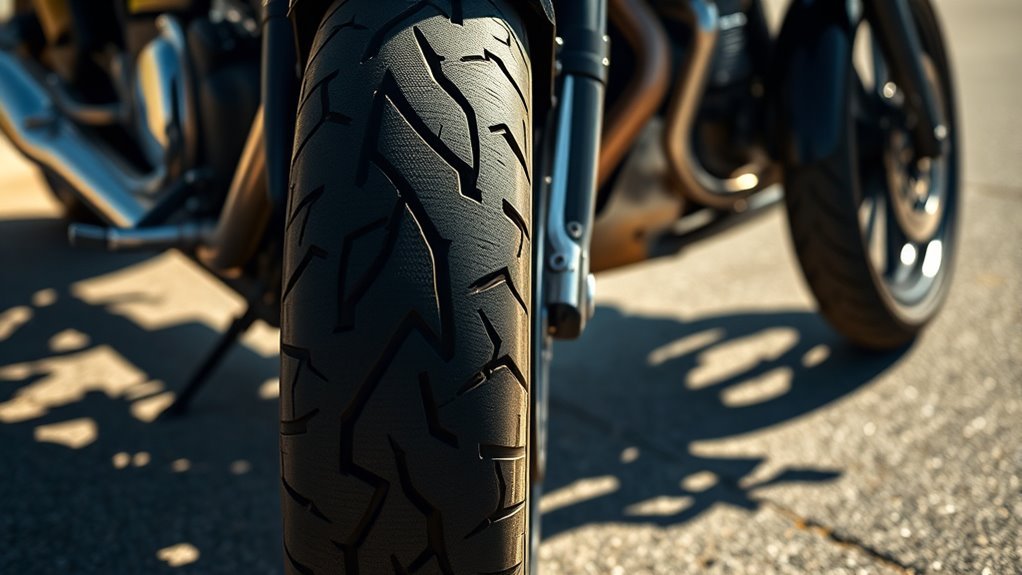
For most street motorcycles, recommended cold tire pressure often falls somewhere around the low-30s to mid-30s PSI in the front and the mid-30s to low-40s PSI in the rear. That range is only a starting point, though. The correct number for your bike is the cold tire pressure listed in your owner’s manual, tire information label, or motorcycle manufacturer’s specifications.
Quick Answer
Use the motorcycle manufacturer’s recommended cold PSI, not the maximum pressure printed on the tire sidewall. Many street bikes use about 32–36 PSI in front and 36–42 PSI in the rear, but exact pressure depends on the model, tire size, rider/passenger load, and riding use.
Key Takeaways
- Check pressure when the tires are cold, ideally before riding or after the motorcycle has been parked for at least three hours.
- Use the PSI listed in your owner’s manual, tire information label, or manufacturer’s fitment data.
- Do not use the tire sidewall maximum as your normal riding pressure unless your motorcycle manufacturer specifies that value.
- Adjust for passenger, luggage, and cargo only according to the motorcycle’s load chart and maximum load rating.
- Check tire condition at the same time: tread depth, cracks, punctures, bulges, uneven wear, and valve caps.
At a Glance
| Time Required | 3–5 minutes |
| Difficulty | Easy |
| Tools Needed | Accurate tire pressure gauge, air compressor or pump, valve caps, owner’s manual or tire-pressure label |
| Cost | Usually free if you already own a gauge; about $10–$30 for a basic quality gauge |
How to Determine and Adjust Tire Pressure for Motorcycles
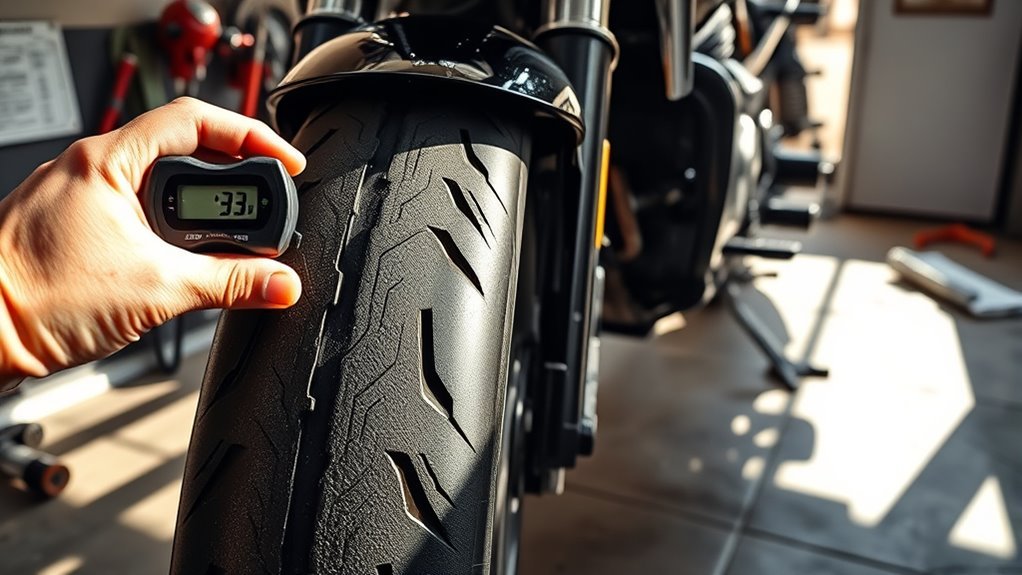
The safest way to determine your motorcycle tire pressure is to use the number set by the motorcycle manufacturer. Michelin’s motorcycle tire guidance states that road-use tire pressure is set by the vehicle manufacturer and is found in the owner’s manual or on the vehicle. Bridgestone also advises checking the frame placard and/or owner’s manual for the correct tire specifications and inflation pressures.
Use this simple process:
- Find the correct PSI. Check your owner’s manual, tire information label, swingarm/frame label, or manufacturer fitment guide.
- Check tires cold. Measure before riding, or after the motorcycle has been parked long enough for the tires to cool.
- Remove the valve cap. Keep it clean and nearby so it does not pick up dirt.
- Press the gauge straight onto the valve stem. A quick hiss is normal, but a long hiss usually means the gauge is not seated squarely.
- Add air if the tire is low. Inflate in short bursts, then recheck.
- Release air only if the cold reading is too high. Press the valve pin briefly, then recheck with the gauge.
- Reinstall the valve cap. The cap helps keep dirt and moisture out of the valve.
Warning: Do not bleed air from a warm tire just because it reads above the cold PSI number. Tire pressure rises as the tire warms during riding. Set pressure when the tires are cold unless your motorcycle or tire manufacturer gives a specific hot-pressure procedure.
[Products Worth Considering]

The JACO ElitePro Digital Tire Pressure Gauge delivers shop-grade accuracy with a clear digital readout, making it easy to maintain proper tire pressure for safer driving and better performance. Built with rugged brass and steel components, a protective guard, and a flexible air hose, it is designed for reliable use across cars, trucks, motorcycles, bikes, RVs, and trailers. The lock-on display, built-in bleeder valve, and bright backlit screen add convenience in any lighting condition.

Turn your iPhone, Android device, or Windows PC into a professional-grade diagnostic scan tool with this Bluetooth OBD2 adapter. It is designed for broad vehicle compatibility and supports popular apps for deeper diagnostics, live data, and code clearing. Built-in protections and firmware updates help keep your vehicle and scanner safe while delivering reliable performance.

This 2-in-1 wireless adapter converts factory wired CarPlay into a convenient wireless connection for compatible vehicles, making every drive simpler and more flexible. It supports quick auto-connect, easy phone switching, and stable audio and navigation performance for iPhone and Android Auto users. Designed for plug-and-play use, it helps reduce cable clutter while keeping calls, maps, and music running smoothly.
Where to Find the Correct Motorcycle Tire PSI
You can usually find the correct motorcycle tire PSI in one or more of these places:
- Owner’s manual: The most reliable source for front and rear cold tire pressure.
- Tire information label or placard: Often located on the frame, swingarm, chain guard area, or under the seat, depending on the motorcycle.
- Manufacturer website or dealer: Useful if you bought the bike used and do not have the manual.
- Tire maker fitment guide: Helpful when using replacement tires, especially if the tire maker lists model-specific guidance.
The number molded into the tire sidewall is not automatically your riding pressure. Dunlop explains that sidewall pressure is a maximum for that tire and may not match the recommended pressure for your motorcycle. Use the sidewall to confirm tire size, load rating, speed rating, rotation direction, and maximum limits, but use the motorcycle’s recommended cold pressure for normal street riding.
Cold vs. Hot Motorcycle Tire Pressure
Motorcycle tire pressure should be checked cold because riding warms the tire and raises the pressure reading. NHTSA defines cold tire pressure as pressure measured when the vehicle has not been driven for at least three hours. For motorcycles, the easiest habit is to check pressure before your first ride of the day.
Note: A tire pressure monitoring system, if your motorcycle has one, is a useful warning tool. It is still smart to verify pressure with a gauge before long rides, after big temperature changes, or when the bike feels different.
The Impact of Rider Weight, Passenger, and Cargo on Tire Pressure
Rider weight, passenger weight, luggage, and accessories all affect how much load your motorcycle tires carry. The right adjustment is not a universal “add 1 PSI for every few pounds” rule. Instead, use the normal-load and maximum-load pressure recommendations in your owner’s manual or tire information label.
For high-speed, fully loaded, or two-up touring use, Dunlop advises inflating tires to the maximum recommended by the vehicle manufacturer for that fitment and never exceeding the lower of the tire sidewall maximum load or the vehicle capacity listed in the owner’s manual.
Pro Tip: If you switch from solo commuting to two-up riding with luggage, check your manual before the ride. Many motorcycles list separate pressure or load instructions for passenger and cargo use.
Top 5 Common Tire Pressure Mistakes and How to Avoid Them
Proper tire pressure is simple, but these mistakes can reduce handling, shorten tire life, or create a safety risk:
- Using the sidewall maximum as the normal PSI. Fix it by using the motorcycle manufacturer’s cold-pressure recommendation.
- Checking pressure right after riding. Fix it by checking cold, before the ride, whenever possible.
- Forgetting the rear tire. The rear often carries more load and may need a different PSI than the front.
- Ignoring passenger and luggage weight. Fix it by following the motorcycle’s load chart and maximum capacity.
- Assuming lower pressure always means more grip. On the street, running below spec can increase heat, wear, steering effort, and instability.
Correct cold tire pressure helps the tire carry the motorcycle, rider, passenger, and cargo while keeping the contact patch, steering response, and tire temperature within the range the bike was designed for.
[Products Worth Considering]

This digital tire pressure gauge delivers highly accurate readings with a bright backlit LCD for easy use in any lighting condition. Designed for cars, trucks, SUVs, and motorcycles, it offers multiple unit options, ergonomic handling, and dependable AAA battery power for everyday checks and roadside confidence.

This extendable snow brush and ice scraper helps clear windshields and vehicle surfaces quickly in harsh winter weather. Its rotating brush head, durable bristles, and strong scraper design make it easy to remove snow and ice without scratching your car, while the comfortable grip and detachable parts improve handling and storage.
The Importance of Front and Rear Tire Pressures
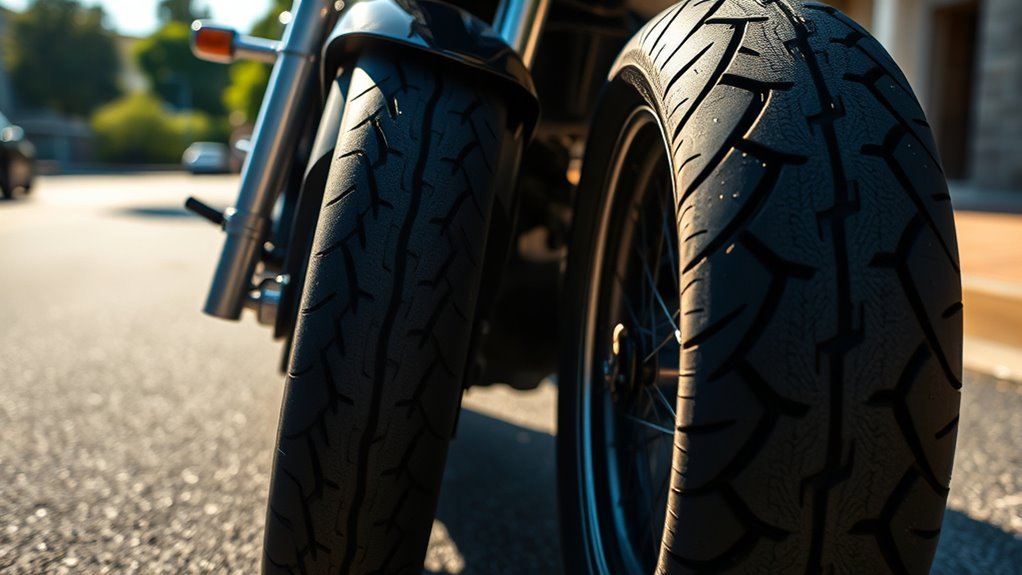
Front and rear motorcycle tires do different jobs, so their recommended pressures are often different. The front tire handles steering feel and a large share of braking load. The rear tire usually carries more weight, handles acceleration forces, and often needs higher pressure.
| Tire Position | Common Cold PSI Examples | What Improper Pressure Can Cause |
|---|---|---|
| Front tire | Often around 32–36 PSI on many street bikes, but always verify by model. | Too low can make steering heavy or vague; too high can reduce comfort and contact patch feel. |
| Rear tire | Often around 36–42 PSI on many street bikes, especially larger sport, touring, and adventure models. | Too low can increase heat and wear; too high can make the ride harsh and reduce grip feedback. |
| Two-up or loaded riding | Use the loaded-riding pressure shown by the motorcycle manufacturer. | Underinflation while loaded can overheat the tire and reduce stability. |
How to Monitor and Maintain Motorcycle Tire Pressure
Monitoring motorcycle tire pressure is one of the easiest safety habits to build. Check it at least monthly, before long rides, before two-up trips, and after major temperature swings. NHTSA also recommends checking tire pressure before long trips and inspecting tires for uneven wear, cracks, foreign objects, and valve caps.
While you are checking PSI, inspect the tire itself:
- Tread depth: Look for tread wear indicators or measure with a depth gauge. Michelin recommends checking wear at several points on the tire.
- Damage: Replace or have the tire professionally inspected if you see cuts, cracks, punctures, bulges, cords, or exposed belts.
- Uneven wear: Cupping, scalloping, or one-sided wear may point to pressure, suspension, alignment, or riding-style issues.
- Valve stem and cap: Replace missing caps and watch for cracking or leaks around the valve stem.
Street vs. Track and Off-Road Tire Pressure
Do not copy track-day or off-road tire pressures for normal street riding. Track tires, tire warmers, dirt tires, sand riding, and competition use may require completely different pressures. Michelin notes that track pressure recommendations are for track use and that road-use pressure should be returned for road riding.
If you ride both street and track, or switch between pavement and off-road routes, follow the tire manufacturer’s specific instructions for that tire model and riding surface. When you return to the street, reset the tires to the motorcycle manufacturer’s cold road pressure.
Motorcycle Tire Pressure Troubleshooting
| Symptom | Possible Cause | What to Do |
|---|---|---|
| Pressure drops repeatedly | Puncture, leaking valve stem, damaged rim, or bead leak | Do not ignore it. Inspect for damage and have the tire professionally checked. |
| Heavy or slow steering | Front tire may be low, worn, or damaged | Check cold PSI and inspect tread and sidewalls before riding further. |
| Harsh ride or skittish feel | Pressure may be too high for the motorcycle’s recommended setting | Check cold pressure against the manual and adjust only when cold. |
| Cupping or uneven wear | Pressure, suspension, braking habits, balance, or worn components | Set correct pressure and have suspension, wheel balance, and tire condition checked. |
Frequently Asked Questions
Is 40 PSI too high for a motorcycle tire?
It depends on the motorcycle and whether you mean the front or rear tire. For some motorcycles, 40 PSI is normal for the rear tire, especially on larger touring, sport-touring, and cruiser models. It may be too high for some front tires or smaller motorcycles. Always compare it with the cold PSI listed in your owner’s manual or tire-pressure label.
Is 40 PSI OK for bike tires?
For a motorcycle, 40 PSI can be OK if the manufacturer recommends it for that tire position and load condition. Do not choose 40 PSI just because it sounds common. Check the exact cold front and rear pressure for your model.
Is 50 PSI too high for motorcycle tires?
For normal street riding, 50 PSI is higher than the recommended operating pressure for many motorcycles. Do not ride at 50 PSI unless your motorcycle manufacturer specifically calls for it and the tire sidewall maximum is not exceeded. If a tire needs 50 PSI to hold shape or carry load, verify the tire size, load rating, and bike specifications before riding.
Is 35 PSI too much for motorcycle tires?
No, 35 PSI is not automatically too much. It is close to the recommended front pressure on many street motorcycles and may be low, normal, or high depending on your model and tire position. Use your manual or tire-pressure label as the final guide.
Should motorcycle tire pressure be checked before every ride?
A quick visual tire check before every ride is smart. Use a gauge at least monthly, before long trips, after big temperature changes, and whenever the bike feels different. If the tire has been losing pressure, check it before riding and inspect for a leak.
Can I use car tire pressure rules for motorcycle tires?
No. Motorcycles use different tire construction, load behavior, lean angles, and front/rear pressure requirements. Follow the motorcycle manufacturer’s tire-pressure chart and the tire maker’s motorcycle-specific guidance.
Conclusion
Maintaining the right motorcycle tire pressure is one of the simplest ways to improve safety, handling, tire life, and ride feel. Use the cold PSI listed by your motorcycle manufacturer, check pressure before the ride, and adjust for passenger or cargo only according to the owner’s manual or tire-pressure label. Keep the front and rear tires within their specified ranges, inspect tire condition often, and never treat the sidewall maximum as a universal riding pressure.
Sources
- NHTSA TireWise: Tire Safety Ratings and Awareness — cold tire pressure definition and general tire-safety guidance.
- NHTSA Tire Safety Checklist — monthly checks, long-trip checks, valve caps, and tire-condition inspection.
- Michelin Motorcycle Tire FAQ — road-use pressure is set by the vehicle manufacturer and found in the manual or on the vehicle.
- Bridgestone Guide for Proper Inflation of Motorcycle Tires — using the frame placard and/or owner’s manual for proper motorcycle tire pressure.
- Dunlop Motorcycle Tires FAQ — sidewall pressure is a tire maximum and may not match the motorcycle’s recommended pressure.
- Dunlop Motorcycle Tire Care & Maintenance — load, inflation, and tire-maintenance safety guidance.