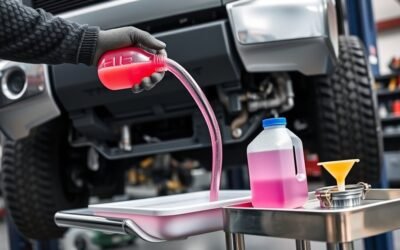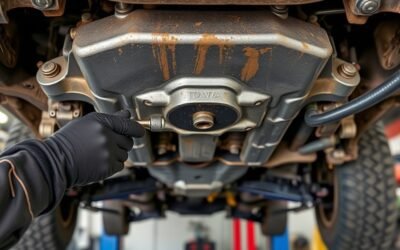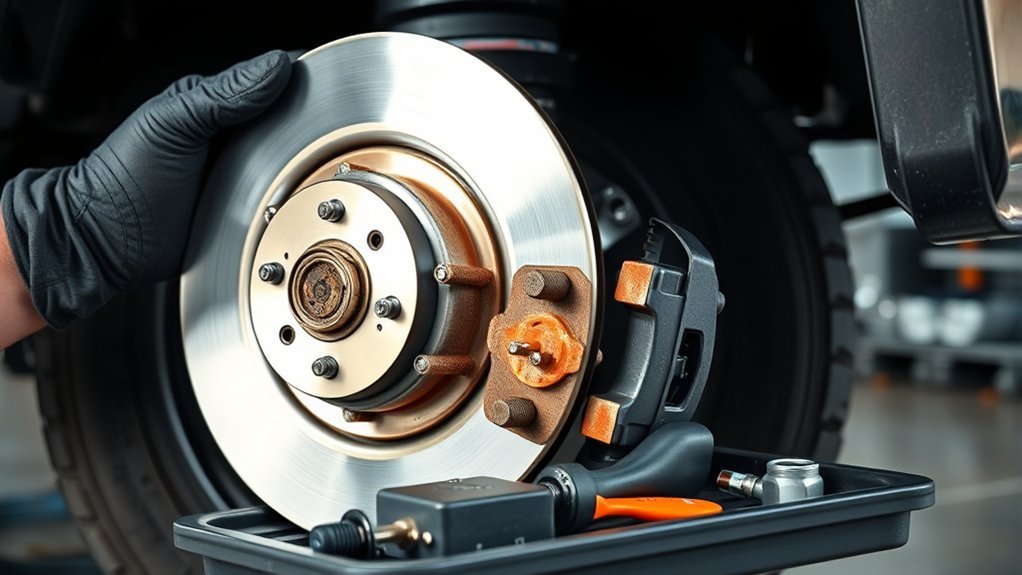
You’ll start by gathering 12 mm and 18 mm sockets, a breaker bar, wood clamps and gloves, then safely support the Tundra on stands and break lug nuts loose. Loosen the 18 mm caliper bolts, remove the 12 mm brake‑line holder, hang the caliper, then tap off a stuck rotor. Compress pistons, install pads with proper spring and pin orientation, torque bolts to spec, check lines and fluid, and bed the pads with controlled stops—keep going for full step‑by‑step details.
Pre-Checks & Tools for Tundra Brake Pad and Rotor Jobs
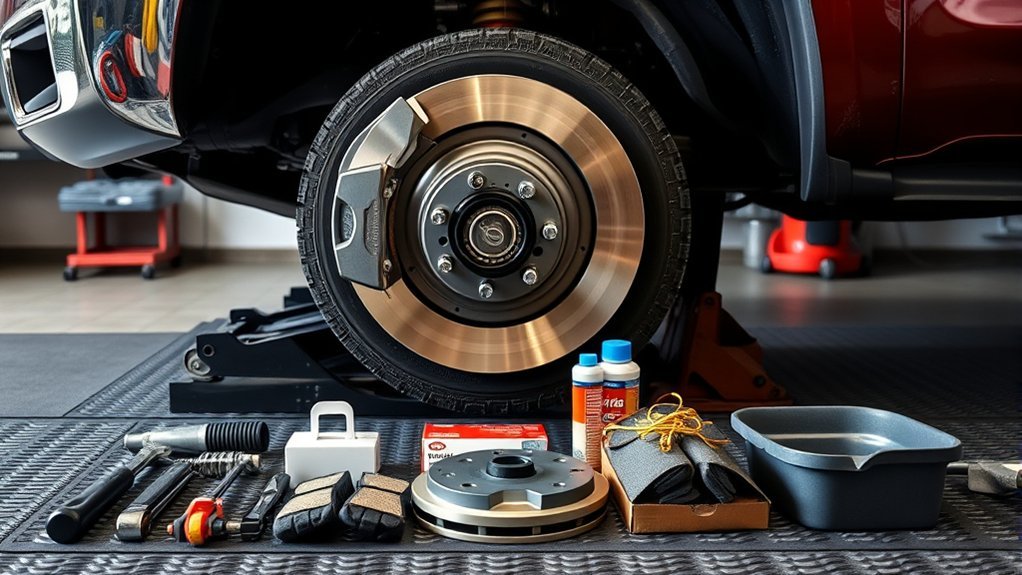
Before you lift the Tundra, gather the required tools: 12 mm and 18 mm sockets, a breaker bar, wood clamps and gloves, and verify you can turn the steering wheel away from the work side for better access to the caliper and rotor. You’ll loosen the two 18 mm caliper bolts with the breaker bar and remove the 12 mm brake-line bolt at the A-arm so the caliper can rotate freely; these steps free the assembly for pad and rotor work. Inspect brake pad materials—organic, semi-metallic, or ceramic—for wear pattern and compatibility with rotor types you plan to install. Confirm rotor surface finish and thickness match manufacturer specs and service limits. Clamp placement should protect lines and sway components while you work. Note torque values for reinstallation and ascertain the brake line and caliper are securely reattached after service. Proceed only when clearances, tool readiness, and part compatibility are confirmed.
Safely Remove Wheel, Caliper, and Rotor (Common Stuck Parts)
Raise and securely support the Tundra on jack stands, turn the steering wheel toward the work side for access, then break loose the wheel lug nuts and remove the wheel. Perform wheel removal deliberately: verify jack stands solid, use a cross pattern to remove lug nuts, and set the wheel aside. You’re creating space to act with authority.
Access the caliper; use a breaker bar on the 18 mm caliper bolts to overcome factory torque. Don’t rush—steady force preserves hardware. Hang the caliper with a bracket or strap; don’t let it dangle by the brake line. When reattaching later, torque and secure the 12 mm brake-line bolt to prevent leaks.
Address rotor issues methodically: if the rotor’s stuck, tap gently between the lug openings with a hammer to break corrosion—avoid striking the braking surface. Once freed, lift the rotor straight off the hub. Organize removed parts for inspection and replacement; liberation comes from controlled, confident technique.
Install New Tundra Brake Pads: Compress Pistons, Springs, and Pins
Compress the caliper pistons fully with a wood clamp so the new pads will seat without binding; position the clamp squarely on the piston face and tighten evenly until the piston is flush with the caliper bore. You’ll use piston compression to create clearance for the new pads; do this slowly and monitor brake fluid level to avoid overflow. With pistons retracted, confirm pad orientation by matching the new pads to the removed ones—leading and trailing edges must align with caliper and rotor direction. Lubricate pad corners where pins slide to reduce friction and noise. Slide pads into the bracket, observing spring clip position and ensuring the spring tension faces outward as removed. Insert pins through pads and clips, pushing them fully home; secure metal retaining clip in its designated holes to lock assembly. Check that springs sit flush and pins rotate freely within their lubricated channels. You’re reclaiming control—precise placement prevents drag and restores confident stopping.
Reassembly, Torque Specs, and Reinstalling the Brake-Line Holder
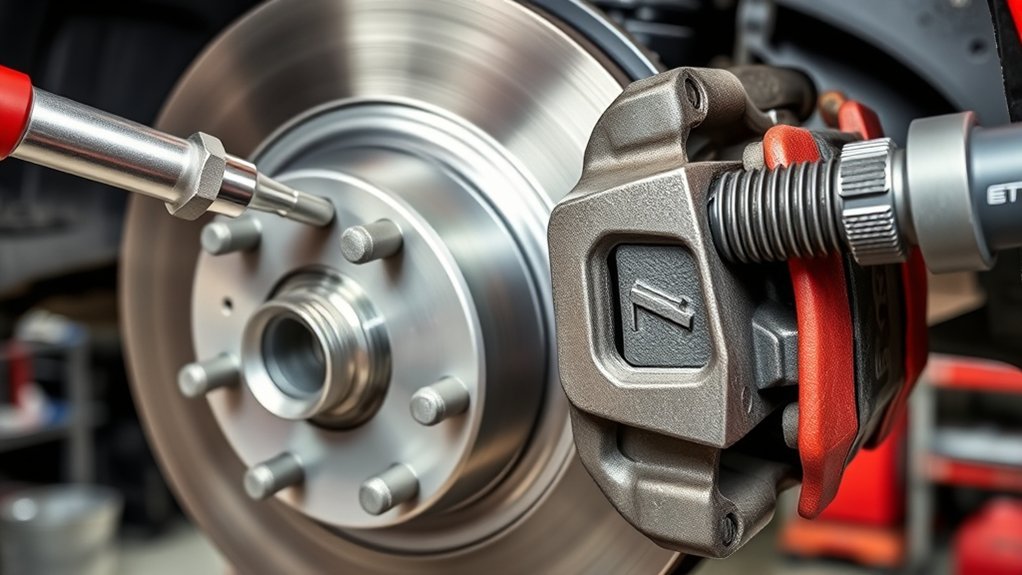
Reinstall the caliper assembly over the new pads, align it with the mounting bracket, and hand-thread the two 18 mm caliper bolts before snugging them to the manufacturer’s torque spec with a torque wrench; then reinsert the 12 mm brake-line holder bolt and snug it with a ratchet to secure the line. Verify caliper alignment visually and by feel, ensuring the piston faces the pad squarely and the carrier sits flush. Tighten both 18 mm bolts to spec to prevent movement under load. Confirm the brake line routing is free of twist and tension; the holder must stop any contact with suspension components.
Reinstall and torque caliper bolts, secure the brake-line holder, and confirm alignment and routing before final torque check
- Torque both 18 mm caliper bolts to manufacturer specification using a calibrated torque wrench.
- Reinsert and snug the 12 mm brake-line holder bolt with a ratchet; confirm no play.
- Inspect caliper alignment and pad orientation; correct any offset immediately.
- Verify brake line routing and holder security to eliminate stress during operation.
Finish with a final bolt-to-spec check to secure freedom from preventable failure.
Bedding New Pads, Post-Install Safety Checks, and Troubleshooting
Begin by bedding the new pads with controlled stops: perform repeated decelerations from about 30 to 10 mph without fully stopping to transfer an even layer of pad material onto the rotor, then allow several cool-down stops between cycles. Follow a systematic bedding procedure: vary speed and pressure, avoid full stops, and complete multiple cycles until feel and fade stabilize. After parking, perform post-install safety checks: verify all fasteners — caliper, bracket, and brake-line holder — are torqued to spec and clips are seated. Inspect brake fluid level and reservoir cap; compressing pistons can raise fluid and risk overflow or contamination, so siphon if necessary and top with specified fluid. If you detect abnormal noises, vibration, or uneven bite, recheck pad orientation, caliper alignment, and hardware torque. Drive gently for the first 200–300 miles, avoiding heavy braking to allow full break-in. Document torque values and observations; act immediately on any persistent anomalies to preserve safety and control.
Frequently Asked Questions
Can I Reuse Old Rotors if They Look Thin but Not Warped?
You can reuse old rotors only if rotor thickness meets minimum spec and surface is uniform; measure thickness, consider resurfacing options if marginal, and replace if below spec or near limits to reclaim safe, liberated braking performance.
What Brake Pad Material Is Best for Towing and Heavy Loads?
You’ll want metallic or semi-metallic pads—they’re built like tanks for towing performance and heavy duty options. Choose high-friction, heat-resistant compounds, follow break-in procedures, monitor wear, and torque to spec for consistent, liberated stopping power.
How Often Should I Replace Brake Fluid After Pad/Rotor Changes?
You should replace brake fluid every 1–2 years after pad/rotor changes. Specify brake fluid types (DOT3, DOT4, DOT5.1), document fluid change frequency, bleed system, and use proper disposal to reclaim control and safety.
Can ABS or Traction Control Codes Appear After This Service?
Yes — you can get ABS or traction control codes after service. Check wheel speed sensors, wiring, and connector cleanliness; perform ABS troubleshooting steps, clear codes, test drive, and recalibrate systems so you regain confident, liberated control.
Are There Specialty Tools for Removing Seized Caliper Guide Pins?
Yes — you can use caliper tools and specialized pullers to free seized pins; heat, penetrating oil, slide-hammer adapters, and guide-pin extractors help. You’ll reclaim control by applying measured force and corrosion-breaking technique.
Conclusion
You’ve finished reassembling the Tundra’s braking system; think of it like tuning a drum — every bolt, pad, and rotor must hit the right note. Run through the checklist: torque specs, brake-line holder, bleed if needed, and a careful test drive with progressive stops. Bedding the pads properly and rechecking fasteners seals the job. If anything feels off, stop, inspect, and troubleshoot before normal driving — safety’s the final torque.