Reviewed for accuracy · Last updated: August 17, 2026
How this guide was checked: The diagnostic order and safety limits were checked against Toyota owner and service-information resources and current U.S. EPA rules for motor-vehicle A/C servicing. This guide does not claim hands-on testing across every Tundra generation.
If your Toyota Tundra AC is not cold, first identify the model year and powertrain, then separate weak airflow from a refrigeration or electrical-control fault. Check the climate settings, airflow, condenser area, and symptom pattern before adding refrigerant or replacing a compressor. On clutch-equipped non-hybrid trucks, continue with the correct fuse, MG CLT relay, clutch command, wiring, and pressure checks. A 2022-or-newer i-FORCE MAX hybrid uses an electric compressor, so clutch-click and jumper-wire tests do not apply. This guide covers a Tundra A/C that runs but stays warm; if the compressor never engages under any setting, start with the Tundra A/C compressor not engaging guide instead.
Quick Answer
A Toyota Tundra AC usually blows warm because of low refrigerant from a leak, restricted cabin airflow, poor condenser airflow, an electrical-control fault, a blend-door problem, or a failed compressor. Start with the model year, hybrid status, airflow, and symptom pattern. Test the MG CLT relay and magnetic clutch only on a clutch-equipped non-hybrid system; leave i-FORCE MAX electric-compressor diagnosis to a hybrid-qualified technician.
Key Takeaways
- Identify the model year and powertrain first. Clutch and MG CLT relay tests do not apply to the high-voltage electric compressor used by the 2022-and-newer i-FORCE MAX hybrid.
- Warm air does not automatically mean a bad compressor; low refrigerant, airflow problems, fuses, relays, sensors, and blend doors can create similar symptoms.
- Do not use a universal clutch-coil resistance number. Fuse names, relay layouts, refrigerant type, pressure targets, and electrical specifications vary by system.
- If refrigerant is low, find the leak before recharging. A top-off can hide the fault or overcharge the system.
- DIY checks are best for controls, filters if equipped, visual inspections, fuses, relays, and basic voltage testing. Refrigerant and high-voltage hybrid work are pro-level jobs.
At a Glance
| Time Required | 15–45 minutes for basic checks; longer for scan-tool, pressure, or repair work |
| Difficulty | Easy for controls, airflow, and fuses; moderate to advanced for electrical and pressure diagnosis |
| Tools Needed | Flashlight, gloves, thermometer, multimeter, fuse puller, scan tool as needed, and service information for the exact model year |
| Cost | $0–$80 for common visual and basic electrical checks; RepairPal currently estimates Tundra compressor replacement at $854–$1,089 before taxes, fees, location differences, and related repairs |
Which Tundra AC System Do You Have?
Use the powertrain split below before testing a clutch or relay. The under-hood A/C label, VIN-based parts lookup, owner manual, and Toyota service information are the final authority for your truck.
| Tundra Version | Compressor Drive | Correct Diagnostic Branch |
|---|---|---|
| 2000–2021 models | Generally belt-driven with a magnetic clutch | Verify the exact fuse, relay, clutch command, wiring, and pressure specifications for the model year |
| 2022+ i-FORCE non-hybrid | Belt-driven compressor with a magnetic-clutch system | Use the non-hybrid electrical and clutch branch after checking airflow, codes, and pressure inputs |
| 2022+ i-FORCE MAX hybrid | Electric compressor powered through the hybrid high-voltage system | Do not perform clutch, MG CLT relay, jumper-wire, or resistance tests; use hybrid-safe scan and service procedures |
Hybrid Warning: The i-FORCE MAX electric compressor is a high-voltage component. Do not probe, unplug, power, or resistance-test it with ordinary clutch procedures.
Quick Checklist: Tundra AC Not Cold
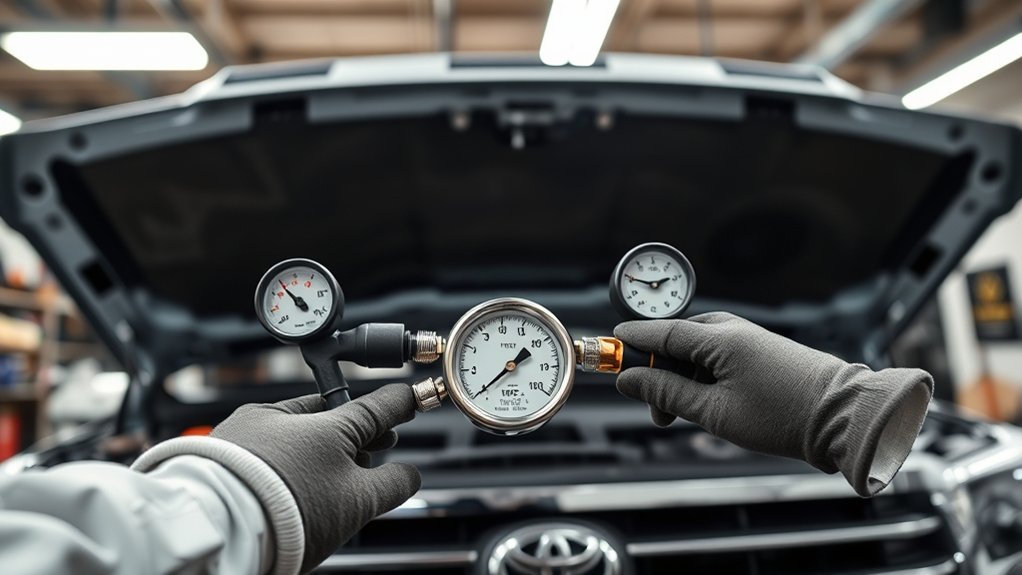
Use this checklist before you spend money on a compressor. The goal is to separate an airflow problem from a refrigeration problem, an electrical-control problem, and a high-voltage hybrid fault.
- Identify the truck. Record the model year, engine, and whether it is an i-FORCE MAX hybrid. Check the under-hood A/C label before selecting refrigerant tools or procedures.
- Confirm the symptom. Set the temperature to LO or maximum cold, turn A/C on, select recirculation, set both zones the same, and compare center-vent temperature at idle and while driving.
- Check airflow. Inspect the cabin filter if the truck has a serviceable filter (see the Tundra cabin air filter replacement guide), confirm every blower speed, and check the intake and vents for blockage.
- Compare the pattern. Note whether one side is warmer, cooling improves above 30–40 mph, the A/C indicator blinks, or the system cycles cold-to-warm.
- Inspect condenser airflow. Look for leaves, mud, bent fins, and fan or fan-clutch problems. The cooling-fan design varies by generation and powertrain.
- Choose the correct compressor branch. On a clutch-equipped non-hybrid, verify clutch command, fuses, relay, and wiring. On an i-FORCE MAX hybrid, stop before electrical compressor testing and use a hybrid-qualified technician.
- Verify pressures and leaks. Read low-side and high-side pressure together with the correct equipment. Low refrigerant usually means a leak; overcharge can also reduce cooling and raise pressure.
Note: Exact fuse labels, relay location, refrigerant type, pressure targets, clutch-resistance specs, and high-voltage procedures vary by model year, market, and powertrain. Use the under-hood A/C label and Toyota service information for the final specification.
What Does Your Tundra AC Symptom Point To?
The symptom pattern usually tells you which branch to test first. Do not condemn a blend-door actuator or compressor from one vent reading alone because low charge, airflow, and control faults can overlap.
| Symptom | Likely Area | First Check |
|---|---|---|
| Weak airflow from all vents | Cabin filter if equipped, blower, blocked intake, evaporator restriction | Confirm all blower speeds and inspect the filter or intake path |
| Driver side cold, passenger side warm | Zone setting, air-mix door/servo, or uneven evaporator cooling from a charge problem | Turn SYNC on, command both zones from full cold to full hot, then compare outlet temperatures. A repeated clicking or knocking sound from behind the dash when you adjust temperature points to a blend-door actuator rather than a charge problem. |
| Cold while driving, warm at idle | Condenser airflow, fan or fan clutch, refrigerant charge, high-side pressure | Inspect condenser cleanliness and verify the model-specific cooling-fan operation |
| A/C light blinks or cooling cuts out | Stored A/C fault, compressor-lock input, clutch/relay fault on non-hybrid, pressure or control fault | Scan the A/C and engine modules before bypassing a relay or powering a compressor |
| Warm all the time with normal airflow | Refrigerant, compressor command, pressure sensor, electrical supply, or compressor performance | Choose the non-hybrid clutch branch or hybrid electric-compressor branch, then verify pressures |
Pro Tip: Record outside temperature, center-vent temperature, left-to-right vent difference, idle behavior, road-speed behavior, and A/C indicator status. A repeatable pattern is more useful than saying the air “isn’t very cold.”
How Do You Check the Fuse, Relay, and Clutch Command?
This section applies only to a clutch-equipped non-hybrid Tundra. For a deeper no-engagement workflow, see the Tundra A/C compressor not engaging troubleshooting guide. Do not use these steps on an i-FORCE MAX electric compressor.
- Scan before bypassing. Save A/C, engine, and body-system codes and review live pressure or compressor-command data if your scan tool supports it. See the Tundra OBD2 codes guide for how to read and interpret stored codes.
- Verify the correct fuse and relay. Do not assume every Tundra uses the same fuse name, relay location, or rating. Check the fuse-box cover and year-specific service information.
- Check fuse continuity and power. A good fuse should show continuity and power on the appropriate side of the circuit. If a replacement fuse opens again, isolate the short instead of installing another fuse.
- Test the MG CLT relay by its pinout. Use the relay diagram and a controlled power source. Confirm that the coil switches the contact circuit rather than swapping relays blindly.
- Check feed voltage and control command. If feed power is present but the relay is not commanded, investigate pressure inputs, A/C amplifier or control-module logic, wiring, and stored codes.
- Inspect the compressor harness. Look for rubbed insulation, oil contamination, corrosion, loose pins, heat damage, or a harness that changes when the engine moves.
Warning: Keep hands, wires, jewelry, and tools away from belts and fans while the engine is running. Use a fused jumper only when the exact Toyota procedure calls for it. Never bypass pressure or hybrid safety controls as a driving fix.
[Products Worth Considering]

EPAuto CP134 is a premium cabin air filter designed to help keep the air inside your vehicle cleaner and fresher. It includes activated carbon to help reduce odors and support a more comfortable ride for drivers and passengers. Built as a replacement option for many Honda and Acura models, it offers broad compatibility and dependable cabin air filtration.
These MOTIUM windshield wiper blades deliver clear, streak-free wiping for improved visibility in rain, snow, and extreme heat. Designed for quiet, smooth operation and easy installation, they include both driver and passenger blades for a quick replacement solution that helps keep driving safer in all seasons.

Armor All Multi-Purpose Car Cleaner Spray delivers an all-in-one clean for interior surfaces, helping restore that just-detailed look throughout your vehicle. It is designed for dashboards, vinyl, fabric, carpet, clear plastic, and consoles, and it helps remove tough dirt, dust, grime, and stubborn stains while providing odor control. Scientifically engineered for automotive surfaces, this cleaner helps refresh your car interior without drying out or damaging delicate materials.
How Do You Interpret Compressor and Clutch Test Results?
Use the results as a diagnostic branch, not as permission to replace the most expensive part. The clutch-coil rows below apply only to clutch-equipped non-hybrid systems.
| Test Result | Most Likely Meaning | Next Step |
|---|---|---|
| Fuse blows again immediately | Shorted circuit, relay, clutch coil, or compressor harness | Disconnect sections of the circuit and isolate the short before replacing parts |
| Relay has no feed power | Fuse, power supply, junction block, or wiring issue | Trace the supply with the correct wiring diagram |
| Relay has power but no control command | Pressure input, control module, A/C amplifier, temperature input, stored fault, or wiring issue | Review codes, live data, and control logic before replacing the relay or compressor |
| Clutch coil reads near 0 Ω | Possible shorted coil or meter/lead error | Zero the meter leads, compare with the exact Toyota specification, and inspect the harness |
| Clutch coil reads OL/infinite | Open coil, disconnected terminal, or broken wire | Inspect the connector and confirm the open circuit before replacing the clutch or compressor assembly |
| Clutch engages but pressures are wrong | Charge error, leak, restriction, condenser airflow, expansion valve, or weak compressor | Use low-side and high-side readings plus leak diagnosis before replacing the compressor |
| i-FORCE MAX hybrid compressor does not run | High-voltage supply, inverter/control command, pressure input, wiring, or electric-compressor fault | Stop DIY electrical testing and use a hybrid-qualified technician with Toyota service information |
Do not treat 1.1 Ω as a universal healthy clutch-coil reading. A near-zero or infinite reading can be useful only after you account for meter-lead resistance, connector condition, the exact compressor design, and the model-year Toyota specification. As general background, the Mobile Air Conditioning Society (MACS) notes that most 12-volt automotive clutch coils fall in roughly the 2–5 Ω range, with readings outside that band typically flagged as suspect. That is industry-wide guidance, not a Tundra-specific number — confirm against Toyota service information for your exact compressor.
A strong diagnosis makes the powertrain, control command, electrical result, pressure pattern, and physical compressor behavior agree before any major part is replaced.
[Products Worth Considering]

This heavy-duty cargo net helps keep truck bed loads secure and organized during transport. Its expandable bungee mesh design offers flexible coverage for a range of cargo sizes, while the included metal carabiners make installation quick and dependable. Built for pickup owners who need reliable load containment, it is suitable for many popular truck models.

This plug-and-play OBD2 scanner helps drivers quickly read and clear engine error codes while providing live data, freeze frame information, I/M readiness, and MIL status for more confident troubleshooting. It adds a built-in voltage test and clear status indicators to support electrical checks and faster diagnostics, making it a practical choice for home users, car enthusiasts, and repair professionals. Compatible with most OBDII vehicles since 1996 and designed with an easy-to-use interface, it offers broad coverage and simple operation in one compact tool.
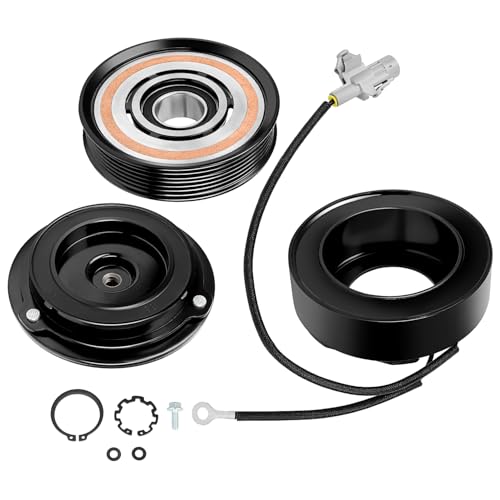
AC Compressor Clutch Fitment: for Toyota for Tundra 4.7L 2000 2001 2002 2003 2004 2005 2006
How Do You Check Refrigerant Pressure and Leaks?
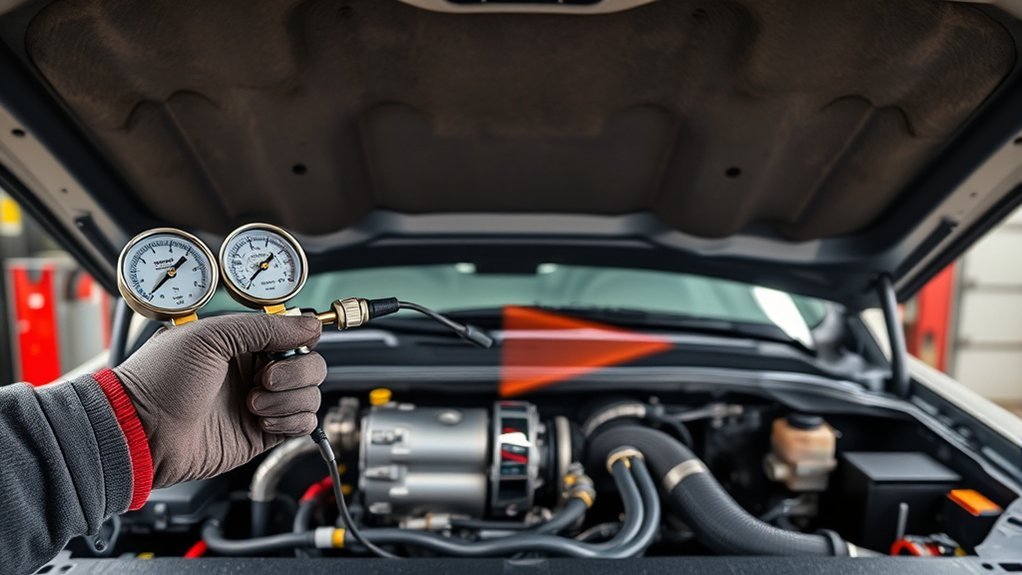
If airflow is strong but the vents stay warm, pressure and leak diagnosis can separate low charge, overcharge, restriction, condenser trouble, and weak compressor performance. Low refrigerant may prevent compressor operation, cause rapid cycling, or make one side of the cabin warmer than the other. Uneven vent temperatures alone do not prove a blend-door failure.
Check the A/C label under the hood before connecting equipment. Tundras use different refrigerants across model years and powertrains: many Tundras built from around the 2018 model year onward use R-1234yf rather than R-134a, though the exact changeover year for your specific truck should be confirmed on the under-hood label rather than assumed from the model year alone. “ Never mix R-134a and R-1234yf, and do not assume a parts-store recharge kit matches the truck.
Warning: Intentional refrigerant venting is prohibited. Anyone servicing a motor-vehicle A/C system for payment or barter must be Section 609 certified and use approved handling equipment. Refrigerant can also cause frostbite or eye injury.
Read low-side and high-side pressure together and compare the pattern with the model-specific service procedure and ambient conditions. A single low-side gauge can be misleading. Look for oily residue at hose crimps, condenser seams, compressor seals, service ports, and the evaporator drain. If the system is low, locate and repair the leak, evacuate the system, and recharge by the specified weight.
Repair Choices, Costs, and When to Replace
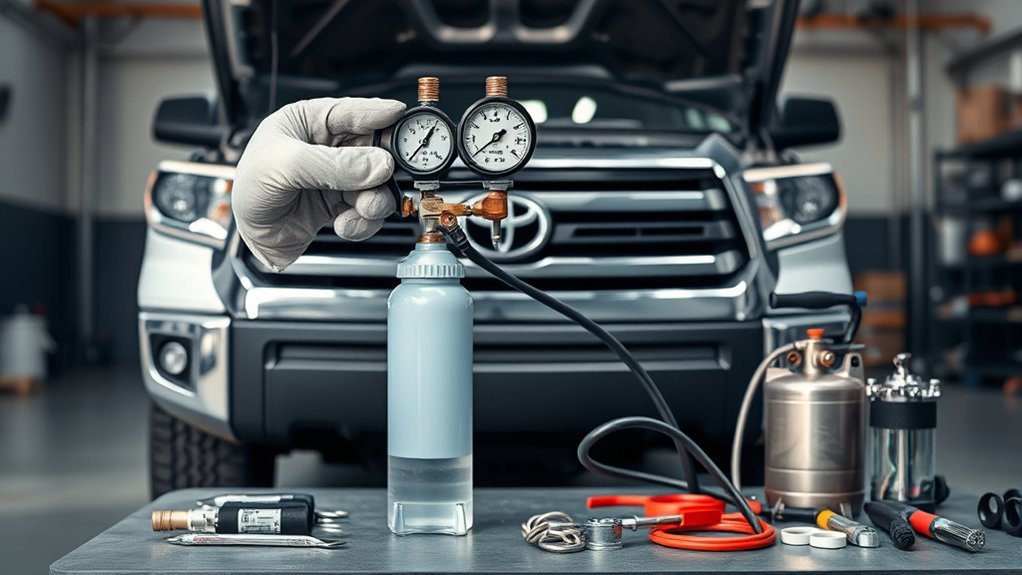
Choose the repair from confirmed test results. A fuse fault, relay fault, refrigerant leak, clutch failure, electric-compressor fault, and worn mechanical compressor can all produce warm air, but they require different parts, tools, and safety procedures.
| Repair Path | When It Makes Sense | Cost Notes |
|---|---|---|
| Fuse or relay replacement | The fuse failed once or the relay fails its specified test, and no deeper short remains | Usually the least expensive path; repeated fuse failure means the circuit still has a fault |
| Leak repair and recharge | Pressure or recovery data confirms low charge and the leak location is found | Cost depends on the leak location, refrigerant type, recovery, evacuation, and charge amount |
| Magnetic clutch replacement | A clutch-equipped non-hybrid has a confirmed clutch fault, the compressor is mechanically healthy, and the clutch is serviceable separately | May save money, but labor overlap can make a complete compressor assembly more practical |
| Mechanical compressor assembly | The compressor is noisy, seized, internally damaged, contaminated, or fails a confirmed performance test | RepairPal currently estimates Toyota Tundra compressor replacement at $854–$1,089 across the model range, though its year-specific estimates vary more — for example, roughly $817–$903 for a 2022 model versus $1,118–$1,616 for some 2011 trucks — before taxes, fees, location, and related repairs |
| Hybrid electric-compressor service | A 2022+ i-FORCE MAX has confirmed high-voltage compressor, control, or isolation trouble | Requires hybrid-safe procedures and may fall outside general estimator ranges |
Ask the shop to show the result that justifies the repair: stored codes, compressor-command data, pressure readings, relay or circuit tests, leak-test results, and evidence of contamination. If a mechanical compressor failed internally, the repair plan may also include the receiver/drier, expansion device, condenser, or approved line-cleaning procedures.
[Products Worth Considering]

[Vehicle Fitment] Compatible with Toyota Tundra 2010-2019 V8 4.6L, Toyota Tundra 2007-2021 V8 5.7L. Check fitment via Amazon Garage to avoid mismatches before purchase.

Vehicle Compatibility: This AC compressor compatible with 2007-2021 Toyota Tundra 5.7 5.7L, for 2010-2019 Toyota Tundra 4.6 4.6L 10 11 12 13 14 15 16 17 18 19

Vehicle Compatibility: This air conditioner compressor with clutch fits for Toyota Tundra 2010-2019 V8 4.6L, for Tundra 2007-2021 V8 5.7L
Which Tundra AC Checks Are Safe to DIY?
You can handle simple checks if you are comfortable around a running engine and basic electrical circuits. Confirming settings, inspecting airflow, checking a serviceable cabin filter, looking for condenser blockage, inspecting fuses, and checking accessible connectors are reasonable starting points.
Move carefully once the diagnosis involves refrigerant, high-side pressure, compressor removal, direct clutch power, module communication, or a hybrid electric compressor. Motor-vehicle A/C systems are sealed and pressure-controlled. Wrong refrigerant, overcharging, venting, bypassing safety inputs, or using non-hybrid tests on a hybrid compressor can damage components and create safety or legal problems.
- DIY-friendly: control settings, symptom logging, filter inspection if equipped, visual condenser inspection, fuse inspection, and connector inspection.
- Advanced DIY only: voltage testing at known non-hybrid relay terminals, clutch-coil resistance checks, scan-tool data review, and manifold-gauge interpretation.
- Best left to a pro: refrigerant recovery, evacuation, recharge by weight, leak repair, compressor replacement, system decontamination, complex module diagnosis, and all high-voltage i-FORCE MAX compressor work.
Note: A documented diagnosis is often cheaper than replacing parts one at a time. Ask for the codes, readings, and test results, not only the final recommendation.
Frequently Asked Questions
Why is my Toyota Tundra AC not blowing cold?
Common causes include low refrigerant from a leak, weak or blocked airflow, poor condenser airflow, a compressor-control fault, a failed clutch on a non-hybrid, an electric-compressor fault on an i-FORCE MAX hybrid, a pressure-sensor issue, or a blend-door problem. Start with the model year, powertrain, airflow, and symptom pattern.
How much does it cost to repair the AC in a Toyota Tundra?
A filter, fuse, or relay can be inexpensive. Leak repair, evacuation, and recharge cost more. RepairPal currently estimates Toyota Tundra compressor replacement at $854–$1,089 before taxes, fees, location differences, and related repairs. Hybrid electric-compressor work and contamination repairs may cost more.
Can I just add refrigerant if my Tundra AC is warm?
Not as a first step. Low refrigerant usually points to a leak. Adding refrigerant without checking the leak, system type, and charge weight can temporarily hide the problem or overcharge the system. Verify the refrigerant on the under-hood label.
What fuse or relay should I check for a Toyota Tundra AC clutch?
On a clutch-equipped non-hybrid, check the fuse-box cover and Toyota service information for the exact year. Many systems use an MG CLT magnetic-clutch relay, but names, locations, pinouts, and fuse ratings vary. This test does not apply to the i-FORCE MAX electric compressor.
Does a 1.1-ohm clutch reading mean the AC clutch is good?
No. Do not use 1.1 ohms as a universal pass/fail number. Account for meter-lead resistance and connector condition, then compare the reading with Toyota service information for that exact compressor and model year.
Why does my Tundra AC blow cold while driving but warm at idle?
That pattern often points to poor condenser airflow or a pressure problem. Check the condenser for blockage, verify the model-specific fan or fan-clutch operation, and evaluate refrigerant charge and high-side pressure. Road speed may be supplying the airflow the system lacks at idle.
Why is one side of my Tundra AC warmer than the other?
On dual-zone trucks, this usually points to the zone setting or a blend-door actuator rather than the compressor. Turn SYNC on and command both zones from full cold to full hot; if one side lags or won’t change, listen for a clicking or knocking sound behind the dash when you adjust the setting, which is a common blend-door actuator symptom. Low refrigerant charge can also cause uneven cooling, so confirm pressures if the actuator tests normal.
Why is the A/C light blinking on my Toyota Tundra?
A blinking A/C indicator can mean the control system detected a compressor, lock-sensor, relay, pressure, wiring, or amplifier fault. Save the A/C and engine-system codes before clearing anything. Do not assume the relay is bad or bypass the circuit without the model-specific procedure.
Does the 2022+ Tundra i-FORCE MAX have an AC compressor clutch?
No. The i-FORCE MAX hybrid uses an electric compressor powered through the hybrid high-voltage system. Magnetic-clutch clicks, MG CLT relay swaps, fused jumpers, and ordinary clutch-coil resistance tests are not the correct diagnostic path.
Conclusion
A Toyota Tundra AC that blows warm needs a symptom-led diagnosis, not random parts replacement. Identify the model year and powertrain first. Then check controls, airflow, the filter if equipped, condenser condition, left-to-right temperature difference, idle versus road-speed behavior, and stored codes. Use fuse, MG CLT relay, clutch-command, and clutch-coil tests only on a clutch-equipped non-hybrid. If the truck is an i-FORCE MAX hybrid, or the repair requires refrigerant recovery, high-side pressure work, leak repair, or compressor replacement, use a qualified technician.
Sources
- Toyota Owners Manuals and Warranties — official model-year owner-manual lookup.
- Toyota Technical Information System — official Toyota repair manuals, wiring diagrams, diagnostic procedures, and specifications.
- Toyota: Troubleshooting Common Car AC Issues — manufacturer overview of common low-cooling causes.
- U.S. EPA Regulatory Requirements for MVAC System Servicing — venting, recovery-equipment, and servicing rules.
- U.S. EPA Section 609 Technician Training and Certification Programs — certification rules for compensated MVAC service.
- RepairPal Toyota Tundra AC Compressor Replacement Cost Estimate — current general estimate and year-by-year ranges.
- MACS: Facts to Know About the Compressor Clutch Coil — general industry clutch-coil resistance guidance.