Your Toyota Tundra’s transmission fluid interval depends on the truck’s model year, transmission, mileage, and workload. For normal driving, Toyota typically calls for inspection at the scheduled maintenance intervals, not automatic replacement at every 30,000 miles. If you tow, haul heavy loads, use a car-top carrier, drive off-road, or see signs of fluid breakdown, service the fluid sooner and follow the maintenance guide for your exact VIN.
Quick Answer
For many Toyota Tundras, normal-use maintenance means inspecting the automatic transmission fluid at Toyota’s listed intervals. If you regularly tow, haul heavy loads, or drive under severe conditions, Toyota’s schedule can call for ATF replacement around 60,000 miles. Always verify the exact interval in your model-year maintenance guide.
Key Takeaways
- Do not treat one mileage number as universal. A 2007–2021 Tundra and a 2022+ Tundra may have different procedures and schedules.
- For normal use, Toyota commonly lists ATF inspection, while towing, car-top carrier use, or heavy loading can move the truck into a replacement schedule.
- A drain-and-fill is a partial fluid replacement. It does not replace 80–90% of the total transmission fluid.
- Sealed Toyota transmissions require the correct fluid temperature and overflow-level procedure. Guessing the level can damage the transmission.
- Use the ATF type specified for your truck, commonly Toyota Genuine ATF WS on many models, and recycle used fluid properly.
At a Glance
| Time Required | About 1–2 hours for an experienced DIY drain-and-fill; longer if you are verifying the factory procedure |
| Difficulty | Moderate to advanced because the fluid level is temperature-sensitive on sealed transmissions |
| Tools Needed | Level lift or safe stands, drain pan, socket set, torque wrench, fluid pump, scan tool or temperature-reading method, new gaskets/crush washers |
| Cost | DIY cost varies by ATF quantity and parts; dealer or shop pricing varies by location and model year |
When to Change Tundra Transmission Fluid
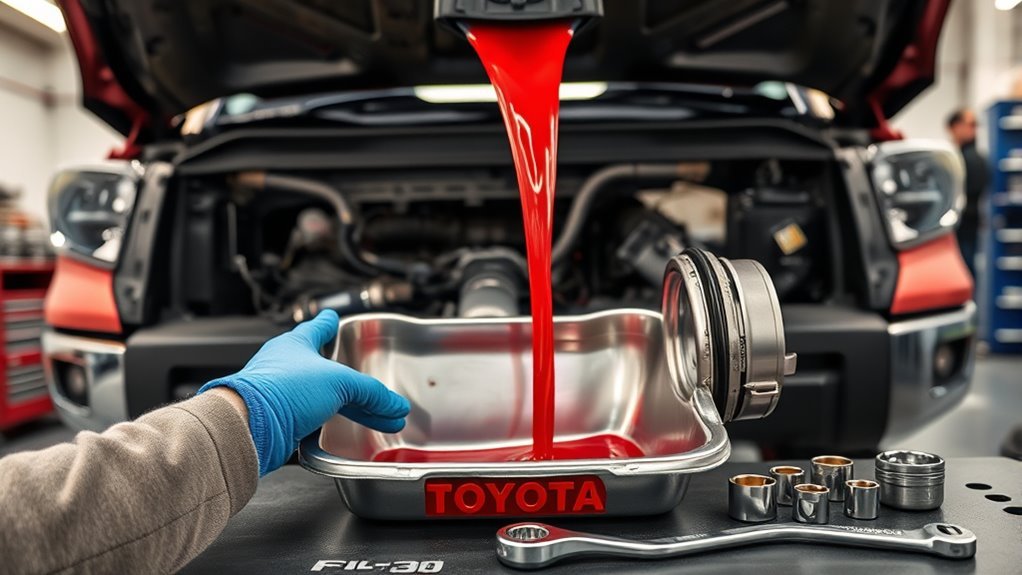
If your Tundra is used mostly for commuting, highway driving, and light hauling, start with the official Toyota maintenance schedule for your exact year. Many current Toyota guides call for automatic transmission fluid inspection at scheduled intervals under normal use. If the truck is regularly used for towing, heavy vehicle loading, or similar severe service, Toyota’s maintenance chart can call for automatic transmission fluid replacement at about 60,000 miles.
The simplest rule is this: inspect by the book, replace sooner when the truck works harder, and never ignore signs of fluid breakdown. Dark fluid, a burnt odor, visible debris, delayed engagement, slipping, harsh shifts, overheating, or a transmission leak should move service from “scheduled maintenance” to “diagnosis now.”
| Driving Pattern | Practical ATF Plan | Why It Matters |
|---|---|---|
| Mostly normal driving | Follow Toyota’s inspection intervals for your model year; replace only if inspection shows a problem or your guide calls for it. | Normal-use WS ATF is designed for long service life, but leaks and contamination still matter. |
| Mixed use, hills, heat, frequent short trips | Inspect more carefully and consider a conservative drain-and-fill if fluid condition, temperature history, or service history is questionable. | Heat and repeated stop-and-go use can accelerate fluid aging. |
| Regular towing or heavy loading | Use the severe-service schedule in your Toyota maintenance guide; many current schedules list ATF replacement around 60,000 miles for these conditions. | Towing raises transmission temperature and load. |
| Unknown history or high mileage | Inspect first. If fluid is badly burnt, black, or full of debris, get a professional diagnosis before a full exchange. | A neglected transmission may need diagnosis, not just fresh fluid. |
Note: Toyota maintenance schedules are model-year specific. Before buying fluid or opening the transmission, confirm the required ATF, service interval, and level-check procedure in your Toyota Warranty & Maintenance Guide or through Toyota’s owner manual portal.
What Toyota Means by “Lifetime” ATF and Why It Matters
“Lifetime” transmission fluid does not mean the fluid is magic or that the transmission can be ignored forever. It usually means the fluid is designed for a long service life under normal operating conditions. Toyota also separates normal maintenance from special operating conditions, such as towing a trailer, using a car-top carrier, or heavy vehicle loading.
That difference matters because many Tundra owners do not use the truck like a light-duty car. A Tundra that tows a camper, hauls equipment, idles in heat, climbs grades, or spends time off-road puts more heat and load into the transmission. In those cases, the severe-service schedule is more relevant than the normal-use schedule.
| Common Claim | Better Interpretation |
|---|---|
| “Lifetime ATF never needs service.” | It may not need routine replacement under normal use, but inspection, leaks, severe service, and fluid condition still matter. |
| “No dipstick means no maintenance.” | No dipstick means the check is more controlled and temperature-sensitive, not that the fluid is impossible to inspect. |
| “A flush is always better than a drain-and-fill.” | Not always. A drain-and-fill is usually the safer routine service; a full exchange should be chosen carefully based on history and condition. |
Which Interval Fits You: Light Use, Mixed, or Towing?
Choose the interval based on how the truck is used, not on a single forum rule. Toyota’s current guidance separates normal scheduled service from special operating conditions. Your owner’s maintenance guide is the final authority, especially if your truck is newer, hybrid, four-wheel drive, or used commercially.
Light-Duty Daily Driving
For a Tundra used mostly for normal commuting and light highway driving, do not automatically assume the transmission fluid must be changed at 30,000 or 60,000 miles. The better approach is to follow the Toyota maintenance guide’s inspection schedule for your model year and replace the fluid only if the inspection, fluid condition, leak check, or service history justifies it.
Keep a record of each inspection. If the transmission shifts normally, shows no leaks, and the maintenance guide calls only for inspection, you can avoid unnecessary service while still protecting the truck.
Mixed Use Balance
Mixed use includes city traffic, hot weather, hills, weekend hauling, light off-road driving, and occasional towing. This is where a conservative owner may choose a drain-and-fill earlier than the normal schedule, especially if the truck has unknown service history or the ATF shows signs of heat stress.
Do not rely on color alone. A little darkening can happen with age, but a burnt smell, black fluid, visible grit, or shift problems should prompt diagnosis. A scan tool or gauge that can show transmission temperature is also useful if you tow or climb long grades.
Regular Heavy Towing
If you regularly tow a trailer, use a car-top carrier, or load the truck heavily, follow the special-operating-condition schedule in your Toyota maintenance guide. On current Tundra schedules, this is the category where automatic transmission fluid replacement can appear around the 60,000-mile service interval.
For towing, also watch the rest of the driveline. Differential oil, transfer case oil on 4WD models, propeller shaft bolts, cooling-system condition, and brake wear often matter as much as ATF. Transmission fluid is only one part of a towing maintenance plan.
Pro Tip: If you tow, write down trailer weight, terrain, outside temperature, and transmission temperature trends. Those notes help you decide whether your truck is truly severe-use or only occasionally loaded.
Drain-And-Fill vs Full Exchange vs “Lifetime”: Pros & Cons
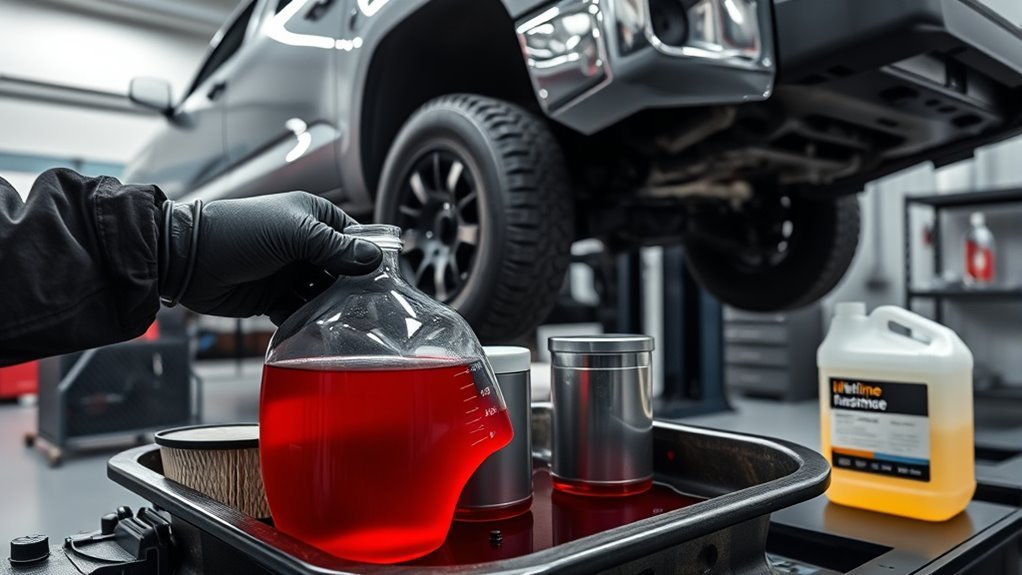
There are three common choices: leave the fluid alone after inspection, perform a drain-and-fill, or have a shop perform a more complete exchange. The right choice depends on mileage, use, fluid condition, and whether the transmission has been serviced before.
- Inspection only: Best when Toyota’s normal schedule calls for inspection, the truck has no leaks, and shifting is normal.
- Drain-and-fill: A partial fluid replacement that removes the fluid that drains from the pan or overflow system. It is usually the preferred routine service when replacement is needed.
- Full exchange: Replaces more old fluid, but it should be done carefully by a qualified shop using the correct ATF and procedure. Be cautious on high-mileage trucks with burnt fluid or heavy debris.
- Pan removal and filter/strainer service: Not normally needed for every drain-and-fill, but appropriate when inspection shows debris, contamination, leaks, or other internal concerns.
Warning: Do not use a universal flush machine, additives, or “compatible” fluid unless the product and procedure are approved for your exact Tundra. The wrong ATF or level can cause shift problems and internal damage.
[Products Worth Considering]

Automatic Transmission Fluid WS is a world-spec fluid specifically designed for sealed, automatic transmissions.

For best performance, follow the manufacturer's recommendations in your vehicle owner’s manual.
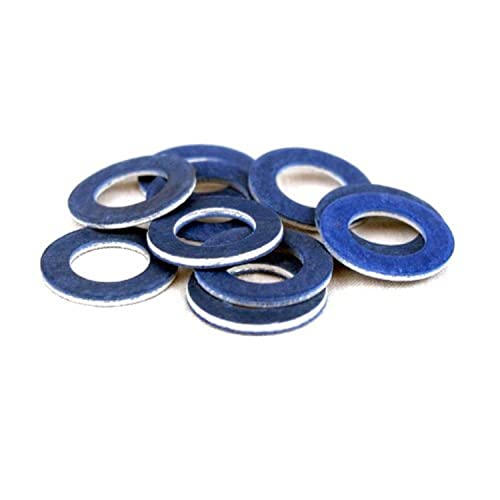
Genuine Toyota - Oil Drain Plug Gaskets (QTY10)
Owner and Shop-Recommended Intervals: 30k, 60k, and 100k Scenarios
Owners and shops often talk about 30,000-, 60,000-, and 100,000-mile intervals, but those numbers mean different things. A 30,000-mile check is a conservative habit for trucks that tow, run hot, or have unknown history. A 60,000-mile replacement is commonly tied to severe service in Toyota maintenance guides. A 100,000-mile discussion usually belongs to broader maintenance planning, not a universal ATF rule.
| Mileage | What It Usually Means | Best Use |
|---|---|---|
| 30,000 miles | Conservative owner inspection, especially for towing, heat, leaks, or unknown history. | Good checkpoint, not a universal Toyota replacement rule. |
| 60,000 miles | Common severe-service replacement point in current Toyota Tundra maintenance charts. | Towing, heavy loading, car-top carrier use, or similar severe operation. |
| 100,000 miles | A broader major-service checkpoint; coolant and other items may be due depending on year. | Review the full maintenance guide, not just ATF. |
If a shop recommends transmission service, ask three questions: What fluid will be used? Will this be a drain-and-fill or a machine exchange? Will the final fluid level be set using Toyota’s temperature-based procedure?
[Products Worth Considering]
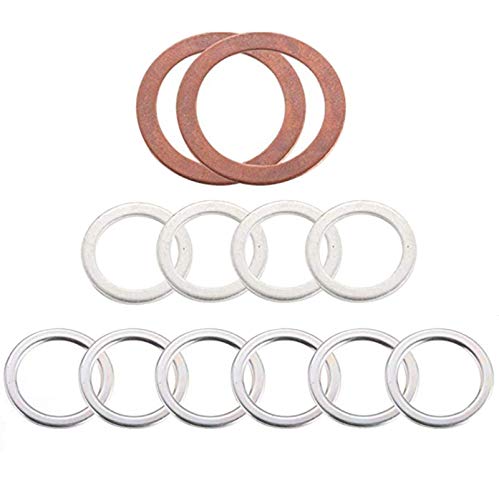
All the gaskets you need for the Toyota diffs and transfer case. There are 2 washers that look the same, those are for the transfer case. Then you have 3 washers that look the same - 2 are for the rear diff and 1 is for the front. The copper one is also for the front diff.

ATF Filling Adapter Designed for automatic transmission fluid filling service on select applications compatible with Toyota and Lexus that use an 18 x 1.5 threaded fill port.

6Qt Genuine 00289-ATFWS
How to Check Tundra Transmission Fluid Condition Without a Dipstick
Many Toyota automatic transmissions that use WS fluid are sealed and do not have a traditional dipstick. That does not make them maintenance-free; it means the level check is done through a fill/overflow procedure at a specified temperature. For many owners, the safest “inspection” is to check for leaks, monitor shifting, watch temperatures, and have a Toyota dealer or qualified technician perform the fluid-level inspection.
Locate the Fill and Overflow Plugs
The fill plug is usually on the side of the transmission case, while the overflow or check plug is used to set the final level. Exact locations and procedures vary by model year and transmission. A 2022+ Tundra 10-speed is not the same as an older 5.7L truck, so do not rely on a generic video for every year.
- Work only on a level surface or lift.
- Support the truck safely; never crawl under a vehicle supported only by a jack.
- Confirm the correct plug before loosening anything.
- Use new gaskets or crush washers where the procedure requires them.
Check Fluid Appearance and Smell
If a small sample is obtained during a proper inspection, look for the following:
- Normal used ATF: red to amber or slightly darker, with no burnt smell and no grit.
- Service concern: dark brown or black fluid, burnt odor, visible debris, or metallic particles.
- Diagnostic concern: large metal flakes, heavy clutch material, slipping, delayed engagement, harsh shifting, or repeated overheating.
A bad sample does not always mean “flush it immediately.” If the transmission already has symptoms, get a diagnosis before forcing a full exchange through a worn unit.
Measure Fluid Temperature
Sealed Toyota transmissions are sensitive to fluid temperature because ATF expands as it warms. The fluid level must be checked in the correct temperature range specified by Toyota for that transmission. This usually requires a scan tool, factory procedure, or a technician who can read the transmission fluid temperature accurately.
Warning: Checking or filling a sealed transmission at the wrong temperature can leave it overfilled or underfilled. Either condition can cause foaming, overheating, slipping, harsh shifts, or internal damage.
DIY Drain-And-Fill for Tundra: Tools, Parts, and Quantities
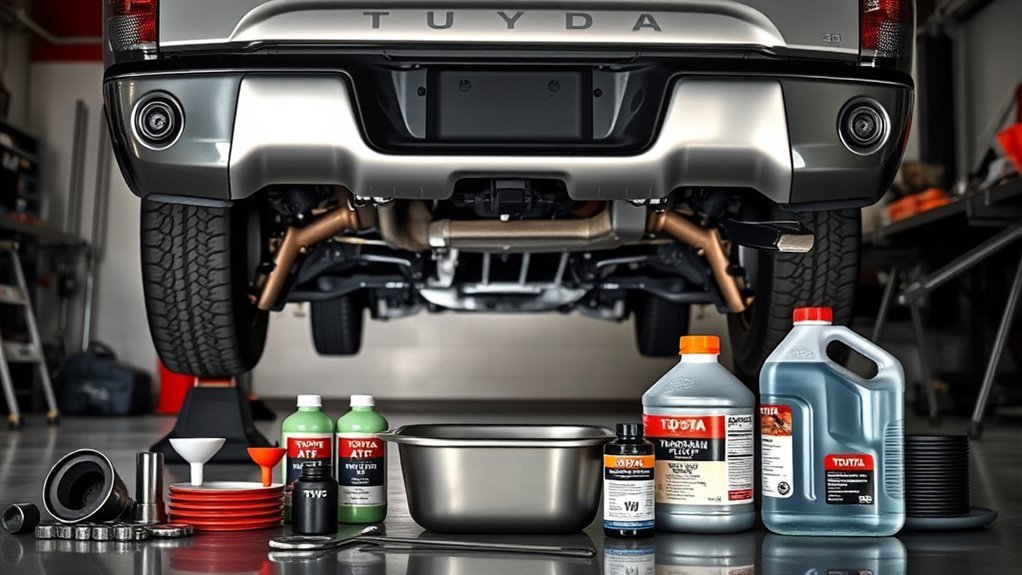
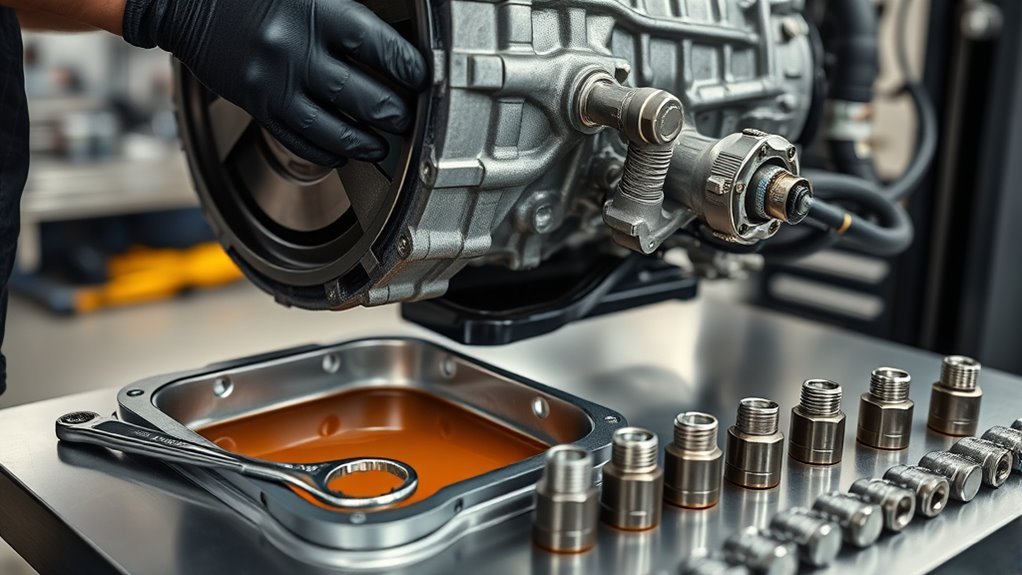
A Tundra drain-and-fill is possible for a careful DIY owner, but it is not the same as changing engine oil. The transmission must be level, the correct ATF must be used, and the final level must be set by the specified temperature-based overflow procedure.
[Products Worth Considering]

COMPATIBLE WITH ALL TOYOTA CARTRIDGE STYLE OIL FILTERS - The Motivx Tools 64.3mm 14 flute oil filter wrench is compatible with all Toyota and Lexus cartridge style oil filter caps from 1.8L - 5.7L engines. This includes popular models like Camry, Tundra, Tacoma, 4Runner, RAV4, Corolla, Highlander, Prius and more that use a cartridge style filter where you remove a plastic cap to expose the paper filter element inside.

Accessorise your Toyota or Lexus with this precision 64.3mm 14-flute oil filter wrench – engineered for a perfect OEM fit on cartridge-style oil filters used in 1.8L – 5.7L engines. Compatible Models Include: Camry, Tundra, Tacoma, 4Runner, RAV4, Corolla, Highlander, Prius, and other vehicles with a 64.3mm 14-flute cap. Stop wrestling with loose chain wrenches. This dedicated tool turns oil changes into a quick, safe, and satisfying job – a must-have for every DIY enthusiast who takes pride in their ride. IMPORTANT: Please confirm your oil filter is a 14-flute, 64mm across-flats fitment before ordering. If it does not match, please do not purchase. Thank you.

This is a bundle package containing both the Motivx Tools cartridge style oil filter wrench and oil filter drain tool for Toyota and Lexus vehicles.
Basic Tools and Supplies
- Correct Toyota-specified ATF for your model year, often Toyota Genuine ATF WS on many Tundras
- Fluid pump or fill tool
- Drain pan with measurement marks
- Socket set and torque wrench
- New drain/fill/overflow plug gaskets or crush washers as required
- Scan tool or reliable method to read transmission fluid temperature
- Safety glasses, gloves, wheel chocks, and a level lift or properly rated stands
Safe DIY Overview
- Verify the factory procedure, ATF type, torque specs, and temperature range for your exact Tundra.
- Park or lift the truck level and secure it safely.
- Remove the correct drain plug and collect the fluid in a clean measuring pan.
- Inspect the drained fluid for burnt smell, grit, clutch material, or metal.
- Reinstall the drain plug with the required new gasket or washer and torque it to spec.
- Refill with the correct ATF through the fill port using the measured amount as a starting point, not as the final level.
- Warm the transmission and cycle through the gears as the Toyota procedure specifies.
- Set the final level through the overflow/check procedure at the specified ATF temperature.
- Check for leaks and record the mileage, fluid type, and amount used.
The refill quantity varies by generation and procedure. A simple drain-and-fill replaces only part of the total fluid, so do not claim that it replaces nearly all of the ATF. Measure what drains out, but always finish by setting the level correctly.
When to Remove the Pan and Change the Filter: Signs & Risks
You generally do not need to remove the pan or change the filter/strainer for every routine drain-and-fill. Pan removal makes more sense when the fluid inspection shows contamination, the pan gasket is leaking, the magnets are loaded with debris, or the transmission has symptoms that require closer inspection.
Visible Metal Shavings
A light paste on a transmission magnet can be normal wear, but visible flakes, chunks, or a sudden increase in metal are warning signs. If you see significant metal, stop treating the service as routine maintenance. The transmission may need professional diagnosis before fresh fluid is added.
- Tiny gray paste on the magnet can be normal over time.
- Shiny flakes or chips suggest abnormal wear.
- Heavy debris plus slipping, delayed engagement, or noise points to a bigger internal problem.
Persistent Fluid Contamination
Dark, gritty, burnt-smelling fluid means the transmission has been running hot or wearing internally. A pan drop and filter/strainer service may help remove debris, but it will not repair worn clutches, valve-body issues, or torque-converter problems. Use the inspection results to decide whether you need service or diagnosis.
Monitor Temps, Sample Analysis, and Towing Best Practices
Transmission temperature is one of the best clues for a towing Tundra. Heat breaks down ATF faster, and towing on grades can push temperatures much higher than daily driving. If your truck displays transmission temperature or you use an OBD-II tool that can read it, watch the trend under load.
- Slow down on long grades instead of forcing repeated high-heat climbs.
- Use Tow/Haul mode when appropriate for your truck and trailer.
- Keep the cooling system clean and working properly.
- Do not exceed the truck’s rated towing or payload limits.
- Inspect for leaks after towing trips.
- Consider a lab fluid analysis if you tow often and want data instead of guessing.
For towing Tundras, the service decision should be based on workload, fluid condition, temperature history, and Toyota’s severe-service schedule—not on the word “lifetime.”
Cost, Scheduling, and Dealer/Parts Hours to Expect
DIY cost depends on the exact ATF, quantity, gaskets, tools, and whether you already own a scan tool. Dealer and independent-shop pricing varies by region, model year, and whether the service is a drain-and-fill, pan service, diagnostic inspection, or full exchange.
Before scheduling service, ask the shop to confirm:
- The exact ATF specification they will use
- Whether the job is a drain-and-fill, pan service, or machine exchange
- How they set the final fluid level
- Whether new gaskets or washers are included
- Whether they will document the service on the invoice
Keep the receipt with your maintenance records. Good records help with resale, future troubleshooting, and warranty conversations if a problem appears later.
Frequently Asked Questions
How often should I change the transmission fluid in my Toyota Tundra?
Check your model-year Toyota maintenance guide. For normal use, Toyota may call for inspection at scheduled intervals rather than automatic replacement. If you regularly tow, haul heavy loads, or use a car-top carrier, the severe-service schedule can call for replacement around 60,000 miles.
Should I change Toyota “lifetime” transmission fluid?
Yes, if the maintenance guide for your use case calls for replacement or if inspection shows burnt, contaminated, leaking, or degraded fluid. For normal use with no symptoms, Toyota may only require inspection. “Lifetime” should not override severe-service maintenance or obvious warning signs.
What is the 100,000-mile service on a Toyota Tundra?
The 100,000-mile service depends on model year, engine, drivetrain, and prior service history. On many Toyota schedules, major checks can include coolant, spark plugs on some engines at nearby intervals, brakes, suspension, driveline fluids, belts, hoses, and leak inspections. Review the maintenance guide for your exact truck.
Does Toyota recommend transmission service?
Toyota recommends following the scheduled maintenance guide. For sealed WS transmissions, normal use may involve inspection rather than routine replacement, while towing, heavy loading, or other special operating conditions can require replacement at specific intervals.
Can I check Tundra transmission fluid without a dipstick?
Yes, but it is not a simple dipstick check. Many Tundras use a sealed transmission with a fill and overflow procedure that must be performed at the correct fluid temperature while the truck is level. If you do not have the right tools, use a qualified technician.
Is a transmission flush better than a drain-and-fill?
Not always. A drain-and-fill is usually the safer routine option when replacement is due. A full exchange may be useful in some cases, but it should be done with the correct ATF, correct equipment, and a clear understanding of the transmission’s condition and service history.
Conclusion
The best Tundra transmission fluid interval is not one fixed number for every truck. For normal driving, follow Toyota’s inspection schedule for your model year. For towing, heavy loading, or severe service, use the special-operating-condition schedule, which can call for ATF replacement around 60,000 miles on current Tundra guides. If the fluid smells burnt, shows debris, leaks, or the transmission shifts poorly, diagnose the problem instead of waiting for the next mileage interval.
A careful drain-and-fill with the correct ATF can be smart maintenance, but only when the final fluid level is set correctly. When in doubt, use your Toyota maintenance guide, verify the procedure by VIN, and have a qualified shop handle the sealed-transmission level check.
Sources
- Toyota 2026 Tundra Warranty & Maintenance Guide — current maintenance chart, normal inspection intervals, and special operating condition replacement guidance.
- Toyota 2021 Tundra Warranty & Maintenance Guide — earlier-generation Tundra maintenance schedule and towing/heavy-load service items.
- Toyota Support: Vehicles Without a Transmission Dipstick — Toyota guidance on sealed WS-fluid transmissions and inspection-based replacement.
- Toyota Genuine World Standard Automatic Transmission Fluid — Toyota ATF WS product information and intended use.
- Toyota Owners Manuals and Warranties — official portal for checking the correct guide for your exact model year.
- U.S. EPA: Managing, Reusing, and Recycling Used Oil — safe handling and recycling guidance for used automotive fluids.