You’re looking at two Tundra 4WD families: part‑time systems you switch into 4‑High or 4‑Low for slippery surfaces or high‑torque low‑speed work, and full‑time systems that use a Torsen center differential to continuously apportion torque for mixed surfaces. Traction aids like A‑TRAC, electronic limited‑slip and a locking rear differential intervene to manage wheelspin. Engage modes per manufacturer steps and inspect drivetrain components for faults, and keep going and you’ll uncover operational details and diagnostics.
Tundra 4WD Configurations: Part‑Time vs Full‑Time
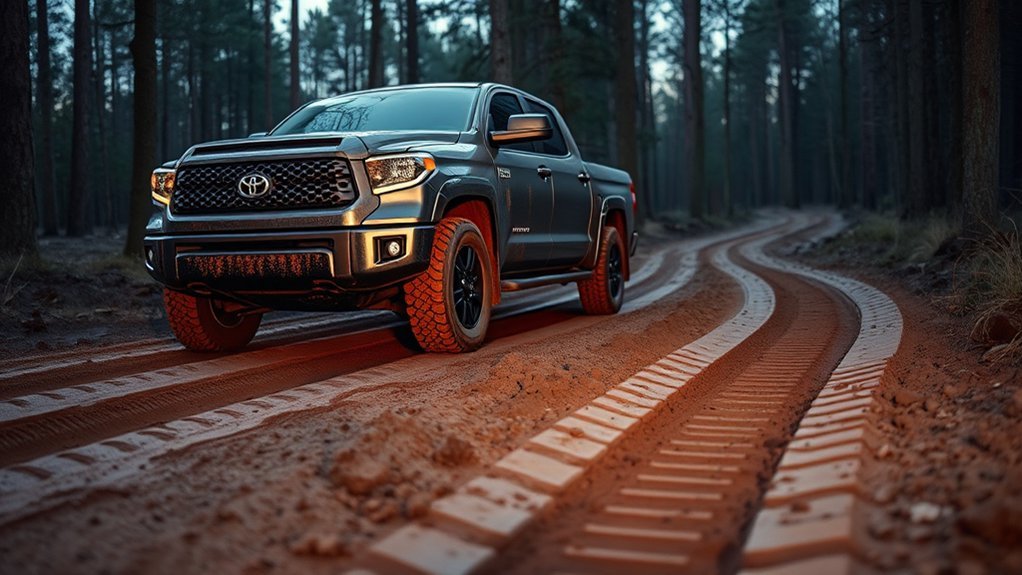
When you need controlled traction across varying conditions, the Tundra offers two distinct 4WD architectures: part‑time systems that engage on demand for four‑high and four‑low operation, and a full‑time system that uses a Torsen center differential to distribute torque continuously. You’ll assess tradeoffs: the part‑time setup gives selectable modes for acute low‑traction events, letting A-TRAC and a locking rear differential concentrate torque where wheel slip occurs; you won’t use it on dry pavement to avoid drivetrain binding. The full‑time arrangement, by contrast, continuously balances torque front-to-rear via the Torsen unit, permitting independent wheel movement and smoother response across mixed surfaces. For liberated drivers who prioritize control, this means you can tailor Tundra performance to mission profiles—precision when you need it, endurance when conditions vary. Both architectures enhance Off road capability, but they do so with different calibration philosophies: one you command tactically, the other you rely on continuously.
Part‑Time 4WD: When to Use 4‑High vs 4‑Low
How do you choose between 4‑High and 4‑Low in a part‑time Tundra? You assess terrain, speed, and torque needs. Use 4 High advantages when you need improved traction at higher speeds on slippery surfaces like snow or mud; engagement is seamless and you don’t have to stop, so you can react quickly to changing grip. Don’t use it on dry pavement — drivetrain binding risks damage.
Shift into 4‑Low for low-speed, high‑torque demands: steep inclines, heavy off‑road obstacles, or deep mud and snow. 4‑Low locks front and rear axles through the transfer case, delivering maximum grip and engine braking so you can control descent and crawl without excessive throttle. Again, avoid dry pavement.
Operational rule set: choose 4‑High for momentum and higher-speed traction, pick 4‑Low for controlled, torque‑intensive maneuvers. That clarity frees you to move decisively without compromising the drivetrain.
Full‑Time 4WD & the Torsen Differential : What It Means
A full‑time 4WD system with a Torsen center differential continuously allocates torque to all four wheels, giving you consistent traction without driver intervention. You get constant power distribution that preserves on‑road manners while extending capability off‑pavement. The Torsen benefits are technical and tangible: a torque‑biasing gearset permits independent wheel rotation, reducing driveline windup and minimizing slippage during turns. Because the differential reacts instantaneously to load changes, traction optimization occurs passively—no mode switching required. A locking function augments this by forcing equal torque front‑to‑rear when surfaces demand maximum grip, so you can break free from terrain constraints with confidence. Full‑time 4WD retains conventional traction control and the utility of part‑time systems but integrates seamless power delivery across conditions. The design improves vehicle stability, control, and predictable handling, supporting drivers who seek liberated mobility without sacrificing engineering rigor or mechanical efficiency.
Tundra Traction Tech: A‑TRAC, Limited‑Slip & Lockers
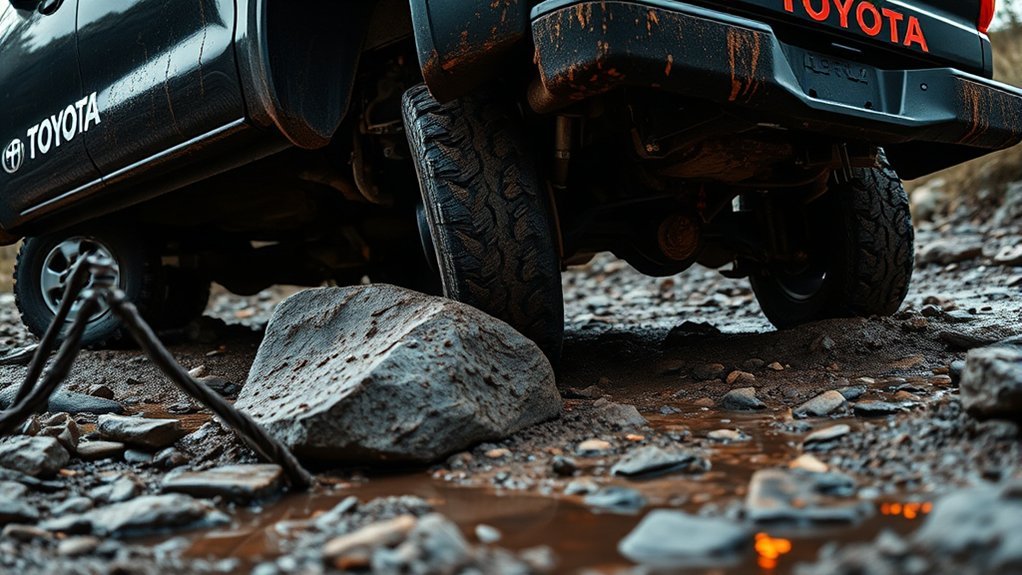
Building on the Torsen‑equipped full‑time system’s balanced torque management, the Tundra’s traction suite adds targeted interventions to keep you moving across inconsistent surfaces. You’ll benefit from A TRAC benefits that detect slip and selectively apply brakes to regain push on snow, mud, or loose gravel, preserving momentum without excessive throttle input. The electronically controlled limited‑slip delivers Limited slip advantages by biasing torque toward the better‑gripping rear wheel, smoothing shifts and reducing oscillation under load. For extreme scenarios, the mechanical locker forces equal torque to both rear wheels, assuring maximal bite when autonomy matters.
- A‑TRAC: wheel‑by‑wheel brake application for forward progression
- Electronically controlled limited‑slip: adaptive torque biasing to maintain control
- Locking rear differential: guaranteed equal torque for off‑camber traction
- Integration: seamless coordination with part‑time 4WD engagement
- Operational outcome: reduced driver intervention, increased route freedom
You’ll get precise, predictable traction modulation that extends your freedom to traverse demanding terrain.
How to Engage Tundra 4WD Modes Safely (Step‑by‑Step)
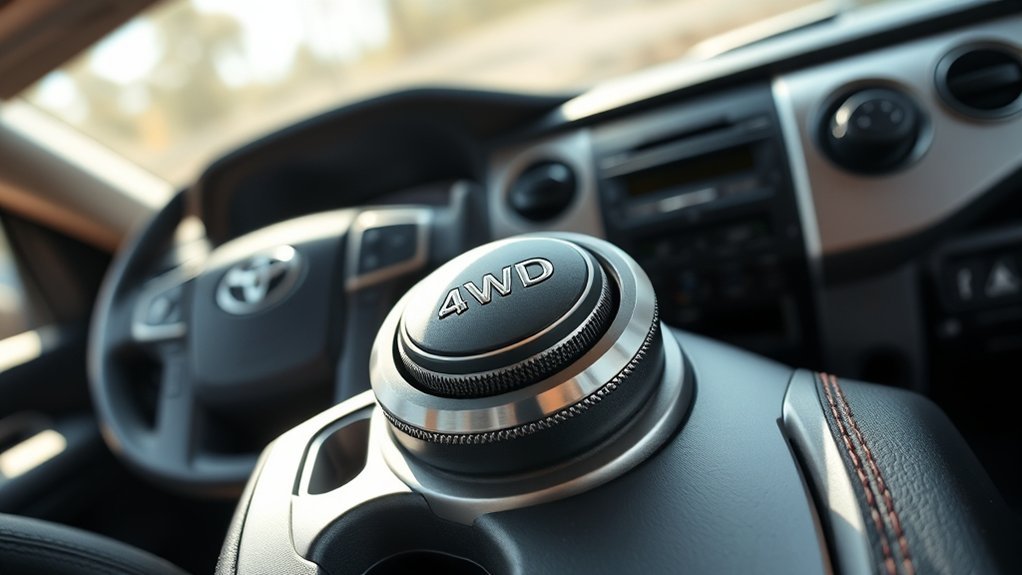
Start by bringing the Tundra to a complete stop and confirming the transmission is in Neutral or Park before selecting a transfer case setting; this minimizes gear clash and guarantees the transfer mechanism aligns properly for 4H or 4L engagement. You then move the transfer case lever to 4H for high‑range traction or to 4L for low‑range torque, applying deliberate, measured force. As you’re engaging 4WD, observe safety precautions: use 4H/4L only on low‑traction surfaces and avoid dry pavement to prevent drivetrain binding. If increased rear traction is required, press the locking rear differential button to equalize torque to both rear wheels. To reclaim freedom and efficiency, stop the vehicle fully before shifting the transfer case back to 2H. Note that full‑time 4WD operates automatically via the Torsen center differential for variable conditions. Execute every transfer operation with situational awareness and controlled inputs to protect the drivetrain and maintain your autonomy off‑road.
Common Tundra 4WD Problems & Quick Diagnostics
Often drivers encounter 4WD issues with the Tundra that stem from a small set of mechanical or electronic failures, so quick, methodical diagnostics will usually isolate the cause. You’ll first scan symptoms: blinking 4WD light, engagement failure, noises, or slipping. Prioritize checks that restore control and autonomy.
Often, 4WD issues on Tundras arise from a few mechanical or electronic faults—quick, methodical checks usually pinpoint the cause.
- Verify transfer case issues: check for fluid leaks, contamination, and correct range selection under load.
- Inspect actuator failures: command 4WD on/off and listen for actuator movement; use a scanner for actuator fault codes.
- Assess linkage problems: examine shift linkage for wear, binding, or misalignment that prevents engagement.
- Evaluate traction faults: test A-TRAC and limited-slip response during controlled slip to confirm differential behavior.
- Execute fluid maintenance: drain and sample transfer case fluid, replace per spec, and note metal particles.
Follow this sequence to liberate yourself from guesswork and make targeted repairs or referrals.
Choosing the Right Tundra 4WD Setup for Your Driving Needs

You should compare part-time and full-time 4WD by matching their functional characteristics to your typical routes and conditions. Use part-time 4WD with A-TRAC and the locking rear differential for low-traction surfaces or technical off-road sections, engaging four-high or four-low as terrain demands. Choose full-time 4WD when you need consistent, always-on traction and stability across varied road conditions without manual intervention.
Part-Time Versus Full-Time
When deciding between part-time and full-time 4WD for your Tundra, evaluate how and where you drive: part-time systems let you switch into 4H or 4L for maximum traction and torque on snow, mud, or steep climbs, while full-time systems use a Torsen center differential to continuously distribute torque and reduce wheel slip on mixed road conditions. You’ll choose based on driving scenarios, weighing part time benefits like selectable engagement and simplified maintenance against full time advantages such as constant traction, refined handling, and fewer driver interventions. Assess performance comparison data, system reliability records, user experiences, maintenance tips, and cost considerations to match hardware to your autonomy goals.
- Analyze expected terrain frequency
- Compare fuel and wear impacts
- Estimate service intervals
- Factor repair and upgrade costs
- Prioritize control versus convenience
Terrain And Usage Tips
Having weighed part-time versus full-time architectures, the next step is matching terrain profiles and usage patterns to the Tundra’s available systems so you get the right trade-offs in traction, fuel economy, and component wear. You’ll select part-time 4WD for off road techniques and low-traction terrain types like snow or mud, engaging four-high for general trails and four-low where torque and engine braking are critical. For daily city and highway use, you’ll revert to rear-wheel drive to maximize fuel efficiency and handling. If you need persistent all-wheel engagement across mixed conditions, choose full-time 4WD with its Torsen center differential to reduce slippage while permitting differential action. Use A-TRAC to modulate wheel slip automatically and preserve momentum.
Frequently Asked Questions
Can You Switch to 4H While Driving Tundra?
Yes — you can switch to 4H while driving at low speeds; you’ll gain 4WD advantages as the system mechanics engage the transfer case smoothly, improving traction on slippery terrain while avoiding dry-pavement drivetrain binding.
Conclusion
“Measure twice, cut once” applies to picking your Tundra’s 4WD: assess terrain, towing needs, and daily driving before committing. You’ll use part‑time 4WD for sporadic off‑road or slippery conditions—4‑High for higher speeds and light traction loss, 4‑Low for torque‑intensive, low‑speed obstacles. Full‑time with a Torsen diff gives constant traction and smoother handling. Match A‑TRAC, limited‑slip, or lockers to your worst‑case scenarios for reliable, mission‑critical performance.