
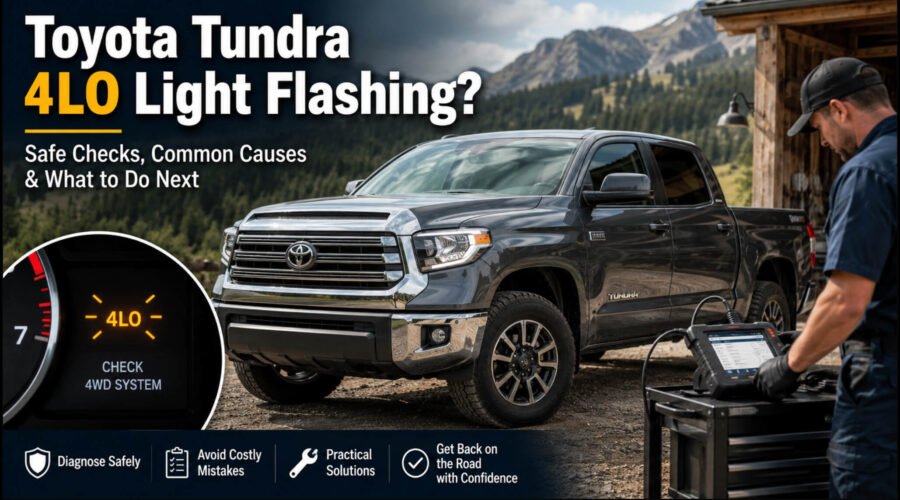
transfer case fluid level as part of a code-led diagnosis.
Quick Answer
A Toyota Tundra 4LO light flashes when the transfer case has not confirmed low range. Slow flashing immediately after a valid 4L request can be part of the shift; rapid flashing, uncommanded flashing, or flashing with other warning lights can indicate a fault. Stop completely, hold the brake, shift to Neutral, and follow the exact-year owner’s manual or multi-information-display instructions. If the mode does not confirm after the manual’s prescribed recovery step, scan the relevant modules before replacing parts.
Key Takeaways
- Use the shift sequence in the owner’s manual for your exact Tundra year before assuming an actuator, sensor, or transfer-case failure.
- Do not operate the 4WD selector while the wheels are spinning, the truck is sliding, or the drivetrain is binding on dry pavement.
- A flashing indicator during a requested shift can be normal until the transfer case confirms the new mode. Do not use a universal stopwatch limit.
- Uncommanded flashing, rapid flashing, a buzzer, a malfunction message, or additional warning lights requires code-based diagnosis.
- Save engine, ABS, chassis, body, network, and 4WD-related codes before disconnecting the battery or clearing faults.
- Stop testing and arrange professional help if the truck grinds, binds, rolls unexpectedly, will not move normally, or feels unsafe.
At a Glance
| Time Required | A few minutes for the prescribed shift and visual checks; longer when module scanning or electrical testing is required |
| Difficulty | Easy for the shift-sequence check; intermediate or professional for module scanning, live-data testing, and actuator diagnosis |
| Tools Needed | Exact-year owner’s manual, flashlight, phone for notes or video, battery tester or multimeter when used correctly, and a scan tool with the required module coverage |
| Cost | No cost for the correct shift sequence and visual checks; diagnostic and repair cost depends on the stored codes, failed component, labor rate, and model year |
Before You Start: Check Your Tundra Year
Tundra 4WD wording, controls, shift requirements, and warning behavior change by generation and configuration. Older trucks may use 2WD, 4H, 4HI, 4L, or 4LO wording. Newer trucks may use 2H, 4H, and 4L and display instructions in the multi-information display.
Use the owner’s manual for your exact year, engine, drivetrain, and trim. Do not assume that a procedure copied from another generation applies to your truck. This page focuses on a flashing warning and fault diagnosis. For normal operating steps without a fault, see how to engage 4LO on a Toyota Tundra.
| Generation | Years | 4WD System Notes |
| 1st Gen | 2000–2006 | Part-time 4WD. Control layout varies by configuration, including lever-type and button-style systems. Follow the exact-year manual because the required sequence and indicator behavior are not identical across every truck. |
| 2nd Gen | 2007–2021 | Electronically controlled 4WD with a dash-mounted selector on many configurations. A position signal, actuator, wiring, voltage, brake-input, ABS, or communication fault can prevent shift confirmation. Diagnose the stored codes instead of assuming one component has failed. |
| 3rd Gen | 2022–present | Electronic 4WD controls with shift instructions or warnings shown in the multi-information display. Record the exact message and follow the on-screen and exact-year manual instructions before interpreting the flashing indicator. |
You can look up Toyota owner’s manuals through Toyota Owners manuals and warranties. If the display gives a specific instruction or malfunction message, follow that exact wording first.
Warning: Keep your foot on the brake and apply the parking brake while completing a stationary shift. On some generations, an incomplete transfer-mode change can temporarily leave the driveline disconnected, so do not rely on Park alone. Do not assume low range or the previous transfer mode is engaged until the indicator is steady or the display confirms the selected mode. Do not apply throttle to test the mode while the indicator is still flashing.
What Does a Flashing 4LO Light on a Toyota Tundra Mean?
A flashing 4LO light usually means the truck has not confirmed a completed low-range shift. The transfer case may still be moving, or the control system may be waiting for the required transmission position, brake input, actuator position, vehicle-speed signal, or another module signal.
The flashing indicator does not prove the transfer case itself is damaged. The next step depends on when the flashing began and which other warnings are present.
| What You See | What It Can Mean | What To Do |
| 4LO flashes immediately after you select 4L | The transfer case may still be changing modes or a required shift condition has not been met. | Stop fully, hold the brake, shift to Neutral, and perform the exact-year procedure once. |
| 4LO flashes with a buzzer or instruction message | The truck may not meet the required speed, brake, transmission-position, or selector conditions. | Read the exact display message and follow the owner’s manual. Do not guess from another model year. |
| 4HI or 4LO flashes rapidly, both flash rapidly, or a malfunction message appears | Toyota owner and service information treats rapid flashing as a possible 4WD-system malfunction. | Stop forcing the selector, save diagnostic codes, and arrange proper testing. |
| 4LO appears without a shift command or with ABS, VSC, traction, or check-engine warnings | A drivetrain, engine, ABS, wheel-speed, brake-input, voltage, or communication fault may be affecting 4WD operation. | Read engine, ABS/skid-control, 4WD, chassis, body, and network modules before clearing anything. |
Is the 4LO Light Flashing During a Shift or Without a Shift Command?
This distinction should guide your first action:
- Flashing began after you selected 4L: Verify the exact shift procedure and wait for the required confirmation.
- Flashing began at startup or during normal driving: Treat it as a possible stored-fault condition. Scan the truck before operating the selector repeatedly.
- Flashing appears with ABS, VSC, TRAC, traction-control, or check-engine warnings: Scan every relevant module. The first useful code may not be stored in the engine computer.
- The truck grinds, binds, rolls unexpectedly, will not move normally, or cannot confirm any mode: Stop driving and arrange professional assistance or towing.
This decision path prevents two common mistakes: replacing an actuator before reading the codes and repeatedly commanding a shift when the drivetrain position is uncertain. If the truck simply will not enter 4WD and no 4LO warning pattern is present, use the separate Tundra 4WD not engaging diagnosis guide.
How to Fix a Flashing 4LO Light on a Toyota Tundra
If your Tundra’s 4LO light starts flashing immediately after you request low range, park on a level surface away from traffic. Do not test the system while the wheels are spinning, while the truck is sliding, or while the tires are bound against dry pavement.
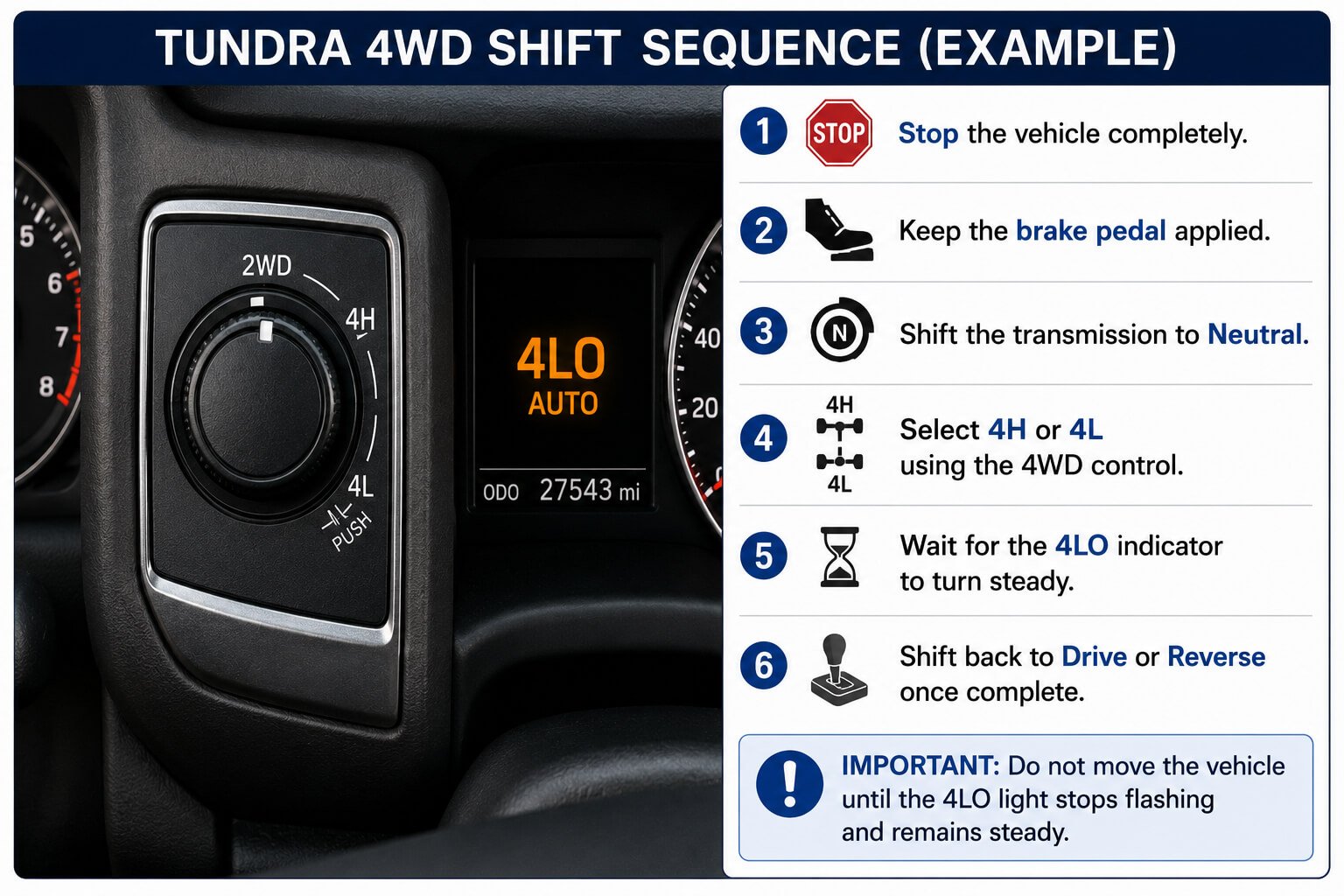
- Bring the truck to a complete stop.
- Apply the parking brake and keep the brake pedal firmly pressed.
- Shift the transmission to Neutral.
- Follow the exact sequence in your owner’s manual. Some configurations require 4H before 4L.
- Select 4L and keep the truck stationary while the transfer case changes modes.
- Wait for the indicator to turn steady or for the multi-information display to confirm the selected mode.
- Only after confirmation should you shift the transmission to Drive, Reverse, or Park as appropriate.
Do not apply throttle to “help” the shift or assume low range has engaged while the indicator is flashing.
If the indicator never confirms the mode, follow the exact-year manual for returning to the previous setting. Some older procedures may instruct the driver to move the vehicle a short distance in a straight line before retrying, while other systems use different instructions. Do not improvise or keep cycling the selector.
Pro Tip: Record a short phone video showing the dash, transmission position, 4WD selector position, buzzer, and display message. Also record whether you requested the shift and whether the symptom changes after a cold start, warm restart, rain, washing, or off-road use. This gives a technician a clearer fault snapshot.
[Products Worth Considering]

The TOPDON VeriDiag X800 BT is a wireless bidirectional automotive diagnostic scanner designed for full-system troubleshooting, active testing, and advanced service resets. It supports broad vehicle coverage, live data viewing, AutoVIN identification, and lifetime free updates to help DIYers and professionals diagnose issues faster and with greater confidence.

The BLCKTEC 440 Bluetooth OBD2 scanner helps drivers and DIY mechanics quickly read and clear trouble codes, monitor live data, and check emissions readiness with confidence. Its color display, graphing capabilities, and battery and charging system testing make it a versatile diagnostic tool for OBD-compliant vehicles. Designed for plug-and-play convenience, it runs directly from your vehicle and includes support for report sharing and ongoing updates.

This automotive test light combines a bright LED voltage display with quick polarity indication for fast, accurate circuit checks in a wide range of vehicle systems. It helps diagnose battery, charging, lighting, and fuse issues with a sharp stainless probe, long spring wire, and easy-to-use alligator clip for efficient troubleshooting.
How Long Should 4LO Take to Engage?
The 4LO indicator normally flashes while the transfer case is moving toward the requested position. It should turn steady, or the display should confirm the selected mode, when the shift is complete.
Toyota does not publish one universal number of seconds that applies to all Tundra generations, control systems, temperatures, and operating conditions. Use confirmation from the indicator or display, not a stopwatch, as the primary signal.
- Normal transition: The light begins flashing after a valid shift command and then becomes steady.
- Incomplete command: The light continues flashing because a required condition, such as Neutral or a complete stop, was not recognized.
- Possible fault: The indicator does not confirm the mode after one correctly performed attempt, flashes rapidly, returns without a command, or appears with other warning lights.
If one correct attempt does not complete, stop repeating the command. Save codes and inspect the system instead of using an arbitrary time limit to decide which part has failed.
Note: Temperature and mechanical drag can change how a system behaves, but a slow shift does not identify the failed component. Record the conditions and compare them with codes, voltage tests, actuator data, and the exact-year diagnostic procedure.
Verify 4WD Operation and Reproduce the Fault
After the stationary shift check, test 4WD operation only if the selected mode has been confirmed and the truck remains safe to move. Use an open, appropriate low-traction area where the tires can release driveline stress. Do not use 4H or 4L for normal driving on dry, high-traction pavement unless your exact owner’s manual permits that mode and surface.
Create a fault snapshot before the symptom disappears. Record:
- Truck year, trim, engine, mileage, drivetrain, and tire size.
- Whether the flashing began after a shift command or appeared on its own.
- Transmission position and 4WD selector position when the light began flashing.
- The exact multi-information-display message, if present.
- Whether the truck was cold, hot, wet, muddy, recently washed, or recently driven through water.
- Whether ABS, VSC, TRAC, traction-control, check-engine, battery, or other warnings appeared.
- Whether the transfer case or front drivetrain made clicking, grinding, clunking, or repeated motor noises.
- Whether the truck actually developed low-range gearing or only displayed a flashing indicator.
- Whether the symptom changes after a restart or after the vehicle warms up.
Do not rock quickly between Park, Drive, Reverse, and Neutral to force engagement. Reproduce the fault only when you can do so safely and without repeatedly loading the drivetrain.
Read Codes Before Disconnecting the Battery
Use an On-board diagnostics II (OBD-II) scanner that supports the modules installed in your exact Tundra. Many low-cost code readers show generic engine powertrain codes but do not access ABS/skid-control, four-wheel-drive, transfer-control, chassis, body, or network modules.
Before buying or borrowing a scanner, check its coverage list for your Tundra’s year. Confirm that it can access:
- The engine and transmission control systems.
- ABS or skid-control data and wheel-speed signals.
- The 4WD or transfer-control system, when separately addressable.
- Body and network modules that can store communication faults.
- Current, pending, history, and manufacturer-specific trouble codes.
- Relevant live data and commanded actuator states, when supported.
Kelley Blue Book explains that OBD-II trouble codes can include powertrain, body, chassis, and network code families. Its scanner guide also distinguishes basic readers from tools that offer wider code coverage, live data, and manufacturer-specific functions.
Record stored codes, pending codes, current codes, history codes, freeze-frame data, and relevant live data before clearing anything. A communication or ABS code may explain the 4WD warning even when no useful generic engine code is present.
Note: Disconnecting the battery may temporarily remove a warning, but it can also erase diagnostic clues and reset learned values. Scan and save the fault data first. A warning that returns after a reset still requires diagnosis.
Common Causes of a Flashing 4LO Light
A flashing 4LO light can involve several systems. Diagnose them in order of evidence rather than replacing the most commonly discussed part.
Incomplete 4WD Shift
An incomplete command is the first condition to rule out when the indicator begins flashing immediately after you select 4L. The truck may still be moving, the transmission may not be in Neutral, the brake input may not be recognized, the prior 4WD mode may not be confirmed, or the selector command may have been interrupted.
Perform the exact-year sequence once. If the system confirms the mode, no parts should be replaced solely because the indicator flashed during the transition.
Weak Battery, Voltage Drop, or Poor Ground
Low system voltage or excessive resistance can disrupt actuator and sensor operation. Check for slow cranking, dim lights, recent jump starts, loose terminals, corrosion, damaged cables, and loose or corroded grounds.
Test the battery and charging system under load. A battery may show acceptable resting voltage but drop excessively when the starter or an electric motor draws current. Verify power and ground integrity before condemning a transfer-case actuator.
Transfer Shift Actuator or Position-Signal Fault
The transfer-control system must confirm that the requested 2H, 4H, or 4L position has been reached. If an actuator cannot move to the commanded position, or a position signal does not agree with the command, the indicator may continue flashing.
Some electronically controlled Tundra 4WD configurations use separate shift motors at the transfer case and the front differential. The front-differential unit is commonly called the A.D.D. (Automatic Disconnecting Differential) actuator. A technician should identify the exact system by model year and VIN, then compare commanded state, actual position data, circuit tests, power, grounds, and connector condition before replacing either assembly.
Do not use C1201 as proof of an actuator or communication failure. In Toyota Tundra service information, C1201 is an engine-control-system malfunction flag stored by the stability-control system when an engine-side fault disables VSC or TRAC. Read the companion engine codes first. A separate 4WD code, circuit test, or failed position response is needed to identify a transfer-case or A.D.D. fault.
Do not diagnose either actuator from the warning light alone. Confirm the exact hardware and test results before replacing a transfer-case actuator, A.D.D. actuator, position switch, wiring, or control module.
Wiring, Connector, or Water Intrusion
Inspect safely accessible harness sections, connector locks, terminals, and grounds around the transfer case and lower drivetrain. Look for corrosion, loose pins, broken insulation, mud, oil saturation, rodent damage, impact damage, or moisture entry.
A symptom that appears after rain, pressure washing, mud, road salt, or a water crossing makes connector and harness inspection more important. It does not prove that water intrusion is the root cause.
ABS, Wheel-Speed, or Brake-Input Problem
ABS, wheel-speed, and brake-switch data may be used by the truck’s drivetrain-control logic. An implausible signal or communication fault can therefore accompany a 4WD warning on some configurations.
Treat these inputs as possible causes only when warning-light combinations, stored codes, and live data support that direction. Do not replace a wheel-speed sensor merely because ABS and 4LO warnings appeared together. For ABS- and traction-specific testing, see the Toyota Tundra ABS and traction-control diagnosis guide.
Transfer-Case Fluid Level or Mechanical Condition
Check for leaks and verify the transfer-case fluid level and specification as part of the mechanical inspection. Use the correct fluid for the exact year and transfer case.
Fluid service will not repair an electrical position sensor, actuator-control circuit, wiring fault, ABS fault, or network problem. Follow the exact-year maintenance guide and operating-condition schedule rather than applying one interval to every Tundra.
A flashing 4LO light is not a parts list. Confirm when the flashing began, perform the correct shift once, save every relevant code, and test the system before replacing an actuator, switch, sensor, or transfer case.
What Determines the Repair Cost?
A reliable price is not possible until the failed circuit or component has been identified. Model year, module access, diagnostic time, corrosion, parts availability, calibration requirements, and internal transfer-case damage can change the estimate significantly. Online price ranges are especially unreliable when they combine a battery repair, wiring repair, actuator replacement, and complete transfer-case replacement under one symptom.
| Diagnostic or Repair Area | Evidence Needed Before Approval | Main Cost Drivers |
| Multi-module diagnosis | Stored codes, freeze-frame data, live 4WD states, and a written test plan | Scanner capability, intermittent-fault reproduction, wiring diagrams, and diagnostic time |
| Battery, terminal, cable, or ground repair | Load-test result and voltage-drop measurements | Battery condition, cable damage, corrosion severity, terminal repair, and ground location |
| Harness or connector repair | Identified open, short, high resistance, damaged terminal, or verified water intrusion | Damage location, connector availability, terminal serviceability, corrosion, and access time |
| Position switch or shift actuator repair | Commanded-versus-actual mismatch, failed circuit test, or confirmed mechanical binding | Which assembly is faulty, whether it is serviced separately, part source, access, and calibration |
| Internal transfer-case repair or replacement | Noise, contamination, internal damage, or failed mechanical inspection | Extent of damage, new or remanufactured assembly, labor, fluid, calibration, and warranty coverage |
Ask for a written diagnosis that identifies the failed circuit or component, the supporting codes or test results, parts, labor, calibration requirements, and warranty terms before approving the repair.
Safe DIY Checks You Can Try at Home
These checks do not require transfer-case disassembly or clearing diagnostic data. Stop if the truck is unstable, you cannot reach a component safely, or the procedure requires lifting the vehicle without suitable equipment.
- Check the owner’s manual: Confirm the correct 4H-to-4L and 4L-to-4H sequence for your exact year and control layout.
- Save the symptom details: Record whether the flashing followed a shift command and note every additional warning or display message.
- Check the battery and charging system: Inspect terminals, cables, and grounds. Use proper load and voltage-drop testing instead of relying only on resting voltage.
- Check the applicable fuse: Use the exact-year owner’s manual and fuse-box diagram to identify any fuse that supplies the 4WD control system. Do not assume every Tundra labels it “4WD” or “4×4.” Replace a blown fuse only with the specified amperage. If it blows again, stop and diagnose the circuit instead of installing another fuse.
- Check brake-light operation: Confirm the brake lights respond normally. A failed brake-light circuit is a useful clue, but it does not by itself identify the 4WD fault.
- Check visible connectors: Look around safely accessible transfer-case and lower harness areas for mud, water, broken locks, corrosion, and rubbed wiring.
- Review recent events: Note water crossings, pressure washing, jump starts, battery replacement, suspension work, tire-size changes, collision repairs, or previous 4WD work.
- Check for leakage and review fluid history: Use the exact-year fluid specification and maintenance schedule. Do not assume a fluid service will clear an electrical warning.
- Scan before resetting: Save codes and freeze-frame information before disconnecting the battery or erasing faults.
Clean visible dirt only when the truck is off and the location is safe to reach. Do not spray random electrical components, unplug modules blindly, probe sealed connectors with oversized tools, or pierce wire insulation without service information.
[Products Worth Considering]

FOXWELL NT201 is an easy-to-use OBD2 scanner designed to help drivers quickly read and clear check engine codes, view live engine data, and check emissions readiness. Its color screen, one-key I/M readiness test, and broad compatibility with most gasoline vehicles since 1996 make it a practical tool for everyday diagnostics and maintenance. With plug-and-play operation and lifetime free updates, it offers a simple way to understand vehicle issues without expensive shop visits.

These heavy-duty running board side steps are designed to improve access to your Toyota Tundra without reducing ground clearance. Built for Double Cab and CrewMax front door applications, they offer practical convenience for everyday entry, roof loading, and off-road use. The durable iron construction and easy no-drill installation make them a reliable upgrade for rugged driving.

This Yuirote universal car motor diagnostic tool helps drivers quickly detect engine fault codes and identify system issues for routine inspections and maintenance. It also supports electronic parking brake reset and emergency release functions, making it useful for handling EPB-related problems without a repair shop visit. Its compact, ergonomic design and broad vehicle compatibility make it a practical choice for car owners and DIY repair enthusiasts.
Complete the Shift Cycle Correctly
Do not treat repeated selector cycling as a calibration procedure. Stop the truck, hold the brake, shift to Neutral, follow the required mode sequence, and wait for the indicator or display to confirm the change.
If the system does not confirm the mode after one correctly performed attempt, stop. Repeated commands do not repair a missing sensor signal, wiring fault, actuator problem, low-voltage condition, or module fault.
Inspect Brake Inputs Only When Evidence Points There
A brake switch or related input may affect shift logic on some configurations, but it should not be treated as the default cause. Check normal brake-light operation and inspect safely accessible pedal-area wiring.
Replace brake-related parts only when codes, live data, circuit tests, or the factory diagnostic procedure support the repair.
Why Weather, Water, and Temperature Can Matter
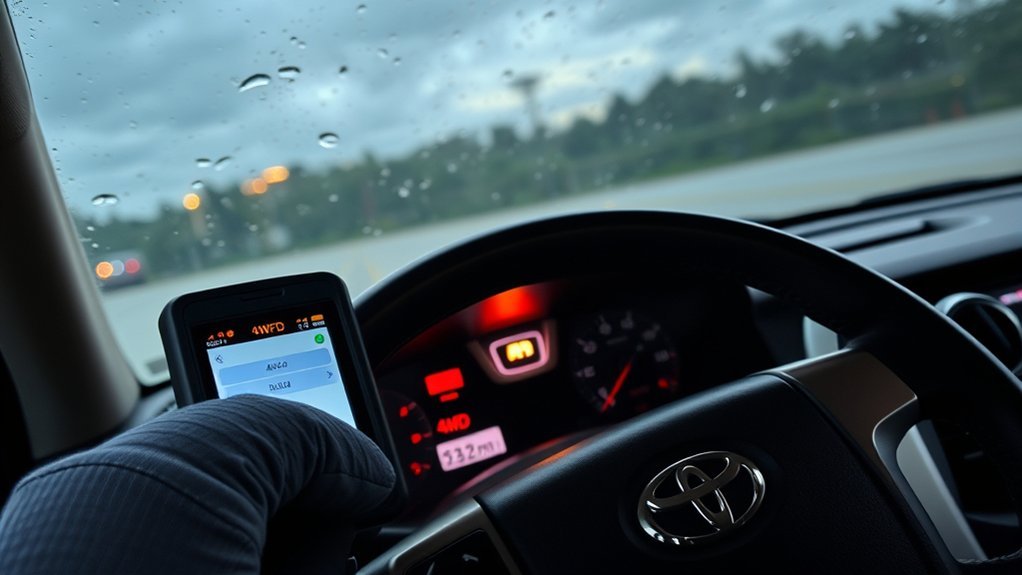
Cold conditions can expose a weak battery, excessive voltage drop, stiff mechanical movement, or a marginal electrical connection. Water, mud, road salt, and pressure washing can affect damaged seals, connectors, grounds, or harness sections near the drivetrain.
- Record whether the fault appears after rain, washing, mud, snow, road salt, or water crossings.
- Record whether it happens only during a cold start or changes after the truck warms up.
- Record whether ABS, VSC, traction-control, battery, or check-engine lights appear at the same time.
- Listen for grinding, clicking, clunking, or repeated electric-motor noises without crawling under a running or unstable truck.
A temperature- or moisture-related pattern is a diagnostic clue, not proof of a failed actuator or connector. Share the pattern with the technician and compare it with stored codes, live data, power and ground tests, and a controlled inspection.
When to Take Your Tundra to a Mechanic
Arrange professional diagnosis if the 4LO light keeps flashing after one correctly performed shift attempt, begins flashing without a shift request, flashes rapidly, displays a malfunction message, or appears with ABS, VSC, traction-control, battery, or check-engine warnings.
Avoid towing, hard acceleration, high-speed driving, and off-road use until the selected transfer mode is confirmed and the fault is understood.
Give the mechanic your fault snapshot, including:
- Truck year, engine, trim, mileage, drivetrain, and tire size.
- Whether you requested 4L before the warning appeared.
- The exact warning lights and display messages.
- All stored, pending, history, and network codes.
- Recent battery, tire, suspension, collision, transfer-case, or electrical work.
- Water exposure, temperature patterns, and unusual drivetrain noises.
- Whether the truck actually entered low range or only displayed the indicator.
Ask for a written diagnostic result. A complete diagnosis may include transfer-case command and position data, actuator response, switch input, power and grounds, wiring, brake-related inputs, wheel-speed data, fluid level, mechanical operation, and module communication.
Warning: Stop driving and call for help if the truck will not move normally, rolls unexpectedly, makes grinding noises, binds severely, cannot confirm a transfer mode, or shows multiple warnings with poor drivability.
[Products Worth Considering]

This complete Deutsch connector kit provides a versatile assortment of sealed DT-style connectors for reliable automotive and industrial wiring repairs. Built with waterproof, dustproof, and corrosion-resistant materials, it helps maintain secure electrical connections in harsh, high-vibration environments. The included pin removal tool, contacts, seal plugs, and storage case make installation, servicing, and organization simple and efficient.

The ANCEL AD410 PRO combines engine diagnostics and 12V battery testing in one easy-to-use tool, helping you read and clear check engine codes while checking battery health, cranking, and charging performance. It also provides live data, freeze frame details, and I/M readiness checks to help you diagnose issues faster and prepare for emissions testing. With plug-and-play operation, a clear screen, and broad vehicle compatibility, it is a practical solution for home mechanics and everyday drivers.
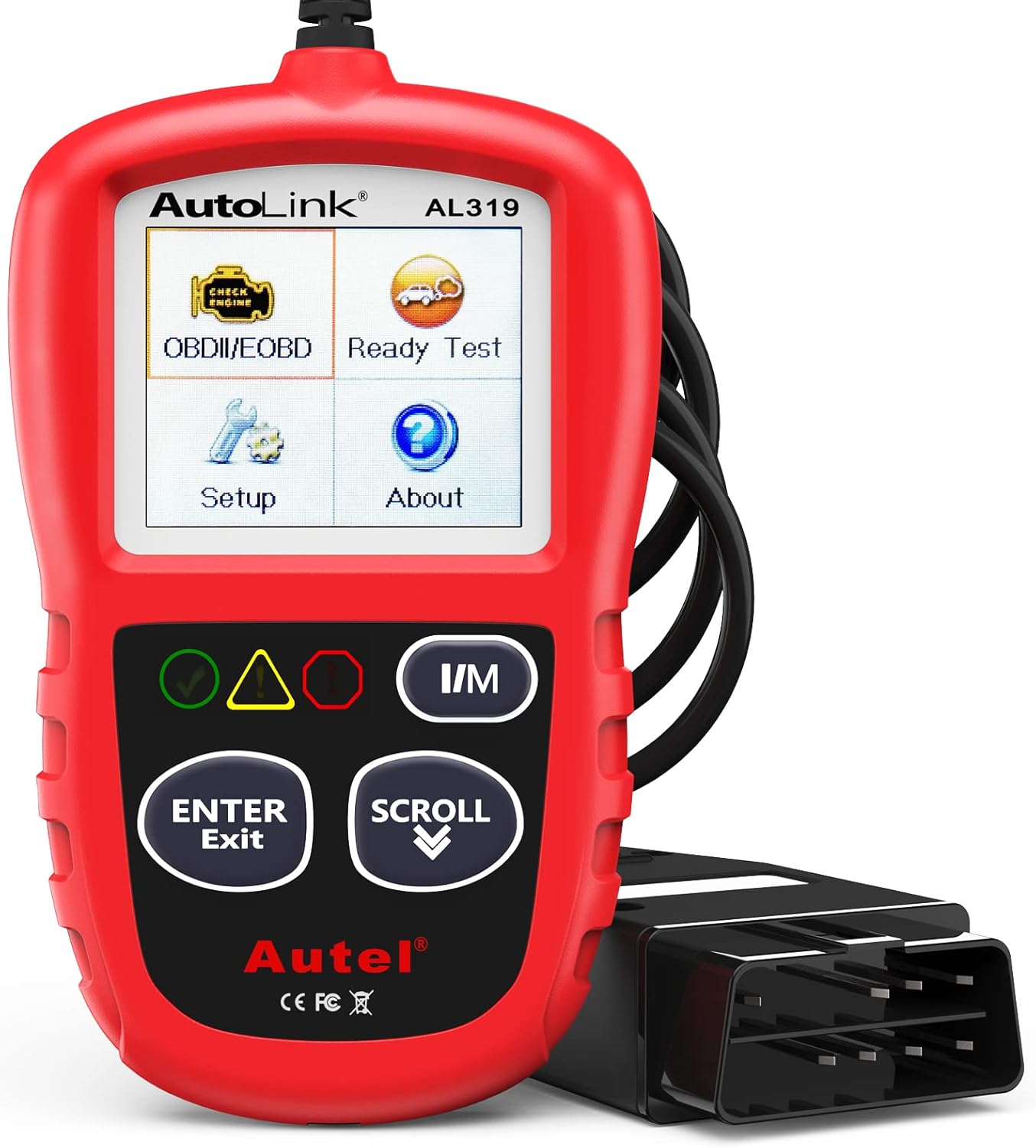
The Autel AL319 is a user-friendly OBD2 scan tool designed to help drivers quickly diagnose check engine light issues and understand vehicle fault codes. It supports reading and clearing DTCs, live data, freeze frame, I/M readiness, and vehicle information, making it a practical choice for DIYers and everyday car owners. With plug-and-play operation, a color display, built-in speaker, and broad vehicle compatibility, it delivers fast, reliable diagnostics without complicated setup.
Frequently Asked Questions
Why are my 4LO and ABS lights flashing?
The truck may have stored a drivetrain, ABS, wheel-speed, brake-input, voltage, or communication fault that affects 4WD operation. The warning-light combination does not identify the failed part. Scan the engine, ABS/skid-control, 4WD, chassis, body, and network systems before replacing a wheel-speed sensor, actuator, or transfer-case component.
Can I drive with the 4LO light flashing?
Avoid hard driving, towing, off-road use, and high-speed travel while the transfer mode is unconfirmed. If the truck moves normally, travel only as needed to reach a safe location or repair facility. Stop immediately if it binds, grinds, rolls unexpectedly, will not move normally, or feels unsafe.
Will disconnecting the battery fix a flashing 4LO light?
Disconnecting the battery may temporarily remove a warning, but it does not repair a failed circuit or component. It can also erase codes, freeze-frame data, and other diagnostic clues. Scan and save the fault information first. If the warning returns, diagnose the underlying cause.
Can low transfer-case fluid cause a flashing 4LO light?
Low fluid caused by a leak or an internal mechanical problem can damage the transfer case or affect its operation, so level and condition belong in a complete inspection. However, a fluid service will not repair an electrical sensor, actuator-control, wiring, ABS, or network fault. Check codes, circuits, actuator data, leakage, level, and mechanical condition together.
What should I tell the mechanic about a flashing 4LO light?
Provide the truck year, engine, trim, mileage, drivetrain, tire size, exact warning lights, display messages, and code numbers. Explain whether you requested 4L before the flashing began. Mention cold starts, rain, washing, water crossings, recent repairs, battery issues, unusual noises, and whether the truck actually entered low range.
Is it bad to use 4LO on dry pavement?
Part-time 4WD can bind on dry, high-traction pavement because the front and rear drivetrains cannot release speed differences easily during turns. That stress can affect tires, shafts, axles, joints, and the transfer case. Use 4H and 4L only on surfaces, at speeds, and under conditions allowed by your exact owner’s manual.
How long does it take for 4LO to engage on a Toyota Tundra?
Toyota does not publish one universal engagement time for every Tundra generation and operating condition. The indicator normally flashes during the transition and turns steady, or the display confirms the mode, when the shift is complete. If one correctly performed exact-year procedure does not confirm the mode, stop cycling the selector and diagnose the fault.
Can a bad wheel-speed sensor cause a flashing 4LO light?
It can contribute on a system that uses wheel-speed or ABS information in its shift logic, but the warning does not prove a sensor has failed. Check ABS and 4WD codes, compare live wheel-speed data, inspect the circuit, and follow the exact-year diagnostic procedure before replacing a sensor.
Why does the 4LO light flash with the check-engine light?
An engine or emissions fault can trigger fail-safe behavior that disables VSC or TRAC and adds other warning lights, even when the transfer case is not the root cause. Scan the engine module and the ABS/skid-control and 4WD-related modules. For example, Toyota Tundra service information defines C1201 as an engine-control-system malfunction flag; it is not proof that the transfer-case actuator or a communication circuit has failed.
What does it mean if both 4HI and 4LO lights flash at the same time?
If both 4HI and 4LO flash rapidly, Toyota service information treats the pattern as a possible four-wheel-drive-system malfunction. Do not continue cycling the selector. Save codes from the engine, ABS/skid-control, 4WD, chassis, body, and network modules before clearing faults. A slow or steady combination during a commanded shift can have a different meaning, so compare the exact pattern with the owner’s manual for your model year.
Is a flashing 4LO light covered under Toyota’s warranty?
It depends on the failed component, the truck’s in-service date and mileage, the cause of failure, and the exclusions in the Warranty & Maintenance Guide. Toyota lists 36-month/36,000-mile basic coverage and 60-month/60,000-mile powertrain coverage for new vehicles, but that does not guarantee every 4WD warning repair is covered. Give a Toyota dealer the VIN and ask for written confirmation that the diagnosed component and labor are covered before authorizing the repair.
What is the A.D.D. actuator and can it cause a flashing 4LO light?
On Tundra configurations that use Toyota’s A.D.D. system, the Automatic Disconnecting Differential actuator is mounted at the front differential and helps connect or disconnect the front driveline. It is separate from the transfer-case shift actuator. If the A.D.D. unit, its circuit, or its position feedback fails, the 4WD system may not confirm the requested mode. Identify the exact hardware by model year and VIN, then test command, power, ground, wiring, connector condition, and position response before replacing either actuator.
Conclusion
A flashing 4LO light needs a controlled diagnostic approach. First determine whether the flashing began during a requested low-range shift or appeared without a command. If you requested 4L, perform the exact-year stop, brake, Neutral, and selector sequence once, then wait for the steady indicator or display confirmation.
If the mode does not confirm, the light returns, flashes rapidly, or appears with ABS, VSC, traction-control, battery, or check-engine warnings, stop cycling the selector. Save every relevant code and inspect power, grounds, wiring, connectors, actuator command and position data, brake and wheel-speed inputs, fluid level, and mechanical transfer-case operation. When C1201 is present, treat it as an engine-control-system flag that requires companion engine codes, not as proof of a failed 4WD actuator.
Stop driving if the truck binds, grinds, rolls unexpectedly, will not move normally, or cannot confirm a safe transfer mode. A code-led diagnosis protects the drivetrain and prevents unnecessary actuator, sensor, switch, or transfer-case replacement.
Safety Disclaimer: This article is for informational purposes only and does not replace the owner’s manual, Toyota repair information, or professional vehicle diagnosis. Consult a qualified technician before driving, towing, or repairing a truck with an unresolved drivetrain warning or uncertain transfer-case position.
Sources
- Toyota Owners Manuals and Warranties — exact-year Tundra owner’s manual lookup
- Toyota Owners: 2025 Tundra Four-Wheel Drive System — current-generation 4H and 4L operating guidance
- Toyota 2002 Tundra Owner’s Manual — early-generation control and operating guidance
- Toyota 2024 Tundra Warranty and Maintenance Guide — transfer-case inspection and severe-use maintenance guidance
- Kelley Blue Book OBD-II Code List — diagnostic trouble-code families
- Kelley Blue Book OBD-II Scanner Guide — code-reader, scan-tool, live-data, and manufacturer-specific capability overview
- Toyota Tundra Service Manual Reference: C1201 — third-party service-manual mirror identifying C1201 as an engine-control-system malfunction flag
- Toyota Tundra Service Manual Reference: 4WD System Description — third-party service-manual mirror describing transfer and A.D.D. actuator control and rapid-flash fault behavior


[…] Tundra Trailer Lights Not Working: Fuse, Ground, and Connector […]