
Understanding GVWR, GCWR, payload, tongue weight, and tow rating is the safest way to know what your 2017 Toyota Tacoma can actually handle. The big takeaway is simple: the Tacoma’s factory ratings are useful, but your real towing limit depends on your exact trim, drivetrain, tow package, passengers, cargo, accessories, hitch, and trailer weight.
Quick Answer
For the 2017 Toyota Tacoma, GVWR is 5,600 pounds and GCWR is 11,360 pounds. Maximum towing ranges from 3,500 pounds on many non-tow-package setups to 6,800 pounds on properly equipped V6 models. Always verify your truck’s door-jamb sticker and owner’s manual before towing.
Key Takeaways
- GVWR is the maximum safe loaded weight of the truck itself: Tacoma, occupants, cargo, hitch hardware, and trailer tongue weight.
- GCWR is the maximum combined weight of the loaded Tacoma plus the loaded trailer.
- The 2017 Tacoma’s tow rating is not one number for every truck; it depends on engine, cab, drivetrain, transmission, trim, and tow package.
- Tongue weight counts against payload, so a trailer that is “under the tow rating” can still overload the truck.
- The safest answer comes from weighing your loaded truck and trailer, not guessing from brochure numbers alone.
At a Glance
| Time Required | 15–30 minutes to check ratings; longer if you visit a scale |
| Difficulty | Easy to moderate |
| Tools Needed | Owner’s manual, driver-door sticker, trailer weight label, calculator, and ideally a certified scale |
| Cost | Usually free to check labels; scale fees are typically low |
Why Understanding GVWR Is Crucial for Tacoma Owners
GVWR stands for Gross Vehicle Weight Rating. It is the maximum weight your Tacoma is designed to carry as a loaded truck. For the 2017 Toyota Tacoma, the factory GVWR is 5,600 pounds, according to Toyota’s published specifications.
That 5,600-pound number includes the truck, fuel, passengers, cargo in the cab, cargo in the bed, accessories, hitch hardware, and the trailer’s tongue weight pressing down on the hitch. It does not mean you can add 5,600 pounds of cargo to the truck.
Exceeding GVWR can hurt braking, steering, suspension control, tire loading, and overall stability. It can also make a trailer feel unstable even when the trailer is technically below the published tow rating.
Warning: Tongue weight is payload. If your trailer puts 640 pounds on the hitch, that 640 pounds must fit within your Tacoma’s remaining payload after passengers, gear, accessories, and hitch equipment are counted.
What Is GCWR and Why Should You Care?
GCWR stands for Gross Combined Weight Rating. It is the maximum allowed weight of the loaded Tacoma and loaded trailer combined. Toyota lists the 2017 Tacoma’s GCWR at 11,360 pounds across the main published configurations.
This number matters because towing is not just about the trailer. A Tacoma carrying five people, camping gear, tools, a bed rack, a tonneau cover, and a loaded cooler has less room left within its ratings than an empty truck with only the driver inside.
To stay within GCWR, add the loaded weight of the truck and the loaded weight of the trailer. If the combined number is over 11,360 pounds, the setup is overweight even if the trailer alone seems to fit within the advertised tow rating.
Key Differences Between GVWR and GCWR for Towing
GVWR and GCWR work together, but they are not the same thing. GVWR protects the truck from being overloaded. GCWR protects the full truck-and-trailer combination from being too heavy.
| Term | What It Limits | 2017 Tacoma Figure |
|---|---|---|
| GVWR | Loaded truck weight | 5,600 lb |
| GCWR | Loaded truck plus loaded trailer | 11,360 lb |
| Payload | Weight added to the truck | About 1,120–1,620 lb, depending on configuration |
| Tow Rating | Maximum trailer weight under specific equipment conditions | 3,500–6,800 lb, depending on configuration |
A safe towing setup must stay within all applicable limits at the same time: GVWR, GCWR, payload, rear axle rating, hitch rating, tongue load rating, tire ratings, and trailer ratings.
Calculating Your Tacoma’s Towing Capacity
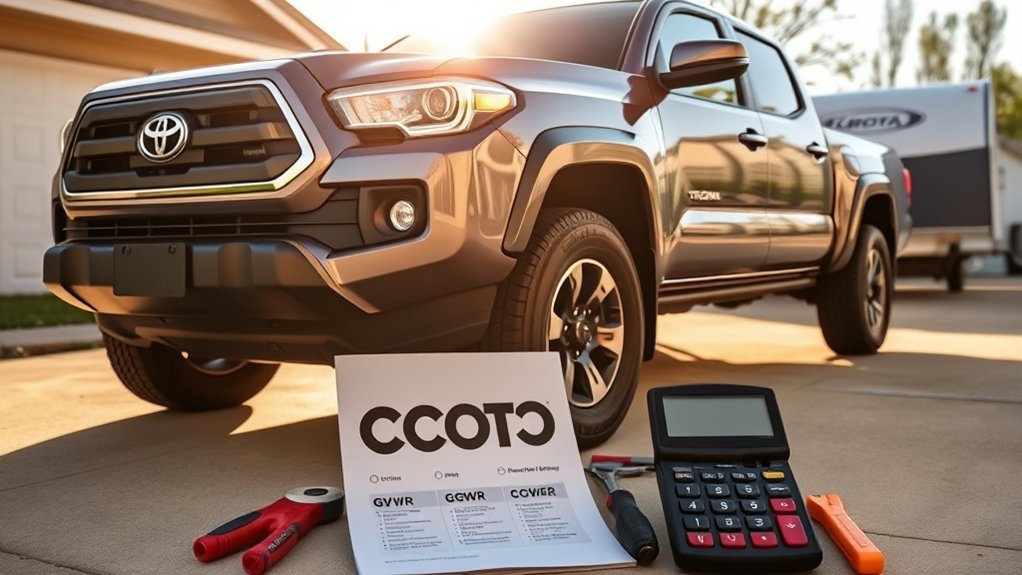
To calculate what your Tacoma can safely tow, start with your exact truck rather than a generic internet number. A 2.7L 4-cylinder Tacoma, a V6 Tacoma without the tow package, a V6 4×4, and a V6 4×2 with the tow package can have very different limits.
[Products Worth Considering]

This trailer coupler lock provides visible, dependable protection for your trailer with a rugged all-metal build and bright yellow finish that helps deter theft. Its universal adjustable design fits common coupler sizes and offers multiple locking positions for a secure, convenient setup. Built for all-weather use, it features protective rubber caps and anti-corrosion plating to help keep the locking mechanism working reliably.

This trailer hitch lock helps secure your trailer and hitch-mounted accessories with a high-strength steel pin designed for 2-inch receivers. It includes a weather-resistant cap to help keep out dust and moisture, plus rubber O-rings to reduce rattling during towing. With two copper keys and a sturdy lock core, it offers added peace of mind and dependable everyday protection.

This trailer hitch pin lock is designed to secure Class III and IV 2-inch and 2-1/2-inch tow receivers, helping keep hitch-mounted gear protected during travel and storage. Its rotating head, tubular key design, and weather-resistant cap make it easy to use while helping guard against moisture, dust, and rust. Built from solid carbon steel with a zinc alloy lock core, it offers dependable towing security for trailers, cargo carriers, bike racks, and more.
Key Weight Ratings
Use these numbers as a starting point, then confirm your exact truck with the labels and manual:
| Rating | 2017 Toyota Tacoma Range or Value | What It Means |
|---|---|---|
| GVWR | 5,600 lb | Maximum loaded truck weight |
| GCWR | 11,360 lb | Maximum loaded truck and trailer combined |
| Payload | About 1,120–1,620 lb | Passengers, cargo, accessories, hitch weight, and tongue weight |
| Max Tow Rating | 3,500–6,800 lb | Maximum trailer weight by configuration |
| Tongue Load | Commonly 350 lb without the V6 Tow Package; up to 640–680 lb with the V6 Tow Package | Maximum downward load on the hitch |
Simple Towing Math for a Tacoma
Use this process before every heavy tow:
- Find your payload sticker. Look for the tire and loading label on the driver-side door jamb. It tells you how much occupant and cargo weight your specific Tacoma can carry.
- Add people and cargo. Include passengers, pets, coolers, tools, bed cargo, aftermarket accessories, and hitch equipment.
- Estimate or measure tongue weight. For many conventional trailers, tongue weight is commonly around 10–15% of loaded trailer weight, but you must also stay under Toyota’s tongue load rating and the hitch rating.
- Check GVWR. Loaded truck weight must stay at or below 5,600 pounds.
- Check GCWR. Loaded truck weight plus loaded trailer weight must stay at or below 11,360 pounds.
- Check the tow rating. Loaded trailer weight must stay under the tow rating for your exact Tacoma configuration.
Pro Tip: The cleanest way to remove guesswork is to weigh your loaded Tacoma and trailer at a certified public scale. Get separate truck axle weights and trailer weight so you can verify GVWR, GCWR, rear axle load, and tongue weight.
Example Payload Check
Here is a simple example. Suppose your Tacoma’s door sticker lists 1,175 pounds of payload. You load 550 pounds of passengers, 250 pounds of camping gear, and 70 pounds of hitch equipment.
That leaves:
1,175 – 550 – 250 – 70 = 305 pounds of remaining payload
In that example, a trailer with 600 pounds of tongue weight would overload the truck’s payload even if the trailer is below the Tacoma’s advertised tow rating.
Towing Configuration Impact
The V6 Tow Package makes a major difference on the 2017 Tacoma. Toyota lists the package as including a Class-IV towing hitch receiver, ATF cooler on automatic models, engine oil cooler, power steering cooler, 130-amp alternator, 4- and 7-pin connector with converter, and Trailer-Sway Control for V6 models.
That is why two Tacomas that look similar can have different towing limits. A properly equipped V6 4×2 Tacoma can reach Toyota’s maximum 6,800-pound rating, while many other configurations are rated lower.
Why Payload Capacity Matters When Towing
Payload is often the limit that Tacoma owners hit first. This is because towing adds weight to the truck through the trailer tongue. The heavier the tongue weight, the less payload remains for passengers and cargo.
For example, a 6,400-pound trailer with 10% tongue weight places about 640 pounds on the hitch. If your Tacoma’s payload sticker is near 1,175 pounds, that one trailer load may use more than half of the available payload before you add passengers, tools, firewood, luggage, or bed cargo.
Toyota defines payload capacity as GVWR minus curb weight and notes that the maximum you can haul depends on occupants, cargo, and added equipment. That means aftermarket parts matter. Bed racks, bumpers, sliders, tonneau covers, winches, larger tires, and drawer systems can reduce your remaining usable payload.
A trailer can be under the Tacoma’s tow rating and still be unsafe if tongue weight, payload, axle weight, or GCWR is exceeded.
[Products Worth Considering]
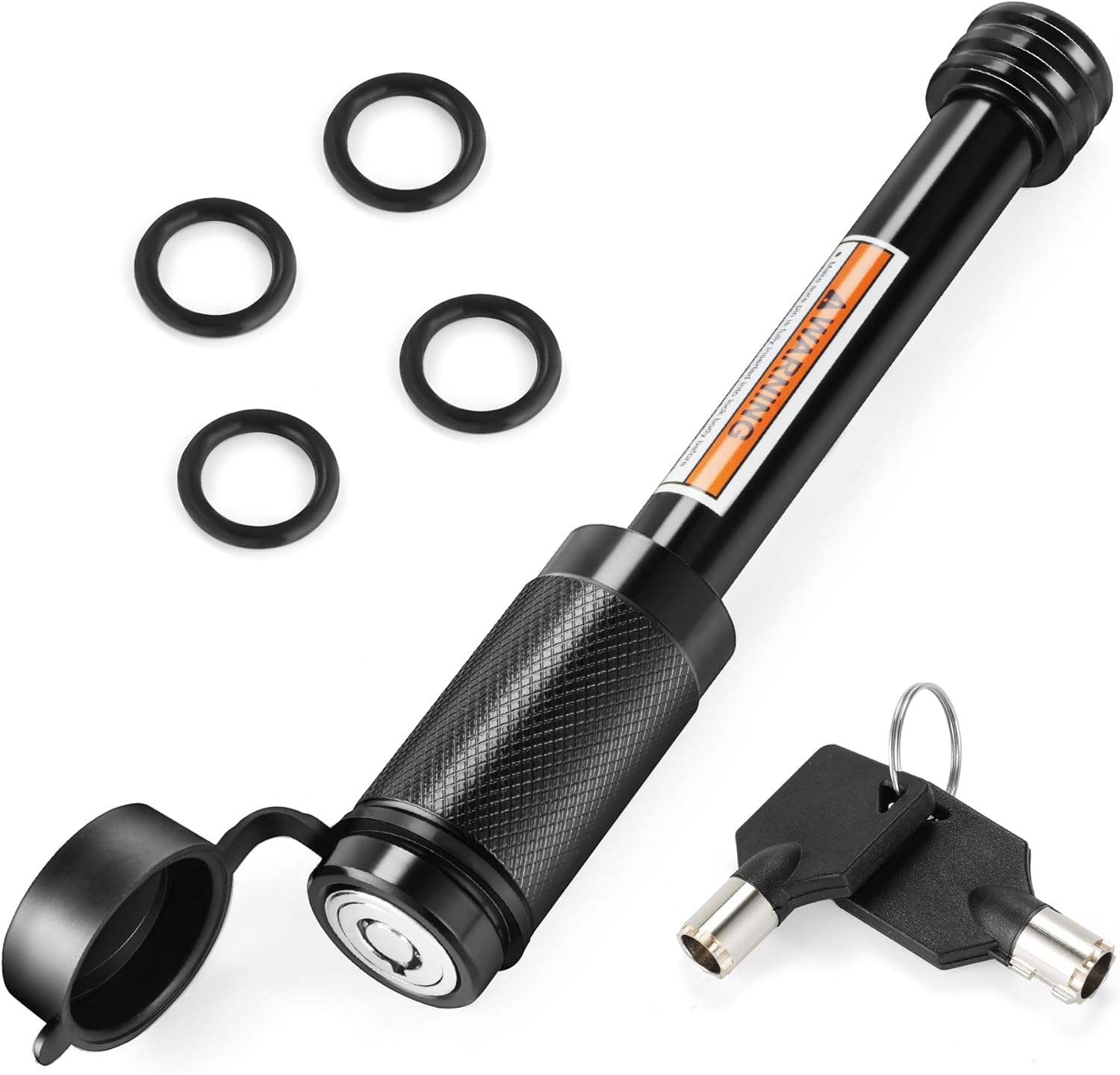
This trailer hitch pin lock helps secure your towing setup with a 5/8-inch pin and compatibility for most Class III and IV 2-inch and 2-1/2-inch receiver hitches. Built from durable carbon steel with a tamper-resistant tubular key system, it adds reliable anti-theft protection while the included rubber O-rings help reduce rattling noise during travel.

This proportional trailer brake controller provides smooth, responsive braking by automatically matching your tow vehicle’s stopping force for safer trailer control. The bright LED digital display makes it easy to monitor voltage output in real time, while adjustable braking and sync settings help tailor performance to different trailers and road conditions. Designed for quick installation and broad compatibility, it supports 1 to 4 axle trailers for dependable towing confidence.
Essential Towing Terms Every Tacoma Owner Should Understand
Towing terms can feel confusing at first, but each one answers a different safety question. Here are the most important terms Tacoma owners should know.
| Term | Meaning | Why It Matters |
|---|---|---|
| Curb Weight | Truck weight before passengers and cargo | Used to estimate payload, but actual weight changes with options and accessories |
| GVWR | Maximum loaded truck weight | Protects truck, tires, suspension, brakes, and handling |
| GAWR | Gross Axle Weight Rating | Keeps front and rear axle loads within safe limits |
| GCWR | Maximum loaded truck and trailer combined | Limits the total moving weight the powertrain and brakes must manage |
| GTW | Gross Trailer Weight | The loaded trailer weight, not the empty brochure weight |
| Tongue Weight | Downward force the trailer places on the hitch | Affects payload, rear axle load, steering feel, and trailer stability |
| Tow Rating | Maximum rated trailer weight for a specific setup | Varies by Tacoma configuration and required equipment |
| Trailer Brake Controller | Device that controls electric trailer brakes | Helps the trailer brake with the truck when properly installed and adjusted |
Optimizing Your Tacoma for Safe Towing
Safe towing is not about chasing the highest possible number. It is about setting up the truck, trailer, load, and driver for control.
[Products Worth Considering]

EASY TO INSTALL - No cutting or splicing required! This vehicle-specific wiring harness allows fast, easy, plug-and-play trailer brake controller installation. Simply plug one end into your vehicle and the other into your CURT brake controller
Essential Towing Equipment
| Equipment | Purpose | Tacoma Owner Note |
|---|---|---|
| Properly rated hitch and ball mount | Connects the trailer safely | Use the lowest rating among truck, hitch, ball, and trailer as the limit |
| 4-pin or 7-pin wiring | Powers lights and trailer brake circuits where equipped | The V6 Tow Package includes a 4- and 7-pin connector with converter |
| Trailer brake controller | Controls electric trailer brakes | Important for heavier trailers with electric brakes |
| Weight distribution hitch | Can help restore front-axle load on some setups | Use only if allowed by the truck, hitch, and trailer manufacturers |
| Proper tires and pressure | Supports load and heat control | Follow the tire placard and tire sidewall limits; do not exceed ratings |
Weight Management Strategies
Good weight management starts before you hitch the trailer. Load heavy cargo low and centered, secure loose items, and avoid placing too much weight behind the trailer axle.
For conventional bumper-pull trailers, a common tongue-weight target is 10–15% of loaded trailer weight. However, Tacoma owners must also respect Toyota’s listed tongue load rating. On many 2017 Tacoma configurations, the listed tongue load is 350 pounds without the V6 Tow Package and up to 640–680 pounds with the V6 Tow Package, depending on the exact model.
Note: The trailer’s published dry weight is usually not the number you tow. Batteries, propane, water, tools, food, camping gear, and dealer-installed options all increase loaded trailer weight.
Safety Precautions While Towing
| Safety Check | When to Check | Why It Matters |
|---|---|---|
| Truck and trailer tire pressure | Before every trip | Underinflation increases heat and instability |
| Lights and turn signals | Before every trip | Keeps other drivers aware of braking and lane changes |
| Safety chains and breakaway cable | Every hookup | Provides backup protection if the trailer disconnects |
| Trailer brakes | Every trip with a braked trailer | Helps control stopping distance and downhill braking |
| Load balance | After loading | Poor balance can cause sway or overload the rear axle |
When towing, leave more following distance, brake earlier, accelerate smoothly, and reduce speed in crosswinds, rain, steep grades, and rough pavement. If sway starts, avoid sudden steering. Ease off the accelerator, hold the wheel steady, and slow down gradually.
Common Towing Mistakes Tacoma Owners Make
Many Tacoma towing problems come from using one rating while ignoring the others. Avoid these common mistakes:
- Using the 6,800-pound number for every Tacoma. That is the maximum for specific properly equipped V6 configurations, not every 2017 Tacoma.
- Forgetting payload. Passengers, cargo, accessories, hitch equipment, and tongue weight all count.
- Relying on trailer dry weight. Loaded trailer weight is what matters on the road.
- Ignoring tongue load. Too little tongue weight can contribute to sway; too much can overload the truck, rear axle, or hitch.
- Skipping the scale. A certified scale is the best way to confirm the real loaded weight of the truck and trailer.
- Assuming aftermarket upgrades raise factory ratings. Better tires, suspension parts, or airbags may improve feel, but they do not automatically increase Toyota’s GVWR, GCWR, or tow rating.
Frequently Asked Questions
What is the highest towing rating on a 2017 Toyota Tacoma?
The highest published towing rating for the 2017 Toyota Tacoma is 6,800 pounds. This applies to specific 3.5L V6 automatic 4×2 configurations with the factory Tow Package. Other configurations are rated lower, commonly 3,500, 6,400, 6,500, 6,600, or 6,700 pounds depending on model and equipment.
Is GVWR the same as towing capacity?
No. GVWR is the maximum safe loaded weight of the Tacoma itself. Towing capacity is the maximum trailer weight for a specific truck configuration. A Tacoma can be under its trailer tow rating and still be overloaded if passengers, cargo, accessories, and tongue weight push the truck over GVWR or payload.
Can a 2017 Toyota Tacoma tow 7,500 pounds?
No. The 2017 Tacoma’s maximum published tow rating is 6,800 pounds when properly equipped. A 7,500-pound trailer exceeds the Tacoma’s factory tow rating and should not be towed with this truck.
What is the 2017 Toyota Tacoma GCWR?
Toyota lists the 2017 Tacoma’s Gross Combined Weight Rating at 11,360 pounds. That is the maximum combined weight of the loaded truck and loaded trailer.
How much tongue weight can a 2017 Tacoma handle?
It depends on configuration. Toyota’s published chart lists many 2017 Tacoma tongue load ratings at 350 pounds without the V6 Tow Package, while V6 Tow Package models can list tongue load ratings up to 640–680 pounds depending on trim, cab, drivetrain, and transmission. Always use the lowest rating among the truck, hitch, ball mount, and trailer.
Does tongue weight count against Tacoma payload?
Yes. Trailer tongue weight presses down on the hitch, so it counts as weight carried by the truck. That means it reduces the payload left for passengers, tools, cargo, and accessories.
Conclusion
For Tacoma owners, safe towing starts with knowing the difference between GVWR, GCWR, payload, tongue weight, and tow rating. The 2017 Toyota Tacoma has a 5,600-pound GVWR, an 11,360-pound GCWR, and a maximum tow rating of up to 6,800 pounds only when properly equipped. The safest approach is to check your exact truck’s labels, confirm the owner’s manual ratings, load carefully, and weigh the full setup before towing near the limit.
Sources
- Toyota Owners — 2017 Tacoma Manuals and Warranties — owner’s manual access and Toyota documentation hub for the 2017 Tacoma.
- Toyota Customer Service — Towing — Tacoma maximum towing guidance and reminder to check the owner’s manual.
- 2017 Toyota Tacoma eBrochure — published Tacoma specifications, including GVWR, GCWR, payload, tongue load, tow package equipment, and towing capacity by configuration.
- Toyota USA Newsroom — 2017 Tacoma Product Information — official Toyota product information page for the 2017 Tacoma.
- National Highway Traffic Safety Administration — Vehicle Load and Tire Safety — guidance on checking vehicle load limits and understanding that trailer weight can transfer to the tow vehicle.

[…] and towing limits instead of relying only on a headline maximum. See the site’s guides to Tacoma GVWR, GCWR, and towing terms and Tacoma towing capacity versus […]