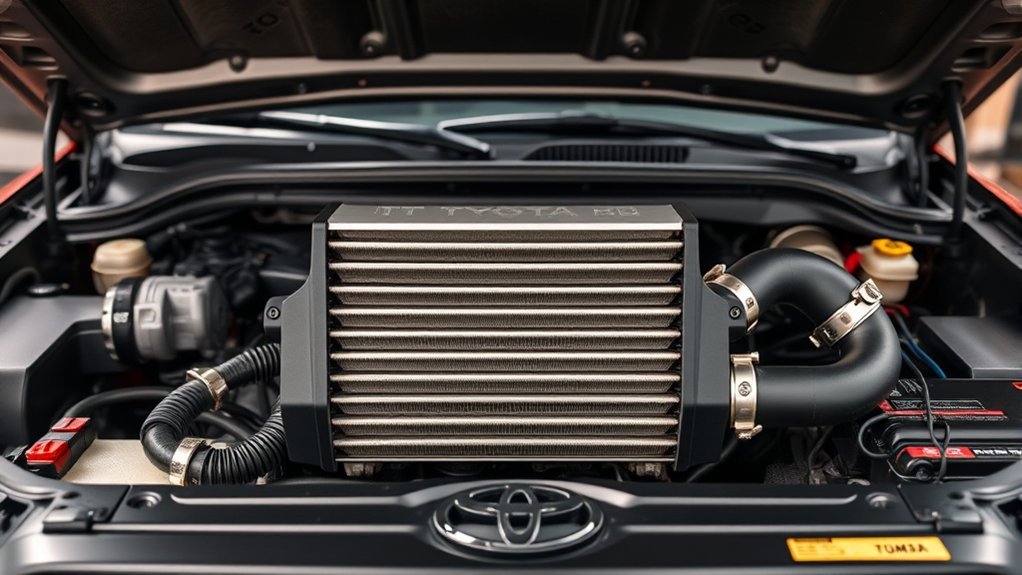
A Toyota Tacoma intercooler cools the compressed air leaving the turbocharger before that air enters the engine. On 2024+ Tacomas, the factory turbocharged 2.4-liter powertrains use charge-air cooling because compression raises air temperature. Lower charge-air temperature increases air density and helps the engine maintain more consistent power under towing, long grades, repeated acceleration, and hot off-road use. Earlier factory U.S.-market Tacomas with naturally aspirated engines did not use a factory intercooler.
Last updated: September 16, 2026 — refreshed with current 2024–2026 Tacoma fitment, Tacoma-specific intercooler test data, current example pricing, and installation guidance.
Quick Answer
The 2024–2026 Toyota Tacoma uses a front-mounted air-to-air intercooler with its turbocharged 2.4-liter engines. The intercooler removes heat from boosted intake air before it reaches the engine. A larger, lower-restriction intercooler can reduce heat soak and pressure drop during repeated load, but the gain depends on the core, airflow, charge pipes, ambient temperature, and calibration. A direct-fit intercooler does not automatically require a tune unless the manufacturer or your other modifications call for one.
Key Takeaways
- Fourth-generation 2024–2026 Tacomas use Toyota’s turbocharged 2.4-liter i-FORCE or i-FORCE MAX powertrains and a factory air-to-air charge-air cooler.
- The main reason to upgrade is better thermal consistency and lower restriction under sustained boost, not a guaranteed horsepower percentage.
- Tacoma-specific testing is more useful than generic “bigger core” claims. Compare outlet temperature, pressure drop, core construction, ducting, and repeat-run data.
- Hissing under boost, oily residue around couplers, damaged fins, high intake-air temperature, or low-boost faults can justify inspecting the intercooler and charge pipes.
- A 2024+ Tacoma intercooler replacement can require bumper access, charge-pipe disconnection, radiator removal, coolant service, sensor transfer, and careful leak checks.
How Does the Toyota Tacoma Intercooler Work?
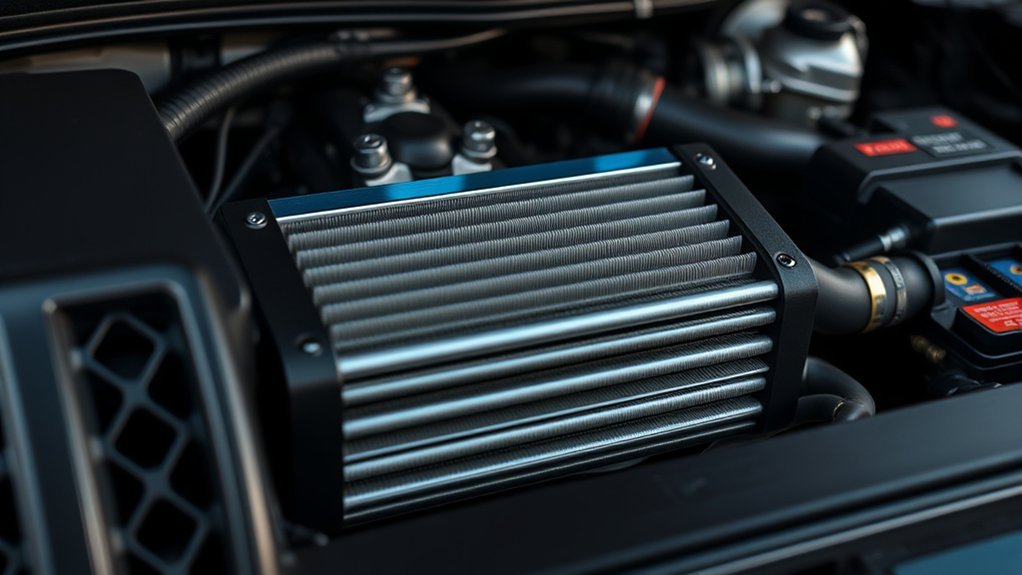
The Tacoma intercooler is a heat exchanger in the turbocharger’s charge-air path. The turbo compresses incoming air, which raises its temperature. The intercooler then removes part of that heat before the air reaches the intake manifold. Cooler air is denser, so the engine receives more oxygen for a given volume of intake air and can manage combustion more consistently.
For 2024, Toyota lists the i-FORCE 2.4-liter turbo engine at up to 278 horsepower and 317 lb-ft of torque, while i-FORCE MAX hybrid models reach up to 326 horsepower and 465 lb-ft depending on configuration. Those factory figures are in Toyota’s 2024 Tacoma eBrochure.
The important intercooler benefit is repeatability under heat. During towing, long grades, sand driving, trail work, or repeated acceleration, charge-air temperature can rise from one pull to the next. A more effective core can slow that heat-soak cycle and reduce the amount of pressure the turbo must make up across a restrictive charge-air path.
Note: This guide is mainly for fourth-generation 2024–2026 Tacomas. Earlier factory naturally aspirated Tacomas do not use a factory intercooler unless an aftermarket forced-induction system has been added.
Why Cooler Charge Air Helps a Turbo Tacoma
An intercooler transfers heat out of the turbocharged intake air. Hot charge air flows through sealed passages inside the core while outside air passes across the fins. Heat moves from the hotter charge air into the aluminum core and then into the cooler outside airflow.
Garrett Motion explains that turbo compression adds heat, hot air is less dense, and an intercooler removes part of that heat before the air reaches the engine. Its overview is available in Garrett Motion’s intercooler guide.
Three measurements matter when you compare a Tacoma intercooler:
- Charge-air temperature: how much the core lowers outlet temperature and how well it resists heat soak during repeated load.
- Pressure drop: the pressure lost between the intercooler inlet and outlet because of flow resistance.
- Airflow through the core: how well ducting, fin density, and the grille path move outside air across the heat exchanger.
A larger core can add thermal capacity, but size alone does not prove better performance. A useful Tacoma test controls the vehicle and conditions, then compares inlet temperature, outlet temperature, pressure drop, and repeated-run behavior between the factory and replacement core.
Is the 2024+ Tacoma Intercooler Air-to-Air or Air-to-Water?
The 2024–2026 Tacoma uses an air-to-air factory intercooler. That is the relevant layout for normal direct-fit Tacoma upgrades: boosted air passes through the core while outside air flowing through the front of the truck removes heat.
| Design | Tacoma Relevance | Advantages | Trade-Offs |
|---|---|---|---|
| Air-to-air | Factory-style layout for 2024–2026 Tacoma | Simple, no separate coolant pump or reservoir, direct exposure to front airflow | Performance depends on ambient airflow, ducting, core design, and heat soak |
| Air-to-water | Custom or specialized builds rather than the normal factory-style Tacoma upgrade path | Flexible packaging and strong short-duration temperature control when engineered correctly | Adds a pump, coolant circuit, heat exchanger, reservoir, plumbing, wiring, weight, and more failure points |
For a stock or mildly modified Tacoma, an air-to-air direct-fit core is usually the simpler path because it works with the factory charge-air layout. Air-to-water systems are a different engineering project, not a drop-in substitute that should be chosen only because the design sounds more advanced.
[Products Worth Considering]

This coolant thermostat is a direct replacement designed for a wide range of Toyota, Lexus, and Scion vehicles. It helps maintain proper engine temperature, supports reliable cooling system performance, and installs easily without special tools or programming. Built to meet OEM standards, it offers durable, stable operation and dependable fitment for compatible models.

The OEMTOOLS coolant vacuum refill kit helps quickly refill a vehicle’s cooling system while removing trapped air that can lead to overheating and engine damage. It also performs vacuum leak tests to help confirm system integrity and reduce the chance of repeat repairs. With multiple bushings, adapters, and a tapered cone seal, it is designed for flexible use on many radiator and coolant bottle necks.

This all-in-one radiator pressure tester and vacuum refill kit helps diagnose cooling system leaks, measure temperature, and refill coolant efficiently. It includes a wide range of adapters for broad vehicle compatibility, plus a pressure tester, vacuum refiller, thermometer, and storage case for organized use. Designed for DIY mechanics and professionals, it simplifies coolant service while reducing guesswork and unnecessary repairs.
Why the 2024+ Tacoma Uses a Front-Mount Intercooler
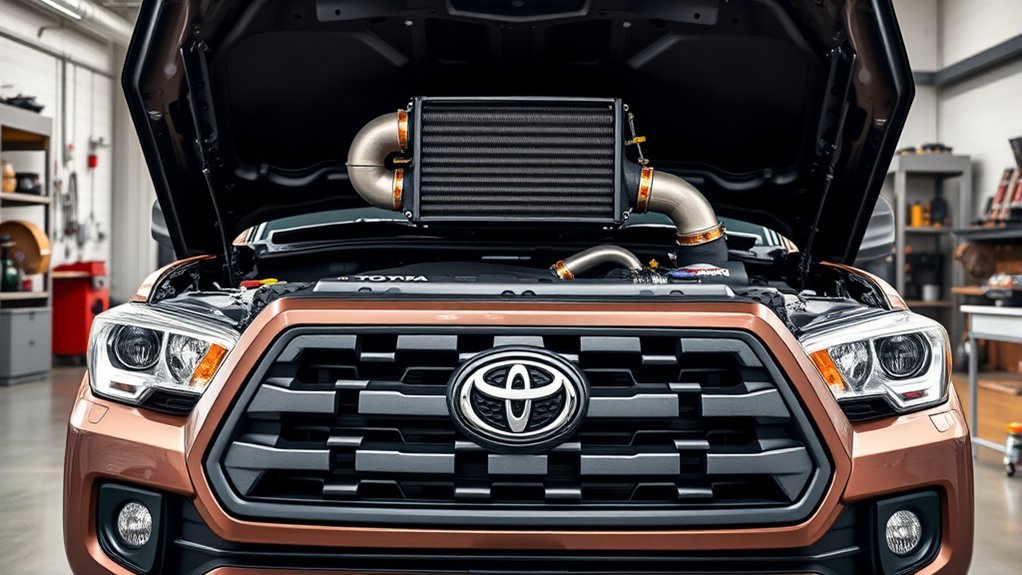
The fourth-generation Tacoma places the intercooler in the front cooling stack, where vehicle speed and grille airflow can move outside air across the core. Current direct-fit upgrades follow that factory front-mounted layout rather than converting the truck to a top-mount intercooler.
Front mounting suits a truck that may tow, climb grades, or stay under boost for longer periods because the core has direct access to outside airflow. The trade-off is packaging: the intercooler shares a tight area with the radiator, A/C condenser, ducts, shutters, sensors, and charge pipes. A larger core therefore has to improve cooling without blocking adjacent heat exchangers or creating poor fitment.
Top-mount intercoolers are common on some other turbo vehicles, but they are not the normal 2024–2026 Tacoma upgrade path. For this Tacoma, compare direct-fit front-mount systems by thermal data, pressure drop, ducting, sensor provisions, hybrid compatibility, and installation requirements.
[Products Worth Considering]

This silicone vacuum hose kit provides a versatile selection of tubing sizes and connector pieces for automotive, marine, and industrial routing tasks. Built for heat resistance and durability, it supports air and water applications in engine bays, custom intake setups, turbo piping, and cooling system projects. The included size variety makes it a practical choice for repairs, fabrication, and DIY maintenance work.

This engine water pump kit is designed to help maintain reliable cooling performance across a wide range of compatible Toyota, Lexus, Scion, and Pontiac vehicles. Built with aluminum and tested for leak-free operation, it offers a direct replacement solution that supports engine efficiency and long-term service life. The kit includes a professional water pump and gasket for a convenient installation-ready repair.

This master quick disconnect kit makes it easier to remove fuel lines, AC hoses, oil pipes, and radiator hoses on a wide range of vehicles. It includes a versatile mix of clip removers, spring lock removers, oil cooler line tools, and disconnect pliers to help handle common and specialized repair jobs. Built for durability and organized storage, it is a practical choice for technicians and DIY mechanics working on modern fuel and transmission systems.
What Core Size, Fins, Ducting, and Piping Change
Core construction, fin density, end-tank shape, ducting, and charge-pipe routing all affect how the Tacoma intercooler performs. A good upgrade has to reject heat while keeping flow resistance low enough that the turbo does not work unnecessarily hard to hit its target pressure.
Garrett’s technical overview explains that bar-and-plate intercoolers use separate charge-air and cooling passages and that fin density has to balance heat transfer with airflow. You can read the construction details in Garrett Motion’s heat-transfer guide.
Tacoma-specific data makes that principle concrete. Mishimoto reports that the factory fourth-generation Tacoma uses a tube-and-fin intercooler. Its 2024+ replacement uses a larger bar-and-plate core, and the company’s development testing reported lower outlet temperatures and lower pressure drop than the stock unit. Treat those numbers as manufacturer test data, not a guarantee that every truck, weather condition, or competing intercooler will produce the same result.
Ducting matters because air must pass through the core rather than around it. Piping matters because every coupler, bend, diameter change, and connection can add volume, restriction, or another possible leak point. Shorter is not automatically better if the routing rubs, necks down, or leaves the core without even airflow.
Pro Tip: Ask for repeat-run intake-temperature data and pressure-drop data before buying. Also check whether the kit includes ducting, charge pipes, clamps, sensor provisions, hardware, hybrid-specific instructions, and a documented leak-check procedure.
When Is a Tacoma Intercooler Upgrade Worth Considering?
Consider an intercooler upgrade when your 2024+ Tacoma regularly sees sustained boost from towing, long grades, hot-weather trail use, repeated acceleration, or added engine power. A stock truck used for ordinary commuting may never need a larger intercooler simply because an aftermarket core exists.
Signs that the intercooler or charge-air system needs inspection include:
- Intake-air temperature climbing quickly during repeated pulls or long grades.
- Power becoming less consistent as the truck and charge-air system get hotter.
- Hissing under boost, which can point to a loose coupler, cracked pipe, damaged seal, or leaking connection.
- Boost-, airflow-, or temperature-related fault codes, especially after charge-air modifications.
- Damaged fins, packed debris, cracked end tanks, or heavy oil residue around charge-pipe joints.
Use Tacoma-specific test data to judge the upgrade rather than assuming a horsepower percentage. Mishimoto’s published engineering material for its 2024+ Tacoma intercooler reports a stock peak pressure drop of about 2.9 psi versus about 1.9 psi with its replacement core, along with lower outlet temperatures in repeated testing. That is vendor-generated data for one product and test setup, so it should be treated as a comparison example rather than a universal Tacoma result.
Price also depends on whether you buy only the core or a complete system. As checked on September 16, 2026, Mishimoto lists its 2024–2026 Tacoma intercooler at $849.95 and its complete intercooler-and-charge-pipe kit at $1,239.95. Prices can change, and other brands may sit above or below those examples.
Choose a Tacoma intercooler by measured heat control, pressure drop, fitment, ducting, and leak-resistant connections—not by core size or claimed horsepower alone.
Front-Mount Intercooler Install: Step-by-Step Overview
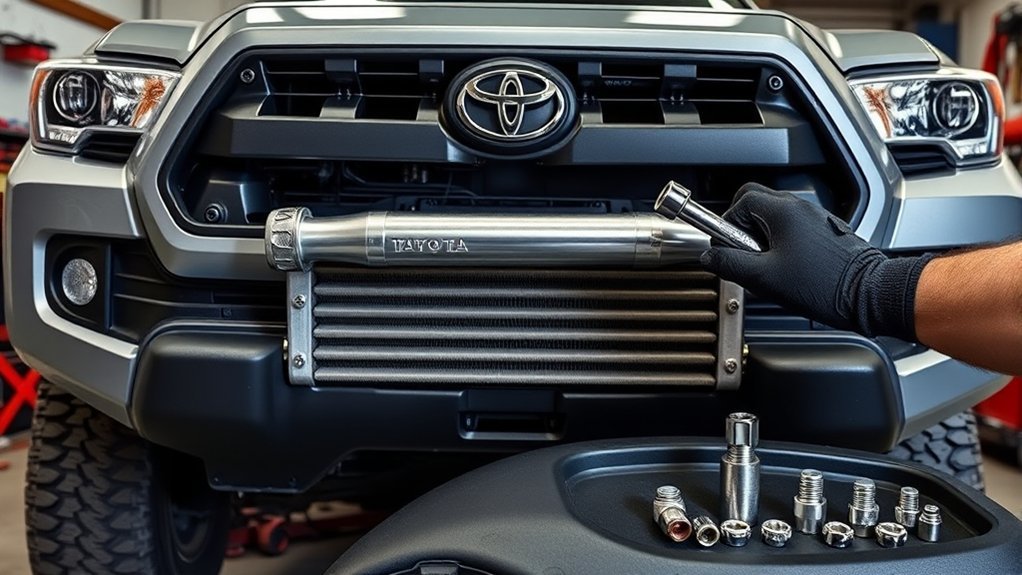
Installing a front-mount intercooler on a 2024+ Tacoma is more involved than swapping a simple intake tube. Mishimoto’s current installation guide lists about 4–5 hours and calls for radiator removal, cooling-system draining and refill, front-bumper access, charge-pipe work, and sensor transfer. Their product and install information is available on the Mishimoto 2024+ Tacoma intercooler kit page.
At a Glance
| Time Required | About 4–5 hours for a complete 2024+ Tacoma performance intercooler kit |
| Difficulty | Medium on Mishimoto’s listing; still an involved cooling-stack job |
| Tools Needed | Metric sockets, torque wrenches, extensions, hose-clamp pliers, pick tools, push-clip pliers, coolant catch pan, and optional coolant vacuum fill tool |
| Current Example Cost | $849.95 for Mishimoto’s intercooler or $1,239.95 for its complete intercooler-and-charge-pipe kit, checked September 16, 2026 |
Warning: Work only on a completely cool engine. Support the vehicle safely, protect painted panels, capture and recycle coolant properly, and follow the exact torque specs from the kit manufacturer or Toyota service information. Incorrect installation can cause coolant leaks, boost leaks, overheating, or drivability problems.
Prep And Vehicle Access
Start by parking on a level surface and letting the truck cool completely. Disconnect any parts the kit instructions require. On some 2024+ Tacoma kits, the radiator is removed and the cooling system is drained, so have a coolant catch container ready and confirm the correct coolant type before starting.
| Task | Fastener / Part | Why It Matters |
|---|---|---|
| Let engine cool | Cooling system | Prevents burns and pressure-related spills |
| Remove undertray | Typically 12mm bolts | Creates access from below |
| Remove upper panels and clips | Push clips and 10mm bolts | Clears bumper and duct access |
| Disconnect bumper wiring | Camera and sensor connectors | Prevents harness damage |
| Protect painted edges | Painter’s tape | Reduces risk of scratches during bumper removal |
Intercooler Removal Steps
After access panels and bumper parts are out of the way, remove the ducting, charge pipes, and any harness clips or hoses blocking the intercooler. Keep fasteners organized by step. If the kit requires radiator removal, clamp or cap lines as instructed, support the A/C condenser, and avoid stressing hard lines or wiring.
- Remove the lower intercooler duct and side ducts.
- Disconnect charge pipes at the turbo outlet, intercooler, and throttle-body side as directed.
- Disconnect required coolant hoses, sensors, and wiring clips.
- Remove the radiator and intercooler assembly only if the kit instructions call for it.
- Transfer any required temperature sensors, fittings, bushings, or crush washers to the new intercooler.
- Inspect factory hoses, clamps, couplers, and mounting points before reassembly.
Reassembly And Leak Check
Reassembly is where details matter. Seat the intercooler squarely, route charge pipes without rubbing or stress, and make sure spring clips and couplers are fully engaged. If your kit provides torque specs, use them exactly and pay attention to whether the value is listed in inch-pounds or foot-pounds.
On the Mishimoto 2024+ Tacoma kit, the guide lists examples such as 13 ft-lb for the six radiator bolts, 53 in-lb for the four factory intercooler mounting bolts, 15 ft-lb for the transferred temperature sensor, and 49 in-lb for the transmission oil cooler bolts. Those values are kit-specific, so do not apply them blindly to a different intercooler.
After reassembly, refill and bleed the cooling system if it was opened. On hybrid models, reconnect the additional radiator hoses and hard lines exactly as the kit instructions specify. Start the truck, inspect for coolant and transmission-fluid leaks where applicable, check every charge-pipe connection, and perform a careful road test while watching for warning lights, abnormal noises, or loss of boost.
Common Intercooler Problems on Tacomas and How to Troubleshoot
Intercooler problems usually show up as heat, leaks, or airflow restrictions. Because the intercooler sits in the charge-air path, even a small issue can make the truck feel sluggish under boost.
- Heat soak: Intake-air temperatures climb after repeated pulls, towing grades, or slow off-road work. Check whether the core is blocked by debris and whether the upgrade is sized correctly for the truck’s use.
- Boost leaks: A hissing sound, oily residue near couplers, loose clamps, or low-boost codes can point to a leak. Pressure testing or smoke testing helps locate the fault.
- Damaged fins or blocked airflow: Mud, leaves, bugs, bent fins, or crash damage reduce heat transfer. Clean carefully and avoid crushing the fins with high-pressure water.
- Poor pipe fitment: Charge pipes that rub, twist, or sit under tension can loosen over time. Check clearance around the radiator, fan shroud, bumper, frame points, and harnesses.
- Sensor or connector issues: A disconnected intake-air temperature sensor, MAP sensor, or bumper harness can trigger warning lights or drivability problems after installation.
Note: A small oil film inside charge pipes can be normal on many turbo engines, but pooled oil, heavy residue, or smoke may point to a separate turbo, PCV, or engine issue that should be diagnosed before blaming the intercooler.
Maintenance, Warranties, and Choosing the Right Aftermarket Unit
A good intercooler still needs basic inspection. Check the core after muddy trail runs, front-end impacts, or any event that could bend fins or pack the grille area with debris. Clean bugs and mud gently. Recheck couplers, clamps, brackets, and pipe routing after installation and periodically afterward, especially if you hear a new hiss or see residue around a connection.
| Factor | What To Check |
|---|---|
| Vehicle fitment | Confirm year, engine code, trim, hybrid compatibility, bumper clearance, and sensor compatibility |
| Core design | Compare core size, construction, pressure drop, and intake-air temperature data |
| Piping and couplers | Look for smooth routing, quality clamps, bead-rolled pipe ends, and proper support |
| Ducting | A larger core still needs directed airflow to work well |
| Warranty | Read coverage terms, proof-of-purchase rules, labor exclusions, transferability, and modification limits |
| Install support | Favor kits with complete instructions, torque specs, hardware lists, and technical support |
Choose a kit based on how you use the truck. A daily driver needs reliable fitment and low maintenance. A tow rig needs sustained cooling and strong clamps. A tuned Tacoma needs pressure-drop data and enough core capacity to support the calibration. A trail truck needs durability, good mounting, and protection from mud and debris.
[Products Worth Considering]

This radiator burping funnel kit helps simplify coolant refilling, bleeding, flushing, and spill-free maintenance across a wide range of vehicles. Its translucent body with clear scale supports controlled filling, while multiple adaptors, caps, and extension pieces improve compatibility and access in tight engine bays. The built-in shut-off valve and rubber-gasket design help reduce spills and make cooling system service cleaner and more convenient.

This coolant electric water pump is designed as a replacement for select Toyota vehicles, helping maintain proper engine cooling performance and reliable temperature control. Built to OE specifications, it offers fitment support for compatible Avalon, Camry, and RAV4 models with 2.5L L4 engines. It also includes cross-reference part numbers for easier matching and comes with after-sales support for covered defects.

This flexible oil funnel is designed to make fluid changes cleaner and easier by guiding oil around obstacles like skid plates and crossmembers. Its shape-retaining core and silicone body can be molded for custom positioning, while the heat-resistant, leak-proof design helps prevent spills during draining and filter removal. Reusable and easy to clean, it works well for cars, trucks, motorcycles, and other hard-to-reach fluid fill or drain applications.
Frequently Asked Questions
How does a Toyota Tacoma intercooler work?
A Tacoma intercooler removes heat from compressed turbo air before that air enters the engine. Cooler charge air is denser and helps the turbocharged engine maintain more consistent combustion and power under load.
Do 2024–2026 Toyota Tacomas have an intercooler?
Yes. Fourth-generation 2024–2026 U.S.-market Tacomas use turbocharged 2.4-liter powertrains and a factory charge-air intercooler. Earlier factory naturally aspirated Tacomas did not use a factory intercooler.
Is the 2024+ Tacoma intercooler air-to-air or air-to-water?
The factory fourth-generation Tacoma uses an air-to-air front-mounted intercooler. Direct-fit aftermarket replacements normally keep that layout. Air-to-water systems are a more specialized custom approach with extra pumps, coolant plumbing, and hardware.
Does a Tacoma need a tune after an intercooler upgrade?
Not necessarily. Some direct-fit intercoolers are designed to work with the factory calibration. Follow the intercooler manufacturer’s instructions, and get calibration advice if the truck also has changes that alter boost, fueling, turbocharger flow, or other engine-control targets.
Can a bad intercooler or charge pipe cause low boost?
Yes. Cracked end tanks, damaged pipes, loose couplers, failed seals, or poor clamp engagement can create charge-air leaks. Symptoms can include hissing under acceleration, reduced power, poor throttle response, or boost-related fault codes.
How much does a 2024+ Tacoma intercooler cost?
Pricing depends on whether you buy only the core or a complete system. As checked September 16, 2026, Mishimoto lists its 2024–2026 Tacoma intercooler at $849.95 and its complete intercooler-and-charge-pipe kit at $1,239.95. Other brands and future prices will vary.
How often should I inspect my Tacoma intercooler?
Inspect the intercooler and charge-pipe connections after installation, after hard off-road trips or front-end impacts, and whenever you notice a new hiss, power loss, damaged fins, packed debris, loose clamps, or residue around charge-air joints.
Conclusion
On a 2024–2026 Toyota Tacoma, the intercooler is part of the factory turbo system, not an optional add-on. It cools compressed charge air before the engine, and a well-designed upgrade can improve temperature control and reduce restriction during sustained load. For a stock daily driver, the factory unit may be completely adequate. For frequent towing, hot-weather trail use, repeated boost, or a tuned setup, compare real Tacoma test data, pressure drop, ducting, fitment, sensor provisions, and installation demands before buying.
If you suspect a problem rather than simply wanting an upgrade, inspect the core and charge-air connections first. A leaking coupler, damaged pipe, blocked core, or disconnected sensor can imitate a weak intercooler and should be diagnosed before parts are replaced.
Sources
- Toyota 2024 Tacoma eBrochure — factory Tacoma powertrain output and model information.
- Toyota USA Newsroom: 2024 Tacoma i-FORCE MAX — official i-FORCE MAX powertrain overview.
- Garrett Motion: Intercooler Cores and Performance Intercoolers — turbocharger charge-air cooling basics.
- Garrett Motion: Heat Transfer and Selecting the Correct Core — intercooler construction, conduction, convection, and core design.
- Mishimoto 2024+ Toyota Tacoma Intercooler Kit — example aftermarket kit specifications, fitment notes, and installation resources.
- Mishimoto: How To Install an Intercooler on a 2024+ Toyota Tacoma — installation overview for a Tacoma-specific performance intercooler kit.