

A steep driveway can scrape a Toyota Supra because the car sits low, has short clearance at the front lip and undertray, and may meet a sharp grade change before the tires can climb it. The safest fix starts with a slow diagonal approach, correct tire pressure, and a quick clearance check before you commit. If the same driveway still scrapes, use ramps, a smoother apron, skid protection, or professional driveway work instead of forcing the car over the edge.
Quick Answer
To drive a Supra into a steep driveway without scraping, approach at a slow diagonal angle, usually around 30–45 degrees, keep the throttle steady, avoid sudden braking, and let one front wheel climb before the other. If the lip still touches, use a curb ramp, driveway bridge, or professional regrading.
Key Takeaways
- Enter steep driveways diagonally and slowly so the front lip does not hit the grade change all at once.
- Check cold tire pressure, front-lip height, undertray clearance, and rear bumper clearance before testing a difficult driveway.
- Do not rely on speed. Momentum can make the suspension compress and turn a light scrape into cracked trim or underbody damage.
- If careful technique still fails, use portable ramps, a smoother driveway apron, skid plates, a front-lift system, or regrading.
At a Glance
| Time Required | 5–10 minutes to test an approach; longer for ramps or driveway changes |
| Difficulty | Easy for technique; moderate to professional for permanent fixes |
| Tools Needed | Tire pressure gauge, flashlight, tape measure, spotter, and optional portable ramps |
| Cost | Free for driving technique; low to moderate for ramps or skid plates; higher for lift systems or regrading |
How to Angle-Enter a Steep Driveway Safely

The best first move is to reduce the angle your Supra sees at the driveway entrance. Instead of driving straight in, approach diagonally at about 30–45 degrees. This lets one front wheel climb before the other, which gives the front lip and undertray a better chance to clear the sharp transition.
- Slow down before the driveway. Creep in at walking speed. Do not use speed to “bounce” the car over the entrance.
- Start wide if traffic and space allow. Line the car up so the front bumper meets the driveway at a diagonal, not straight on.
- Keep throttle and braking smooth. Sudden braking can compress the nose and make the front lip scrape sooner.
- Let the first front wheel climb. Pause slightly as the first wheel reaches the slope, then keep rolling gently as the second wheel follows.
- Watch the rear bumper on the way in. A steep driveway can scrape the rear diffuser or bumper after the front clears.
- Back out with the same care. Exit diagonally too, because the rear departure angle can be the problem on the way out.
Warning: Do not stop with the front lip sitting on the edge of the driveway and then add throttle. If you hear scraping, stop, reverse slowly if safe, and change the angle or use ramps before trying again.
Prep Your Supra: Tires, Gear, and Suspension Checks
Before you tackle a steep driveway, do a quick setup check. Toyota’s current GR Supra specifications confirm the car’s low sports-car proportions, and the owner’s manual should be your source for model-specific tire, jacking, and maintenance instructions. For tire pressure, use the cold pressure listed on the driver-side placard or in the owner’s manual, not the maximum number molded into the tire sidewall. The National Highway Traffic Safety Administration also recommends checking tire pressure when tires are cold.
- Tires: Check cold tire pressure and look for uneven wear, cuts, bubbles, or low tread before testing a difficult driveway.
- Gear selection: Use first gear, manual mode, or gentle automatic creep so the car moves smoothly without a throttle surge.
- Suspension: If your Supra has adjustable coilovers or air suspension, use the higher safe street setting before entering.
- Load: Extra passengers, cargo, or a full trunk can reduce usable clearance. Test the driveway with your normal daily load.
- Undercarriage: Look under the front lip, undertray, oil-pan area, exhaust, and rear diffuser for existing damage.
Pro Tip: If you are unsure where the lowest point is, slide a piece of cardboard under the front lip and undertray while the car is parked flat. Mark the lowest contact point, then use that spot as your clearance reference.
Why Supras Scrape: Approach, Breakover, and Departure Angles
Supra driveway scraping comes down to three simple geometry limits: approach angle, breakover angle, and departure angle. You do not need to calculate them perfectly, but you do need to understand what each one controls.
| Angle | What It Means | What Scrapes |
|---|---|---|
| Approach angle | How steep a slope the front of the car can meet before the bumper or lip touches. | Front lip, splitter, bumper cover, undertray |
| Breakover angle | How sharp a crest or grade change the car can pass over without high-centering. | Center underbody, braces, exhaust, pinch-weld area |
| Departure angle | How steep a slope the rear of the car can leave without dragging. | Rear bumper, diffuser, exhaust tips |
The Supra’s wheelbase and low ground clearance are great for handling, but they leave less room for abrupt grade changes. That is why a driveway can look harmless from the driver’s seat and still catch the lip or undertray. The sharper the change between street, gutter, apron, and driveway, the more likely the car is to scrape.
The problem is usually not the driveway’s total steepness alone. It is the sudden grade break where the street, gutter, curb, apron, and driveway meet.
How to Measure Your Driveway Before You Scrape
A quick driveway check can save your bumper. You are looking for the exact point where the car touches, not just the overall slope.
- Measure the lowest front point. On level ground, measure from the pavement to the bottom of the front lip or undertray.
- Measure the front overhang. Measure from the front tire contact patch to the lowest front point. A longer overhang needs a gentler driveway transition.
- Find the sharp grade break. Look for the curb, gutter, drain channel, apron edge, or driveway crown where the angle changes suddenly.
- Test with a spotter. Have someone stand safely to the side and watch the front lip, center underbody, and rear bumper.
- Mark the safe line. Once you find the angle that works, use that same wheel path every time.
Note: Many public agencies treat driveway aprons, sidewalks, gutters, and curb cuts as part of the right-of-way. The Federal Highway Administration notes that driveway access rules vary by state and locality, so check local permit rules before changing a curb, gutter, or sidewalk area.
[Products Worth Considering]

Camco Trailer Aid Plus provides a 5 1/2-inch lift to make tandem tire changes on trailers and RVs easier and faster. Its strong polymer construction is lightweight, waterproof, rustproof, and built for dependable outdoor use, while the high weight capacity supports a wide range of trailer maintenance needs. Designed for convenient portability, it helps you change a flat without unloading cargo or horses.

ROBLOCK low profile car ramps are designed to give low-chassis vehicles safer access for lifting, repairs, and maintenance work. The widened, shortened ramp design helps create room for a jack while the 17-degree slope and curved shape improve vehicle placement and stability. Built from impact-resistant PP with non-slip features and a high load capacity, these ramps are a practical choice for home garages and professional service use.

These foldable emergency tire traction pads help give your vehicle the grip it needs to get unstuck from snow, ice, mud, or sand. Each lightweight pad is easy to carry and designed with a honeycomb surface and adjustable angle to improve traction across different road conditions. Built to support heavy loads, they make a practical roadside recovery tool for unexpected driving emergencies.
Fixes When Technique Fails: Portable Ramps, Lifts, and Regrading
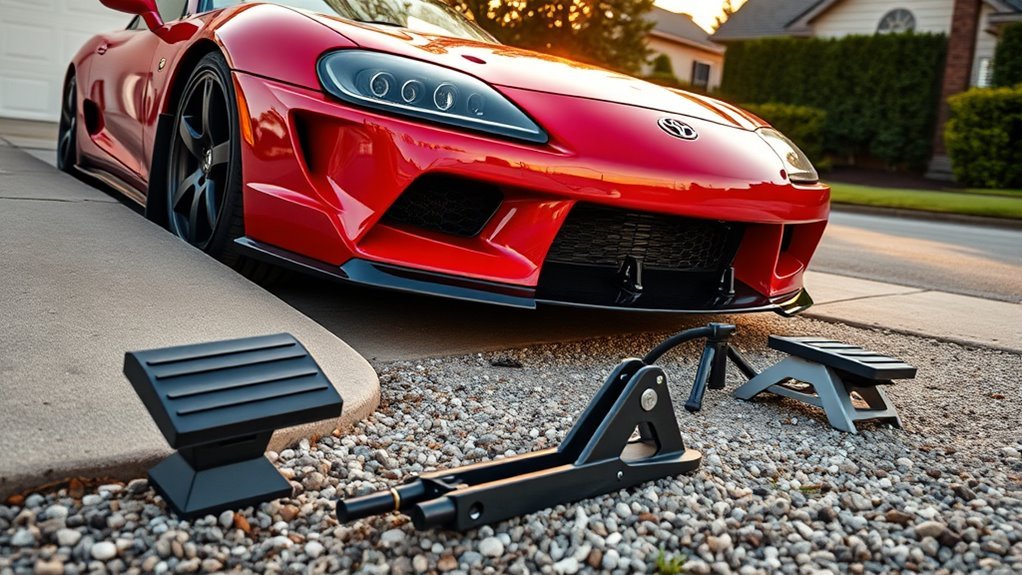
If careful line selection still leaves your Supra kissing the driveway, change the driveway transition instead of forcing the car. The best fix depends on whether you need a temporary solution, daily convenience, or a permanent repair.
- Portable rubber bridge: A removable curb ramp can smooth a rolled curb or gutter dip. Products such as BRIDJIT curb ramps are designed for rolled curb driveway entries and modular width adjustment.
- Low-profile service ramps: Use these for inspection or garage work, not as a loose public-street fix unless the product and local rules allow it.
- Skid plates: These do not create more clearance, but they can protect vulnerable contact points from light scraping.
- Front lift or air suspension: These can add useful approach clearance, but they cost more and may require alignment, maintenance, and careful installation.
- Driveway apron or regrading: This is the cleanest permanent fix when the driveway shape is the real problem.
For permanent driveway work, ask a local concrete contractor or civil engineer about the grade break, not just the total slope. For example, Texas Department of Transportation driveway guidance discusses limiting driveway grade changes with vertical curves, which is exactly the kind of transition that helps low-clearance cars avoid scraping.
Warning: Do not leave loose boards, bricks, or unsecured ramps in the street, gutter, or sidewalk path. They can move under the tires, block drainage, create a trip hazard, or violate local right-of-way rules.
[Products Worth Considering]

These X-BULL recovery traction tracks help drivers get unstuck from sand, snow, mud, or ice with a stable U-shaped elastic design and a wavy ramp that makes tire entry easier. Built from reinforced nylon, they are flexible, impact-resistant, and designed to perform in extreme temperatures while providing reliable emergency traction for a wide range of vehicles.

This front windshield sunshade is designed to help keep your Toyota RAV4 cooler by reducing heat buildup after parking in direct sunlight. It blocks most UV rays to help protect your dashboard, seats, and steering wheel from sun damage, while the accordion folding design makes it easy to set up, store, and transport. Built with a durable triple-laminate construction and a silver reflective surface, it offers practical everyday sun protection for compatible RAV4 models.

Durable Rubber Material: Our 5" height curb ramp is constructed from durable and high-quality rubber materials. It features wear-proof and weather-proof material for long-lasting use against harsh weather conditions. Large Load Capacity: 33069 lbs/15 T. Therefore, It is an excellent tool to help your vehicles get over curbs smoothly.
Had a Scratch or Near-Miss? Quick Troubleshooting and Inspection
When you hear a scrape, stop and inspect before repeating the same approach. A light rub on a plastic lip may be cosmetic, but a hard hit can loosen panels or damage parts under the car.
- Park on level ground. Do not crawl under a car that is unstable or partly on a slope.
- Use a flashlight. Check the front lip, bumper tabs, undertray, oil-pan area, intercooler area, exhaust, and rear diffuser.
- Look for fluid leaks. Any drip after a hard underbody strike needs immediate attention before driving farther.
- Check for loose fasteners. Missing clips, hanging splash shields, or loose undertray panels can get worse at speed.
- Note the scrape point. Record whether the contact happened at the front, middle, or rear so you know which angle needs improvement.
- Listen on the next drive. New rattles, vibration, pulling, or steering changes mean you should have the car inspected.
If the car hit hard enough to bend a bracket, shift an undertray, or knock the steering alignment out, do not keep testing the driveway. Repair the damage first, then change the approach angle or driveway transition.
Choose the Right Long-Term Fix for Your Budget and Use Case
Match the fix to how often the driveway causes trouble. A driveway you use once a month may only need portable ramps. A driveway you use every day may justify a permanent apron change or lift solution.
| Fix | Best For | Trade-Off |
|---|---|---|
| Better driving line | Mild scraping or occasional steep entries | Requires space, patience, and consistency |
| Portable ramps | Rolled curbs, gutter dips, and temporary parking | Must be secure, legal, and kept clear of drainage paths |
| Skid plates | Light contact on known low points | Protects parts but does not add clearance |
| Front lift or air suspension | Daily low-car use where driveway work is not possible | Higher cost, more parts, possible alignment and maintenance needs |
| Regrade or repave | A home driveway that scrapes multiple vehicles | Most permanent, but usually needs permits, labor, and local approval |
Use long-term planning instead of guessing. Count how often the scrape happens, where the car touches, how much clearance you need, and whether the problem is on your property or in the public apron. That tells you whether the answer is technique, a removable bridge, vehicle protection, or driveway construction.
[Products Worth Considering]

Rolled Curb Ramp with Channel: Qty: 1PCs; Product Size: 48.1"L x 16"W x 2.6"H/ 122 x 40 x 6.5 cm. Designed to help your motor vehicles get over curbs or elevated sidewalks easily and without damage. Besides, the curb bridge can be permanently installed in high traffic areas to create a secure driving environment for driveway, parking lots, and more. Channel size: 2.2"W x1.4"/ 5.5 x 3.5 cm. With a channel on the bottom features for cable protection and water drainage.

Secure Your Vehicle: With a 15-ton weight capacity, this curb ramp is ideal for frequent garage use. It keeps your car’s tires and undercarriage secure from curb damage, ensuring a smooth entry and exit for SUVs and pickups

INTEGRATED MOUNTING HOLES: The Pyle Vehicle Curb Ramp can be permanently installed in high traffic areas using the integrated mounting holes at the edges of the ramp. It also has a built-in water or cable channel in the bottom
Frequently Asked Questions
How do I drive a Supra into a steep driveway without scraping?
Approach slowly at a diagonal angle, usually around 30–45 degrees, and keep the throttle steady. Let one front wheel climb before the other, avoid sudden braking, and use a spotter the first few times. If the front lip still touches, use a driveway ramp or change the driveway transition.
How do I fix a steep driveway entrance?
The most effective fixes are smoothing the grade break, adding a properly fitted curb ramp, rebuilding the driveway apron, or regrading the driveway. If the change touches the curb, gutter, sidewalk, or public right-of-way, check local permit rules before starting work.
What is the best way to make a steep driveway easier for a low car?
The best fix is a smoother transition, not simply a flatter driveway. A longer, gentler apron or vertical curve reduces the sharp break that catches the front lip, underbody, or rear bumper. Portable ramps can help temporarily, but regrading is the cleaner permanent solution.
Will skid plates stop my Supra from scraping?
Skid plates can protect parts from light contact, but they do not increase ground clearance. If the car is scraping because the driveway angle is too sharp, you still need a better approach angle, ramps, a lift solution, or driveway work.
Should I add air suspension or a front lift to my Supra?
A front lift or air suspension can help if you deal with steep driveways every day and cannot modify the driveway. Before installing one, compare the cost with ramps or apron work, and ask a qualified installer about alignment, reliability, maintenance, and warranty concerns.
Conclusion
Keeping your Supra scratch-free on steep driveways is about technique first and hardware second. Start with the slow diagonal approach, keep tire pressure correct, use a spotter, and learn exactly where the car touches. If the same driveway still scrapes after careful driving, stop treating it as a driving problem and fix the transition with ramps, skid protection, a lift solution, or professional driveway work. The goal is simple: clear the driveway without using speed, luck, or repeated bumper damage.
Sources
- Toyota 2026 GR Supra Full Specs — official GR Supra model specifications and vehicle configuration context.
- Toyota GR Supra Owner’s Manual — owner guidance for tire, maintenance, jacking, and inspection references.
- NHTSA TireWise Tire Safety — cold tire pressure and manufacturer placard guidance.
- Federal Highway Administration: Access Management and Driveways — driveway access rules and local permitting context.
- Texas DOT Driveway Grades — grade-change and vertical-curve guidance for driveway profiles.
- BRIDJIT Curb Ramps — example of a removable modular curb-ramp solution for rolled curb driveway entries.



[…] This section is the clearance-focused summary. For ramps, driveway changes and a more detailed approach walkthrough, see the site’s dedicated guide to entering a steep driveway in a Supra without scraping. […]