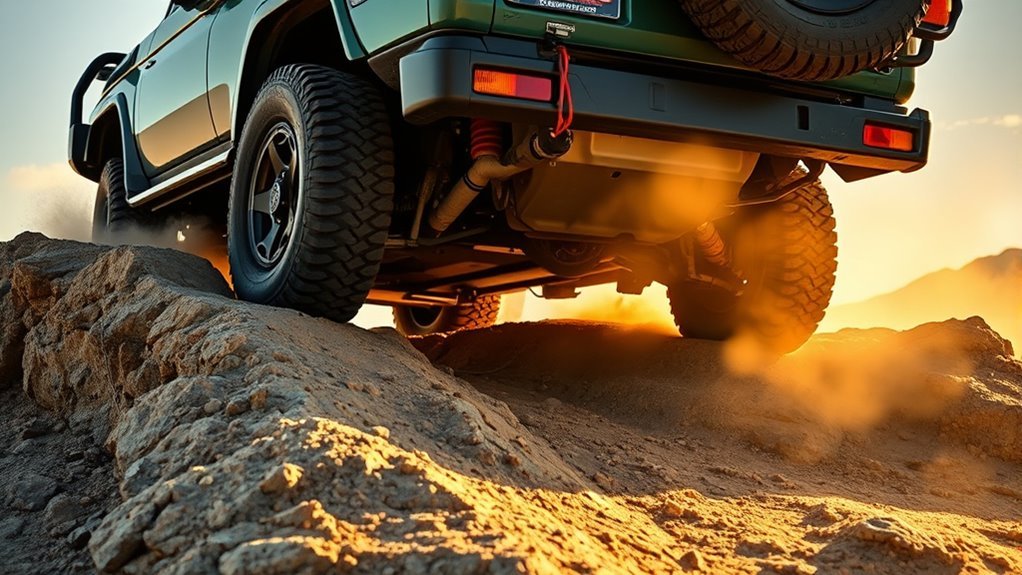
The Toyota Land Cruiser’s breakover angle tells you how easily it can crest a sharp ridge, ramp, or trail hump without the belly of the vehicle touching down between the axles. Toyota advertised the current U.S. 250-series Land Cruiser with a 25-degree breakover angle, but that number is model-, trim-, tire-, load-, and measurement-dependent. Treat it as a planning guide, not a promise that every Land Cruiser in every market or generation clears the same obstacle.
Quick Answer
Toyota lists the U.S. 2024 Land Cruiser with up to a 25° breakover angle, along with a 31° approach angle, 22° departure angle, and up to 8.7 inches of ground clearance. Older Land Cruiser generations and non-U.S. trims can differ, so always check the exact model-year spec.
Key Takeaways
- A higher breakover angle helps reduce the chance of high-centering on sharp crests, ledges, ruts, and trail humps.
- Toyota’s 25° figure applies to the current U.S. 250-series Land Cruiser specification; other Land Cruiser generations and regions may use different numbers.
- The correct geometry formula is breakover angle = 2 × arctan(2 × clearance ÷ wheelbase) for a simplified, symmetrical crest.
- Cargo, passengers, tire pressure, worn springs, skid plates, rock sliders, and aftermarket parts can reduce the real-world clearance you have on the trail.
- Bigger tires and suspension lifts can improve breakover angle, but bumpers mostly affect approach and departure angles rather than true breakover clearance.
Land Cruiser Breakover Angle: 25° and What It Means
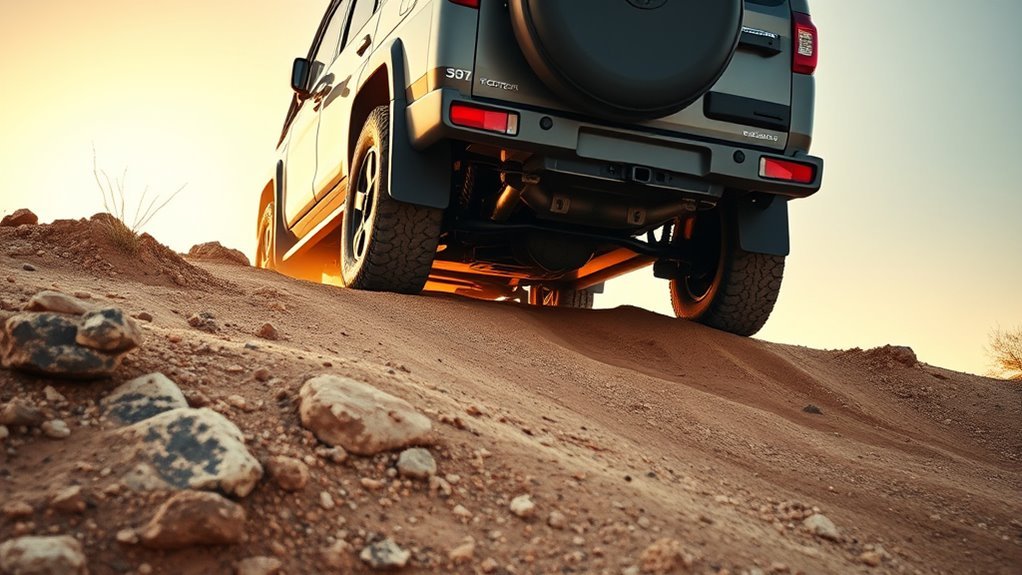
The Toyota USA Newsroom lists the 2024 U.S. Land Cruiser at up to 31° approach, 25° breakover, and 22° departure, with ground clearance up to 8.7 inches. In plain terms, the breakover angle describes the sharpest ramp-like crest the vehicle can roll over before the underside touches the peak between the front and rear wheels.
That 25° number is useful because the Land Cruiser has a long wheelbase compared with smaller trail vehicles. A longer wheelbase improves highway stability and interior space, but it gives the vehicle more belly to drag over sharp trail features. The breakover angle helps you decide whether to straddle a ridge, take it at an angle, stack recovery boards, or choose a cleaner line.
Note: Do not assume every Toyota Land Cruiser has a 25° breakover angle. Land Cruiser 70-, 80-, 100-, 200-, 250-, and 300-series models vary by market, wheelbase, suspension, tires, bumper design, and factory measuring method.
Why 25° Matters for Off-Road Performance
A 25-degree breakover angle matters most when the obstacle is sharp and centered under the vehicle. Think of a ridge, a rock shelf, a washout lip, a peaked dune, a deep two-track trail, or a mound between two ruts. These are the moments when the Land Cruiser’s middle section is most likely to drag.
| Trail Situation | Why Breakover Angle Matters | Best Driving Choice |
|---|---|---|
| Sharp ridge or ramp crest | The center skid area may touch before the tires finish climbing | Approach slowly and slightly off-angle when safe |
| Deep center mound between ruts | The mound can high-center the frame or skid plates | Keep tires on the high points instead of dropping into ruts |
| Rock ledge transition | A long wheelbase can drag as the rear tires climb | Use a spotter, low range, and steady throttle |
| Soft sand or snow crest | The belly can plow into the surface and stop momentum | Plan tire pressure and recovery gear before the climb |
The Land Cruiser’s 25° breakover angle is best used as a trail-planning number: it helps you avoid high-centering, but load, tire pressure, suspension sag, and line choice decide what happens in the dirt.
Breakover Angle vs. Approach Angle vs. Departure Angle
Breakover angle is only one part of off-road geometry. For trail planning, compare it with the Land Cruiser’s approach and departure angles:
| Measurement | What It Protects | Common Contact Point |
|---|---|---|
| Approach angle | Front of the vehicle | Front bumper, air dam, tow hooks, skid plate edge |
| Breakover angle | Middle of the vehicle | Frame crossmember, skid plate, exhaust, rock slider, underbody bracket |
| Departure angle | Rear of the vehicle | Rear bumper, hitch receiver, spare tire area, exhaust tip |
A short front bumper can improve approach angle. A tucked rear bumper or high-clearance hitch can improve departure angle. True breakover angle, however, is driven mainly by wheelbase and the lowest points between the axles.
[Products Worth Considering]

This all-in-one front end service kit is designed to help remove stubborn ball joints, tie rod ends, and pitman arms on a wide range of vehicles. Built from hardened alloy and organized in a portable ABS case, it offers reliable performance for both professional mechanics and DIY repairs.

This front license plate bracket is a direct replacement for compatible Toyota RAV4 models, offering an easy way to restore a damaged or missing front plate holder. Built from durable ABS material with the same dimensions as the original, it installs without modification and helps maintain a clean factory look.

This frameless convex blind spot mirror helps expand your field of view for safer lane changes, passing, and merging. The HD glass design offers a clear, wide-angle rear view, while the swivel mount supports flexible positioning for cars, SUVs, trucks, vans, and RVs. Easy to install and built for all-weather use, it is a practical upgrade for everyday driving confidence.
How Breakover Angle Is Calculated: Formula and Example
The simplified breakover-angle formula is:
Breakover angle = 2 × arctan(2 × ground clearance ÷ wheelbase)
Use the same unit for both numbers. If wheelbase is in inches, clearance must also be in inches. In this formula, ground clearance means the useful midpoint clearance at the lowest underbody point likely to touch the crest, not just the published minimum clearance spec.
At a Glance
| Time Required | 10–15 minutes |
| Difficulty | Easy for an estimate; moderate for precise underbody measuring |
| Tools Needed | Tape measure, level parking surface, calculator, flashlight, notepad |
| Cost | Free if you already have a tape measure |
Simple Example
Suppose a vehicle has a 100-inch wheelbase and 11 inches of useful midpoint clearance. The calculation is:
2 × arctan(2 × 11 ÷ 100) = 2 × arctan(0.22) ≈ 24.8°
Rounded, that vehicle would have about a 25° breakover angle in a simplified geometry model. This is why using the full formula matters: leaving out the first “2 ×” cuts the result roughly in half and creates a misleading number.
How to Measure Your Own Land Cruiser
- Park on level ground with the fuel, passengers, tools, water, fridge, roof load, and recovery gear you normally carry.
- Measure the wheelbase from the center of the front wheel hub to the center of the rear wheel hub on the same side.
- Use a flashlight to find the lowest underbody point between the axles that could touch a crest.
- Measure from the ground to that point. Avoid using a hanging mud flap or flexible trim piece as the main number.
- Run the formula, then leave a safety margin for tire deflection, suspension movement, uneven rocks, and driver error.
Pro Tip: Measure the Land Cruiser loaded for the trail, not empty in the driveway. Heavy cargo, rear-mounted accessories, passengers, and low tire pressure can reduce the clearance that matters when you crest an obstacle.
Why Published Specs Sometimes Disagree
Published Land Cruiser breakover-angle numbers can disagree because sources may be measuring different vehicles, trims, regions, loading conditions, or geometry points. Toyota’s own live 2026 Land Cruiser specifications page also notes that specifications can change and may vary by market or equipment.
Common reasons for conflicting numbers include:
- Different Land Cruiser generations: A 200 Series, 250 Series, 300 Series, Prado, or 70 Series may not share the same wheelbase, tire package, suspension, or bumper design.
- Different markets: U.S., Canada, Australia, Japan, Europe, and Middle East specifications can differ.
- Different loading conditions: Curb weight, payload, passengers, full fuel, and accessories all affect ride height.
- Different reference points: Some figures use a simplified ground-clearance calculation, while vehicle-dimension standards such as SAE J1100 define formal measurement procedures for motor-vehicle dimensions.
- Different underbody parts: A skid plate, crossmember, exhaust bracket, rock slider, fuel-tank guard, or aftermarket mount may become the first point to touch.
Note: Do not try to reverse-engineer Toyota’s 25° breakover angle using only the published minimum ground-clearance number. Minimum ground clearance may be measured at a different point than the part of the underbody used for a ramp-breakover measurement.
How Tires, Lifts, Skid Plates, and Bumpers Change Breakover Angle
The fastest way to improve a Land Cruiser’s breakover angle is to increase usable clearance between the axles. The most common changes are larger tires, suspension lifts, skid plates, rock sliders, and bumper upgrades. Each affects the vehicle differently.
| Modification | What It Usually Changes | Net Impact on Breakover Angle |
|---|---|---|
| Larger tires | Raises axle and body height by about half the tire-diameter increase, before tire deflection | Improves breakover angle if the tires fit without rubbing |
| Suspension lift | Raises the frame, body, and many skid-plate areas | Can improve breakover clearance, especially at the frame and belly area |
| Rock sliders | Protect rocker panels but may hang lower than stock trim | May reduce measured clearance slightly while improving protection |
| Skid plates | Protect expensive parts but can become the first contact point | May reduce clearance slightly; improves survivability when contact happens |
| Slim front or rear bumper | Reduces front or rear overhang | Mostly improves approach or departure angle, not true breakover angle |
| Heavy rear accessories | Adds weight behind the rear axle and can create sag | Can reduce real-world breakover and departure clearance |
Plan modifications as a system. A lift may improve belly clearance, but it can also change alignment, driveline angles, brake-line length, headlight aim, center of gravity, and warranty considerations. Bigger tires may help clearance, but they can affect gearing, fuel economy, spare-tire fitment, rubbing, speedometer accuracy, and braking feel.
Warning: Never rely on a lift or larger tires as a substitute for safe line choice. High-centering can damage skid plates, exhaust parts, mounts, driveline components, fluid lines, and recovery points.
[Products Worth Considering]

Designed for Toyota RAV4 models from 2013 through 2018, this three-piece windshield wiper set delivers clear, quiet performance for dependable visibility in changing weather. The precision-fit blades provide streak-free wiping, simple installation, and durable all-season use with reduced wind noise and consistent pressure across the windshield.
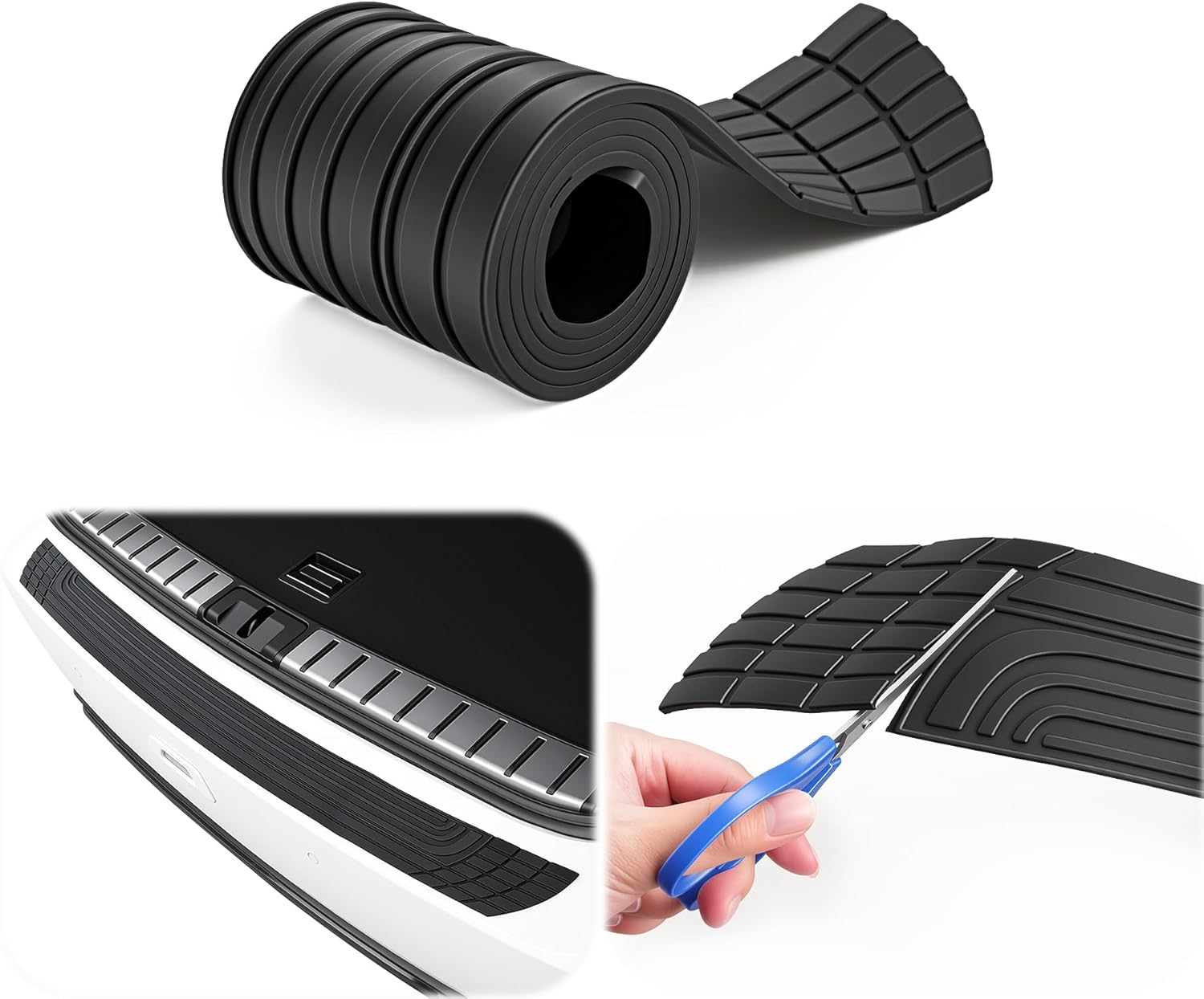
Protect your vehicle’s rear bumper from scratches, scuffs, and everyday loading damage with this universal bumper protector. Its flexible rubber design helps absorb impact and features an anti-slip groove pattern for added security when placing cargo in the trunk. Easy to install without drilling or welding, it is a practical exterior accessory for most cars and SUVs.

This front bumper license plate bracket is designed for Toyota vehicles from 2000 to 2026, offering a secure and street-legal way to mount your plate without covering important registration details. Made from durable, rust-proof materials, it helps protect your car’s finish while providing a clean, stable fit. The kit includes mounting hardware and a wrench for easier installation, making it a practical accessory for drivers who want a reliable plate holder solution.
Field Checks: How to Test, Avoid, and Recover When You Hit the Limit
Before you drive a sharp crest, do a quick field check. Look under the Land Cruiser for low-hanging parts, loose skid plates, bent brackets, damaged exhaust sections, or gear that has shifted. Check tire pressure, confirm recovery points are accessible, and make sure passengers know when to stay clear.
[Products Worth Considering]

This front bumper license plate bracket is designed for Toyota Camry and Camry Hybrid models from 2018 to 2026, offering a secure and street-legal way to mount your plate. Built from durable, rust-proof plastic with included screw bolts and a wrench, it helps protect your bumper paint while making installation straightforward. The bracket fits US and Canada plates and is made to keep your license plate and registration sticker visible.

This flexible oil funnel is designed to make fluid changes cleaner and easier by guiding oil around obstacles like skid plates and crossmembers. Its shape-retaining core and silicone body can be molded for custom positioning, while the heat-resistant, leak-proof design helps prevent spills during draining and filter removal. Reusable and easy to clean, it works well for cars, trucks, motorcycles, and other hard-to-reach fluid fill or drain applications.

This AUTOBOO windshield wiper blade set is designed to fit Toyota RAV4 models from 2013 to 2018 with an OE-style replacement fit. It includes front and rear blades for clear visibility, quiet operation, and dependable all-weather performance, while the easy J/H arm installation helps make replacement quick and simple.
Pre-Drive Visual Inspection
Use this quick checklist before a technical trail section:
- Look under the center of the vehicle for loose skid plates, dangling wiring, low exhaust parts, or brackets that may catch.
- Check that cargo is secured so the vehicle does not sag or shift when climbing.
- Confirm that tire pressure suits the surface and that all four tires are in good condition.
- Walk the obstacle before driving it when visibility is poor.
- Use a spotter for rocks, ledges, and crests you cannot see from the driver’s seat.
Driving Technique to Avoid High-Centering
Approach sharp crests slowly and deliberately. Use low range when the terrain calls for it, keep throttle smooth, and avoid bouncing the vehicle. In many cases, crossing the obstacle at a slight angle lets one tire climb before the other, which can reduce the chance of dragging the belly. Only do this when the side slope is safe and the vehicle will not tip or slide.
On public land, stay on legal routes and avoid creating bypasses around obstacles. The U.S. Forest Service advises motorized users to travel only on designated routes and know where they are allowed to drive before heading out.
Recovering From Grounding
If the Land Cruiser becomes grounded, stop before spinning the tires. Spinning can dig holes, reduce clearance further, and make recovery harder. Toyota’s owner guidance for a stuck vehicle warns against excessive wheel spin and notes that a vehicle may lunge suddenly when it frees itself, so keep people away from the recovery path.
- Stop and assess what is touching: skid plate, frame, rock slider, exhaust, hitch, or another part.
- Clear loose dirt, sand, snow, or rocks from around the tires and contact point.
- Use traction boards, flat rocks, or a shovel to build a smoother ramp for the tires.
- Back off gently if the approach line caused the contact and the rear path is clear.
- Use rated recovery points, a proper strap, or a winch only when you understand the load path and everyone is standing clear.
- After recovery, inspect skid plates, mounts, fluid lines, exhaust parts, and steering or suspension components before continuing.
Warning: Do not crawl under a grounded vehicle on unstable terrain unless it is securely supported and cannot move. A vehicle can shift suddenly when rocks, boards, sand, snow, or recovery tension changes.
Frequently Asked Questions
What is the breakover angle of a Toyota Land Cruiser?
Toyota lists the current U.S. 250-series Land Cruiser at up to 25 degrees of breakover angle. Other Land Cruiser generations, trims, tires, and global-market versions may differ, so check the exact model-year brochure or owner documentation before using one number for every Land Cruiser.
Is a higher or lower breakover angle better?
A higher breakover angle is better for off-road clearance because it lowers the chance of high-centering on sharp crests and ridges. A lower number means the vehicle is more likely to drag its underbody between the axles.
What is the correct breakover-angle formula?
For a simplified estimate, use breakover angle = 2 × arctan(2 × ground clearance ÷ wheelbase). This assumes a symmetrical sharp crest, equal tire size, no tire deflection, and the lowest contact point near the middle of the wheelbase.
Do bigger tires improve the Land Cruiser’s breakover angle?
Yes, bigger tires can improve breakover angle because they raise the vehicle. The useful gain is roughly half the increase in tire diameter, reduced by real-world tire deflection. Make sure the tire fits properly and does not rub at full steering lock or suspension compression.
Does a bumper upgrade improve breakover angle?
Usually no. A slim front bumper mainly improves approach angle, and a high-clearance rear bumper mainly improves departure angle. Breakover angle is mostly controlled by wheelbase and clearance between the axles.
Can I use the 25° number as a safe trail limit?
Use 25° as a planning reference, not a hard safety limit. Real trails are uneven, tires flex, suspension moves, cargo changes ride height, and rocks rarely form a perfect ramp. When in doubt, walk the obstacle, use a spotter, and choose a conservative line.
Conclusion
The Land Cruiser’s 25° breakover angle is a strong off-road planning number for the current U.S. 250-series model, but it only tells part of the story. The real-world limit depends on your exact Land Cruiser, tire size, payload, suspension height, underbody accessories, and the line you drive. Use the correct formula, measure your own setup when modified, and approach sharp crests slowly. Respect the geometry and the Land Cruiser will clear more trail with less underbody drama.
Sources
- Toyota USA Newsroom: The Evolution of a Legend — The All-New 2024 Land Cruiser — official 31° approach, 25° breakover, 22° departure, and 8.7-inch ground-clearance figures.
- Toyota 2026 Land Cruiser Specifications — current U.S. specification reference and Toyota’s equipment/availability caveat.
- Toyota Owners: If the Vehicle Becomes Stuck — official stuck-vehicle warnings and recovery cautions.
- SAE J1100: Motor Vehicle Dimensions — vehicle-dimension measurement standard reference.
- U.S. Forest Service: Off-Highway Vehicle Touring — responsible route planning and designated-trail guidance.