
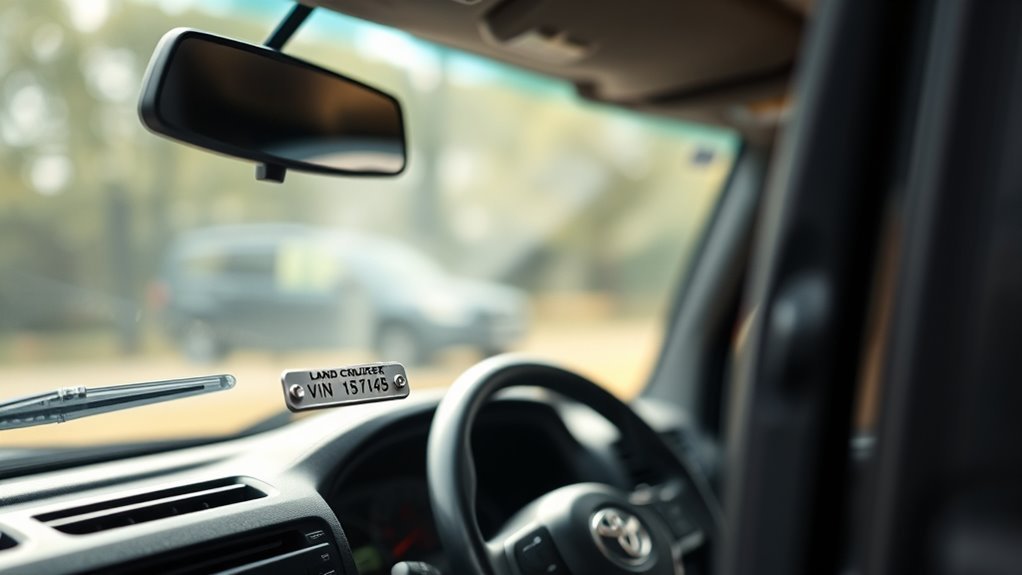
Finding the Toyota Land Cruiser VIN is usually simple once you know which generation you are checking. Modern Land Cruisers use the windshield-area VIN and certification label, while older 40, 55, 60, 62, 80, and 100 Series models may also use firewall, fender, door-pillar, or frame stampings. Use the full number, not a guessed or partial number, before ordering parts, checking records, or verifying ownership.
Quick Answer
Check the driver-side dashboard VIN visible through the windshield, then the driver’s door jamb or door-pillar certification label. On older Land Cruisers, also inspect the passenger-side firewall, inner fender, and right-front frame rail. Photograph the full number and compare it with the title, registration, and Toyota records.
Key Takeaways
- For late-model Land Cruisers, start with the VIN at the top-left instrument panel and the Certification Label on the door area.
- For vintage Land Cruisers, check the firewall, inner passenger fender, and frame number because tag placement changed by model year and series.
- U.S. VINs are 17 characters on modern vehicles and do not use the letters I, O, or Q.
- Use the full VIN or frame number when ordering parts; a registered year alone can be wrong for older imported or restored Land Cruisers.
At a Glance
| Time Required | 5–15 minutes |
| Difficulty | Easy; moderate if the frame stamping is dirty or corroded |
| Tools Needed | Flashlight, phone camera, microfiber cloth, mild cleaner, paper and pen |
| Cost | Free unless a dealer, inspector, or title specialist must verify a damaged or missing tag |
Start With the Easiest Land Cruiser VIN Locations
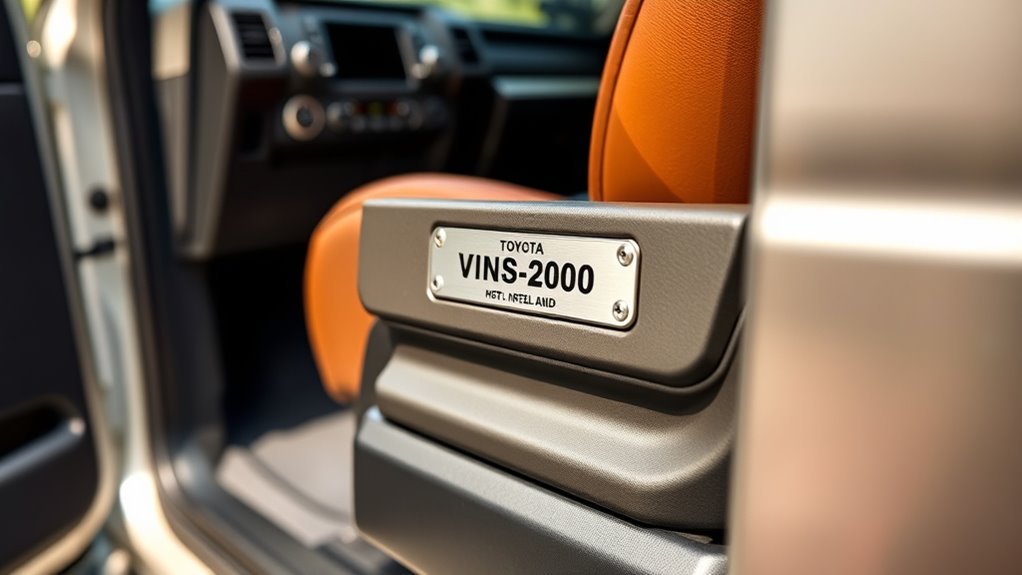
Begin with the locations that are easiest to inspect without tools. Stand outside the driver’s side and look through the lower corner of the windshield near the dashboard. Toyota’s current Land Cruiser manual describes the VIN as the legal identifier and says it appears on the top-left instrument panel, the Certification Label, and, on some models, the front right frame.
Next, open the driver’s door and inspect the door jamb, door pillar, and certification label area. This label may include the VIN, build information, tire information, and other vehicle data. On older Land Cruisers, especially classic 40 and 55 Series vehicles, the identifying tag may be under the hood instead of on the door area.
Note: Toyota’s owner-manual wording applies to the specific model year and market. If your Land Cruiser was imported, restored, repainted, or modified, verify more than one VIN or frame-number location before relying on a single tag.
[Products Worth Considering]

These premium stainless steel license plate screws are designed to help secure your plate firmly while resisting rust and reducing rattling noise. Built for broad compatibility with most domestic cars and trucks, they offer a simple, reliable upgrade for cleaner-looking and better-protected license plate mounting.

This license plate screw kit provides a complete, rustproof mounting solution for securing front and rear plates on most vehicles. Made from stainless steel with included washers, foam pads, covers, and inserts, it helps prevent corrosion, reduce vibration, and create a clean finished look. The self-tapping design makes installation quick and simple with basic tools.

This anti-theft license plate screw kit helps secure front or rear plates with a tamper-proof design that resists common removal tools. Made from rustproof 304 stainless steel, it is built for durable outdoor use while helping reduce plate vibration and paint scratching. The kit includes screws, nuts, caps, washers, a screwdriver, and nylon plugs for broad compatibility with cars, trucks, motorcycles, and trailers.
Check the Driver’s Door Jamb and Vehicle Identification Tag
The driver’s door jamb is one of the best places to find a Land Cruiser VIN because it is easy to read and often matches the registration record. Open the driver’s door fully, then look along the door pillar, latch area, and jamb for a metal plate or printed certification label.
| Item | Action |
|---|---|
| Locate | Open the driver’s door and inspect the pillar, jamb, and latch-side label area |
| Read | Copy the full VIN exactly as shown and take a clear photo |
| Check | Look for loose rivets, peeling labels, mismatched paint, corrosion, or obvious tampering |
| Compare | Match the VIN against the title, registration, insurance card, and service records |
Clean the label gently with a damp microfiber cloth if dirt is covering the characters. Avoid sandpaper, wire brushes, harsh solvents, or abrasive pads because they can damage a printed label or make a stamped tag harder to verify.
Warning: Do not remove, drill, repaint, restamp, or alter a VIN plate, certification label, or frame number. If a tag is missing or appears altered, stop and have the vehicle checked by a Toyota dealer, DMV/title office, law-enforcement VIN inspector, or qualified classic Toyota specialist.
VIN Locations by Land Cruiser Model and Year
Land Cruiser identification changed over time, so the right place to look depends on the model year, market, and series. Use this table as a practical starting point, then confirm with the owner’s manual or Toyota service information for your exact vehicle.
| Land Cruiser model or era | Common VIN or ID locations to inspect | What to record |
|---|---|---|
| 1958–1967 early U.S.-market models | Passenger-side firewall ID tag; frame stamping may also be present | Full frame number, model code, engine number, and any production data shown |
| 1968 and later 40 and 55 Series | Driver’s door pillar; under-hood tag locations may also appear | VIN or frame number plus production date and model designation |
| 60 Series and some early 62 Series | Driver’s door pillar; also inspect under the hood and frame if records do not match | Full VIN, body/model code, color/trim code, and frame number if visible |
| Later 62, 80, and 100 Series | Driver’s door or door pillar, dashboard near windshield, under-hood tag, frame | 17-character VIN and any supporting build-label information |
| 200, 250, and newer U.S.-market models | Top-left instrument panel visible through windshield, Certification Label, and sometimes front right frame | 17-character VIN exactly as printed or stamped |
For the frame number, use a flashlight and inspect the right-front frame area around the front tire. On some Land Cruisers the stamping may be in front of the tire; on others it may be behind the tire. Dirt, undercoating, surface rust, or repainted chassis rails can hide the digits.
Pro Tip: Take one close-up photo of the VIN and one wider photo showing where the tag or stamping is located. This makes parts ordering, title questions, insurance updates, and restoration records much easier later.
[Products Worth Considering]

Secure your license plates, frames, and covers with rust-proof stainless steel screws designed for lasting performance. The included nylon inserts help create a firm, stable grip that reduces loosening and vibration, while the corrosion-resistant construction stands up to rain, snow, and salty road conditions. Installation is quick and simple, making this kit a practical upgrade for most U.S. vehicles.

This LivTee license plate screw kit provides a secure, rust-resistant mounting solution for front and rear plates on most U.S. vehicles. Made from premium stainless steel with included washers, foam pads, screw caps, and optional nylon inserts, it helps prevent rattling, loosening, and corrosion for a cleaner, longer-lasting installation.

How to Read a Modern Toyota Land Cruiser VIN
Modern U.S.-market VINs follow federal VIN rules. The National Highway Traffic Safety Administration explains that a VIN is a 17-character number that identifies a specific vehicle and can be decoded through its public VIN decoder. Federal rules also require a check digit in position 9, and allowed VIN characters exclude the letters I, O, and Q to reduce confusion with 1 and 0.
| VIN section | What it usually identifies | Why it matters |
|---|---|---|
| Positions 1–3 | World manufacturer identifier | Confirms manufacturer and country/manufacturer information |
| Positions 4–8 | Vehicle attributes | Helps identify body, engine, restraint, and model details depending on manufacturer data |
| Position 9 | Check digit | Helps detect many transcription mistakes |
| Position 10 | Model year code | Helps distinguish model year from registration year |
| Position 11 | Assembly plant | Supports factory identification and some parts lookups |
| Positions 12–17 | Serial number | Identifies the individual vehicle within the production sequence |
Use the NHTSA VIN Decoder for modern 17-character VINs, then compare the decoded result with Toyota parts data, your owner’s manual, and the labels on the vehicle. The NHTSA decoder is useful for basic identification, but Toyota or a qualified parts supplier is still the better source for exact trim, market, and part-number compatibility.
Decode and Use Your Land Cruiser VIN: Full Frame Number vs. Partial VIN
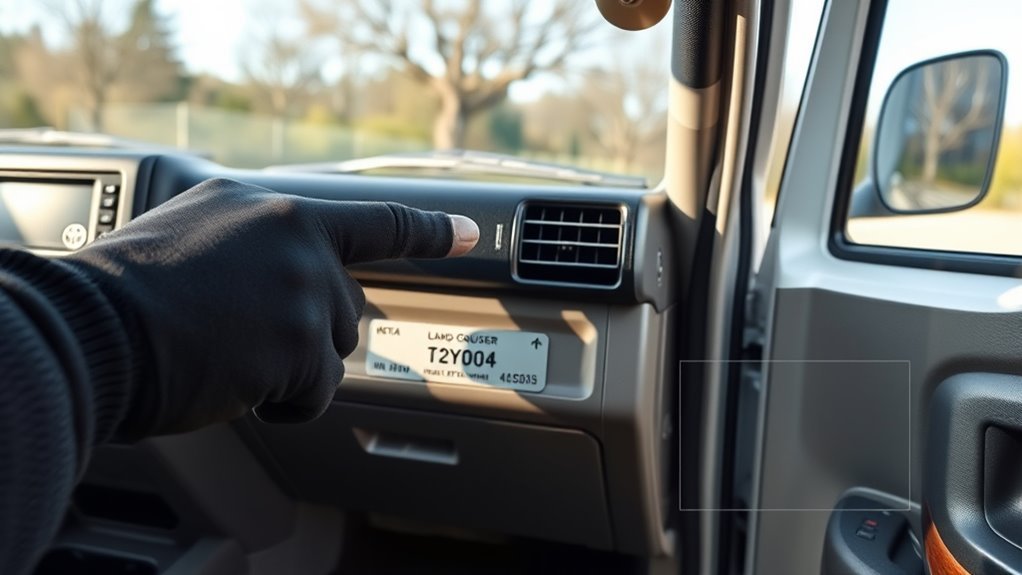
Once you find the VIN plate or frame stamping, record the full number before ordering parts. A partial VIN, model nickname, or registered year can lead to the wrong axle, brake, drivetrain, trim, or body part, especially on older Land Cruisers with swaps or import history.
Use this procedure:
- Locate the VIN or frame number on the dashboard, door area, firewall, inner fender, or frame.
- Clean the area gently and photograph the full tag or stamping.
- Transcribe every character exactly, using uppercase letters and numbers.
- Check for common errors: 5 vs. S, 2 vs. Z, 8 vs. B, and 1 vs. L.
- Run a modern 17-character VIN through the NHTSA decoder or Toyota parts tools.
- For older models, provide the full frame number, model code, engine number, and production date to a Toyota dealer or Land Cruiser parts specialist.
- Match the decoded or verified details to the title, registration, insurance, service records, and parts catalog before buying parts.
For early models that may not show a production date on the ID plate, the full frame number becomes especially important. It can help identify the correct production range and prevent mistakes when buying classic Land Cruiser parts.
What to Do if the VIN Is Missing, Unreadable, or Does Not Match
A missing or mismatched VIN does not always mean fraud. Older Land Cruisers are often restored, repainted, re-bodied, imported, or repaired after decades of use. Still, mismatched numbers must be handled carefully because the VIN is tied to ownership and legal identity.
| Problem | Likely cause | Best next step |
|---|---|---|
| Door label is faded | Age, cleaning chemicals, sun exposure, or repainting | Check dash, firewall, frame, title, and Toyota records |
| Frame number is hard to read | Rust, dirt, undercoating, or chassis paint | Clean gently and use angled light; avoid grinding or restamping |
| Title VIN and vehicle VIN differ | Clerical error, import paperwork issue, body swap, or incorrect title | Contact your DMV/title office or licensed VIN inspector before buying or selling |
| VIN tag looks altered | Possible repaint damage, incorrect restoration, or tampering | Pause the transaction and request professional verification |
The safest rule is simple: one clear VIN is helpful, but two or more matching identifiers are much better for a Land Cruiser with age, restoration work, or import history.
Get Help Verifying Your Land Cruiser VIN
If you are unsure about a VIN entry or need confirmation of factory options, contact a Toyota dealer, Toyota’s Technical Information System, your DMV/title office, or a reputable Land Cruiser parts supplier. Have clear photos ready before you call or email.
| Task | Action |
|---|---|
| Locate VIN | Check the dash, driver’s door area, firewall, inner fender, and frame |
| Early models | Use the full frame number, not only the registered year |
| VIN decoding | Use NHTSA for basic modern VIN data and Toyota resources for vehicle-specific records |
| Parts ordering | Provide the full VIN or frame number, model code, engine, transmission, axle details, and production date if available |
| Legal verification | Use your DMV, title agency, law-enforcement VIN inspection process, or a licensed inspector if numbers conflict |
Before ordering parts, ask the supplier to confirm the vehicle details against the VIN or frame number. This is especially important for brake parts, drivetrain parts, axles, emissions components, body panels, and trim pieces that changed within the same Land Cruiser series.
Frequently Asked Questions
How many VIN locations are on a Toyota Land Cruiser?
A modern Toyota Land Cruiser commonly has a VIN visible at the lower driver-side windshield area and on the Certification Label. Depending on the model year and market, it may also be stamped on the frame. Older Land Cruisers may have ID tags on the firewall, inner fender, driver’s door pillar, and frame.
Where is the VIN on a newer Toyota Land Cruiser?
Start at the driver-side dashboard where the VIN is visible through the windshield. Then check the Certification Label in the driver’s door or door-jamb area. Toyota’s current Land Cruiser manual also notes that, on some models, the number is stamped on the front right frame.
Where is the VIN on an older FJ40 or FJ55 Land Cruiser?
Many early U.S.-market FJ40 and FJ55 Land Cruisers use an ID tag on the firewall or driver’s door pillar, depending on year. Also check the frame stamping near the front tire area. Because older tags can be missing or repainted, record the full frame number when ordering parts or verifying the vehicle.
Is the frame number the same as the VIN?
On many classic Land Cruisers, owners and parts suppliers often use the frame number as the key identifier, especially when the vehicle predates modern 17-character VIN requirements or when the ID plate lacks a production date. On modern vehicles, use the 17-character VIN shown on the dash and certification label.
Can I decode a Toyota Land Cruiser VIN online?
Yes. For modern 17-character VINs, the NHTSA VIN Decoder can identify basic manufacturer-reported information. For exact parts fitment, use Toyota parts data, Toyota service information, or a trusted Land Cruiser parts supplier because online decoders may not show every trim, market, or production change.
What should I do if my Land Cruiser VIN does not match the title?
Do not guess or alter anything. Photograph every VIN, ID tag, and frame stamping you can find, then contact your DMV/title office, a law-enforcement VIN inspection service, a Toyota dealer, or a licensed title professional. Resolve the mismatch before buying, selling, registering, or insuring the vehicle.
Conclusion
To find your Toyota Land Cruiser VIN, start with the driver-side dashboard and door-jamb label, then check the firewall, inner fender, and frame on older models. Record the full number, photograph it, and compare it with your paperwork before ordering parts or making ownership decisions. For classic Land Cruisers, the full frame number is often the detail that prevents costly parts mistakes and title confusion.
Sources
- Toyota 2026 Land Cruiser Interactive Manual — Toyota VIN locations including instrument panel, Certification Label, and front right frame on some models.
- Toyota Owners Manuals and Warranties — official Toyota owner-manual access and Toyota Technical Information System reference for older vehicles.
- NHTSA VIN Decoder — official U.S. VIN decoder and explanation of 17-character VIN use.
- 49 CFR Part 565: Vehicle Identification Number Requirements — federal VIN format, check digit, character, and location requirements.
- Toyota Technical Information System — official Toyota service-support source for Toyota vehicles marketed in North America.
- Specter Off-Road Land Cruiser VIN Locations — Land Cruiser-specific reference for classic model ID tag, frame number, and parts-ordering information.

[…] at the lower driver-side corner of the windshield or on the driver-side door area. You can use this VIN location guide for a general explanation of common Toyota VIN locations, but confirm the location in your Camry […]