

Last updated: September 16, 2026 — reviewed against Toyota’s 2026 long-term vehicle-storage guidance, Toyota’s Supra-specific storage bulletin, and NHTSA tire guidance.
For long-term Toyota Supra storage, use a Supra-specific maintenance schedule instead of relying only on generic car-storage advice. Toyota’s recent U.S. long-term-storage guidance for the MkV GR Supra calls for monthly tire-pressure checks and A/C-compressor lubrication, 12V battery maintenance after 60 days and every 30 days after that, engine operation and vehicle movement every six weeks, and brake-rotor rust removal every eight weeks. Toyota also specifies 43 psi as a storage-only tire pressure in its MkV storage guidance; return the tires to the normal cold-driving pressure on the vehicle placard before road use. This guide is aimed primarily at 2020–2026 MkV/A90/A91 GR Supra owners; older Supra generations require generation-specific procedures. Use this checklist as a practical starting point, then confirm model-year details in your Toyota owner’s manual.
Quick Answer
For MkV Toyota Supra long-term storage, wash and dry the car, prepare the fuel and 12V battery, set the tires to Toyota’s storage-only pressure where applicable, avoid leaving the parking brake applied, protect the car from moisture and rodents, and follow Toyota’s periodic storage schedule. Current Toyota guidance applicable to the 2026 Supra lists monthly tire and A/C checks, 12V battery maintenance after 60 days and every 30 days thereafter, engine operation and at least 30 feet of vehicle movement every six weeks, and brake-rotor rust removal every eight weeks. Before driving again, restore normal cold tire pressure, inspect the battery, fluids, brakes, tires and engine bay, and remove every storage plug or block.
Key Takeaways
- Toyota’s MkV Supra storage guidance uses 43 psi for storage only; reset every tire to the vehicle’s normal cold-driving pressure before road use.
- Do not substitute brief cold starts for Toyota’s periodic storage procedure. The long-term-storage schedule includes engine operation and vehicle movement every six weeks.
- Toyota also schedules A/C-compressor lubrication monthly and brake-rotor rust removal every eight weeks.
- For long-term storage, Toyota instructs that the parking brake should not remain applied; follow the owner’s manual for the electronic parking-brake Auto function.
- Battery procedures differ by Toyota bulletin and model year, so use the current guidance for your Supra rather than a generic charger routine.
At a Glance
| Time Required | About 2 to 4 hours for basic cleaning, inspection and storage setup; longer if maintenance or fluid service is due. |
| Difficulty | Easy to moderate. Use a qualified shop for battery, brake, fluid or tire work you are not comfortable performing. |
| Tools Needed | Accurate tire gauge, compatible battery equipment, microfiber towels, breathable cover if used, wheel chocks and a basic inspection light. |
| Cost | Varies by storage space, cover, battery equipment and whether professional maintenance is needed. |
Toyota Supra Long-Term Storage Checklist
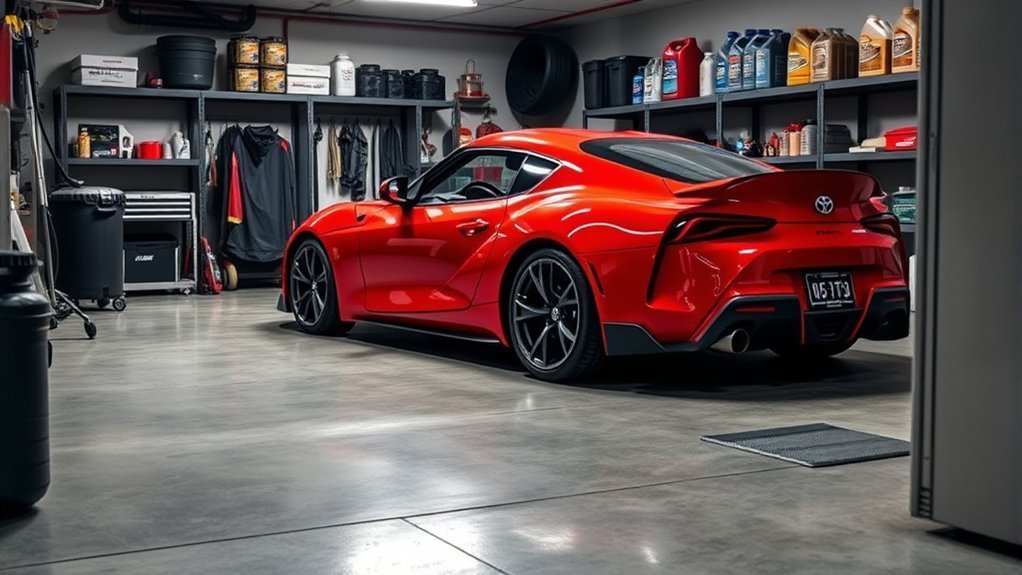
Start with a clean, dry Supra. Wash the body, wheels, wheel wells and underbody areas you can safely reach. Dry the paint, door jambs, hatch area, mirror edges and fuel-door area before covering or closing the car for storage.
Vacuum the interior, remove food wrappers, take out damp mats or bags, and clean cupholders and storage pockets. For more detail on choosing and using a cover, see the Toyota Supra car-cover guide.
- Clean and dry the Supra: Remove dirt, road salt, brake dust, bugs and interior debris.
- Prepare the fuel: Start with fresh fuel. If you choose to use a fuel stabilizer for owner storage, use only the amount specified on its label; Toyota’s cited periodic storage schedule does not list stabilizer as a required interval item.
- Plan 12V battery maintenance: Follow the Toyota storage procedure applicable to your model year rather than assuming one charging method fits every MkV Supra.
- Set storage tire pressure correctly: Toyota’s MkV storage guidance specifies 43 psi for storage only. Check it monthly and restore normal cold-driving pressure before driving.
- Do not leave the parking brake applied: Follow Toyota’s long-term-storage procedure and use an appropriate safe parking setup with wheel chocks where needed.
- Follow periodic maintenance: Include the Toyota intervals for battery condition, A/C operation, engine/vehicle movement and rotor-rust removal.
- Control moisture and pests: Keep the storage area clean and dry, use a breathable cover where appropriate, and inspect for rodent activity.
- Record the condition: Take photos, note mileage and save the storage date so you know how long the car has been sitting.
Warning: Never run the Supra in a closed garage. Gasoline vapors and exhaust are hazardous, and fuel work must be kept away from sparks, open flames, cigarettes, heaters and pilot lights.
Toyota’s Supra Long-Term Storage Schedule
Toyota’s 2026 U.S. long-term vehicle-storage bulletin applies to the 2026 Supra and gives specific recurring intervals. It is a dealer/pre-delivery storage procedure, so owners should use it together with the owner’s manual and the bulletin applicable to their exact model year.
| Storage Action | Toyota Interval | What It Means for a Supra Owner |
|---|---|---|
| 12V battery maintenance | After 60 days, then every 30 days | Follow the battery procedure for your model year. Toyota’s 2026 bulletin uses a ground-cable disconnect and periodic battery inspection protocol. |
| Tire inflation pressure | Monthly | Toyota’s MkV guidance specifies 43 psi for storage only. Restore placard pressure before road use. |
| Parts-rust inspection | Monthly | Check exposed metal and brake areas, especially in humid, wet or coastal storage environments. |
| A/C compressor lubrication | Monthly | Toyota’s procedure includes operating the A/C with the blower on high after the engine has warmed and idle has dropped below 1,000 rpm. |
| Engine starting and vehicle movement | Every 6 weeks | Toyota calls for at least 15 minutes below 1,500 rpm, ten excursions above 3,000 rpm, and at least 30 feet of movement. Do this only in a safe, ventilated environment. |
| Disc-brake rotor surface-rust removal | Every 8 weeks | Drive in a safe area and use the brakes normally to prevent severe rust accumulation. If the car cannot be driven safely, inspect the brakes before later road use. |
Important: Toyota revises technical bulletins over time. Use the current bulletin for your exact model year rather than assuming the 2026 procedure applies unchanged to every Supra ever built.
Fuel Stabilization for Long-Term Storage
Fuel care is still important, but separate general owner-storage practice from Toyota’s official periodic schedule. Toyota’s cited long-term-storage bulletin focuses on recurring battery, tire, rust, engine, A/C and brake maintenance rather than listing fuel stabilizer as a required interval item.
If you choose to use fuel stabilizer for seasonal storage, start with fresh fuel and follow the stabilizer manufacturer’s exact dose and mixing instructions. Do not add an arbitrary extra amount, and do not expect stabilizer to repair fuel that is already badly degraded.
Pro Tip: Record the date, fuel level and any stabilizer used. That makes recommissioning easier because you know exactly how old the fuel is and what was added.
[Products Worth Considering]

Protect your 2020-2026 Toyota GR Supra with a precision custom-fit cover designed to hug the vehicle’s contours for a secure, reliable fit. Built for all-weather use, it helps guard against rain, snow, sun, and other outdoor elements while the soft inner lining helps reduce the risk of scratches. Added straps, waterproof seams, and ventilation provide dependable protection and everyday convenience.

This custom-fit car cover is designed for Toyota Supra and GR Supra models, offering dependable all-weather protection for both indoor and outdoor use. Built with durable Oxford fabric and a soft cotton lining, it helps shield your vehicle from rain, sun, snow, dust, and UV exposure while protecting the paint finish. Windproof straps, dual air vents, reflective details, and included security accessories add convenience and peace of mind.

KUST Custom Fit Trunk Mat is designed for 2020-2026 Toyota GR Supra models to help protect the cargo area from dirt, spills, and daily wear. Its TPE construction offers a fresh, odor-free feel, while the raised-edge design adds extra coverage for all-weather protection. Lightweight and easy to remove, it makes cleaning simple and helps keep the trunk neat and protected.
Battery Maintenance: Keeping Your Supra Charged
Toyota’s long-term-storage battery instructions have changed across MkV model-year bulletins, so a Supra owner should not rely on one generic charger rule. The current 2026 bulletin says to remove the 12V battery ground cable for long-term storage, then inspect the battery after 60 days and every 30 days thereafter. When the negative cable is reconnected, Toyota notes that electrical systems or functions may need to be reset or reinitialized.
An earlier Supra-specific Toyota storage bulletin used a different procedure: charge the battery to 12.9V every six weeks using the under-hood jump-starting posts and do not connect the diagnostic charger directly to the battery. That difference is why the correct model-year procedure matters.
If you prefer a smart maintainer for an owner-storage setup, use only a compatible unit and connect it exactly as the Toyota owner’s manual and charger instructions permit. For more detail on the 12V system, see the Toyota Supra battery maintenance and charging guide.
| Battery Approach | Toyota Context | Watch Out For |
|---|---|---|
| 2026 storage-bulletin protocol | Disconnect battery ground for long-term storage; inspect after 60 days and every 30 days thereafter. | Confirm the transmission is in Park before disconnecting and follow Toyota procedures when reconnecting and reinitializing systems. |
| Earlier Supra-specific bulletin | Charge to 12.9V every six weeks through the under-hood jump-start posts. | Do not assume this older procedure supersedes the current guidance for a newer model year. |
| Owner smart maintainer | A practical owner option when permitted by the vehicle and charger instructions. | Use a charger compatible with the installed battery type and approved connection points. |
[Products Worth Considering]

The JACO ElitePro Digital Tire Pressure Gauge delivers shop-grade accuracy with a clear digital readout, making it easy to maintain proper tire pressure for safer driving and better performance. Built with rugged brass and steel components, a protective guard, and a flexible air hose, it is designed for reliable use across cars, trucks, motorcycles, bikes, RVs, and trailers. The lock-on display, built-in bleeder valve, and bright backlit screen add convenience in any lighting condition.

Armor All Extreme Wheel and Tire Cleaner is a powerful spray designed to cut through stubborn dirt, grease, tar, and brake dust on wheels and tires. It is safe for use on factory and aftermarket finishes, including alloy, steel, chrome, and plastic wheel trims, while its fast-acting formula works in just seconds. The deep-cleansing action helps reach hard-to-clean areas and leaves wheels looking clean and shiny.

This Yuirote universal car motor diagnostic tool helps drivers quickly detect engine fault codes and identify system issues for routine inspections and maintenance. It also supports electronic parking brake reset and emergency release functions, making it useful for handling EPB-related problems without a repair shop visit. Its compact, ergonomic design and broad vehicle compatibility make it a practical choice for car owners and DIY repair enthusiasts.
Tire Care: Preventing Flat Spots and Damage
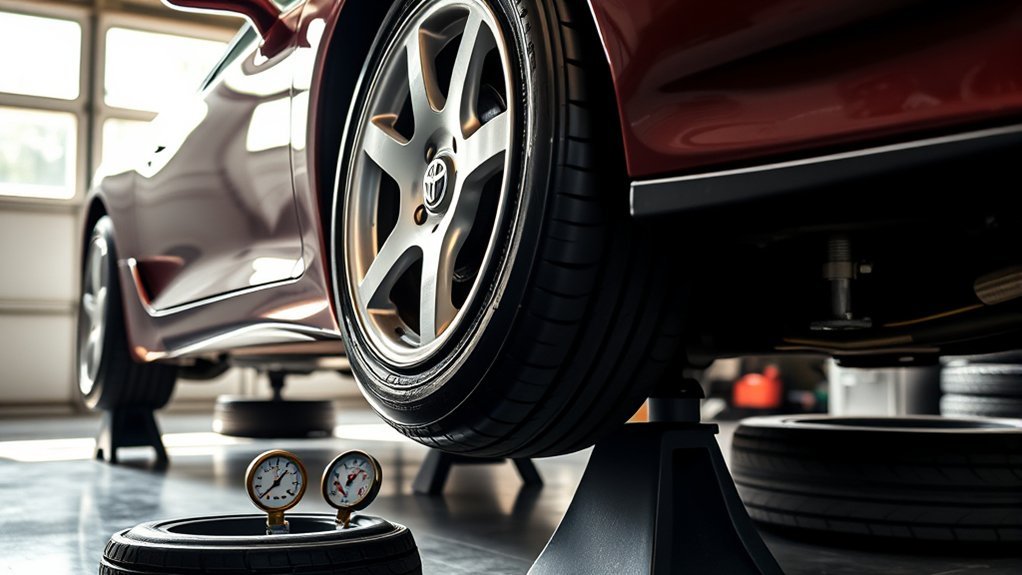
Toyota’s MkV long-term-storage guidance specifies 43 psi for storage only and calls for tire-pressure checks once a month. That storage number is not the normal road-pressure target. Before driving the Supra, return each tire to the correct cold-driving pressure shown on the vehicle placard or in the owner’s manual.
This distinction matters because NHTSA tells drivers to use the vehicle manufacturer’s placard pressure for normal cold tire inflation, not the maximum pressure molded into the tire sidewall. Park the Supra on a clean, solid surface and inspect the tires regularly for pressure loss, cracking, cuts, bulges or other damage.
| Action | Why It Helps | When to Do It |
|---|---|---|
| Set storage pressure to 43 psi where the applicable Toyota bulletin specifies it | Toyota uses the higher storage-only setting to address flat-spot risk during extended parking. | Before long-term storage. |
| Check pressure with a gauge | Ambient-temperature changes and normal air loss can alter pressure. | Monthly. |
| Move the car | Toyota includes at least 30 feet of movement in its periodic long-term-storage procedure. | Every six weeks under the Toyota schedule. |
| Reset pressure before driving | Returns handling, ride and tire loading to the vehicle manufacturer’s road-use setting. | Before the first road drive. |
Note: NHTSA recommends checking tire pressure when tires are cold and using the vehicle placard or owner’s manual for normal driving pressure. TPMS is not a substitute for a monthly gauge check.
[Products Worth Considering]

This tire inflator attachment combines accurate pressure reading and easy inflation in one heavy-duty tool for maintaining tire pressure with less hassle. A longer hose and 360-degree swivel air chuck help create a secure seal while giving you better control during use. Designed for universal compressor compatibility, it measures, inflates, and deflates without batteries.

This dual filter kit helps keep your vehicle running and riding cleaner by replacing both the engine air filter and cabin air filter at the same time. It is designed for a range of Toyota and Lexus hybrid models, helping support engine performance while reducing odors and airborne particles inside the cabin. Built with high-quality filtration materials, it offers a convenient maintenance solution for routine filter replacement.

This professional compression tester kit helps diagnose engine health quickly and accurately in gasoline-powered cars, trucks, ATVs, and small engines. The fluorescent triple-scale gauge improves readability in low light, while the built-in Schrader valve, safety release, and included adapters make testing simple, stable, and reliable.
Fluids and Brakes Before Storage
Before storage, check engine oil, coolant, brake fluid, washer fluid and visible leaks. If routine service is due, complete it before the car sits rather than using storage as a reason to postpone needed maintenance. The Supra preventive-maintenance guide covers the broader maintenance items that should be considered separately from the storage checklist.
Brakes need more than a one-time pre-storage glance. Toyota’s long-term-storage schedule calls for disc-brake rotor surface-rust removal every eight weeks. Its procedure uses normal braking while driving in a safe area to prevent severe rust accumulation. If the car cannot be driven safely, inspect the brakes carefully before later road use instead of assuming surface rust will clear itself.
- Engine oil: Check condition and service status before storage.
- Coolant: Confirm the correct level and investigate any unexplained loss.
- Brake fluid: Check condition and service status; do not ignore a soft pedal or visible leak.
- Washer fluid: Use a mix appropriate for the temperatures the car will experience.
- Brake rotors: Follow Toyota’s periodic rust-removal interval when the car can be driven safely.
- Leaks: Inspect under the car before storage, during periodic checks and again before recommissioning.
Parking Brake, Wheel Chocks, and Transmission
Toyota’s long-term-storage guidance says do not apply the parking brake while the vehicle is stored. It also says vehicles with an electronic parking brake should not be allowed to engage automatically; follow the owner’s manual for disabling the Auto function where applicable.
For an automatic-transmission Supra, Toyota specifies Park. For a manual-transmission vehicle, Toyota specifies First or Reverse. On an appropriate level storage surface, wheel chocks can add protection against unintended movement. If the car must be stored on a slope or in an unusual setup, use a safer location or obtain professional guidance rather than relying on one restraint method.
Moisture Management: Preventing Corrosion
Keep the storage space clean and dry. Toyota’s storage guidance specifically recommends a paved, secure storage area and calls for a monthly rust inspection. Humid or coastal conditions deserve extra attention because exposed metal components and brake surfaces can corrode while the car sits.
| Action | Purpose | Frequency |
|---|---|---|
| Inspect for rust | Catches corrosion before it becomes severe. | Monthly under Toyota’s storage schedule. |
| Use a breathable cover when appropriate | Keeps dust off clean paint without using a non-breathing plastic tarp directly against the finish. | During the storage period. |
| Keep the garage clean and dry | Reduces dampness, clutter and pest shelter around the vehicle. | Before and during storage. |
| Follow the full periodic engine procedure | Avoids replacing Toyota’s defined maintenance routine with brief cold starts that do not complete the prescribed operating cycle. | At the applicable Toyota interval. |
Pest Control: Keeping Rodents Away

Rodents can damage wiring, insulation, filters and cabin materials. Scent products alone are not a reliable primary defense. Focus on sanitation, exclusion, inspection and safe trapping.
- Remove food sources: Take food, pet food, birdseed, wrappers and trash out of the garage.
- Reduce hiding spots: Keep cardboard, cloth, firewood and clutter away from the car.
- Seal openings: Close accessible gaps around garage doors, vents, pipes and walls where practical.
- Block vehicle openings carefully: If you temporarily plug an exhaust outlet or another opening, attach a bright steering-wheel reminder so it is removed before the engine is started.
- Use traps safely: Place traps according to their instructions and keep them away from children and pets.
- Inspect regularly: Look for droppings, shredded material, odors, tracks or fresh gnaw marks.
Warning: Use rodenticides cautiously. Follow the label exactly and consider the risk to children, pets and wildlife. A poisoned rodent can also die in an inaccessible vehicle or building cavity.
Ideal Storage Environment for Your Toyota Supra
A clean, dry, secure indoor space gives you the most control over weather, dust, moisture and pests. Toyota’s storage bulletin calls for a paved, well-lit and secure area. If the car is stored outdoors, inspection frequency becomes even more important because rain, temperature changes, wind-blown debris and pests are harder to control.
Before covering the car, make sure the paint and cover are clean and dry. Do not place a plastic tarp directly on the finish. Inspect the storage area periodically rather than assuming that a closed garage will remain dry and pest-free for several months.
The safest Supra storage plan combines clean preparation with Toyota’s recurring battery, tire, A/C, movement, rust and brake checks.
Monthly Storage Checkup
A monthly inspection catches changes between Toyota’s longer six-week and eight-week service intervals. Do not simply uncover the car, start it for two minutes and walk away; use the applicable Toyota procedure when an engine or A/C maintenance interval is due.
- Check tire pressure with a gauge and maintain the applicable storage-only setting.
- Inspect for visible rust, leaks and rodent activity.
- Check the storage area and cover for moisture or contamination.
- Perform Toyota’s monthly A/C-compressor lubrication procedure when due.
- If the battery has been stored for 60 days or more, follow the applicable battery-inspection interval.
- At six weeks, complete the applicable engine-operation and vehicle-movement procedure.
- At eight weeks, perform the applicable brake-rotor surface-rust-removal procedure.
What Not to Do During Supra Storage
- Do not use a plastic tarp directly on the paint. Use a clean cover appropriate for the storage environment.
- Do not improvise a battery-charging connection. Follow the Toyota procedure for the model year and the charger instructions.
- Do not leave food or scented trash nearby. It can attract pests.
- Do not leave the parking brake applied for long-term storage. Follow Toyota’s storage procedure and owner-manual guidance for the electronic parking brake.
- Do not substitute brief cold starts for the full Toyota storage procedure. If engine operation is due, complete the applicable procedure in a safely ventilated location.
- Do not drive away at the storage-only tire pressure. Reset every tire to the correct cold-driving pressure first.
- Do not forget temporary exhaust, intake or pest barriers. Remove all storage blocks before starting the engine.
Recommissioning Your Supra: Steps for a Smooth Return to the Road
Before driving your Toyota Supra after storage, inspect it as if you were preparing for a road trip. A successful engine start does not prove that the tires, brakes, battery, wiring or fluids are road-ready.
- Remove all storage blocks: Take out exhaust plugs, temporary covers, wheel chocks, reminder tags and moisture products.
- Inspect the engine bay: Look for nests, chewed wires, loose hoses, leaks or unusual smells.
- Restore the battery correctly: If the negative cable was disconnected, reconnect it according to the applicable Toyota procedure and address any required system reinitialization.
- Check fluids: Verify engine oil, coolant, brake fluid, washer fluid and any visible leaks.
- Reset tire pressure: Return all four tires from the storage setting to the correct cold-driving pressure on the vehicle placard or owner’s manual.
- Inspect tires: Check tread, sidewalls, cuts, cracks, bulges and any persistent flat-spot vibration.
- Check the parking brake: Confirm that any Auto-function change made for storage is restored as required by the owner’s manual.
- Test the brakes gently: Light surface rust may clear with normal braking, but grinding, pulling, pulsing or a soft pedal needs attention.
- Start in a ventilated area: Watch warning lights and listen for abnormal sounds.
- Take a slow shakedown drive: Stay close to home, avoid hard acceleration initially and recheck for leaks or warning lights afterward.
- Schedule service if needed: If the car sat for an extended period or anything feels abnormal, have it inspected before spirited driving.
Frequently Asked Questions
What are the common problems with Supras after storage?
Common storage-related problems include a weak 12V battery, tire-pressure loss or flat spotting, brake-rotor rust, a parking brake that was left applied, moisture-related corrosion, stale-fuel symptoms and rodent damage. The risk increases when the car is stored without Toyota’s periodic tire, battery, A/C, movement and brake checks.
How do you prepare a Toyota Supra for long-term storage?
Clean and dry the car, remove food and clutter, prepare fresh fuel, follow the model-year Toyota 12V-battery procedure, set the applicable storage tire pressure, avoid leaving the parking brake applied, protect the car from moisture and rodents, and record the storage date. During storage, follow Toyota’s recurring tire, A/C, battery, engine-movement, rust and brake-rotor intervals.
What tire pressure should a Toyota Supra use during long-term storage?
Toyota’s MkV long-term-storage guidance specifies 43 psi for storage only and calls for a pressure check once a month. Before driving, return every tire to the normal cold-driving pressure on the vehicle placard or in the owner’s manual. Do not use the tire sidewall maximum as the normal road-pressure target.
Why is the Toyota Supra being discontinued?
Toyota confirmed that the 2026 model year is the final production run of the fifth-generation GR Supra and announced that MkV production would end in spring 2026. The 2026 lineup included 3.0, 3.0 Premium and MkV Final Edition grades, with 1,300 MkV Final Edition units allocated to North America. Toyota’s cited U.S. materials do not identify one single official cause for ending MkV production.
How long can a Supra be stored without being driven?
A Supra can remain stored for months when it is maintained correctly, but Toyota’s procedure does not treat long-term storage as “park it and forget it.” The schedule includes monthly checks, battery maintenance after 60 days, engine and vehicle movement every six weeks, and brake-rotor rust removal every eight weeks. Follow the procedure for your model year.
Should I start my Supra every few weeks during storage?
Do not use brief cold starts as a substitute for proper maintenance. Toyota’s long-term-storage guidance schedules engine operation and vehicle movement every six weeks: run a gasoline engine below 1,500 rpm for at least 15 minutes, raise engine speed above 3,000 rpm ten times, and move the vehicle at least 30 feet. Toyota separately schedules A/C-compressor lubrication monthly. Perform engine operation only outdoors or with proper exhaust extraction.
Should I store my Supra on jack stands?
Toyota’s MkV long-term-storage procedure uses a storage-only tire-pressure setting plus periodic vehicle movement; it does not require routine jack-stand storage. If the car must be lifted for service, use the correct lifting points and stable equipment on a suitable surface. Do not put the car on stands solely because generic storage advice says it is mandatory.
Conclusion
Proper Toyota Supra storage is an ongoing maintenance routine, not just a one-time cleaning job. Prepare the car clean and dry, follow the correct model-year battery procedure, use Toyota’s storage-only tire setting where applicable, leave the parking brake released according to the storage procedure, and control moisture and pests. During storage, remember the core Toyota intervals: tire and A/C checks monthly, battery maintenance after 60 days and every 30 days thereafter, engine operation and vehicle movement every six weeks, and brake-rotor rust removal every eight weeks. Before the first road drive, remove every storage block, restore normal cold tire pressure, inspect the car carefully and take the first trip slowly.
Sources
- Toyota T-SB-0002-26 Rev1: Long-Term Vehicle Storage Guidelines — current 2026 Toyota storage communication applicable to the 2026 Supra; supports battery, tire, A/C, engine-movement, parking-brake and rotor-rust intervals.
- Toyota T-SB-0034-20 Rev1: Supra Long-Term Vehicle Storage Guidelines — Supra-specific Toyota bulletin supporting the 43-psi storage setting, under-hood battery-charging procedure, periodic engine movement and A/C lubrication.
- NHTSA TireWise — supports monthly cold tire-pressure checks, placard pressure and TPMS guidance.
- Toyota Manuals and Warranties — source for model-year owner-manual procedures and normal driving specifications.
- Toyota USA Newsroom: GR Supra 2026 Final Production Run — supports the final-production-run statement and 1,300-unit North American MkV Final Edition allocation.
- NOAA CAMEO Chemicals: Gasoline — gasoline flammability and vapor-safety information.
- UC IPM House Mouse — rodent exclusion, sanitation and trapping guidance.



[…] Frequent short trips or long storage […]
[…] Many 12-volt car batteries last about 3–5 years, but heat, short trips, vibration, and long storage can shorten that […]
[…] can start from cold before a long trip, but do not attempt the detailed measurement immediately after […]
[…] you buy a new unit, ensure you maintain service records, as proper care dictates future resale value for sports […]
[…] Connect an AGM-compatible smart trickle charger through the under-hood terminals during winter storage or extended parking. […]
[…] rule, and investigate stored vehicle messages if the transmission behaves abnormally. Keep up with routine maintenance and have recurring drivetrain warnings properly diagnosed rather than simply clearing the […]