
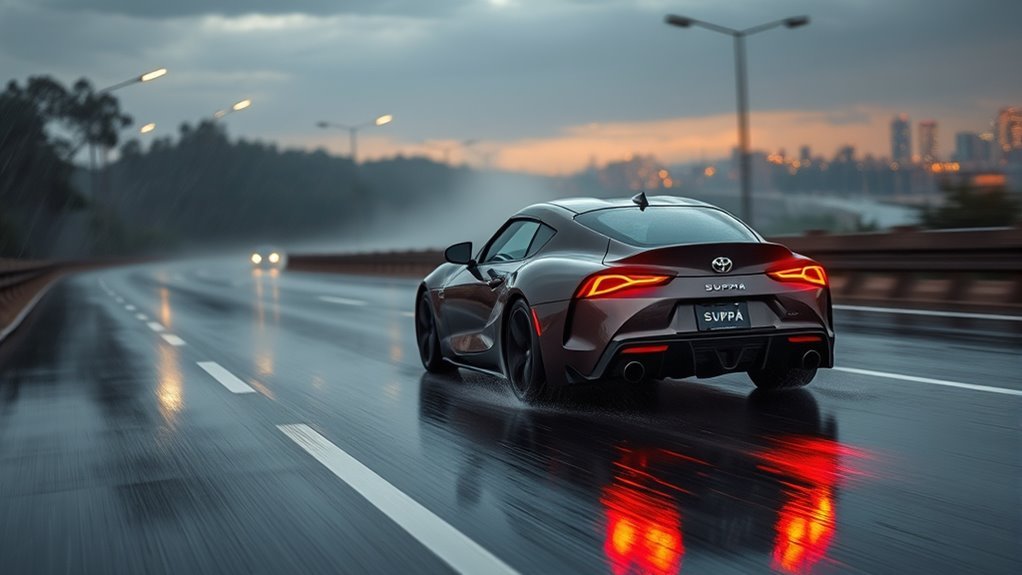
Driving a Toyota Supra in heavy rain is possible, but the margin for error shrinks quickly. The GR Supra is a rear-wheel-drive sports car, and Toyota’s 2026 wet-weather guidance is straightforward: use low-beam headlights, increase following distance, drive slower than normal, and avoid sudden acceleration, braking, or steering. In standing water, tire condition, water depth, visibility, and smooth inputs matter more than horsepower.
Quick Answer
In heavy rain, slow down early, leave extra following distance, use low-beam headlights, keep Vehicle Stability Control and traction control active, and avoid cruise control and flooded roads. If the Supra hydroplanes, ease off the accelerator, keep the wheel steady, avoid abrupt braking or steering, and make gentle corrections only as tire contact returns.
Key Takeaways
- Slow down before standing water, curves, lane changes, and braking zones; do not wait until the Supra starts sliding.
- Keep traction control and Vehicle Stability Control on for public-road rain driving; Toyota’s Traction mode is not the default setting for heavy rain.
- NHTSA says tires should be replaced at 2/32 inch of tread, but wet performance can deteriorate earlier; frequent heavy-rain drivers may choose a larger tread-depth safety buffer.
- Never enter floodwater, moving water, or water of unknown depth. Toyota’s stated calm-water limit is a vehicle maximum, not a flood-crossing target.
- Skip cruise control, VSC Off, hard acceleration, sudden downshifts, and abrupt steering or braking in heavy rain.
At a Glance
| Time Required | A few minutes for a pre-drive rain check; longer if tires, brakes, or wipers need service |
| Difficulty | Easy, but it requires patience and smooth inputs |
| Tools Needed | Tire pressure gauge, tread depth gauge, washer fluid, clean microfiber cloth |
| Cost | Usually no service cost for inspection if you already have the basic gauges; replacement or repair cost varies by need |
The Federal Highway Administration reports that 75% of weather-related crashes happen on wet pavement and 47% happen during rainfall, so rain deserves the same respect you would give other low-grip conditions.
Toyota-specific water limit: Toyota’s 2026 Supra owner’s manual says to drive through calm water only, no deeper than 9.8 inches (25 cm), at no faster than walking speed, up to 3 mph (5 km/h), and to deactivate Auto Start/Stop first. Treat those numbers as maximum vehicle limits, not permission to enter floodwater. If water is moving, its depth is unknown, the road is flooded, or a barricade is present, turn around. Toyota lists multiple 2026 owner’s-manual editions by production period, so use the manual that matches your vehicle.
What Should You Do If Your Supra Hydroplanes?

If your Supra starts to hydroplane, ease your foot off the accelerator, look where you want the car to go, and keep the steering wheel as steady as conditions allow. Avoid sudden braking or a sharp steering correction while the tires are riding on water, because abrupt inputs can make the vehicle harder to control.
As tire contact returns, use small steering corrections and light, progressive braking to reduce speed. ABS, traction control, and stability control may help when tire-road contact exists, but they cannot create grip while a tire is separated from the pavement by water.
Warning: Keep cruise control off in heavy rain. If it is already active when conditions worsen, cancel it smoothly and regain manual control of vehicle speed.
How Fast Should You Drive a Toyota Supra in Heavy Rain?
There is no single safe speed for every storm. Heavy rain, worn tires, pooled water, poor visibility, traffic, and road geometry can make even moderate speeds unsafe. Drive below the posted limit whenever conditions require it, and slow enough that you can stop within the distance you can clearly see. Reduce speed well before puddles, corners, bridges, ramps, lane changes, and braking zones.
Because the Supra sends power to the rear wheels, use progressive throttle and avoid abrupt kickdowns, sudden downshifts, or quick torque inputs. Smooth acceleration gives the rear tires more opportunity to maintain grip when pavement friction changes from one part of the lane to another.
Pair that throttle discipline with early braking. Begin slowing sooner than you would in the dry, press the pedal progressively, and leave more room than normal from the vehicle ahead. Painted lane lines, metal covers, bridge joints, wet leaves, road debris, and newly wet pavement can all offer less grip than the surrounding asphalt.
Pro Tip: If visibility becomes too poor to drive safely, signal and leave the travel lane at the first safe location rather than simply slowing to a crawl in moving traffic. Once safely stopped, use hazard lights as permitted or required by local law and wait for visibility to improve.
Should You Keep VSC On in Heavy Rain?
Yes. Keep Toyota’s Vehicle Stability Control system enabled for public-road driving in heavy rain. VSC and traction-control functions can intervene when wheelspin or vehicle movement departs from the driver’s intended path, within the limits of available tire grip.
Toyota describes Traction mode as a setting that prioritizes forward movement on special or loose road surfaces while allowing reduced driving stability during acceleration and cornering. That makes normal VSC the safer default for heavy rain, rather than Traction mode or VSC Off. For a deeper explanation of the electronics, see how Supra stability control works.
Electronic aids are backups, not permission to drive faster. They work best when the tires still have road contact and the driver provides smooth inputs and adequate space. If standing water separates the tread from the pavement, no stability system can fully overcome that loss of grip.
How Much Tire Tread Does a Supra Need for Heavy Rain?

Tire condition is one of the most important controllable factors in how your Supra behaves in heavy rain. Use tires appropriate for the vehicle and conditions, and match Toyota’s recommended size, load capability, and speed rating. Inspect all four tires for uneven wear, damage, and major tread-depth differences.
Check tread depth with a gauge, not a guess. The National Highway Traffic Safety Administration says tires should be replaced when tread reaches 2/32 inch. Wet-weather performance can deteriorate earlier; Michelin notes a noticeable decline in wet-road braking performance around 4/32 inch and says drivers who frequently encounter wet weather or heavy rain may choose replacement at that depth for an additional safety buffer.
Set tire pressure to the cold pressure listed on the Supra’s tire placard or owner information, not the maximum number printed on the tire sidewall. NHTSA defines a cold tire for pressure checking as one that has not been driven on for at least three hours. Correct inflation supports predictable handling, braking, tire durability, and water evacuation.
If you replace only two tires, the U.S. Tire Manufacturers Association recommends installing the new pair on the rear axle. The newer tires generally provide better wet grip at the rear, helping reduce the possibility of oversteer and loss of vehicle stability.
Note: Summer performance tires can provide strong wet grip when they are healthy and operating within their intended temperature range, but they are not winter tires. In cold conditions, follow the tire manufacturer’s temperature guidance and use a tire type suited to the climate.
[Products Worth Considering]

Restore cloudy, yellowed vehicle lenses with this easy-to-use headlight restoration kit from 3M. It includes sanding discs, a disc pad holder, masking tape, and a clear coat protectant to help improve clarity on headlights, taillights, and other plastic lenses. Designed to remove haze and buildup without damaging the lens surface, it offers a practical way to refresh appearance and avoid costly replacement.

The JACO ElitePro Digital Tire Pressure Gauge delivers shop-grade accuracy with a clear digital readout, making it easy to maintain proper tire pressure for safer driving and better performance. Built with rugged brass and steel components, a protective guard, and a flexible air hose, it is designed for reliable use across cars, trucks, motorcycles, bikes, RVs, and trailers. The lock-on display, built-in bleeder valve, and bright backlit screen add convenience in any lighting condition.

This digital tire pressure gauge delivers highly accurate readings with a bright backlit LCD for easy use in any lighting condition. Designed for cars, trucks, SUVs, and motorcycles, it offers multiple unit options, ergonomic handling, and dependable AAA battery power for everyday checks and roadside confidence.
When Alignment Problems Reduce Wet Grip
Good tires still need consistent contact with the road. If the Supra pulls, tramlines, wears tires unevenly, or feels unusually nervous under braking, have the alignment, steering, tires, and suspension inspected before relying on the car in severe rain.
For a street-driven Supra, use an alignment and suspension setup intended for predictable road behavior rather than copying aggressive track settings. Excessive or incorrect camber, toe, ride height, damaged parts, or worn bushings can contribute to uneven tread contact and unpredictable tire wear.
If your Supra has aftermarket suspension, wheels, spacers, or non-standard tire sizes, have the complete setup checked by a qualified performance alignment shop. Wet-road behavior depends on the tire, pressure, tread condition, alignment, suspension condition, and driver inputs working together.
Spotting Road Hazards: Standing Water, Paint & Debris
After a dry spell, early rain can mix with accumulated oil, dust, and road debris and create a slick surface. Scan far ahead for standing water, shiny patches, ruts, clogged drains, and low areas where water collects. If you cannot confidently judge water depth, do not use the puddle as a test of the Supra’s clearance.
Be careful with painted surfaces such as crosswalks, lane markings, turn arrows, and stop bars. They may offer less grip when wet. The same caution applies to metal plates, railroad tracks, bridge expansion joints, manhole covers, wet leaves, mud, gravel, and debris washed into the lane.
Stay on visibly clear pavement within your lane and avoid abrupt lane changes simply to dodge a puddle. Give large trucks and buses extra space when their spray can suddenly obscure your windshield, and increase following distance so you have time to react to brake lights, stalled vehicles, or hidden water.
Can a Toyota Supra Drive Through Standing Water or Floodwater?
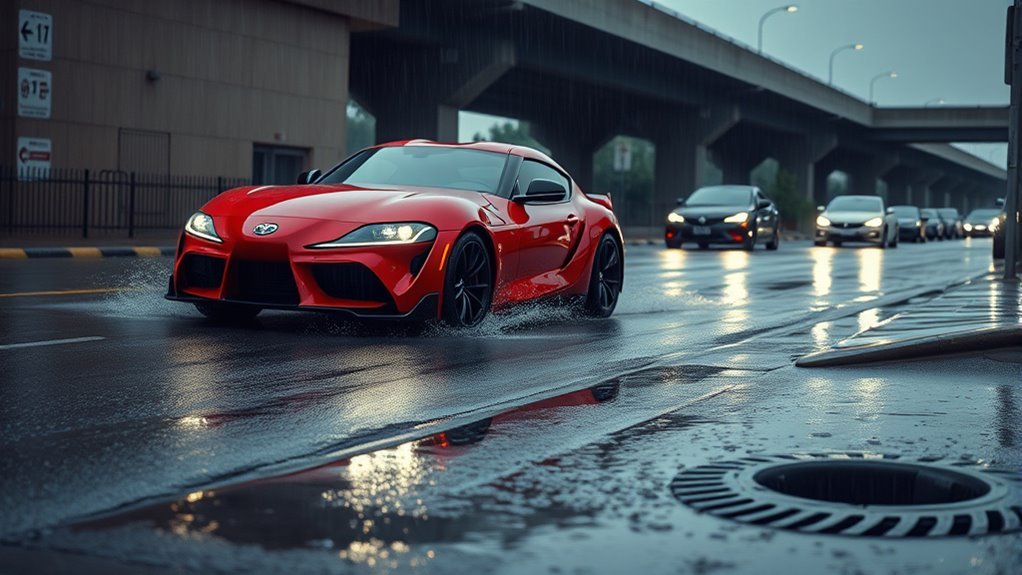
Floodwater is different from shallow, known, calm standing water. The National Weather Service says never drive into floodwater or around barriers blocking a flooded road. Moving water can carry vehicles away, and even apparently shallow water can hide a damaged or washed-out road surface. If the road is flooded, the water is moving, or its depth is unknown, turn around.
For calm water only, Toyota’s 2026 Supra manual states a maximum depth of 9.8 inches (25 cm) and a maximum speed of walking pace, up to 3 mph (5 km/h). Toyota also says to deactivate Auto Start/Stop before driving through water. These numbers are vehicle limits, not a recommendation to enter a flooded roadway. Use the owner’s manual that matches your exact model year and production period.
After passing through shallow, known calm water, check brake response gently at low speed when it is safe to do so. Toyota’s 2026 manual also advises gently applying the brake pedal every few miles on wet roads or in heavy rain, but only when that action will not endanger other traffic; the generated heat helps dry the brake discs and pads. If braking feels abnormal, the engine runs poorly, warning lights appear, or the car behaves unusually, stop safely and have it inspected.
Warning: Never drive around a barricade or treat Toyota’s 9.8-inch water limit as permission to cross floodwater. If depth, current, or the condition of the road underneath is uncertain, reroute.
[Products Worth Considering]

Rain-X WeatherBeater wiper blades are conventional replacement blades designed to meet or exceed OEM standards for quality, durability, and dependable performance. The pre-installed multi-adapter helps simplify installation on many vehicles, while the natural rubber squeegee and galvanized steel frame deliver a clean wipe, rust resistance, and long-lasting all-weather reliability.

Convert factory wired CarPlay to a wireless experience with this compact plug-and-play adapter designed for compatible vehicles. It supports GPS navigation, music, calls, Siri, and messaging while automatically reconnecting for a smoother drive. The slim mini design helps keep your cabin tidy and delivers a stable, responsive connection with preserved audio quality.

Enhanced Visibility: Improves safety with bright multifunctional LED lights for braking and fog conditions.
What Should You Check Before Driving a Supra in Heavy Rain?
Because wet roads amplify small problems, do a focused pre-drive inspection before heavy rain. Start with tires: measure tread depth across the inner, center, and outer grooves; check for uneven wear; inspect sidewalls; and set cold pressures correctly.
Next, inspect the wipers. Replace blades that chatter, streak, split, or leave uncleared bands. Top off washer fluid and clean the inside of the windshield, because interior haze can make glare and defogging more difficult at night.
Check brake response with a short, low-speed test before reaching busy traffic. The pedal should feel firm and predictable. If it feels soft, the vehicle pulls while braking, you hear grinding, or brake-related warning lights remain on, have the problem inspected instead of using a storm as a road test.
Also check headlights, taillights, brake lights, turn signals, defogger, battery condition, and visible fluid leaks. Use low-beam headlights in rain so other road users can see you; avoid high beams in heavy spray or fog because reflected light can make forward visibility worse.
[Products Worth Considering]

This item can no be shipped to the state in California, Техаs, Arizona please check with the manufacturer regarding warranty and support issues.

3-Second Easy Installation & Exact Fit: Designed strictly for J/U Hook wiper arms (9x3 & 9x4). No extra adapters or tools are needed; they easily click and lock into place in seconds for a seamless upgrade. To ensure complete confidence in your purchase, utilizing the 'Amazonconfirmedfit' tool at the top of the page helps verify these automotive replacement windshield wiper blades match your exact vehicle perfectly.

Non-Clogging: This windshield washer fluid pad has a diameter of 0.63 inches, fitting most vehicle washer fluid reservoir openings. It dissolves completely and quickly upon contact with water, leaving no debris behind. This assures that it will never clog your washer system, nozzles, or filters
Quick Pre-Drive and In-Car Safety Checklist
Use this quick checklist before setting off in a Supra when heavy rain is likely:
- Tires: Check tread depth, cold pressure, sidewall damage, and uneven wear.
- Wipers and washer fluid: Confirm the windshield clears without streaks.
- Lights: Turn on low beams and confirm brake lights and signals work.
- Cabin visibility: Set HVAC to defog, clean the glass, and adjust mirrors before moving.
- Driver settings: Keep normal VSC and traction-control functions active; avoid VSC Off or track-style settings.
- Loose items: Secure bottles, phones, bags, and cargo so nothing can roll into the pedal area.
- Route: Avoid known low-water crossings, construction zones, and flood-prone roads.
- Emergency gear: Carry a phone charger, flashlight, reflective triangle or vest, basic first-aid kit, and tire inflator or sealant kit if appropriate for your setup.
What to Avoid When Driving a Supra in Heavy Rain
Heavy rain is not the time to test the Supra’s power. Avoid full-throttle pulls, hard launches, abrupt downshifts, aggressive lane changes, close following, or deliberate sliding. A car that feels settled on one patch of pavement can lose grip when the tires meet deeper water, debris, or a low-friction surface.
Do not judge wet-weather grip by tire width alone. Tread depth and design, compound, inflation pressure, vehicle load, speed, temperature, and water depth all affect how effectively a tire maintains road contact. A worn performance tire can offer much less hydroplaning resistance than it did when new.
Finally, do not use another vehicle as proof that a route is safe. A truck or SUV may have more clearance, different tires, and a different intake or electrical layout. If the route is flooded or questionable, reroute or wait rather than following another driver into it.
Frequently Asked Questions
What is the best way to prepare a Toyota Supra for driving in heavy rain?
Check tire tread depth and cold pressure, inspect wipers and lights, clean the windshield, confirm the defogger works, keep normal stability systems enabled, and plan a route that avoids flooding. Address worn tires, brake problems, or poor visibility before entering severe weather.
What are the most important safety tips for heavy rain?
Slow down, increase following distance, use low-beam headlights, avoid cruise control, steer and brake smoothly, keep VSC active, and stay out of floodwater. If visibility becomes too poor to drive safely, leave the travel lane at the first safe location and wait for conditions to improve.
What should I do if my Supra starts hydroplaning?
Ease off the accelerator, keep the wheel steady, look where you want the car to go, and avoid sudden braking or sharp steering. As tire contact returns, make gentle corrections and brake progressively to reduce speed.
What speed should I drive in heavy rain?
There is no universal safe speed for heavy rain. Drive below the posted limit whenever conditions require it and slow enough that you can stop within the distance you can clearly see. Reduce speed further for pooled water, worn tires, curves, traffic, or poor visibility.
Should I turn off traction control in the rain?
No. For public-road rain driving, keep normal Vehicle Stability Control and traction-control functions enabled. Toyota’s Traction mode prioritizes forward movement on certain loose or low-grip surfaces while allowing reduced driving stability, so it is not the normal heavy-rain setting.
Can I drive a Supra through floodwater?
No. Do not enter a flooded roadway, moving water, water of unknown depth, or a road blocked by a flood barricade. Floodwater can move a vehicle and may hide a washed-out or damaged road surface. Turn around and choose another route.
What is Toyota’s maximum standing-water depth for a 2026 Supra?
Toyota’s 2026 Supra manual says calm water only, no deeper than 9.8 inches (25 cm), at no faster than walking speed up to 3 mph (5 km/h), with Auto Start/Stop deactivated. These are maximum vehicle limits, not a target for crossing floodwater. If the water is moving, depth is uncertain, or the road is flooded, turn around.
Should I use cruise control in a Supra during heavy rain?
No. Keep cruise control off in heavy rain and maintain direct control of vehicle speed. Wet conditions may require you to ease off the accelerator immediately when traction or visibility changes.
Conclusion
You can drive a Toyota Supra in heavy rain, but the safe approach is conservative: slow down before grip becomes a problem, keep normal VSC active, leave extra space, and use smooth steering, throttle, and braking. Before the next storm, measure tire tread, set cold pressures to the vehicle placard, confirm the wipers and defogger work, and check the route for flooding. If the roadway is flooded, reroute; if the car hydroplanes, ease off the accelerator and avoid abrupt inputs until tire contact returns.
Sources
- Federal Highway Administration — Rain & Flooding — wet-pavement and rainfall crash statistics.
- National Highway Traffic Safety Administration — Tire Safety — tire pressure, tread depth, inspection, and maintenance guidance.
- National Weather Service — Turn Around Don’t Drown — floodwater, moving-water, and barricade safety guidance.
- Toyota Owners — Manuals & Warranties — current 2026 Supra owner’s manuals; select the manual matching the vehicle’s production period for rain, water-depth, wet-brake, and control-system guidance.
- Toyota 2026 GR Supra Owner’s Manual — Driving Stability Control Systems — Vehicle Stability Control and Traction-mode behavior.
- Michelin — Tire Tread Depth — wet-road performance, tread depth, and the additional wet-weather buffer associated with earlier replacement.
- U.S. Tire Manufacturers Association — Replacing Tires — tire replacement specifications and rear-axle placement when replacing only two tires.

[…] This guide focuses on hydroplaning prevention and recovery. For broader visibility, floodwater, and storm-driving precautions, see the Toyota Supra heavy-rain safety guide. […]