Last updated: September 1, 2026
Substantive update: Added Toyota’s 2019–2024 cold-start misfire bulletin and 2019–2020 fuel-pump recall check, clarified hybrid applicability, and refreshed repair-cost estimates.
A P0300 code on a Toyota RAV4 means the engine computer has detected random or multiple cylinder misfires. One or more cylinders are not burning the air-fuel mixture cleanly, but the code does not identify one failed part. Save the scan data first, then work through ignition, intake leaks, fuel delivery, and mechanical condition instead of replacing parts at random. On some 2019–2024 gasoline RAV4s, Toyota also has a cold-start misfire bulletin that can change the diagnostic path. This guide covers U.S.-market gasoline and hybrid RAV4 models; exact procedures and specifications vary by model year and engine.
Quick Answer
P0300 on a Toyota RAV4 means “random/multiple cylinder misfire detected.” Read stored, pending, and permanent codes and save the freeze-frame data before clearing anything. Then check plugs and coils, unmetered-air leaks, fuel delivery, injectors, and compression. If a 2019–2024 gasoline RAV4 with the A25A-FKS engine misfires after a cold soak and freeze-frame coolant temperature is 14°F–41°F, check Toyota T-SB-0010-24 before treating it as a generic P0300. Stop driving if the check engine light flashes, the engine shakes badly, power drops sharply, or you smell raw fuel.
Key Takeaways
- P0300 does not identify one cylinder; it points to a random or multi-cylinder misfire pattern.
- Related codes such as P0301, P0302, P0303, or P0304 help narrow the fault to a specific cylinder on most 4-cylinder RAV4 models.
- A flashing check engine light means the misfire is active and can overheat the catalytic converter.
- The best diagnostic order is scan data first, then ignition, air leaks, fuel delivery, and mechanical checks.
- Toyota T-SB-0010-24 applies to some 2019–2024 RAV4s with the A25A-FKS gasoline engine when misfire codes set after a cold soak with coolant at 14°F–41°F; it is not a blanket diagnosis for every P0300.
- Certain 2019–2020 RAV4s were included in Toyota/NHTSA fuel-pump recall 20V-682. Check the 17-digit VIN instead of assuming every vehicle in those model years is affected.
- Use Toyota repair information for your exact model year and engine before applying fuel-pressure, spark-plug, torque, or electrical specifications.
At a Glance
| First Pass | Save codes and freeze-frame data, inspect the intake tract, and check coil connectors and plug wells |
| DIY Limit | Basic scanning and visual checks are beginner-friendly; fuel-pressure, compression, leak-down, and hybrid-system work may require a qualified shop |
| Useful Tools | OBD-II scanner, flashlight, basic hand tools, spark plug socket, multimeter, smoke machine or vacuum-leak equipment, and a model-appropriate fuel-pressure test setup |
| Model-Specific Check | 2019–2024 A25A-FKS cold-start misfire: review Toyota T-SB-0010-24; 2019–2020 RAV4: check the VIN for open fuel-pump campaigns |
| Stop Driving When | The light flashes, the engine shakes severely, power drops, stalling occurs, or raw fuel is present |
Warning: If the check engine light is flashing, reduce engine load, pull over safely, and avoid continued driving. A severe misfire can send unburned fuel into the exhaust and overheat the catalytic converter.
What Does P0300 Mean on a Toyota RAV4?
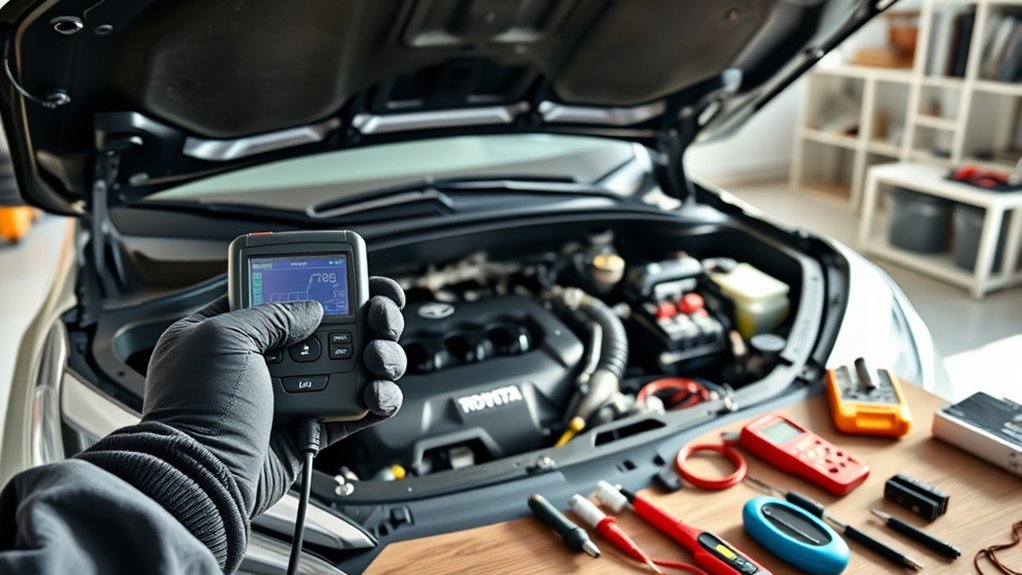
When your Toyota RAV4 stores a P0300 code, the powertrain control module has detected a misfire pattern that is random, spread across more than one cylinder, or not yet isolated to a single cylinder. A misfire happens when a cylinder does not produce a complete combustion event. That can come from weak spark, too much or too little fuel, unmetered air, poor compression, or incorrect engine timing.
OBD-II misfire monitoring matters because a severe misfire can overheat the catalytic converter. EPA OBD guidance treats a flashing malfunction indicator light as an urgent warning of a severe misfire. Save the available freeze-frame, companion-code, and misfire data before clearing codes so you can reproduce the conditions that set P0300.
| Code | Meaning | How It Helps |
|---|---|---|
| P0300 | Random or multiple cylinder misfire | Look for shared causes such as air leaks, fuel delivery, bad fuel, or multiple worn ignition parts. |
| P0301–P0304 | Misfire on cylinders 1–4 | Most 4-cylinder RAV4 models use these to identify the affected cylinder. |
| P0305–P0306 | Misfire on cylinders 5–6 | Used on older V6-equipped RAV4s; it does not apply to 4-cylinder models. |
| P0171 / P0174 | Lean air-fuel mixture | P0171 points to a lean condition on Bank 1. P0174 is a Bank 2 lean code and is mainly relevant to older V6-equipped RAV4s; 4-cylinder models have only one bank. |
| P0101 / P0102 | Mass airflow sensor range or low input | Check intake ducting, MAF contamination, wiring, and air filter condition. |
Are There RAV4-Specific P0300 Problems to Check?
Yes. Before treating every P0300 as a generic ignition problem, check whether your RAV4 fits a Toyota-specific pattern. Toyota bulletin T-SB-0010-24 covers some 2019–2024 RAV4s with the A25A-FKS gasoline engine when P0300 or P0301–P0304 sets after a cold soak with freeze-frame coolant temperature between 14°F and 41°F. Toyota’s procedure verifies compression, ignition, injectors, and the fuel system before the bulletin’s exhaust-side hydraulic lash-adjuster repair is considered.
| RAV4 Pattern | What to Check | What It Changes |
|---|---|---|
| 2019–2024 gasoline RAV4, A25A-FKS, cold-soak misfire at 14°F–41°F | Toyota T-SB-0010-24 | Follow the bulletin’s compression, ignition, injector, and fuel-system checks before considering its specified exhaust-side lash-adjuster repair. |
| Certain 2019–2020 RAV4s | NHTSA recall 20V-682 and the Toyota VIN recall lookup | A low-pressure fuel-pump fault can affect fuel delivery. The recall covered certain vehicles with specific Denso pumps, not every RAV4 in those years. |
| RAV4 Hybrid | Use hybrid-specific Toyota service information and check the VIN for open campaigns. | T-SB-0010-24 names the A25A-FKS gasoline engine, so do not apply that bulletin to a hybrid simply because P0300 is present. |
Model-year shortcut: A matching bulletin or recall does not prove the cause. It tells you which Toyota-specific branch to check before replacing plugs, coils, injectors, or a fuel pump.
Can You Drive a Toyota RAV4 With P0300?
A RAV4 with P0300 may idle roughly, shake at stoplights, hesitate during acceleration, lose power under load, smell like raw fuel, or use more fuel than normal. In some cases, the engine may feel normal because the misfire only happens during a specific load, temperature, or speed range.
A solid check engine light usually means the vehicle needs diagnosis soon. A flashing check engine light is more urgent because it indicates an active misfire severe enough to threaten the catalytic converter. If the light flashes, avoid highway driving, towing, hard acceleration, and long-distance driving until the fault is corrected.
| Misfire Pattern | Best First Checks | Why |
|---|---|---|
| P0300 plus one cylinder code | That cylinder’s plug, coil, injector, wiring, and compression | The cylinder-specific code gives you a focused starting point. |
| Roughest at idle, smoother with more RPM | Vacuum leaks, purge valve, PCV hoses, and intake-gasket areas | Unmetered air often has a larger effect when airflow is low. |
| Misfire mainly under acceleration or load | Plug condition and gap, weak coils, fuel pressure, and injector delivery | Higher cylinder pressure exposes weak ignition and fuel-supply problems. |
| Multiple-cylinder misfire with positive fuel trims | Intake leaks, MAF accuracy, and fuel delivery | The pattern points toward a cause shared by several cylinders. |
Note: Do not clear the code before saving the freeze-frame data. Freeze-frame details show engine speed, load, coolant temperature, and other conditions present when the code set.
[Products Worth Considering]

This ignition coil pack and pre-gapped spark plug set is designed for select 3.5L V6 Toyota and Lexus models, helping restore smooth engine performance and reliable starting. Built to meet or exceed OEM specifications, it can help fix common issues like misfires, rough idle, poor fuel economy, and reduced power. The complete 6-piece set offers a convenient replacement solution for compatible vehicles.

This complete ignition kit includes six direct replacement coil packs and six pre-gapped iridium spark plugs designed for select Toyota and Lexus 3.5L V6 vehicles. It can help address misfires, rough idle, hard starting, hesitation, and check engine light issues caused by worn ignition components while supporting smooth, reliable engine performance. Built for easy installation and backed by testing, warranty coverage, and technical support, it is a convenient tune-up solution.

This ignition coil and iridium spark plug set is designed to restore smooth engine performance and reliable starts for compatible Toyota, Lexus, Scion, and Pontiac vehicles. It features durable coil construction for dependable electrical connection and long-lasting iridium plugs for extended service life. The set includes four matched coils and plugs, making it a convenient replacement solution backed by a one-year warranty.
What Should You Check First When P0300 Appears?
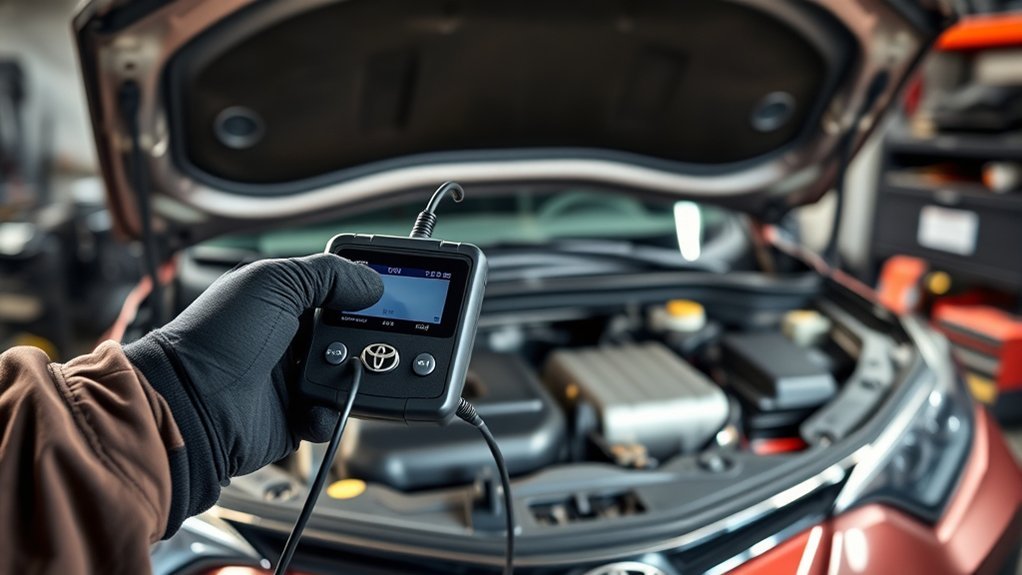
Because diagnosing a P0300 starts with data, begin by connecting an OBD-II scanner. Read stored codes, pending codes, permanent codes, and freeze-frame data before touching parts. This prevents guesswork and helps you decide whether the misfire is cylinder-specific, load-related, temperature-related, or linked to another system.
- Record all codes and freeze-frame data. Note engine RPM, coolant temperature, fuel trims, vehicle speed, and engine load. If the misfire happened cold, hot, at idle, or under acceleration, the repair path changes.
- Check for cylinder-specific codes. If P0300 appears with P0302, for example, focus first on cylinder 2 while still checking shared causes.
- Inspect the engine air filter and intake duct. A clogged air filter, loose airbox, cracked intake boot, or disconnected hose can skew the air-fuel mixture.
- Look for obvious ignition issues. Check for loose coil connectors, oil in spark plug wells, rodent damage, corrosion, or water intrusion.
- Follow safety steps. Let the engine cool before working near exhaust parts, keep hands clear of moving belts and fans, wear eye protection, and relieve fuel pressure before opening any fuel line.
Pro Tip: If your scanner shows live misfire counters or Mode $06 data, watch which cylinder count rises first and under what operating condition. Generic scanners may label Mode $06 results differently, so confirm the test IDs before treating a value as proof.
[Products Worth Considering]

This ignition coil pack and iridium spark plug set is designed to restore smooth starting, strong acceleration, and dependable engine performance for a wide range of compatible Toyota, Lexus, Scion, and Pontiac vehicles. Built as a direct OEM replacement, it offers plug-and-play installation and helps reduce misfires while improving fuel economy and overall drivability. The premium iridium plugs and matched coils deliver consistent spark output and long-lasting durability for everyday driving.

This set of four ignition coils is designed to restore smooth engine performance and reliable starting for compatible Toyota, Scion, and Lexus applications. Built to meet or exceed OE specifications, these coil packs help reduce misfires, hesitation, and check engine light issues while supporting stronger ignition output. The direct-fit design makes installation straightforward, and the package includes a warranty for added peace of mind.

Pitch Adjustment Function: The spark plugs tester is equipped with a pitch adjustment valve and a round knob, which can adjust the observation pitch of the spark plugs according to the needs of different car models, and at the same time can effectively avoid the occurrence of misfire and burnt ignition coils
How Do You Test Spark Plugs and Ignition Coils?
If P0300 appears with a cylinder-specific P0301–P0306 code, use that cylinder code to test the affected plug and coil first. If only P0300 is present across several cylinders, check shared causes such as intake leaks, fuel delivery, or a model-specific Toyota bulletin before buying multiple coils.
[Products Worth Considering]
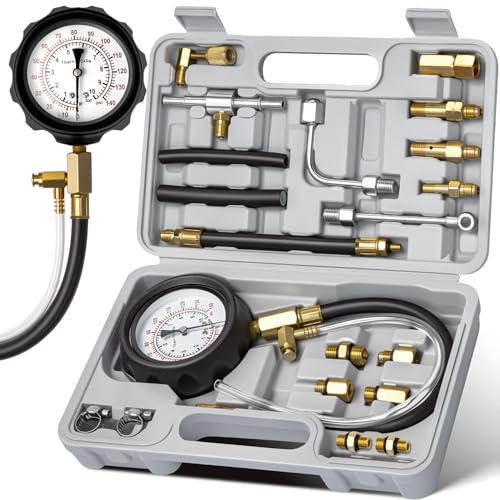
ACCURATE DUAL-SCALE GAUGE: Features a shock-resistant dry gauge with built-in damping mechanism, providing clear 0–140 PSI and 0–10 BAR dual scales for precise fuel system diagnostics

Universal Design: The included adapters, hoses and fittings cover most fuel injection systems and Gas Engine Cars, Motorcycles, Trucks, SUVs, ATVs, UTVs, RVs. (Does not compatible with Bosch, CIS Jetronic, TB System on GM vehicles, 2012 Dodge 5.7L, 1999 GNMC Sonoma 4.3). Please verify your vehicle's vallve size and pressure specs before purchase
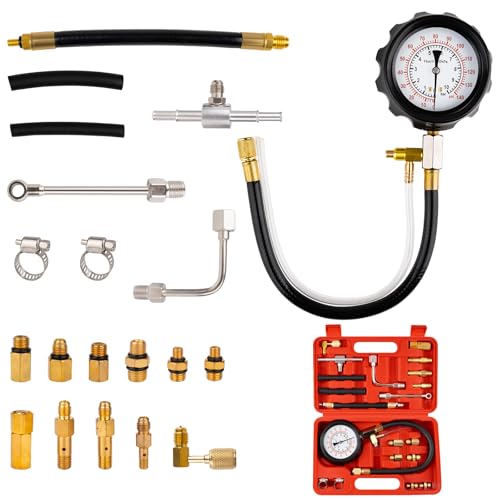
Compatibility Note: For further confirmation of specific model compatibility, refer to the vehicle owner's manual or contact a professional technician. Excludes Fo/rd, K/I/A, Bo/s/ch, C/I/S Je/tro/nic, G//M Th/rot/tle Bo/dy Systems, A/cu/ra, J/ee/p, B/M/W, Ni/s/san, and To/yo/ta fuel systems. Not compatible with small/non/standard S/chra/der vallves, high/pre/ssure direct in/ject/ed engines, or die//sel injection pumps. Verify your vehicle’s vallve size and pressure specs before purchase
1. Inspect the spark plugs
Remove and inspect the spark plugs if mileage, symptoms, or scan data point toward ignition. Look for worn electrodes, cracked porcelain, oil fouling, fuel wetness, heavy carbon, or a gap that is clearly outside specification. Many late-model RAV4 engines use long-life iridium plugs, but the replacement interval and plug type depend on model year and engine. Check Toyota maintenance information for your exact vehicle before choosing parts or setting gap.
2. Swap coils to see if the misfire follows
If the scan tool shows a cylinder-specific misfire, move that cylinder’s ignition coil to another cylinder, clear the codes, and run the engine under the same conditions. If the misfire follows the coil, the coil is suspect. If it stays on the same cylinder, look at the plug, injector, wiring, compression, or air leak near that runner.
3. Use a spark tester when needed
An inline spark tester can confirm that a spark event is present, but it cannot prove the coil is strong enough under cylinder pressure. Avoid pulling a coil or plug wire off a running engine by hand. That can shock you, damage electronics, or create a spark near fuel vapors.
4. Be careful with multimeter-only coil testing
Older ignition coils can often be checked with resistance tests, but many modern coil-on-plug units contain internal electronics that do not fail in a way a simple resistance check will catch. Use Toyota service specifications, scan data, coil swapping, and known-good comparisons before condemning a coil.
5. Do not rely on a timing light for most modern RAV4 engines
On modern RAV4 engines, ignition timing is controlled by the engine computer and is not adjusted like older distributor systems. If timing-related symptoms are present, inspect scan data, cam/crank correlation codes, variable valve timing faults, timing-chain condition, and related sensors instead of treating ignition timing as a basic manual adjustment.
How Do You Check Fuel Delivery and Vacuum Leaks?
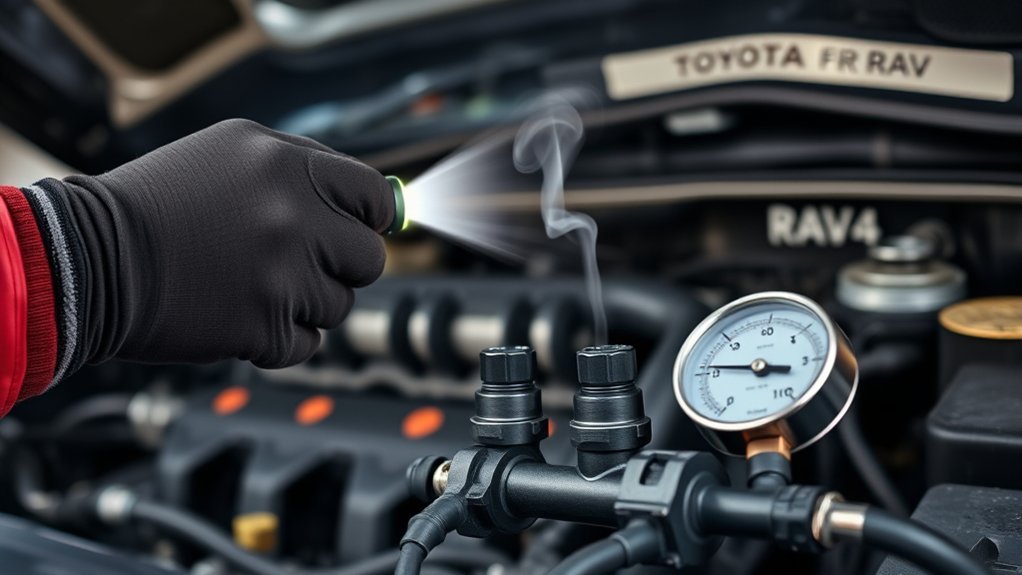
If ignition checks do not reveal the cause, move next to fuel delivery and intake sealing. A random misfire often comes from something that affects more than one cylinder: low fuel pressure, contaminated fuel, unmetered air, a dirty mass airflow sensor, or a vacuum leak.
- Fuel trims most positive at idle, then closer to normal with more RPM: an intake or vacuum leak becomes more likely.
- Fuel trims positive at idle and while driving: check MAF accuracy, fuel pressure, and fuel quality.
- Fuel trims near normal with one cylinder counting misfires: focus on that cylinder’s ignition, injector, wiring, and compression.
- Check fuel trims first. High positive short-term or long-term fuel trim can point toward a lean condition from vacuum leaks, intake leaks, low fuel pressure, or MAF sensor issues.
- Test fuel pressure with the correct procedure. Attach a fuel-pressure gauge only where the vehicle is designed to be tested, and compare readings to Toyota specifications for your model year. Low or unstable pressure can indicate a weak pump, restricted filter or strainer, electrical supply issue, or pressure-control problem.
- Check injector operation. Listen for a steady injector click with a mechanic’s stethoscope, verify wiring and connector condition, and compare injector balance if you have the right equipment. Swapping injectors can help, but it is more involved than swapping coils and may require new seals.
- Inspect for vacuum and intake leaks. Check PCV hoses, brake-booster hose, intake manifold gasket areas, the air intake tube, and small vacuum lines. A smoke machine is the safest and cleanest way to find leaks.
- Do not use flammable spray tests. Do not spray starter fluid, carburetor cleaner, brake cleaner, or other flammable products around a running or hot engine. Use a smoke machine or have a qualified technician test for leaks.
What Other Problems Can Cause P0300?
If the ignition, fuel, and intake checks pass, widen the diagnosis. P0300 can also come from a sensor problem, exhaust restriction, valve timing problem, or internal engine issue.
- MAF sensor contamination: A dirty or skewed mass airflow sensor can cause the wrong fuel calculation. Use MAF-safe cleaner only; do not touch the sensing element.
- Engine coolant temperature sensor errors: If the computer thinks the engine is colder or hotter than it really is, fueling may be wrong.
- Oxygen or air-fuel ratio sensor issues: A skewed sensor can mislead fuel-trim corrections, though it is usually not the first part to replace.
- EGR or EVAP purge faults: A stuck-open purge valve or unexpected exhaust gas flow can create rough running and lean-like symptoms.
- Low compression: Burned valves, worn rings, head-gasket issues, or timing-chain problems can cause a misfire that no plug or coil will fix.
- Exhaust restriction: A damaged or restricted catalytic converter can cause power loss and misfire-like symptoms, especially under load.
Diagnostic rule: Prove that the affected cylinder has spark, the correct air-fuel mixture, and enough compression at the right time.
What Is the Best Diagnostic Order for RAV4 Code P0300?
Use this order to keep the diagnosis efficient:
- Scan all modules and save freeze-frame data. Do not clear codes yet.
- Check for companion codes. Lean, MAF, coolant-temperature, cam/crank, or fuel-system codes can change the whole direction.
- Inspect air intake and obvious wiring issues. Look for cracked ducts, loose clamps, disconnected hoses, water intrusion, and damaged connectors.
- Check spark plugs and coils. Replace worn plugs with the correct type and verify suspect coils by swapping when practical.
- Review live data. Check fuel trims, MAF readings, coolant temperature, oxygen or air-fuel sensor behavior, and misfire counters.
- Smoke-test the intake. Repair any vacuum or unmetered-air leak before deeper testing.
- Verify fuel delivery. Test fuel pressure, injector control, and injector balance when symptoms point to fuel.
- Run compression or leak-down tests. Do this if one cylinder repeatedly misfires after spark and fuel checks pass, or if the engine has mechanical noise, overheating history, or oil/coolant loss.
- Repair the confirmed fault, clear codes, and road-test. Recheck pending codes and monitor misfire counters after the repair.
How Much Does It Cost to Fix RAV4 Code P0300?
Once you confirm the fault, match the repair to the failed system. Do not replace all coils, injectors, sensors, or the fuel pump just because P0300 is present. Random misfire codes need proof.
The U.S. estimates below are examples, not quotes. RepairPal states that these RAV4 estimates were updated August 7, 2026 and exclude taxes, fees, location differences, and related repairs.
| Confirmed Problem | Common Fix | Typical Cost Range | DIY? |
|---|---|---|---|
| Worn or fouled spark plugs | Install correct Toyota-spec plugs | $156–$224 average estimate | Yes, for many owners with basic tools |
| Failed ignition coil | Replace the confirmed bad coil | $267–$349 average estimate | Usually yes |
| Intake manifold gasket leak | Replace the confirmed leaking gasket and inspect the manifold | $482–$656 average estimate | Usually shop-level |
| Contaminated or failed MAF sensor | Clean only with MAF-safe cleaner, or replace after testing confirms failure | $295–$369 average replacement estimate; cleaning is not included | Yes, with care |
| Low fuel pressure | Repair fuel pump, wiring, relay, or pressure-control fault | $1,439–$1,575 average estimate | Usually shop-level |
| Low compression or timing issue | Mechanical engine repair | Varies widely; diagnosis is essential first | No, for most owners |
Visit a shop if the check engine light is flashing, the engine shakes badly, the RAV4 has poor power, you smell fuel, you find low compression, or the code returns after basic ignition and intake checks. Professional diagnosis is also the safer choice for hybrid models, fuel-system work, high-voltage areas, and anything involving advanced scan data or engine mechanical testing.
How Do You Confirm the P0300 Repair Worked?
After repairing the confirmed fault, clear the stored and pending codes with a scanner and road-test the RAV4 under the same conditions shown in the freeze-frame data. Then recheck stored, pending, and permanent codes. A permanent code may remain until the OBD monitor confirms the repair; it is not normally erased on command. Some monitors need a complete drive cycle before the vehicle is ready for emissions testing.
If P0300 returns immediately, the root cause is still present. If a new cylinder-specific code appears, use that new code to narrow the diagnosis. If a catalyst-efficiency code appears after a long period of misfiring, have the catalytic converter and oxygen or air-fuel ratio sensor data checked before replacing parts.
Frequently Asked Questions
What is code P0300 on a Toyota RAV4?
P0300 means the RAV4’s engine computer detected random or multiple cylinder misfires. It does not name one failed part. The usual diagnostic areas are spark plugs, ignition coils, vacuum leaks, fuel delivery, injectors, sensors, and engine compression.
Can I drive my Toyota RAV4 with a P0300 code?
If the check engine light is solid and the engine runs normally, drive only as needed to diagnose or repair it. If the light is flashing, the engine is shaking, or power is poor, stop driving and have the vehicle inspected to avoid catalytic converter damage.
What is the most common cause of P0300 on a RAV4?
Common causes include worn spark plugs, failing ignition coils, intake or vacuum leaks, dirty or skewed MAF sensor readings, low fuel pressure, clogged injectors, or bad fuel. The most likely cause depends on mileage, maintenance history, and the freeze-frame data.
Will replacing spark plugs fix P0300?
It can, but only if the plugs are worn, fouled, damaged, or incorrect. If the misfire comes from a vacuum leak, injector problem, weak fuel pump, bad coil, or low compression, spark plugs alone will not fix the code.
Why does P0300 come back after I clear it?
Clearing the code only erases the warning; it does not repair the misfire. If P0300 returns, the engine computer is still detecting a combustion problem. Save the new freeze-frame data and continue diagnosis instead of repeatedly clearing the light.
Does Toyota have a TSB for RAV4 P0300 on cold starts?
Yes. Toyota T-SB-0010-24 covers some 2019–2024 RAV4s with the A25A-FKS gasoline engine when P0300 or P0301–P0304 occurs after a cold soak and freeze-frame coolant temperature is 14°F–41°F. The bulletin calls for compression, ignition, injector, and fuel-system checks before its exhaust-side hydraulic lash-adjuster repair. It does not automatically apply to every P0300 or to a RAV4 Hybrid.
Can a fuel-pump recall be related to P0300 on a RAV4?
A low-pressure fuel-pump problem can reduce fuel delivery and contribute to rough running, stalling, or misfire symptoms. Toyota/NHTSA recall 20V-682 included certain 2019–2020 RAV4s with specific Denso fuel pumps. Check the 17-digit VIN on Toyota’s recall lookup rather than assuming every 2019–2020 RAV4 is affected.
Is P0300 different on a RAV4 Hybrid?
The code meaning is the same, but diagnosis can be different because the gasoline engine may start and stop during hybrid operation. Toyota T-SB-0010-24 names the A25A-FKS gasoline engine, so do not apply that bulletin to a hybrid simply because P0300 is present. Power the vehicle down before inspection, do not touch orange high-voltage cables or components, and use Toyota-specific hybrid service procedures or a shop with hybrid experience.
Can a vacuum leak cause P0300 on a Toyota RAV4?
Yes. Air entering after the MAF sensor can make the mixture too lean and cause random or multiple-cylinder misfires. Check the intake tube, PCV hoses, brake-booster hose, purge system, and intake-manifold sealing areas. A smoke test is safer and more reliable than spraying flammable cleaner around the engine.
How can I tell whether the coil or injector is causing the misfire?
When a cylinder-specific code is present, swap the ignition coil with another cylinder and repeat the test under the same conditions. If the misfire follows the coil, the coil is suspect. If it stays on the original cylinder, inspect the plug, injector control and delivery, wiring, air leak near that runner, and compression.
Conclusion
A P0300 Toyota RAV4 code means the engine is misfiring randomly or across multiple cylinders. Save the scan data, check companion codes, then use the model year and operating conditions to choose the next branch: Toyota T-SB-0010-24 matters for a qualifying 2019–2024 A25A-FKS cold-start misfire, while certain 2019–2020 RAV4s warrant a VIN recall check for the low-pressure fuel pump. Otherwise, inspect ignition and intake sealing, verify fuel delivery, and move to compression or timing tests only when earlier checks pass. If the check engine light flashes, the engine shakes badly, power drops, or raw fuel is present, stop driving and arrange diagnosis before the catalytic converter or engine suffers further damage.
Sources
- Toyota T-SB-0010-24: MIL ON With Misfire DTC(s) in Cold Temperatures — Toyota bulletin for some 2019–2024 RAV4s with A25A-FKS engines and cold-soak misfires at 14°F–41°F.
- NHTSA Safety Recall Report 20V-682 — Includes certain 2019–2020 Toyota RAV4s equipped with specific Denso fuel pumps.
- Toyota Safety Recall and Service Campaign Lookup — Checks open campaigns by 17-digit VIN or license plate and state.
- U.S. EPA: Frequently Asked Questions About On-Board Diagnostics — Explains OBD warning-light behavior and the urgency of a severe misfire.
- Electronic Code of Federal Regulations, 40 CFR § 86.1806-17 — Federal OBD requirements for applicable later-model vehicles.
- Toyota Owners: RAV4 Warning Lights and Indicators — Toyota owner guidance for warning lights and inspection when warning indicators do not operate normally.
- Toyota Owners: RAV4 Maintenance Requirements — Toyota guidance on regular maintenance, repairs, and using appropriate service information.
- RepairPal: Toyota RAV4 Spark Plug Replacement Cost — Average estimate updated August 7, 2026.
- RepairPal: Toyota RAV4 Ignition Coil Replacement Cost — Average estimate updated August 7, 2026.
- RepairPal: Toyota RAV4 Mass Airflow Sensor Replacement Cost — Average estimate updated August 7, 2026.
- RepairPal: Toyota RAV4 Fuel Pump Replacement Cost — Average estimate updated August 7, 2026.
- RepairPal: Toyota RAV4 Intake Manifold Gasket Replacement Cost — Average estimate updated August 7, 2026.