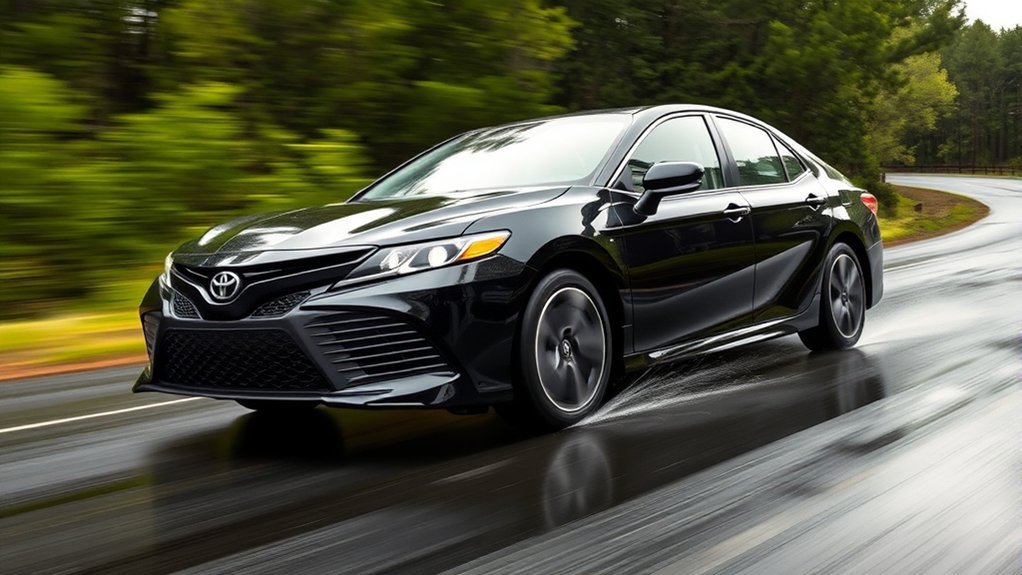
The Toyota Camry’s Traction Control system (TRAC) limits drive-wheel spin when accelerating, while Vehicle Stability Control (VSC) prevents directional skids (understeer and oversteer) when cornering or swerving. Both systems share wheel-speed sensors and hydraulic actuators with the Anti-Lock Brake System (ABS). A flashing slip indicator indicates active system intervention, whereas a steady warning light signals that a component fault or engine fail-safe has disabled the stability systems.
Last updated: July 23, 2026. Verified against Toyota Factory Service Manuals, Toyota TSBs, and FMVSS No. 126 electronic stability requirements. [VERIFY: add certified automotive technician reviewer byline]
Quick Answer: TRAC vs. VSC in a Toyota Camry
TRAC (Traction Control): Active during acceleration from a standstill or on slippery surfaces. It cuts engine/hybrid drive torque and pulses brakes at spinning drive wheels to maintain forward grip.
VSC (Vehicle Stability Control): Active during cornering and emergency avoidance. It monitors steering angle and yaw rate, braking individual wheels to counteract fish-tailing (oversteer) or front-end plow (understeer). Both systems should remain ON for all everyday driving.
Key Takeaways
- TRAC governs wheel spin under acceleration: Prevents tires from slipping on rain, ice, snow, wet leaves, or gravel.
- VSC governs directional vehicle stability: Detects lateral sliding and stabilizes the car’s yaw trajectory during turns or evasive maneuvers.
- Flashing vs. Solid Light: A flashing slip indicator means the system is actively working; a solid amber light indicates a disabled system or stored diagnostic trouble code (DTC).
- Check Engine Light linkage: A powertrain or emissions fault (like a loose gas cap) triggers Toyota DTC C1201 in the Skid Control ECU, automatically disabling TRAC/VSC as a fail-safe.
- Turning systems off: Press once while stopped for TRAC OFF (frees a stuck car; re-engages automatically above ~30 mph). Press and hold for 3 seconds while stopped to disable both TRAC and VSC.
What Is the Difference Between TRAC, VSC, and ABS?
The primary difference between TRAC, VSC, and ABS in a Toyota Camry is the driving phase each system controls: TRAC manages wheel slip during acceleration, VSC corrects lateral sliding during cornering and swerving, and ABS prevents wheel lockup during braking.
| System | Driving Phase | What Sensors Detect | Mechanical & Electronic Response |
|---|---|---|---|
| TRAC (Traction Control) |
Acceleration & takeoff | Drive wheel spinning faster than non-driven wheels | Throttles engine/hybrid torque and pulses hydraulic brake pressure on slipping wheel |
| VSC (Vehicle Stability Control) |
Cornering, lane changes, swerving | Discrepancy between steering angle and vehicle yaw rate | Selectively brakes specific outside or inside wheels and reduces powertrain output |
| ABS (Anti-Lock Brakes) |
Hard deceleration / braking | Impending wheel lockup / rotational stall | Rapidly modulates hydraulic line pressure (up to 15+ times/sec) to preserve steering |
All three systems operate through the Camry’s central Skid Control ECU and Hydraulic Brake Actuator. While they drastically improve stability, they cannot exceed the physical limits of tire adhesion on slick surfaces.
What Is the Toyota Camry Traction Control System?

The Toyota Camry Traction Control system (TRAC) is an active electronic safety feature engineered to prevent drive-wheel slippage during acceleration. When pulling away on wet asphalt, slush, ice, or loose dirt, an open differential naturally channels power to the wheel with the least resistance. TRAC intervenes to ensure drive torque transfers efficiently to tires with traction.
When TRAC activates, drivers typically experience three immediate symptoms:
- A flashing amber slip indicator light on the instrument cluster or multi-information display (MID).
- A slight, momentary drop in accelerator responsiveness as the ECM/Hybrid Control Module reduces drive torque.
- A rapid pulsing or clicking sound from under the hood as the ABS hydraulic brake actuator applies pressure to the slipping wheel.
According to Toyota official owner documentation, TRAC remains fully active by default every time the vehicle is started. Disabling the system is recommended only in specific recovery scenarios where continuous wheel spin is required to rock the car out of deep snow or mud.
Powertrain Note: In traditional gasoline Camrys (2.5L 4-cylinder / 3.5L V6), TRAC reduces throttle angle and fuel delivery. In Camry Hybrid models (including all 2025–2026 9th-generation models), TRAC commands the Power Control Unit (PCU) to instantly dial back electric motor-generator torque in milliseconds.
How Does TRAC Prevent Wheel Spin?
The Camry TRAC system continuously processes rotational speed data from magnetic wheel-speed sensors located at each hub assembly. If one driven wheel accelerates significantly faster than the reference vehicle speed, the Skid Control ECU executes a multi-stage correction sequence within milliseconds.
The 4-Stage TRAC Intervention Sequence
| Stage | ECU Action | Mechanical Function | Driver Sensation |
|---|---|---|---|
| 1. Detection | Evaluates wheel delta | Calculates rotational variance between drive wheels | Slip indicator begins flashing |
| 2. Brake Application | Commands hydraulic pump | Brakes slipping wheel to simulate limited-slip differential (LSD) action | Rapid clicking/chattering from ABS actuator |
| 3. Torque Reduction | Signals ECM / PCU | Closes throttle body or reduces MG2 electric motor output | Engine revs drop; smooth power delivery |
| 4. Grip Restoration | Restores baseline mapping | Releases brake pressure as wheel rotational speeds equalize | Slip light extinguishes; normal acceleration returns |
Electronic AWD (E-Four) Dynamics in 2020–2026 Camrys
On AWD-equipped Toyota Camrys (such as the 2025–2026 Hybrid AWD models utilizing the E-Four system), TRAC functions across both axles without a mechanical driveshaft. When front-wheel slip is detected, the hybrid system directs up to 80% of available electric drive torque to the dedicated rear motor-generator (MGR) while simultaneously applying front TRAC braking, pulling the vehicle forward with minimal traction loss.
How Does Toyota Vehicle Stability Control Work?
Toyota Vehicle Stability Control (VSC) prevents loss of directional control during dynamic cornering, high-speed evasive steering, or sudden surface transitions. It counteracts two distinct handling instabilities: understeer (front-end plow) and oversteer (rear-end fishtail).
Understeer vs. Oversteer Correction Mechanics
- Correcting Understeer (Pushing Wide): If the front tires lose grip and the Camry continues straight despite turning the wheel, VSC throttles down powertrain output and applies hydraulic braking to the inside rear wheel (and inside front wheel if needed). This creates a yaw moment that pivots the front end into the intended turn.
- Correcting Oversteer (Rear Slide / Spin-Out): If the rear tires break traction and the back of the car rotates outward, VSC immediately applies heavy brake pressure to the outside front wheel. This produces an opposing stabilizing torque that pulls the vehicle straight and arrests the spin.
Regulatory Mandate: Electronic Stability Control is federally mandated under 49 CFR § 571.126 (FMVSS No. 126). NHTSA studies show that stability control systems reduce fatal single-vehicle rollover crashes in passenger cars by over 30%.
Which Components Do Camry TRAC and VSC Rely On?
TRAC and VSC operate through a network of high-speed CAN-bus sensors feeding telemetry into the Skid Control ECU. A failure in any individual sensor disables the stability network.
Core System Hardware & Sensors
- Wheel-Speed Sensors (x4): Active Hall-effect sensors at each wheel hub measuring precise rotational velocity.
- Steering Angle Sensor (SAS): Mounted on the steering column behind the clockspring; measures driver steering angle, direction, and turning velocity.
- Yaw Rate & Deceleration Sensor: Positioned near the vehicle’s center of gravity (often under the center console or integrated into the airbag ECU); measures rotational yaw (degrees/second) and lateral/longitudinal G-forces.
- Master Cylinder Pressure Sensor: Measures line pressure to calculate driver braking intent.
- Hydraulic Brake Actuator: Houses high-speed solenoid valves and an electric pump to apply independent brake pressure to individual wheels without driver pedal input.
What Happens When a Sensor or Component Fails?
| Component Fault | Warning Lights Triggered | Diagnostic & Repair Action |
|---|---|---|
| Wheel-Speed Sensor / Reluctor Ring | ABS, TRAC OFF, VSC, Slip Indicator | Read chassis C-codes (e.g., C0200/C0205); check harness for road debris damage |
| Steering Angle Sensor Out of Calibration | VSC OFF, Slip Indicator | Perform Zero-Point Calibration using OBD-II scan tool after wheel alignment |
| Yaw Rate / Deceleration Sensor Drift | Solid VSC warning light | Verify mounting torque and re-zero sensor on a perfectly level surface |
| Low 12V Battery Voltage (<11.8V) | Multiple sporadic warnings at startup | Load test 12V battery and inspect alternator / DC-DC converter output |
| Mismatched Tire Circumference (>2% delta) | Flashing slip light under normal driving | Verify all 4 tires share identical sizing, wear level, and cold inflation pressure |
Safety Warning: If a solid amber TRAC/VSC light is accompanied by a red BRAKE warning light or a spongy pedal, the vehicle may have lost hydraulic assist or brake force distribution. Stop in a safe location immediately and arrange a tow.
What Commonly Causes Camry TRAC and VSC Problems?
In Toyota vehicles, stability control warning lights are frequently triggered by secondary powertrain issues rather than physical brake hardware failure. Common root causes include:
- Toyota Fail-Safe Logic (DTC C1201): Whenever the Engine Control Module (ECM) triggers a Check Engine light for emissions, misfires, or EVAP leaks (even a loose fuel filler cap), it commands the Skid Control ECU to disable TRAC and VSC as a fail-safe measure, illuminating the dash lights.
- Damaged Wheel-Speed Sensor Harness: Located in the wheel wells, these wires are exposed to road salt, gravel impact, or damage during strut and wheel bearing replacement.
- Lost Zero-Point Calibration: Occurs frequently after an alignment, suspension component replacement, or deep battery discharge. The ECU forgets the calibrated center position of the steering wheel and yaw sensor.
- Corroded ABS Reluctor Tone Rings: Road grime or rust buildup on axle tone rings distorts magnetic pulses, leading the ECU to falsely detect wheel lockup or spin.
- Low Auxiliary 12-Volt Battery Voltage: Voltage drops below 11.5V during engine cranking cause the microprocessors in the ABS/VSC module to fail internal self-checks.
If your warning light appeared following repair work, consult the Camry traction-control-light causes and fixes guide for a step-by-step diagnostic workflow.
[Products Worth Considering]

This Yuirote universal car motor diagnostic tool helps drivers quickly detect engine fault codes and identify system issues for routine inspections and maintenance. It also supports electronic parking brake reset and emergency release functions, making it useful for handling EPB-related problems without a repair shop visit. Its compact, ergonomic design and broad vehicle compatibility make it a practical choice for car owners and DIY repair enthusiasts.

This automotive test light combines a bright LED voltage display with quick polarity indication for fast, accurate circuit checks in a wide range of vehicle systems. It helps diagnose battery, charging, lighting, and fuse issues with a sharp stainless probe, long spring wire, and easy-to-use alligator clip for efficient troubleshooting.

The GEARWRENCH Professional Bi-Directional Diagnostic Scan Tool brings OE-level diagnostics to your smart device for efficient troubleshooting and repair. It offers full bi-directional control, live actuation testing, live data mapping, freeze frame capture, and support for 23 reset and relearn functions to help technicians complete complex jobs with confidence. With software updates included, broad vehicle coverage, and a two-year warranty, it delivers powerful shop-ready capability without ongoing fees.
What Do the Camry TRAC and VSC Warning Lights Mean?
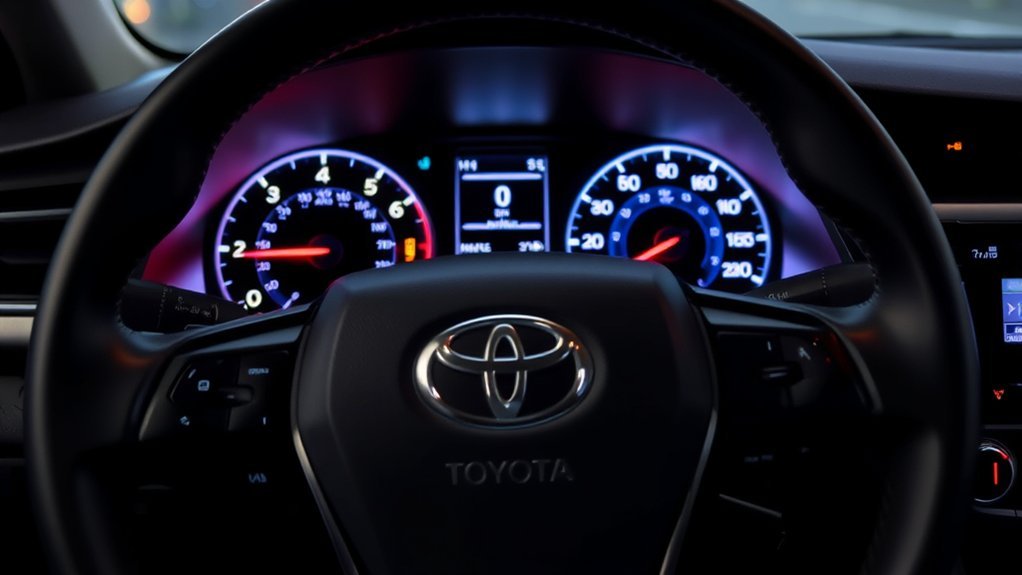
Understanding whether a light is flashing or steady determines whether you are experiencing active safety intervention or an electronic fault.
| Dashboard Symbol / Message | State | Operational Meaning | Immediate Action |
|---|---|---|---|
| Car with Squiggly Lines (Slip Indicator) |
Flashing | TRAC, VSC, or ABS is actively intervening to control wheel slip or skid | Hold steering steady, ease off the accelerator, drive smoothly |
| Car with Squiggly Lines (Slip Indicator) |
Solid Amber | Fault detected in stability system; TRAC/VSC assistance is disabled | Standard braking remains; pull diagnostic chassis DTCs |
| TRAC OFF | Solid Amber | Traction control manually switched off via dash button | Press button to re-engage; automatically re-engages above ~30 mph |
| VSC OFF + TRAC OFF | Solid Amber | Both systems turned off via 3-second button hold while stopped | Press button once or restart car to restore active stability control |
| Check Engine + TRAC / VSC OFF | Solid Amber | Powertrain fault triggered C1201 fail-safe in Skid Control ECU | Scan OBD-II engine codes first; clearing engine code resolves VSC light |
For complete dashboard symbol descriptions across generations, see the Toyota dashboard warning lights portal.
How Do You Turn TRAC and VSC Off in a Camry?
Keep TRAC and VSC engaged during all standard driving. The only operational reason to disable TRAC is when the drive wheels are mired in deep snow, slush, or mud, and engine torque reduction prevents the tires from spinning fast enough to generate momentum.
Operating Instructions
| Time Required | 5–10 seconds |
| Location | Lower-left dash panel or center console near shifter |
| Prerequisite | Vehicle completely stopped |
- Bring the Camry to a complete stop and place the transmission in Park (P) or Drive (D) with your foot firmly on the brake.
- To turn OFF TRAC only (Rocking out of snow/mud): Quickly press and release the VSC OFF / Traction button (car icon with skid lines and “OFF”). The
TRAC OFFindicator will illuminate. In this mode, drive wheels can spin, but VSC remains standing by if high-speed skidding occurs. Note: TRAC will automatically re-enable once vehicle speed exceeds ~30 mph (~50 km/h). - To turn OFF BOTH TRAC and VSC (Full mechanical override): While stopped, press and hold the button for at least 3 seconds. Both
TRAC OFFandVSC OFFlights will illuminate on the cluster. Both wheel-spin limitation and yaw-stability braking are now disabled. - To Re-enable: Press the button once more, or simply turn the vehicle off and restart the engine/hybrid system. All systems automatically default to ON at startup.
According to Toyota Technical Support, you should re-engage TRAC as soon as the vehicle is on solid ground. For winter driving strategies, see when to turn off traction control in a Toyota Camry.
Pro Tip: Turning TRAC off does not give you more grip; it only allows tire spin to dig down to pavement or rock the chassis. Avoid high-RPM wheel spinning on dry ground to prevent differential and transaxle damage.
How Do You Maintain the Camry’s Traction and Stability Systems?
Because TRAC and VSC rely on precise physical measurements and hydraulic responses, maintaining the mechanical running gear is essential to electronic system health.
- Maintain Correct Tire Pressures: Inflate to the cold PSI listed on the driver-side door B-pillar placard. Uneven tire pressures alter effective rolling radii, triggering false wheel-slip calculations.
- Match Tire Sizes and Tread Depths: Keep tire circumference variance across all four wheels within 2%. Running a significantly worn tire alongside a new tire can confuse ABS/VSC wheel speed inputs.
- Protect Sensor Wiring During Brake/Strut Work: Ensure ABS wheel speed sensor wiring harnesses are securely clipped into their factory brackets away from suspension pinch points and hot brake rotors.
- Flush Brake Fluid Every 3 Years / 36,000 Miles: Moisture-contaminated fluid causes internal corrosion in the micro-valves of the expensive ABS/VSC hydraulic actuator assembly.
- Perform Zero-Point Calibration After Alignments: If the steering wheel was recentered during an alignment, confirm the shop recalibrated the Steering Angle and Yaw Rate zero points.
- Use a Full-System OBD-II Diagnostic Scanner: Inexpensive $20 code readers only read standard OBD-II powertrain codes. To troubleshoot TRAC/VSC, use a scanner capable of querying Toyota ABS/Chassis (C-series) and Body (B-series) ECUs.
[Products Worth Considering]

This enhanced OBD2 scanner helps drivers quickly diagnose check engine light issues, read and clear trouble codes, and check emissions readiness before a smog test. It also adds EVAP and O2 sensor testing, live data, freeze frame capture, and a one-click battery health check in a simple plug-and-play tool with a bright color screen.

This WEJOWE OBD2 scanner helps drivers quickly identify check engine causes, read and clear trouble codes, and view live vehicle data with built-in DTC lookup. It also includes battery voltage testing, I/M readiness checks, freeze frame retrieval, and support for printing diagnostic reports to help simplify repairs and maintenance. Designed for most OBDII vehicles since 1996, it offers an easy-to-use solution for DIY car diagnostics.

FOXWELL NT201 is an easy-to-use OBD2 scanner designed to help drivers quickly read and clear check engine codes, view live engine data, and check emissions readiness. Its color screen, one-key I/M readiness test, and broad compatibility with most gasoline vehicles since 1996 make it a practical tool for everyday diagnostics and maintenance. With plug-and-play operation and lifetime free updates, it offers a simple way to understand vehicle issues without expensive shop visits.
What Can VSC Do in Rain, Snow, and Ice?
On rain-slicked or icy highways, VSC acts as an electronic guardian against catastrophic loss of control. If hydroplaning causes the front tires to float or black ice causes the rear tires to break loose in a curve, VSC instantly engages.
However, VSC and TRAC operate within the laws of physics:
- They cannot create friction: On polished ice or bald tires, braking a spinning wheel produces zero corrective yaw force.
- They cannot shorten stopping distances on ice: ABS prevents skids to retain steering capability, but stopping distances on packed snow or ice remain 3 to 4 times longer than on dry pavement.
- Tires remain paramount: High-quality all-weather or dedicated winter tires with severe snow ratings (3PMSF) offer exponentially greater stability improvements than electronic aids alone.
For dedicated winter driving preparation, review the Toyota Camry traction-control-in-snow guide.
Driving Rule: Electronic stability control assists the driver during unexpected skids—it is not an autopilot. Always reduce speed before entering slippery curves and increase following distances in wet and winter conditions.
What Should You Do If a TRAC or VSC Warning Stays On?
If your warning lights remain illuminated steadily after engine startup, follow this diagnostic sequence:
- Check the VSC Button: Ensure the button was not accidentally bumped. Press it once to verify the indicator does not turn off.
- Inspect the Gas Cap: On gasoline models, an improperly tightened fuel cap triggers an EVAP leak code (e.g., P0442/P0455), which immediately activates the C1201 fail-safe and disables TRAC/VSC. Tighten until it clicks, then drive for 1–2 drive cycles.
- Scan for Stored Diagnostic Trouble Codes (DTCs): Connect a scanner that reads both Engine (P-codes) and Chassis/ABS (C-codes). Resolve engine DTCs first, as clearing powertrain codes frequently clears the VSC light automatically.
- Check 12V Battery Health: Measure resting battery voltage. A resting voltage below 12.0V or a cold cranking drop below 9.6V can trigger stability module communication codes (U-codes).
- Inspect Wheel Well Sensor Wiring: Visually inspect the thin wire harness running behind each brake rotor hub for fraying, rodent damage, or road debris impact.
- Perform a Zero-Point Calibration: If DTC C1210 (Zero Point Calibration of Yaw Rate Sensor Undone) or C1336 is present, execute the sensor zero-point learning procedure using an advanced scan tool or the DLC3 OBD-II pin jumper method.
[Products Worth Considering]

The MOTOPOWER MP69033 is a compact OBD2 scanner designed to help drivers quickly diagnose check engine issues and understand vehicle fault codes. It offers a range of practical functions including code reading and clearing, live data, freeze frame, vehicle information, and I/M readiness, all displayed on a clear LCD screen. Compatible with many OBD II and CAN vehicles, it is a convenient plug-in tool for routine engine diagnostics and basic troubleshooting.
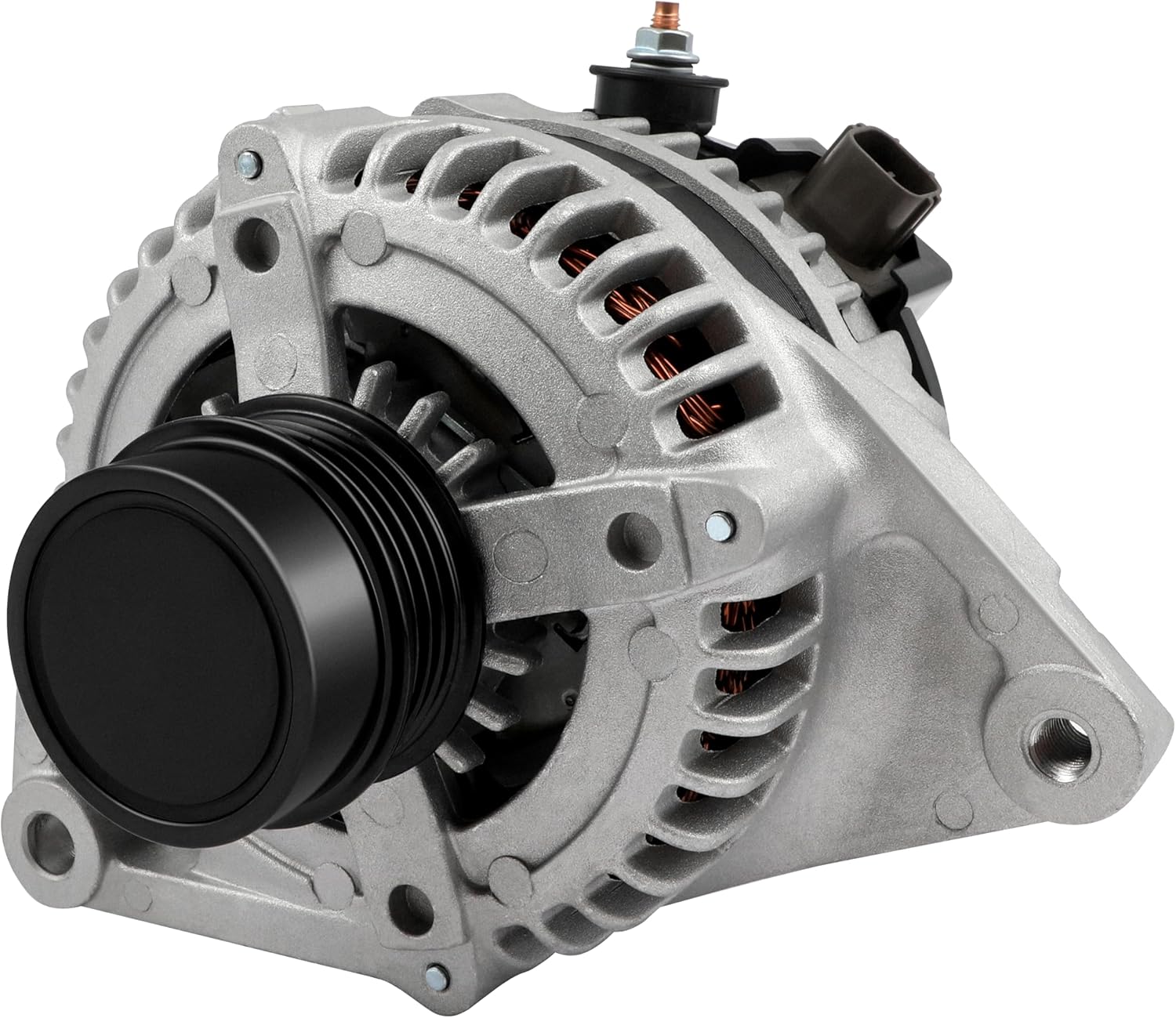
This high output alternator is designed to fit select Toyota, Scion, and RAV4 2.5L applications, delivering reliable charging performance for everyday driving. Built with a 12-volt, 100-amp design and precision-engineered components, it helps support battery recharge, stable electrical output, and consistent operation when your vehicle shows signs of charging issues.
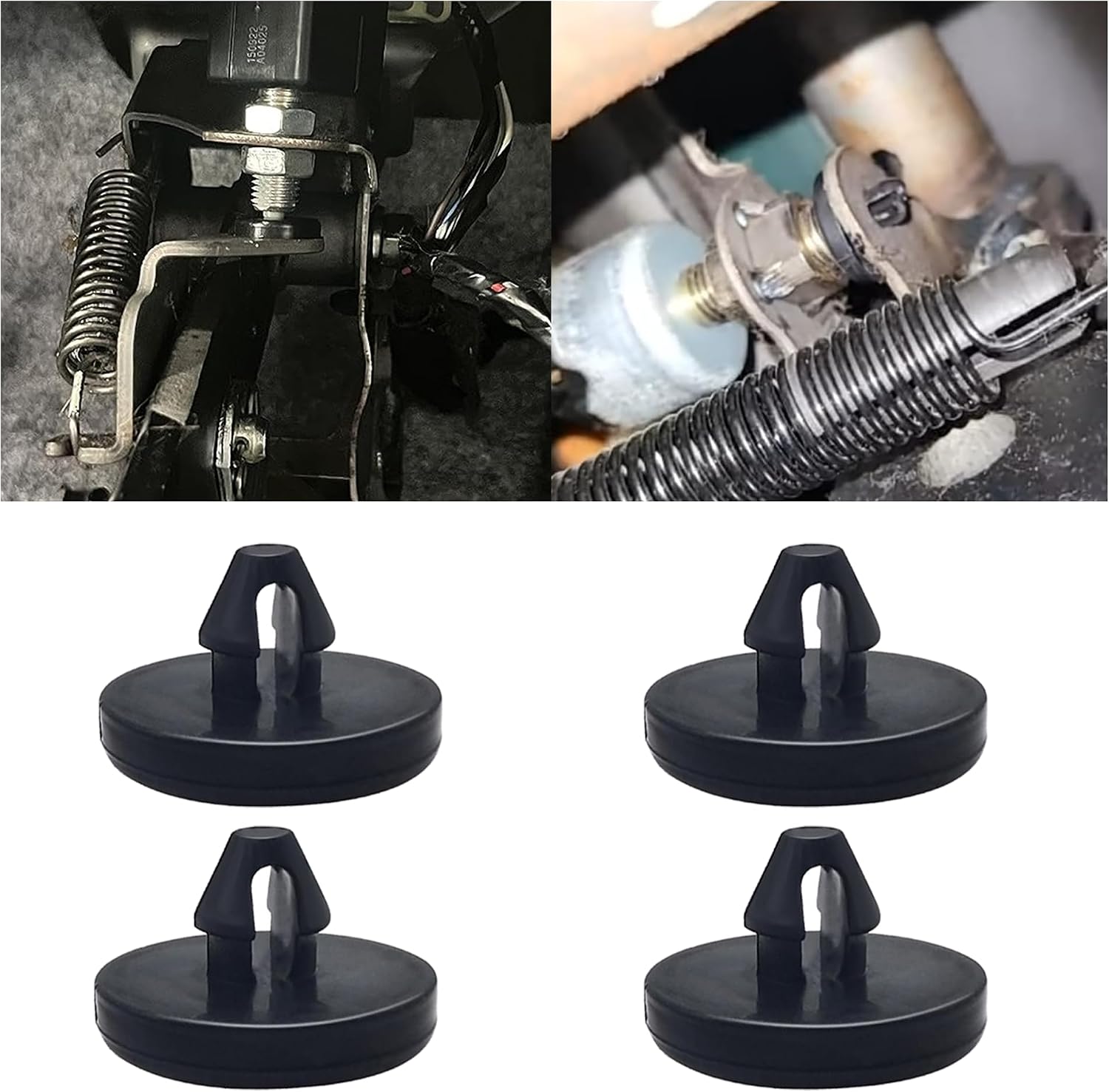
This brake pedal stop pad set is designed as an OEM replacement for compatible Toyota, Lexus, and Scion models, helping restore proper brake light switch function when the brake light stays on. Made from durable nylon, these compact stoppers are built for reliable long-term use and quick, tool-free installation. The set includes multiple pieces for convenient replacement and sharing.
How Does Model Year Change Camry TRAC and VSC Behavior?

While TRAC and VSC have been standard on the Camry since the late 2000s, system integration and driver interfaces have evolved significantly across vehicle generations:
- 7th Generation (2012–2017): Uses discrete analog instrument cluster lights (separate
TRAC OFFandVSC OFFlamps). VSC shutoff requires the 3-second stationary button hold. - 8th Generation (2018–2024): Integrated into the Toyota Safety Sense (TSS 2.5+) network. Stability interventions interface directly with Dynamic Radar Cruise Control and Lane Tracing Assist. AWD models introduce dynamic torque vectoring assist.
- 9th Generation (2025–2026+): Exclusively Hybrid (5th Gen Toyota Hybrid System). Incorporates high-speed electronic motor torque modulation (millisecond reaction time) and standard electronic on-demand all-wheel drive (E-Four) integration, displaying real-time traction distribution on the digital gauge cluster. Details can be found at Toyota’s 2026 Camry Portal.
Frequently Asked Questions
Why did my Check Engine light and TRAC OFF / VSC light come on at the same time?
In Toyota vehicles, the Skid Control ECU automatically disables TRAC and VSC as a safety fail-safe whenever the engine computer (ECM) detects a powertrain or emissions issue (logging code C1201). Even minor faults like a loose gas cap, oxygen sensor fault, or small EVAP leak will turn on both lights simultaneously. Diagnosing and fixing the engine code will turn off the traction lights.
What causes the traction control and stability light to come on in a Toyota Camry?
A flashing light means the system is actively preventing wheel slip or a skid. A solid amber light indicates the system is disabled due to a manual switch off, a failed wheel-speed sensor, damaged wiring, a lost steering angle zero-point calibration, low 12V battery voltage, mismatched tire sizes, or an engine fault (DTC C1201).
What is the difference between TRAC and VSC in a Toyota Camry?
TRAC (Traction Control) prevents drive-wheel spin when accelerating in a straight line on slippery surfaces. VSC (Vehicle Stability Control) prevents lateral skidding, fishtailing (oversteer), and front-end pushing (understeer) when cornering or making emergency steering maneuvers by selectively braking individual wheels.
Is it safe to drive with the VSC or TRAC light on?
Yes, standard driving and basic power braking remain functional, but you will have no automated skid correction or wheel-spin prevention. Drive conservatively and avoid aggressive cornering. However, if a red BRAKE warning light is also illuminated, the vehicle is unsafe to drive and should be towed.
When should I turn traction control off in a Camry?
Turn TRAC off only when stuck in deep snow, slush, sand, or mud where wheel spin is required to rock the car free. Press the VSC button once to turn off TRAC. Re-enable TRAC as soon as the vehicle is moving normally; it will automatically turn back on once you exceed approximately 30 mph.
Can bad tires trigger traction or stability control problems?
Yes. Mismatched tire sizes, severely uneven tread wear across axles, or incorrect tire pressures alter the rotational speed of individual wheels. This can cause the Skid Control ECU to falsely detect wheel slippage, triggering unwarranted TRAC activation or solid warning lights.
Conclusion
The Toyota Camry’s TRAC and VSC systems operate as an integrated safety net. TRAC limits wheel spin under acceleration to maximize forward momentum, while VSC modulates individual brake calipers and powertrain output to prevent dangerous spins and understeer during turns. ABS serves as the hydraulic and sensory foundation for both systems.
For safe everyday driving, leave both systems enabled. If you see a flashing slip light, ease off the throttle and steer smoothly. If a steady amber warning light appears, scan for chassis and powertrain diagnostic trouble codes, check your 12V battery and tire pressures, and address any underlying engine DTCs before replacing expensive brake hardware.
Sources
- Toyota 2025 Camry Owner Information — Driving Assist Systems — confirms TRAC, VSC, ABS operating parameters, and button-disable procedures.
- Toyota Owners — Dashboard Warning Lights — provides official symbol definitions for slip indicators, TRAC OFF, and VSC OFF lamps.
- Toyota Support — When to Use the VSC OFF Button — outlines emergency vehicle recovery and wheel spin recommendations.
- 49 CFR § 571.126 — FMVSS No. 126 Electronic Stability Control Systems — federal safety mandate governing passenger car stability control performance.
- Toyota — 2026 Camry — specifications for 9th-generation THS 5 hybrid powertrain and electronic On-Demand AWD (E-Four).