
Last updated: July 14, 2026
What’s in This Article
- How to Tell If Your Camry Is Burning Oil
- Which Camry Years and Engines Had Documented Oil Consumption?
- How Much Oil Use Is Too Much for a Camry?
- How to Measure Your Camry’s Oil Consumption
- DIY Checks to Narrow Down the Cause
- When to Run a Compression or Leak-Down Test
- Most Likely Causes for Camry Oil Consumption
- Risk-Reduction Steps That May Slow Oil Loss
- Long-Term Repairs and Typical Costs
- Warranty, Trade-In, and Documentation Tips
- When to Stop Driving and Call a Mechanic
- Frequently Asked Questions
A Toyota Camry may be burning oil when the dipstick level keeps falling without a matching external leak, blue or gray exhaust appears, or the engine needs oil between scheduled services. Check the level immediately and do not wait for the red oil-pressure warning. Start by inspecting for leaks and PCV-system faults, then measure the loss over a known distance.
Certain 2007 to 2009 Camry models and certain 2007 to 2011 Camry Hybrid models with a 2AZ engine were included in Toyota’s historical ZE7 oil-consumption program. Other years can also consume oil, but they should not automatically be diagnosed as having the same 2AZ condition. Compression and leak-down tests can reveal compression-sealing faults, but normal results do not rule out stuck oil-control rings.
Quick Answer
Check the dipstick on level ground, inspect for external leaks, and examine the PCV valve, grommet, and hoses. Record the odometer and calculate how much oil the engine uses per 1,000 miles. Use compression, leak-down, spark-plug, or borescope checks when symptoms suggest deeper engine damage, but do not use a normal compression result to rule out stuck oil-control rings.
Key Takeaways
- Do not wait for the oil-pressure warning before checking the dipstick.
- Rule out external leaks and PCV faults before approving internal engine work.
- Measure oil use under repeatable conditions instead of relying on smoke alone.
- Normal compression does not rule out stuck or worn oil-control rings.
- Toyota’s ZE7 program was historical and had time and mileage limits.
- Stop the engine for an oil-pressure warning, knocking, or an unsafe oil level.
| What You Notice | What It May Suggest | Best Next Check |
|---|---|---|
| Oil level drops and a puddle or wet engine area is visible | External leak | Inspect the valve cover, timing cover, oil pan, filter, drain plug, and surrounding surfaces |
| Oil level drops with no visible smoke or puddle | Intermittent oil burning or a hidden leak | Measure oil use, clean the engine exterior, and inspect the intake and spark plugs |
| Blue-gray puff after startup or a long idle | Valve-stem seals, PCV flow, or oil pooling | Check the PCV system and compare plug deposits before deeper testing |
| Blue-gray smoke during acceleration or under load | Ring, cylinder, PCV, or broader engine-wear concern | Measure consumption and consider compression, leak-down, plug, and borescope checks |
| Red oil-pressure warning, knocking, or heavy smoke | Immediate lubrication or engine-damage risk | Stop the engine safely and arrange professional diagnosis |
How to Tell If Your Camry Is Burning Oil (Quick Symptoms)
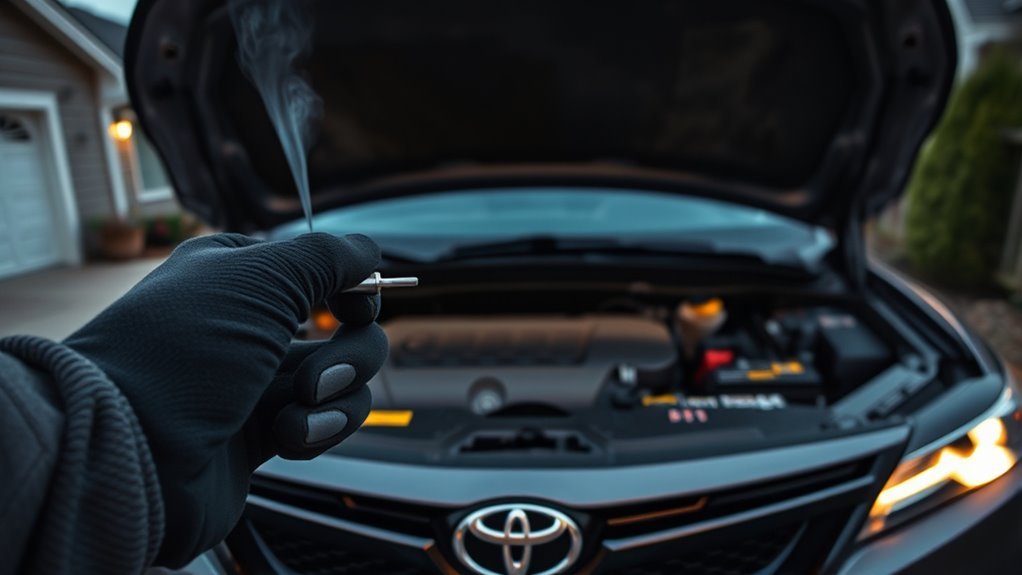
Check the oil level on level ground with the engine off and cool enough for oil to drain into the pan. Wipe the dipstick, insert it fully, pull it again, and compare the level with the marked range. Toyota advises adding oil slowly and checking again instead of pouring in a full container at once.
Do not depend on a dashboard warning to tell you when the level is low. The red oil-pressure warning indicates a pressure problem, not a dependable measurement of the oil remaining in the pan. Stop the engine promptly if that warning stays on.
Watch the exhaust at cold startup, after several minutes of idling, during acceleration, and after deceleration. Blue or blue-gray smoke means oil may be entering the combustion process. A puff after startup or idle raises suspicion of valve-stem seals or oil pooling. Smoke under load raises concern about rings, cylinders, or crankcase ventilation.
Treat the smoke pattern as a clue rather than proof. A PCV fault, worn valve seals, ring trouble, and cylinder wear can create overlapping symptoms. The site’s Toyota Camry blue-smoke guide explains the visual patterns in more detail.
Your Camry can also consume oil without producing an obvious cloud. Small amounts may burn only under conditions you do not observe, and the catalytic converter can reduce visible evidence. A repeatable dipstick loss with no matching external leak still needs investigation.
Write down the mileage, dipstick reading, amount added, smoke color, and driving conditions. Take photos of the dipstick under the same lighting and parking conditions when possible. Those records help a mechanic compare the symptoms with test results.
Which Camry Years and Engines Had Documented Oil Consumption?
Toyota’s historical Warranty Enhancement Program ZE7 addressed excessive oil consumption in certain vehicles equipped with a 2AZ engine. The published coverage included certain 2007 to 2009 Camry models and certain 2007 to 2011 Camry Hybrid models. The gasoline Camry generally used the 2AZ-FE, while the covered hybrid application used the 2AZ-FXE.
| Camry Group | Why It Matters | Recommended First Move |
|---|---|---|
| Certain 2007–2009 Camry models with a 2AZ engine | Included in Toyota’s historical ZE7 documentation | Check the VIN and service history, then measure the current consumption rate |
| Certain 2007–2011 Camry Hybrid models with a 2AZ engine | Also included in the historical ZE7 documentation | Check the VIN, prior repair records, and current oil-use pattern |
| Other Camry years and engines | Not included in the cited ZE7 bulletin, although normal wear or another fault can still cause oil loss | Diagnose the actual symptoms instead of assuming the historical 2AZ condition |
Toyota’s related inspection bulletin states that the piston assembly was changed to reduce oil consumption in the affected applications. Its dealer procedure used a controlled oil-consumption test before directing technicians to the piston-and-ring repair bulletin.
ZE7’s published secondary coverage limit was 10 years from the vehicle’s first use or 150,000 miles, whichever came first. That time limit has expired for the covered model years. You can still ask a Toyota dealer to check the VIN and service history for prior campaign work, related repairs, or another form of applicable coverage.
How Much Oil Use Is Too Much for a Camry?
Engines can consume some oil during normal use, especially as mileage and wear increase. Your Camry needs diagnosis when the level falls quickly, repeated top-offs are required well before the next service, smoke or plug deposits appear, or the loss rate keeps increasing.
A steady loss near one quart per 1,000 miles is serious enough to document and diagnose, but it is not a universal pass-or-fail standard for every Camry. Your engine, model year, driving pattern, leak condition, and Toyota service information all matter.
Toyota’s historical ZE7 procedure used a controlled dealer test over 1,100 to 1,300 miles. The dealer filled the engine to the specified level, sealed the relevant points, and checked the vehicle when it returned to the same dealership. That procedure is useful context, but it should not be represented as active warranty coverage for every Camry.
Note: Check the owner’s manual for your exact year and engine. Oil grade, capacity, inspection steps, and Toyota Camry service intervals can differ.
How to Measure Your Camry’s Oil Consumption
Measure oil use under repeatable conditions. Park in the same level location, allow a similar drain-back period, and read the dipstick using the same method. Fix a known external leak before treating the calculated loss as internal consumption.
Oil-Use Formula
Quarts used per 1,000 miles = quarts added ÷ miles driven × 1,000
Example: Adding 0.75 quart after 600 miles equals 1.25 quarts per 1,000 miles.
- Establish the starting level. Fill only to the correct dipstick mark and record the odometer.
- Check at regular intervals. Recheck about every 500 miles while diagnosing the loss and before long trips.
- Add a measured amount. Record exactly how much oil was needed to return to the original mark.
- Calculate the rate. Use the formula above instead of reporting only that the engine “uses some oil.”
- Repeat the measurement. One reading can be affected by parking angle, drain-back time, or an inaccurate starting level.
| Date | Odometer | Dipstick Reading | Oil Added | Smoke, Leaks, or Driving Notes |
|---|---|---|---|---|
| Starting check | Record mileage | Record exact mark | Record amount | Note parking surface and engine condition |
| Follow-up check | Record mileage | Record exact mark | Record amount | Note smoke, leaks, load, and trip type |
| Confirmation check | Record mileage | Record exact mark | Record amount | Compare the calculated rate with the first interval |
Do not overfill the crankcase to extend the distance between top-offs. Excess oil can foam, increase crankcase pressure, enter the intake, damage seals, or create misleading symptoms.
[Products Worth Considering]

Castrol EDGE 0W-20 advanced full synthetic motor oil is engineered for drivers seeking strong wear protection, excellent viscosity control, and thermal stability. It delivers superior performance in critical engine areas, including fuel economy, high-temperature protection, sludge control, and wear defense. Designed for extended oil-change intervals, it helps keep modern engines running smoothly under demanding conditions.

These genuine Toyota oil drain plug gaskets are designed to help maintain a reliable seal during oil changes, reducing the chance of leaks and supporting proper engine maintenance. With an OEM fit and trusted Toyota quality, they are a practical choice for routine service on compatible vehicles. The convenient quantity pack is ideal for keeping multiple maintenance intervals covered.

The Funnel King 32950 Oil Drain Pan is a compact fluid catch basin designed for clean, easy draining during routine maintenance. Its open shape and pour edge help transfer used oil, coolant, and other shop fluids with less mess, while the lightweight polypropylene construction stands up to common automotive chemicals. Sized to fit under many cars and small engines, it is a practical choice for garages, workshops, and DIY oil changes.
DIY Checks to Narrow It Down: PCV, Leaks, Smoke, Oil Use
Start with the least invasive checks before pricing internal engine work. A restricted, damaged, or incorrectly flowing PCV system can affect crankcase pressure and carry excess oil mist into the intake.
- Inspect the PCV system. Check the valve, grommet, and hoses for cracks, sludge, collapse, loose fittings, or heavy oil pooling. A shake test applies only to some valve designs and is not conclusive.
- Look for external leaks. Inspect the valve cover, timing cover, oil pan, oil filter, drain plug, and areas where oil can run onto a shield instead of reaching the ground.
- Clean and recheck. A dirty engine can hide the source. Clean the affected exterior area safely, drive the car, and look for fresh oil.
- Inspect the intake path. A light oil film can be normal, but heavy pooling may support a PCV or blow-by concern.
- Measure the loss. Fill to the correct mark, record the mileage, and calculate the rate over at least two comparable intervals.
- Observe smoke timing. Note whether smoke appears at startup, after idling, during acceleration, under load, or during deceleration.
- Watch for related symptoms. Record misfires, rough idle, poor power, a burnt-oil smell, abnormal noises, fouled plugs, or a check-engine light.
A qualified technician can remove and compare the spark plugs. Oily deposits, heavy ash, or one cylinder that looks different from the others can help direct the next test. A borescope may reveal unusual piston deposits, an oil-wet cylinder, or cylinder-wall scoring, although the findings still require professional interpretation.
These checks help separate an external leak, ventilation problem, valve-seal concern, and broader internal wear. They also reduce the chance of approving an engine repair based on smoke color alone.
When to Run a Compression or Leak-Down Test and How to Read Results
Use pressure testing when the engine also has a misfire, low power, rough running, an uneven cylinder pattern, or another reason to suspect compression-sealing damage. A compression test measures the pressure each cylinder creates while the engine cranks. Compare the readings with the factory procedure for the exact engine rather than a generic internet number.
A leak-down test sends regulated compressed air into a cylinder at top dead center and measures how much escapes. Air at the throttle body can indicate an intake-valve leak. Air at the exhaust can indicate an exhaust-valve leak. Air at the oil filler, dipstick tube, or PCV opening can indicate leakage past the compression rings or cylinder wall. Bubbles in the cooling system can raise concern about a head gasket or another combustion-to-coolant leak.
| Test | Useful For | Important Limitation |
|---|---|---|
| Compression test | Finding weak or uneven cylinder pressure | Does not directly test the oil-control rings |
| Leak-down test | Locating compression leakage through valves, rings, cylinders, or the cooling system | Normal leakage does not rule out an oil-control-ring problem |
| Measured oil-consumption test | Confirming how much oil disappears over a controlled distance | Confirms the rate, not the failed part by itself |
| Spark-plug and borescope inspection | Comparing deposits, oil evidence, piston condition, and cylinder-wall appearance | Visual findings require context and may not prove the complete cause |
Mobil’s general leak-down guide treats 5% to 10% loss as strong, 10% to 20% as usable but worth monitoring, and more than 20% as a serious concern. These are general guidelines, not Toyota factory limits for every Camry engine. Cylinder-to-cylinder consistency and the location of escaping air matter as much as one percentage.
A normal compression or leak-down result does not rule out stuck oil-control rings. Oil-control rings remove oil from the cylinder wall but do not perform the same sealing job as the compression rings. Combine pressure results with measured consumption, plug deposits, borescope findings, PCV condition, and the engine’s service history.
Warning: Disable fuel and ignition before compression testing, keep loose clothing and tools away from moving parts, and use a trained mechanic if you do not know the safe procedure.
[Products Worth Considering]

CHAPIN’s low-profile oil drain pan is designed to slide under low-clearance vehicles and equipment, making fluid changes easier in tight spaces. The large splash-free target area helps reduce mess while the molded carry handles support easier lifting, pouring, and storage. Built for draining oil, coolant, and other automotive fluids, it offers a practical high-capacity solution for routine maintenance.

This professional compression tester kit helps diagnose engine health quickly and accurately in gasoline-powered cars, trucks, ATVs, and small engines. The fluorescent triple-scale gauge improves readability in low light, while the built-in Schrader valve, safety release, and included adapters make testing simple, stable, and reliable.

This PCV valve and hose kit is designed as a direct replacement for select Toyota, Scion, and Lexus applications, helping restore proper crankcase ventilation and engine performance. Built with durable NBR rubber and made for straightforward installation, it offers a reliable fit for compatible 2.4L models. It is a practical maintenance part for addressing worn or failing PCV components while supporting smoother engine operation.
Most Likely Causes for Camry Oil Consumption (PCV, Rings, Seals)
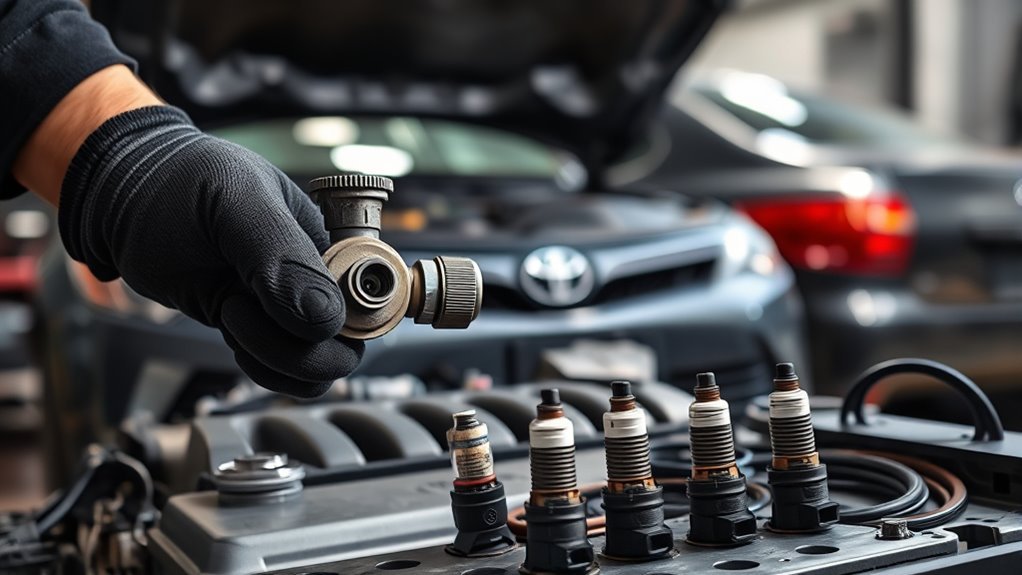
Several faults can reduce the oil level, and more than one can exist at the same time. Match the measured loss, smoke pattern, leak evidence, cylinder results, and engine history before approving major work.
Oil loss identifies a condition to measure. It does not identify the failed part until leaks, PCV flow, plug deposits, pressure results, and engine history are compared.
- Stuck or worn oil-control rings: Carbon-stuck or worn oil-control rings can leave too much oil on the cylinder wall. The oil then burns during combustion. This concern is central to Toyota’s historical 2AZ oil-consumption documentation.
- PCV-system fault: A restricted valve, damaged hose, incorrect valve, or heavy oil carryover can affect crankcase pressure and move oil into the intake.
- Valve-stem seal wear: Worn seals can let oil move down the valve guides, often creating a puff after startup or prolonged idling.
- Compression-ring or cylinder wear: Worn compression rings, damaged pistons, or cylinder-wall wear can cause blow-by, low pressure, poor power, and oil consumption.
- External oil leak: A valve cover, timing cover, oil pan, filter, drain plug, or another sealing point can lose oil without producing exhaust smoke.
- Incorrect oil level or service error: An inaccurate starting level, overfilling, an incorrect filter installation, or a loose drain plug can distort the diagnosis.
A head-gasket fault is not the first explanation for ordinary oil consumption. Consider it when other evidence appears, such as coolant loss, overheating, combustion gas in the cooling system, contaminated fluids, or a leak-down result that produces bubbles in the coolant.
Risk-Reduction Steps That May Slow Oil Loss
These steps can reduce immediate risk or correct a maintenance fault, but they cannot rebuild worn rings, cylinders, or valve guides. Continue measuring the oil level even if one step appears to reduce the loss.
- Replace a confirmed faulty PCV component with the correct engine-specific part.
- Repair external leaks before judging the engine’s internal consumption rate.
- Use the oil grade permitted by the owner’s manual for the exact model year, engine, and operating conditions.
- Check the dipstick frequently while the cause remains unresolved and before long trips.
- Keep the level inside the marked range without overfilling.
- Treat additives cautiously. An additive cannot restore worn metal or repair a broken ring, and it may change oil performance or compatibility.
Do not switch to a thicker viscosity solely to hide consumption unless the owner’s manual permits it or a qualified technician recommends it for a documented reason. A change that reduces visible symptoms can also delay the diagnosis of a mechanical fault.
Long-Term Repairs and Typical Costs (Ring Job, Short Block, Engine Swap)
Choose a long-term repair only after testing identifies a defensible cause. Ask for the measured oil-use rate, compression readings, leak-down percentages, cylinder pattern, plug condition, relevant photos, and a written estimate before approving internal work.
| Repair or Test Path | Best For | Planning Figure | What to Confirm First |
|---|---|---|---|
| Camry compression test | Checking for weak or uneven cylinder pressure | About $137–$201 before taxes, fees, or added tests, based on RepairPal’s July 2026 national estimate | Whether leak-down, borescope, scan, plug inspection, or oil-use testing is included |
| Valve-seal or top-end repair | A supported valve-seal diagnosis with acceptable lower-cylinder condition | Quote required because access and labor vary by engine and repair method | Smoke pattern, leak-down location, plug deposits, guide condition, and included gaskets |
| 2AZ piston-and-ring repair | A supported oil-control-ring or piston diagnosis on an applicable engine | Toyota’s historical Camry repair bulletin listed 14.8 warranty labor hours; retail pricing requires a current shop quote | Cylinder condition, machine-work needs, piston-and-ring parts, seals, fluids, and warranty terms |
| General engine rebuild | An engine that can be rebuilt economically with reusable major components | General U.S. planning range of about $2,500–$4,000; not Camry-specific | Machine work, parts list, cylinder measurements, labor, exclusions, and warranty |
| Used, rebuilt, or new engine replacement | Severe wear, multiple damaged cylinders, or a poor rebuild value | General U.S. planning range of about $2,000–$10,000 or more; not Camry-specific | Engine source, identification, mileage, compression evidence, installation parts, labor coverage, and warranty |
National estimates are planning tools rather than quotes. Location, engine version, rust, parts availability, shop labor, machining, emissions rules, taxes, and related repairs can move the total substantially.
Compare the repair cost with the Camry’s value, body condition, transmission health, tire and suspension needs, rust, and your plans for the car. A focused repair can make sense when testing identifies one correctable fault. A replacement engine may make more sense when several cylinders show damage and the rest of the vehicle remains worth keeping.
[Products Worth Considering]

The Scepter AM07029 Oil Drain Pan makes oil changes cleaner and easier by helping contain spills and reducing mess in the garage or driveway. Its lidded opening, removable drain screen, and gasketed pour spout support convenient collection, transport, and disposal of fluids. Built from durable high-density polyethylene, it resists rust, dents, and corrosion for reliable use with engine oil, transmission fluid, hydraulic fluid, and antifreeze.

NGK Iridium IX spark plugs are designed to deliver a stable spark, reliable ignition, and long-lasting performance for compatible Toyota Camry 2.5L engines. The fine-wire iridium center electrode helps improve durability and efficient combustion, making these plugs a smart replacement choice for maintaining smooth engine operation. Sold in a convenient four-pack, they are built for consistent performance and dependable fitment.

This ignition coil and iridium spark plug kit is designed to restore smooth engine performance, reliable starts, and efficient combustion for compatible Toyota models. Built for a precise fit across select Camry, RAV4, Sienna, Highlander, and Venza applications, it helps improve idle stability, fuel economy, and emissions. The kit includes durable replacement parts backed by a one-year unlimited-mileage guarantee for added confidence on the road.
Warranty, Trade-In, and Documentation Tips: What to Disclose and How to Get Help
Strong records can help with a dealer review, service-contract claim, repair decision, trade-in discussion, or private sale. Keep oil-change receipts, top-off receipts, mileage notes, dipstick photos, smoke videos, diagnostic results, and written estimates.
Toyota’s ZE7 documents covered certain 2007 to 2009 Camry models and certain 2007 to 2011 Camry Hybrid models with a 2AZ engine. Its secondary coverage ended 10 years from first use or at 150,000 miles, whichever came first. That published time limit has expired for the covered model years.
A Toyota dealer can still check the VIN and service history to see whether the vehicle previously received campaign-related testing or piston-and-ring work. You can also use Toyota’s current recall and service-campaign lookup, but do not assume that a historical warranty enhancement is an active safety recall.
Used-car service-contract coverage depends on the written contract, the diagnosed cause, prior symptoms, exclusions, and maintenance records. Ask the administrator to identify the exact contract provision when it approves or denies a claim.
For a private sale, describe the known condition accurately, provide available records, and follow the disclosure rules that apply where the vehicle is sold. Avoid making claims about the vehicle’s condition that your records do not support.
When to Stop Driving and Call a Mechanic
Stop the engine if the Camry oil-pressure warning stays on, the engine knocks, the dipstick shows no safe reading, smoke becomes heavy, oil reaches a hot exhaust surface, or the engine begins overheating. Add the correct oil only when you can do so safely and without overfilling, then arrange service.
Running with inadequate oil can damage bearings, camshafts, timing components, pistons, cylinder walls, and other lubricated parts. Repeated oil burning can also contaminate oxygen sensors and shorten Camry catalytic-converter life.
Call a mechanic when the loss continues after a verified leak or PCV repair, the rate increases, one cylinder develops abnormal deposits or pressure, the engine misfires, or smoke continues after warmup. Ask the shop to separate external loss, ventilation faults, compression-sealing damage, and oil-control-ring concerns before quoting an engine replacement.
Frequently Asked Questions
Which Camry Years Were in Toyota’s Oil-Consumption Program?
Toyota’s ZE7 documents covered certain 2007 to 2009 Camry models and certain 2007 to 2011 Camry Hybrid models equipped with a 2AZ engine. Its published secondary coverage limit was 10 years from first use or 150,000 miles, whichever came first. That time limit has expired for the covered model years, but a dealer can check the VIN for prior work and service history.
Can a Camry Burn Oil Without Blue Smoke?
Yes. Small amounts may burn only under conditions you do not observe, and the catalytic converter can reduce visible smoke. A repeatable drop on the dipstick with no matching external leak still requires diagnosis.
Can a Compression Test Rule Out Stuck Oil-Control Rings?
No. A compression test evaluates cylinder pressure and can reveal compression-ring, valve, or cylinder-sealing problems. Oil-control rings perform a different job, so normal compression does not rule out a stuck or worn oil-control ring.
Is It Safe to Drive a Camry That Burns Oil?
It depends on the loss rate and symptoms. A closely monitored engine with no warning light, knocking, heavy smoke, or unsafe level may remain driveable while you arrange diagnosis. Stop the engine for an oil-pressure warning, knocking, overheating, heavy smoke, or a dipstick level below the safe range.
How Often Should I Check the Oil While Diagnosing the Problem?
Check it about every 500 miles while establishing the consumption rate, before long trips, and more often when the loss is rapid. Use the same level parking area and a similar drain-back period so the readings remain comparable.
Does Burning Oil Affect My Camry’s Emissions Test Results?
Yes. Oil burning can create visible smoke, foul spark plugs, contaminate oxygen sensors, and damage the catalytic converter. It may cause an emissions failure when the inspection checks smoke, diagnostic readiness, or exhaust performance.
Can Synthetic Oil Increase Mileage Between Oil Changes?
Synthetic oil may support a longer scheduled interval when the owner’s manual permits it. Toyota states that many vehicles requiring 0W-20 synthetic oil can qualify for a 10,000-mile or 12-month interval, with exceptions. An extended change interval does not reduce the need to check the level when the engine consumes oil.
Is Oil Burning Covered Under Typical Used-Car Warranties?
Coverage depends on the contract, diagnosed failure, exclusions, prior symptoms, and maintenance records. Wear, pre-existing conditions, and neglected maintenance may be excluded. Ask for the coverage decision and the controlling contract language in writing.
Safety Disclaimer: This article provides general vehicle information and does not replace diagnosis by a qualified mechanic. If you see an oil-pressure warning, heavy smoke, a fuel or burning-oil smell, fire risk, overheating, or engine knocking, stop safely and get professional help.
Conclusion
A Camry that loses oil needs a measured diagnosis rather than a guess based on smoke alone. Start with the dipstick, external leaks, and PCV system. Record the odometer and calculate the oil used per 1,000 miles. Use compression, leak-down, plug, and borescope findings to identify related damage without assuming that normal compression rules out the oil-control rings.
Check and photograph the dipstick today, record the odometer, and repeat the check under the same conditions. Stop the engine immediately if the red oil-pressure warning, knocking, overheating, an unsafe oil level, or heavy smoke appears.
How this guide was verified: This update was checked against Toyota owner guidance, Toyota’s ZE7 warranty documents, the related 2AZ inspection and piston-and-ring repair bulletins, a recognized leak-down procedure, and current national repair estimates. It does not replace a VIN-specific diagnosis.
References
- 2025 Camry Hybrid Owner’s Manual: Maintenance Data – Toyota, 2025
- How to Tell If You May Need an Oil Change – Toyota
- What Are the Oil Change Intervals Using Synthetic Oil? – Toyota Support
- Warranty Enhancement Program ZE7: Engine Oil Consumption – Toyota via NHTSA, 2015
- T-SB-0158-14: 2AZ-FE and 2AZ-FXE Engine Oil Consumption Inspection Procedure – Toyota via NHTSA, 2014
- T-SB-0094-11: 2AZ-FE Engine Oil Consumption Repair Procedure – Toyota via NHTSA
- Toyota Recall and Service Campaign Lookup – Toyota
- Causes of Smoky Vehicles – NSW Environment Protection Authority
- How to Do a Leak-Down Test – Mobil
- Toyota Camry Engine Compression Test Cost – RepairPal, accessed July 2026
- How Much Does It Cost to Replace a Car’s Engine? – Synchrony, 2025



[…] A Toyota Camry oil leak usually comes from a valve or head cover gasket, oil filter, drain plug, oil pan seal, timing cover, oil-pressure switch, VVT-i oil hose, or crankshaft seal. First check the dipstick and look for fresh oil, but remember that a falling oil level does not always mean an external leak. If the engine and parking area stay dry, the Camry may be burning or consuming oil internally. […]