
Last updated: July 31, 2026. This revision separates the 2020–2024 mechanical AWD system from the 2025–2026 electronic system, clarifies the limits of the roller test, and updates the tire, clearance, and winter-safety guidance.
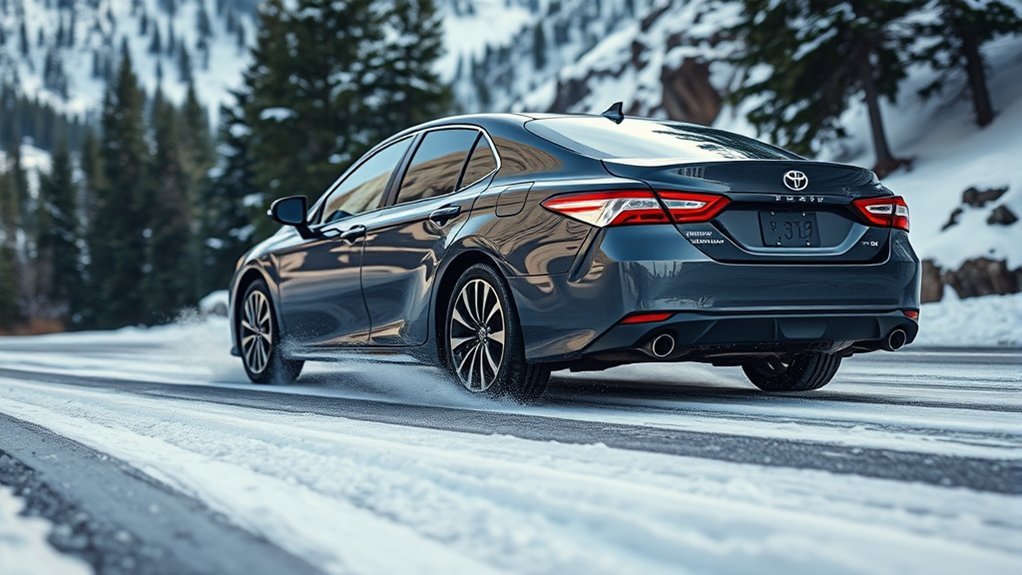
The Toyota Camry AWD is a capable winter commuter on packed snow, slush, wet pavement, and maintained roads when it has suitable tires. AWD mainly helps the Camry accelerate and pull away by adding rear-wheel power. It does not shorten braking distance or overcome poor tire grip. The 2025–2026 U.S. Camry uses Electronic On-Demand AWD with a rear electric motor, while 2020–2024 AWD models use a mechanical driveshaft system. Both remain limited by the Camry’s approximately 5.4 inches of ground clearance, so deep snow, frozen center ridges, and rutted tracks can stop the car even when its wheels still have traction.
Evidence note: This guide synthesizes Toyota specifications and named third-party tests. It does not claim an in-house Camry winter test. The roller demonstration discussed below used a 2020 mechanical-AWD Camry, while a separate 2026 winter-driving review evaluated the current electric AWD system on packed snow with winter tires.
Quick Verdict: Is the Camry AWD Good in Snow and Mud?
| Condition | Camry AWD Verdict | Main Limitation |
|---|---|---|
| Packed or light snow | Good with appropriate tires | Braking and cornering still depend on tire grip |
| Slush and wet pavement | Useful for smoother starts and acceleration | Hydroplaning risk remains if speed is too high |
| Icy driveway or intersection | Better starting traction than FWD on comparable tires | AWD does not provide a similar braking advantage |
| Deep or heavily rutted snow | Poor fit | About 5.4 inches of ground clearance can lead to underbody contact or high-centering |
| Shallow, firm mud | May help maintain low-speed motion | No dedicated off-road mode, low clearance, and limited mud-specific test evidence |
| Deep mud or unpaved trails | Not recommended | The Camry is an on-road sedan, not an off-road vehicle |
The best winter setup is a Camry AWD fitted with four matched winter tires and inflated to the cold pressures shown on the driver-door placard. If the roads are normally plowed and snow is moderate, that combination is suitable for most commuting. A higher-clearance crossover or SUV is the safer choice when you regularly travel before plows arrive or encounter frozen snow ridges and deep ruts.
How Does the 2025–2026 Camry AWD System Work?
The 2025 and 2026 U.S.-market Camry uses Toyota’s Electronic On-Demand All-Wheel Drive system. A dedicated motor-generator on the rear axle supplies rear-wheel power when the control system determines that it will support acceleration, handling, stability, or traction. There is no mechanical driveshaft connecting the hybrid powertrain to the rear axle.
The AWD version produces 232 net-combined horsepower, compared with 225 horsepower for the front-wheel-drive version. The rear motor operates automatically, so the driver does not need to activate an AWD lock or select a dedicated snow mode. AWD also carries a small fuel-economy cost: Toyota rates the LE FWD at up to 51 mpg combined versus up to 50 mpg combined for LE AWD, and the gap widens on sportier trims. [VERIFY: confirm current combined mpg by trim for SE/XLE/Nightshade/XSE FWD vs. AWD] For a more complete explanation of system operation, see this Camry AWD system guide.
Mechanical AWD vs. Electronic On-Demand AWD
The model year matters because Toyota has used two different AWD systems in recent Camrys.
| Model Years | AWD Design | How Rear Power Is Supplied | Relevant Test Evidence |
|---|---|---|---|
| 2020–2024 | Dynamic Torque Control AWD | A propeller shaft and electronically controlled rear coupling can send up to 50% of engine torque to the rear axle | The 2020 TFL roller test and period snow-course reviews apply to this system |
| 2025–2026 | Electronic On-Demand AWD | A dedicated electric motor-generator powers the rear axle without a mechanical driveshaft | Current Toyota specifications and 2026 packed-snow driving reports apply to this system |
Toyota’s older Dynamic Torque Control AWD could disconnect its rear driveline when rear power was not needed. The current electric system is integrated with the hybrid powertrain and controls rear-motor assistance according to driving conditions. Both systems are intended mainly for on-road traction rather than low-range or off-road use.
[Products Worth Considering]

This LUMITECO tire tread depth gauge set makes it easy to monitor tire wear and maintain safer driving performance. The color-coded scale provides quick, easy-to-read measurements, while the compact pocket-size design and included clip make it convenient to keep in your vehicle or toolbox. Suitable for cars, trucks, motorcycles, and more, it offers a simple reusable way to check tread depth whenever needed.

These X-BULL recovery traction tracks help drivers get unstuck from sand, snow, mud, or ice with a stable U-shaped elastic design and a wavy ramp that makes tire entry easier. Built from reinforced nylon, they are flexible, impact-resistant, and designed to perform in extreme temperatures while providing reliable emergency traction for a wide range of vehicles.

BUNKER INDUST off-road traction boards help vehicles regain grip in mud, sand, and snow with a double-sided diamond array and cross-shaped teeth for improved bite and stability. Built from upgraded automotive-grade polypropylene, they resist UV damage, cold-weather brittleness, and wheel-spin heat while remaining flexible enough to handle demanding recovery situations. Contoured ramps, ergonomic handles, and multiple mounting points make them practical to use, store, and retrieve when adventure turns into recovery.
How Does Traction Control Work With Camry AWD?
The Camry’s traction and stability systems work with AWD to limit excessive wheelspin and help the car follow the driver’s intended path. The systems may reduce drive power or apply braking control when a tire loses grip. They cannot create traction that the tires and road surface do not provide.
- Leave traction and stability control on during normal rain, snow, slush, and ice driving.
- Use smooth accelerator, steering, and brake inputs so the systems do not have to correct abrupt weight transfer.
- Do not treat dashboard intervention as proof that the car can safely maintain the same speed used on dry pavement.
For the limited situation in which the vehicle is already stuck, see the Camry snow-driving guide and follow the procedure for your exact model year.
What Did the 2020 TFL Roller Test Actually Show?
The widely shared TFL roller demonstration used a 2020 Camry with the older mechanical AWD system. The rollers simulated tires resting on a surface with almost no drive traction; they did not reproduce snow depth, tire compaction, ice temperature, mud resistance, or braking performance.
According to Motor1’s report of the test, the Camry drove away when both front wheels were on rollers. It also completed a diagonal challenge with one front wheel and the opposite rear wheel on rollers. Those results showed that the 2020–2024 system could transfer enough drive force to the tires that retained grip.
Front-Wheel Roller Test
With rollers under both front tires, the 2020 Camry’s rear axle moved the car forward. This represents a situation in which the front tires cannot apply useful drive force while the rear tires remain on a grippier surface. It supports the claim that the mechanical AWD system can help with low-traction starts, but it does not measure stopping, steering, or deep-snow performance.
Diagonal and Three-Roller Outcomes
The 2020 Camry also drove away with one front wheel and the opposite rear wheel on rollers. In the more difficult three-roller setup, only one rear tire had direct contact with the floor. The vehicle struggled, and the published report described the result as inconclusive because the car appeared to slide off the rollers rather than cleanly powering through the challenge.
These results should not be presented as a test of the 2025–2026 electric AWD system. They also do not prove that a Camry can escape deep mud or snow when the underbody is dragging.
What Snow and Mud Conditions Can Camry AWD Handle?
Camry AWD is most useful on maintained roads where the tires still contact a firm surface. Typical examples include packed snow, slush, wet pavement, an icy paved incline, and a lightly snow-covered driveway. Rear-wheel assistance can reduce front-wheel spin and help the car pull away more smoothly.
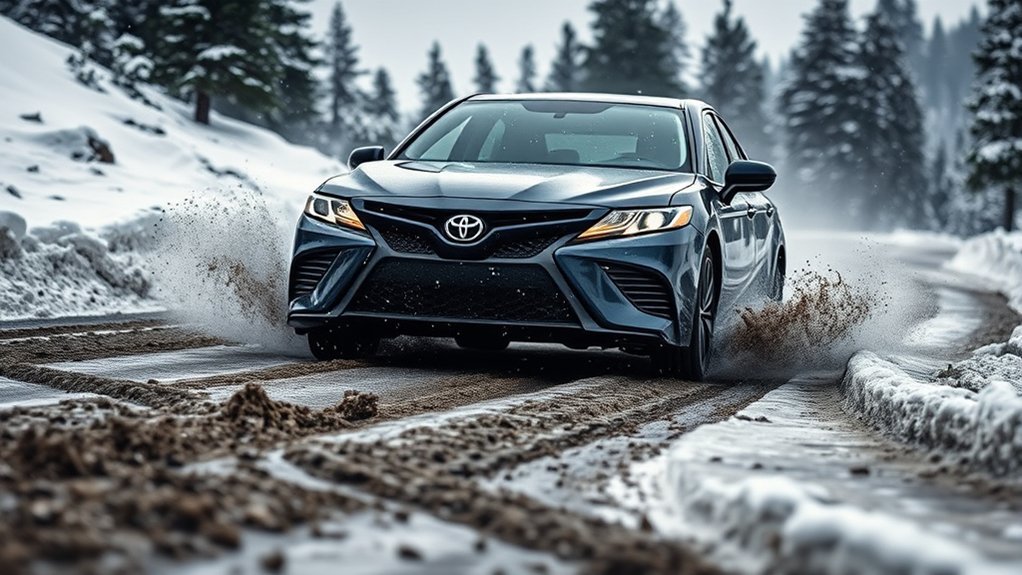
Evidence for mud performance is more limited. Shallow mud over a firm base may behave like another low-traction start, but soft or deep mud adds rolling resistance and can fill the tire tread. The Camry has no low-range gearing, dedicated mud mode, underbody protection, or SUV-level clearance. Do not use it as a trail vehicle merely because it has AWD.
What Can Camry AWD Not Do in Winter?
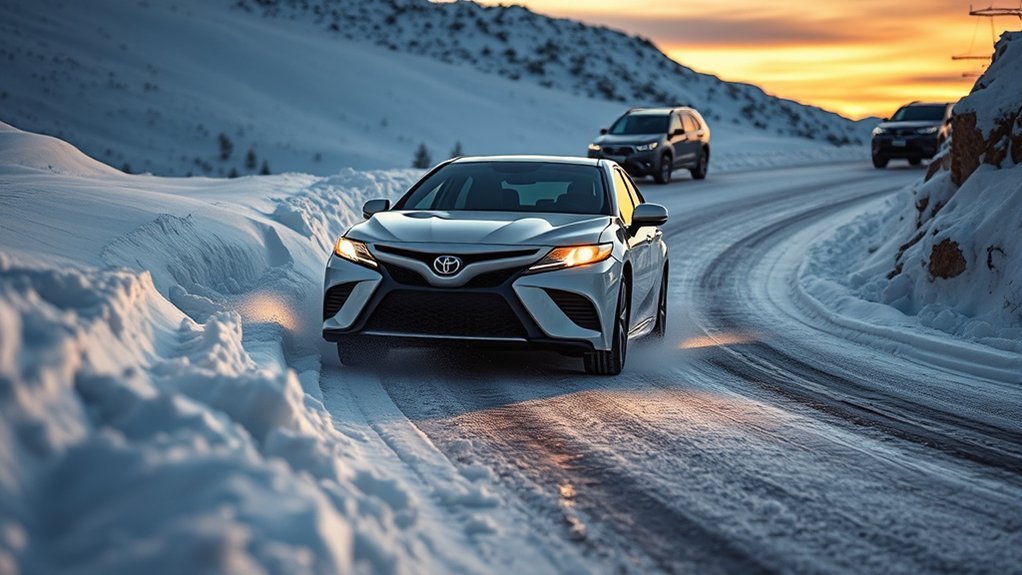
AWD helps apply power, but it does not provide a comparable improvement in emergency braking. All four tires already participate in braking on a modern FWD or AWD car. Stopping and cornering therefore depend mainly on tire grip, speed, road condition, and driver input.
The 2025–2026 Camry has about 5.4 inches of minimum ground clearance across its trims. Do not interpret that figure as a safe maximum snow depth. Loose powder may compress, while a frozen center ridge can strike the underbody even when the surrounding snow looks shallow. If packed snow reaches the splash shields or floor area, it can lift weight from the tires and high-center the car.
- AWD cannot compensate for worn, unsuitable, or badly inflated tires.
- AWD does not eliminate understeer when the front tires exceed their cornering grip.
- Deep snow can trap the car through underbody drag even if the wheels continue turning.
- The published minimum clearance is about 5.4 inches across current LE, SE, Nightshade, XLE, and XSE trims.
- Sport trims use different suspension tuning and lower-profile tires, but current published specifications do not show lower minimum ground clearance.
For more detail about underbody and driveway risks, see the Camry ground-clearance guide.
Do You Still Need Winter Tires With Camry AWD?
Yes, if you regularly drive in snow, freezing weather, or on ice. AWD can mask weak tire traction during acceleration because more wheels receive power, but braking exposes the available grip more clearly. In one controlled Tire Rack ice test, a FWD test car stopped from 12 mph in 35.1 feet on studless winter tires and 53.6 feet on touring all-season tires. That was an 18.5-foot, or 34%, reduction. The figures are not Camry-specific, but they illustrate why drivetrain cannot replace winter tire grip.
Install winter tires as a matched set of four. Do not fit winter tires only to the front axle, because the rear tires may then lose lateral grip earlier and make the car unstable. On an AWD vehicle, the four tires should also be closely matched in size and wear.
[Products Worth Considering]

These off-road traction boards are designed to help vehicles recover from mud, sand, and snow with reliable grip and easier ramp-up. Their double-sided diamond construction, cross-shaped teeth, and contoured ramps improve traction while the durable polypropylene build stays flexible in harsh conditions. Convenient mounting points, ergonomic handles, and a visible leash make them practical to carry, store, and retrieve when recovery is needed.

This color coded tire tread depth gauge helps you quickly check tire wear and monitor when replacement is needed. Calibrated in easy-to-read 32nds with clear red, yellow, and green ranges, it offers fast visual results for cars, trucks, motorcycles, and other passenger vehicles. The pocket clip makes it simple to keep on hand for routine maintenance and safety checks.

Protect your vehicle’s original carpet with custom-fit all-weather floor mats designed to help trap dirt, mud, snow, slush, and spills before they reach your interior. A ribbed channel surface, perimeter lip, and nib backing work together to help keep debris contained and the mats securely in place, while the front mats include a molded vehicle logo for a factory-correct look.
How Should You Check Tire Pressure in Cold Weather?
Check all four tires when they are cold and inflate them to the pressures printed on the driver-door placard. Do not use the maximum pressure molded into the tire sidewall as the normal target. Tire pressure falls as outside temperature drops, so recheck it after a major cold snap and at least monthly during winter.
For model-specific instructions, see the Camry tire-pressure guide.
What Maintenance Matters Before Winter?
- Inspect tread depth, uneven wear, cuts, and sidewall damage.
- Replace damaged or badly mismatched tires before relying on AWD.
- Correct pulling, vibration, or abnormal wear rather than assuming AWD will hide it.
- Clear snow and ice from the windshield, lights, roof, grille, and sensor areas.
- Secure luggage so it cannot shift and stay within the vehicle’s listed load limits.
- Do not add loose ballast to the trunk in an attempt to create traction.
How Should You Drive a Camry AWD in Snow and Mud?
Use slow, deliberate control inputs. AWD may let the car accelerate more confidently than surrounding two-wheel-drive vehicles, but that can create false confidence before the first turn or stop. The National Highway Traffic Safety Administration recommends slowing down and increasing following distance because controlling or stopping a vehicle is harder on snow and ice.
- Accelerate gently: Add power progressively and let the AWD and traction systems respond without a sudden surge of wheel torque.
- Brake early: Begin slowing before a turn, intersection, downhill section, or traffic queue.
- Separate major inputs: Avoid hard braking or heavy acceleration while applying a large steering angle.
- Look for clearance hazards: Avoid plow piles, frozen center ridges, deep tire ruts, and mud holes with an unknown base.
- Preserve momentum carefully: In shallow slush or mud, use a steady low speed without charging into a deeper section.
- Leave the systems on: Keep TRAC and stability control active during normal driving.
What Should You Do If the Camry Gets Stuck?
Stop spinning the tires continuously. Excess wheelspin can dig the tires deeper, polish snow into ice, overheat components, or throw mud and debris. Clear packed material from around the tires and make sure snow is not blocking the exhaust outlet.
Use the exact owner’s-manual procedure for your model year. Some Camrys allow traction control to be disabled briefly when controlled wheelspin is needed to rock free from snow or mud. Turn the system back on as soon as the car is moving normally. If the underbody is resting on packed snow or mud, more wheel torque may not help; the obstruction must be removed or the vehicle recovered safely.
Should You Choose a Camry AWD or an SUV?
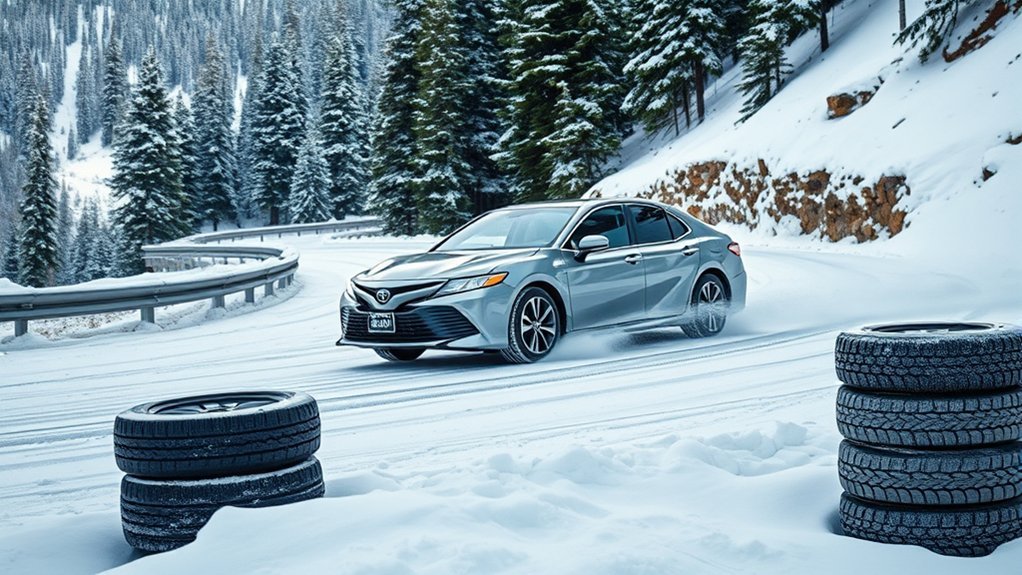
Choose a Camry AWD when most of your winter travel is on paved, maintained roads. It is well suited to packed snow, slush, wet commutes, paved hills, and occasional shallow mud over a firm surface. It also retains the lower seating position and road manners of a sedan — one of the few in its class still available with AWD at all.
Choose a higher-clearance crossover or SUV when you routinely drive before snowplows arrive, cross deep frozen ridges, use unmaintained roads, or encounter muddy ruts. In a 2026 Camry AWD winter test on a closed Bridgestone course, the reviewer found the car manageable on packed snow with dedicated winter tires, but noted that the rear motor supplies only about 40 of the car’s 232 system horsepower, so the AWD system stays front-biased and produced noticeable understeer; low sedan clearance was flagged as the bigger limit in heavier snow.
The practical decision is not simply AWD sedan versus AWD SUV. Compare the route, tire plan, and likely snow depth:
- Maintained city and highway routes: Camry AWD with four winter tires is a strong setup.
- Mild winter with rare snow: Camry FWD with suitable tires may be enough.
- Steep paved driveway or frequent slippery starts: Camry AWD provides a useful acceleration advantage.
- Regularly unplowed roads or deep ruts: Choose more ground clearance.
- Trails, deep mud, or off-road travel: Choose a vehicle designed for that use.
[Products Worth Considering]

These foldable emergency tire traction pads help give your vehicle the grip it needs to get unstuck from snow, ice, mud, or sand. Each lightweight pad is easy to carry and designed with a honeycomb surface and adjustable angle to improve traction across different road conditions. Built to support heavy loads, they make a practical roadside recovery tool for unexpected driving emergencies.

This smart tire tread depth gauge provides quick, accurate readings from 0 to 1 inch in 1/32-inch increments, helping drivers assess tire wear with confidence. Its color-coded display makes it easy to see tread condition at a glance, while the pocket clip adds convenient portability for garages, glove boxes, and on-the-go inspections. Designed for use on trucks, motorcycles, automobiles, and other passenger vehicles, it is a simple tool for safer tire maintenance.

This smart color coded tire tread depth gauge makes it easy to check tread wear at a glance with clear red, yellow, and green ranges. Calibrated from 0 to 1 inch in 1/32 inch increments, it helps you quickly assess tire condition for safer driving and timely replacements. The pocket clip design makes it convenient to carry and use on trucks, motorcycles, cars, and other passenger vehicles.
Frequently Asked Questions
Does Camry AWD Help on Icy or Slippery Roads?
Camry AWD can improve acceleration and help the car pull away when comparable FWD tires would spin. It does not shorten braking distance in the same way. Slow down, leave extra following distance, and use tires suited to ice and snow.
Is the Toyota Camry AWD Good in Snow?
Yes, on packed or moderate snow over maintained roads. Its main strengths are smoother starts and added drive traction. Deep snow remains a problem because the current Camry has about 5.4 inches of minimum ground clearance.
Do I Need Winter Tires With a Camry AWD?
Use four matched winter tires if you regularly drive in snow, ice, or prolonged freezing conditions. AWD helps acceleration, while winter tires improve acceleration, braking, and cornering grip.
How Much Snow Can a Camry AWD Handle?
There is no reliable maximum depth because loose powder, packed snow, frozen ridges, tire condition, and vehicle loading all change the outcome. Avoid snow approaching the underbody and do not treat the 5.4-inch clearance figure as a snow-depth rating.
Is the Camry AWD Good in Mud?
It may help in shallow mud over a firm surface, but the Camry is not an off-road vehicle. Deep mud, soft ground, and ruts can overwhelm its tires and low ground clearance. The available evidence is stronger for slippery-road and packed-snow use than for mud.
Final Verdict
The Toyota Camry AWD is a good winter commuter when its route is mostly paved and maintained. The 2025–2026 electric system and the 2020–2024 mechanical system both add rear-wheel assistance automatically, but test results from one generation should not be attributed to the other.
For the strongest setup, fit four matched winter tires, use the cold pressure on the driver-door placard, and leave enough space to brake. Before choosing the Camry over an SUV, inspect the roads you actually use. Packed snow and slush suit the Camry AWD; deep unplowed snow, frozen ridges, trails, and mud ruts call for more ground clearance.



[…] Brake Hold applies braking force, but the tires still need enough traction to keep the vehicle stationary. For additional low-traction guidance, see the Camry AWD slippery-road guide. […]