Toyota Camry Door Locks Not Working: Symptoms, Causes, and Fixes
What’s in This Article
- Common Symptoms of Door Lock Actuator Issues
- Electrical Issue vs. Door Lock Actuator Problem
- How to Replace a Door Lock Actuator
- Troubleshooting Remote Lock and Unlock Issues
- Tools and Parts You’ll Need for the Repair
- Reassembling the Door for a Secure Fit
- Common Mistakes to Avoid After Replacing an Actuator
- Frequently Asked Questions
A Toyota Camry door lock problem can make one door stick, make every lock fail, or leave your remote useless. Start with the simplest checks first: the key fob battery, manual lock function, fuses, and whether the problem affects one door or every door. This guide shows you how to narrow the cause, replace a worn actuator, and test the repair before you put the door panel back on.
Quick Answer
If one Toyota Camry door won’t lock or unlock, the door lock actuator often needs attention. If all doors fail at the same time, check the key fob battery, door lock fuse, relay, wiring, or control module before replacing parts.
Key Takeaways
- Check whether one door or all doors fail before you buy a replacement actuator.
- Replace the key fob battery first if the remote fails but manual locks still work.
- Listen for buzzing, clicking, or groaning sounds from one door during lock operation.
- Test the actuator before you fully reinstall the door panel.
- Stop and get help if you find damaged wiring, water intrusion, or repeated fuse failure.
Common Symptoms of Door Lock Actuator Issues
When your Toyota Camry has a bad door lock actuator, you’ll usually notice a clear pattern. One door may fail to lock or unlock with the remote, key fob, or power lock switch while the other doors still work.
You may also hear a buzzing, clicking, or groaning noise from the affected door. That sound often means the actuator motor still receives power, but the internal mechanism can’t move the lock correctly.
Watch for these common symptoms:
- One door locks sometimes but fails at other times.
- One lock moves slowly or only halfway.
- The door makes noise but does not lock or unlock.
- The alarm or interior light acts strangely after lock failure.
- The lock works manually but not through the power switch.
Inspect the door area for signs of corrosion, water, damaged wiring, or broken clips. These problems can strain the actuator and make the lock less reliable.
Electrical Issue vs. Door Lock Actuator Problem
Before you remove the door panel, decide whether the fault points to the whole lock system or one door. If every door stops responding, start with electrical checks. If only one door fails, focus on that door’s actuator, wiring, or latch linkage.
This step saves time and helps you avoid replacing a good part. A door lock actuator can fail, but a weak key fob battery, blown fuse, bad switch, or damaged wire can create similar symptoms.
Electrical Issues Overview
If none of the doors lock or unlock from the switch or remote, inspect the power supply first. Check the key fob battery, door lock fuse, relay, and visible wiring near the door jamb.
If the remote fails but the door switch works, the key fob battery or remote may cause the issue. Toyota owner guidance for wireless remotes also points to battery depletion or radio interference when the remote stops working from a normal distance.
If fuses keep blowing or the locks fail again after a quick fix, ask a qualified technician to test the circuit. Repeated electrical failure can point to a short, control module issue, or water-damaged connector.
Actuator Failure Symptoms
A failing actuator usually affects one door. The lock may buzz, click, move weakly, or stop before it reaches the full lock or unlock position.
Manual locking may still work because your hand moves the latch linkage directly. The power lock system fails because the actuator motor or gear can no longer move that linkage with enough force.
Understanding this difference matters because repair costs can change quickly. According to RepairPal’s January 2026 estimate, a Toyota Camry door lock actuator replacement often costs about $489 to $598 before taxes, fees, and local price changes.
Troubleshooting Steps Explained
Use the symptom pattern to choose your next step. Start with easy checks, then move to door panel removal only when the evidence points to the actuator.
| Issue Type | Symptoms | Action Required |
|---|---|---|
| Electrical | No doors respond | Check key fob battery, fuse, relay, wiring, and switch |
| Actuator | One door buzzes or moves weakly | Inspect and replace the actuator if power reaches it |
| Remote Failure | Remote fails but door switch works | Replace the key fob battery and retest |
| Manual Lock Works | Lock moves by hand but not by power | Check actuator, connector, and latch linkage |
| Wiring or Module | Intermittent or repeated system-wide failure | Get a circuit test before replacing parts |
Replacing a Door Lock Actuator: A Step-by-Step Guide
Before you start replacing the door lock actuator, gather the right tools and match the part to your Camry’s model year and door position. Front left, front right, rear left, and rear right actuators may use different part numbers.
Plan for about 1 to 3 hours if you have basic hand tools and some trim removal experience. Move slowly because door clips, rods, and connectors can break if you force them.
Warning: Disconnect the 12-volt battery before working near door wiring, and keep your hands clear of sharp door metal.
[Products Worth Considering]

This two-piece front door lock actuator motor set is designed to restore reliable power door lock operation for a wide range of Toyota, Lexus, and Scion vehicles. It includes left driver and right passenger side actuators and is made as a direct replacement for common factory part numbers. With broad vehicle compatibility and a one-year warranty, it offers a practical solution for fixing faulty door locking issues.

This front left door lock actuator assembly is a direct replacement for select Toyota and Lexus models, helping restore reliable power door locking and latch operation. Built as an OEM-quality aftermarket part, it includes the latch assembly and is factory tested for dependable performance. It is designed for driver-side front door fitment across a wide range of compatible vehicles and comes with replacement support for added peace of mind.
Tools Required For Replacement
Use the right tools before you pull the panel loose. A plastic trim tool helps protect the panel better than a metal screwdriver.
- Torx screwdriver set
- Socket wrench and basic sockets
- Plastic trim removal tool
- Flathead screwdriver
- Needle-nose pliers
- Multimeter for power and ground checks
- Safety glasses and work gloves
- Compatible Original Equipment Manufacturer (OEM) or quality replacement actuator
Choose an actuator that fits your exact Camry year, trim, and door location. A close-looking part may still use the wrong connector or linkage position.
Common Installation Mistakes
Many actuator replacements fail because the new part never gets tested before reassembly. Connect the actuator, test the lock, and confirm the rod movement before you reinstall the full door panel.
Check each connector and locking rod carefully. A loose connector, clipped wire, or misaligned rod can make a new actuator act like a bad one.
Safe Replacement Steps
- Park the Camry on a flat surface, turn it off, and disconnect the 12-volt battery.
- Remove the trim covers, door handle screws, armrest screws, and switch panel with care.
- Use a trim tool to release the door panel clips without bending the panel.
- Disconnect the window switch and lock switch connectors.
- Peel back the moisture barrier only as much as needed, and keep the adhesive clean.
- Locate the actuator, latch linkage, and electrical connector inside the door.
- Disconnect the actuator connector and release the lock rods or cables.
- Remove the actuator mounting screws or bolts, then take the actuator out.
- Install the new actuator in the same position and reconnect rods, cables, and wiring.
- Reconnect the battery, test the lock several times, then finish reassembly.
Troubleshooting Remote Lock and Unlock Issues in Your Car
If your Toyota Camry’s remote lock and unlock feature stops working, confirm whether the problem comes from the remote or the car. Lock and unlock the doors from the interior switch and with the physical key first.
If the manual locks and door switch work, replace the key fob battery and test the remote again. Make sure you install the battery with the correct polarity, and clean light corrosion from the battery contacts if needed.
Here’s a quick troubleshooting guide:
| Step | Action |
|---|---|
| 1. Check Battery | Replace the key fob battery with the type listed in your owner’s manual. |
| 2. Test Remote | Stand near the car and test lock, unlock, trunk, and panic functions if equipped. |
| 3. Test Door Switch | Use the interior switch to see whether the car’s lock system still responds. |
| 4. Inspect Fuses | Check the owner’s manual for the correct fuse location before pulling any fuse. |
| 5. Get Diagnosis | Ask a technician to test wiring, switches, and modules if the problem continues. |
If the remote still fails, review your vehicle’s manual for your exact key type. Some smart key systems, remote start systems, and older wireless transmitters use different battery types and reset steps.
[Products Worth Considering]

COMPATIBLE WITH AIRTAG & KEY FOBS: Works with Apple AirTag, all major car key fobs (Toyota, Honda, BMW, Ford, Chevrolet, Lexus), fitness trackers, glucose monitors, tire pressure sensors, and any CR2032 / 3V lithium coin battery device.

**Please confirm compatibility using the fitment guide located in the product images**

CONFIRM FIT **Please confirm compatibility using the fitment guide located in the product images** This battery will only fit your key fob if it exactly matches one of the examples in the compatibility guide.
What Tools and Parts You’ll Need for the Repair
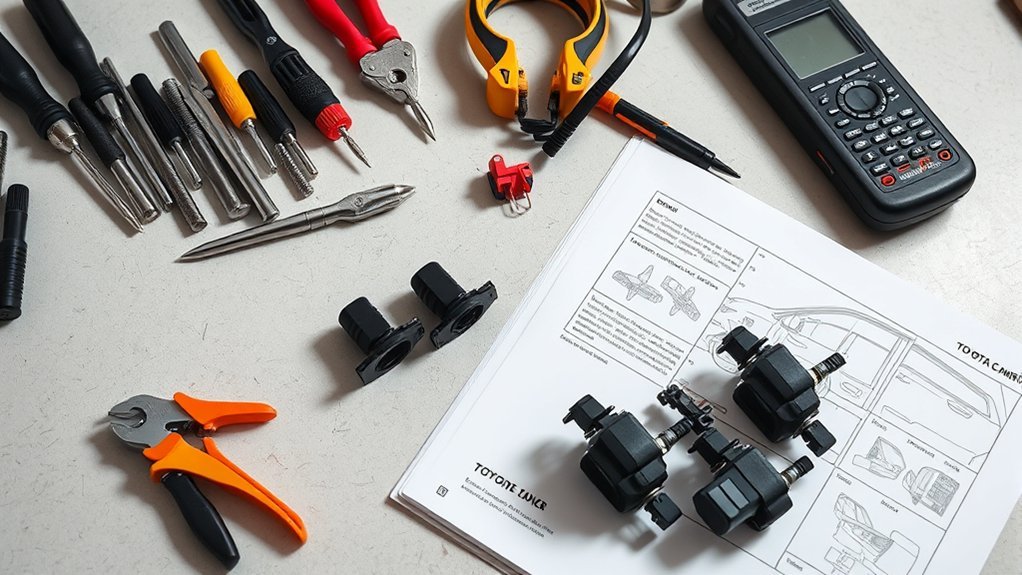
To repair the door locks on your Toyota Camry, start with tools that let you remove trim without damage. You’ll need Torx screwdrivers, a socket set, and a plastic trim removal tool for most door panel jobs.
You’ll also need a compatible door lock actuator for your exact model year and door position. Inspect the connector shape, mounting points, and latch linkage before you install it.
Keep a multimeter nearby if the issue may involve power or ground. If you find cut wires, corrosion, melted insulation, or water inside the door, repair the electrical fault before you install a new actuator.
Pro tip: Take photos before you remove rods, clips, and connectors so you can match every part during reassembly.
[Products Worth Considering]

[Compatible with Toyota models] : 4Runner 2010-2019 | Camry 2007-2017 | Corolla 2009-2013 | Corolla iM 2017-2018 | Highlander 2008-2013 | Land Cruiser 2008-2019 | Matrix 2009-2014 | Prius C 2012 | Prius V 2012-2014 | RAV4 2006-2018 | Sequoia 2008-2019 | Sienna 2011-2014 | Tundra 2007-2019 | Venza 2009-2016.
Reassembling the Door for a Secure Fit
Reassemble the door only after the lock passes several tests. Lock and unlock the door with the switch, remote, and manual lock before you snap the panel back in place.
Reconnect all electrical connectors firmly. Then align the door panel with the door shell, and press each clip into its slot without forcing the panel.
Install the screws for the handle, window switch, and armrest in the correct places. Before you finish, confirm that the locking rod moves freely and does not bind against the panel or moisture barrier.
Test the window, lock switch, speaker, mirror switch if equipped, and interior light. RepairPal recommends a full performance check after actuator work because other door-mounted parts can be affected during panel removal.
Common Mistakes to Avoid After Replacing an Actuator
After replacing the actuator, avoid mistakes that can make the lock fail again. Start by checking every electrical connection, lock rod, cable, and clip before you reinstall the panel.
Don’t force the door panel back onto the door. If a clip does not line up, remove the panel and check the clip position instead of hitting the panel harder.
Don’t skip the final lock test. Test the lock with the remote, interior switch, manual lock, and outside handle so you can catch problems before the job feels complete.
Keep every screw and clip organized during disassembly. Missing fasteners can cause rattles, loose trim, or poor switch fit after reinstallation.
When to Seek Professional Help
Stop the repair and seek professional help if every lock fails, fuses keep blowing, or the wiring looks damaged. These signs can point to a deeper electrical fault instead of a simple actuator problem.
You should also get help if the door will not open from inside or outside. A stuck latch can trap the panel in place and make the repair harder without proper tools.
If your Camry has smart key features, alarm issues, or repeated battery drain after lock failure, ask a technician to test the system. A wrong guess can turn a small repair into a larger electrical problem.
Frequently Asked Questions
Why Is My Toyota Camry Not Locking?
Your Toyota Camry may not lock because of a weak key fob battery, blown fuse, bad switch, wiring fault, or failed door lock actuator. If one door fails while the others work, start with that door’s actuator and wiring.
How Much Does It Cost to Fix a Car Central Locking System?
The cost depends on the failed part and your location. RepairPal’s January 2026 estimate lists Toyota Camry door lock actuator replacement at about $489 to $598 before taxes, fees, and related repairs.
Can a Bad Key Fob Battery Stop My Camry Door Locks From Working?
Yes, a weak key fob battery can stop remote lock and unlock functions. If the door switch and manual key still work, replace the key fob battery before you inspect the actuator.
Why Does Only One Camry Door Lock Stop Working?
One failed door usually points to a local problem in that door. The most common causes include a worn actuator, loose connector, damaged latch linkage, or broken wire near the door hinge area.
Should I Replace the Actuator or Check the Fuse First?
Check the fuse first if every door stops responding. If only one door fails and you hear buzzing from that door, inspect the actuator and connector before replacing parts.
Safety Disclaimer: This article is for informational purposes only and does not replace professional automotive repair advice. If you find damaged wiring, repeated fuse failure, stuck latches, or airbag-related door components, consult a qualified technician before continuing.
Conclusion
A Toyota Camry door lock problem becomes easier to fix when you match the symptom to the likely cause. Check the key fob, fuse, switch, and wiring before you replace an actuator.
If one door buzzes, moves weakly, or fails by itself, inspect that door’s actuator and linkage. Test the repair before final reassembly so you don’t need to remove the panel twice.
With careful checks and the right part, you can restore dependable lock function and keep your Camry easier to secure every day.
References
- Toyota Camry Door Lock Actuator Replacement Cost Estimate — RepairPal, 2026
- How To Fix Toyota Power Door Lock Problems — Toyota of Stamford
- Toyota Camry Door Lock Failure Diagnosis Guide — Toyota Parts Center