Last updated: August 31, 2026
Yes. The 2026 U.S.-spec Hyundai Sonata has Forward Collision-Avoidance Assist (FCA) as standard on every trim Hyundai lists. FCA combines forward-collision warning with automatic emergency-braking support for covered situations, and the 2026 system also includes pedestrian detection, cyclist detection, and Junction Turning. Equipment varies on older Sonatas, so used-car shoppers should confirm the model year, trim, Driver Assistance menu, warning lights, and repair history.
Quick Answer
Yes. Hyundai lists Forward Collision-Avoidance Assist with pedestrian detection, cyclist detection, and Junction Turning as standard on every 2026 U.S. Sonata trim: SE, SEL Sport, N Line, Hybrid Blue, Hybrid SEL, and Hybrid Limited. FCA can warn you and may assist with braking, but it cannot detect every hazard or replace attentive driving.
Key Takeaways
- Hyundai’s 2026 U.S. specification sheet lists FCA with pedestrian detection, cyclist detection, and Junction Turning as standard across every listed Sonata trim group.
- Hyundai’s FCA documentation describes a front-view camera and front radar that help detect supported vehicles, powered two-wheelers, pedestrians, and cyclists.
- The 2026 Sonata owner’s manual uses Standard or Late warning timing. Standard is the recommended default for normal driving.
- IIHS rates the 2026 Sonata’s standard FCA system Acceptable for vehicle-to-vehicle prevention and Good for pedestrian prevention.
- Hyundai says Junction Turning operates when the Sonata is about 6–19 mph and the oncoming vehicle is about 19–44 mph; those ranges do not guarantee detection or braking.
- Weather, glare, curves, hills, unusual vehicles, abrupt cut-ins, and blocked sensors can reduce performance, so FCA remains a backup rather than a substitute for braking.
At a Glance
| Time Required | 2–5 minutes to check settings and visible sensor areas; longer if warning lights require diagnosis. |
| Difficulty | Easy for settings and sensor cleaning; professional service needed for calibration or repairs. |
| Tools Needed | Infotainment screen or instrument-cluster menu, owner’s manual, and a clean soft cloth. |
| Cost | Free to check and clean; dealer diagnosis, calibration, or sensor repair varies by issue. |
Does the Sonata Have Forward Collision-Avoidance?
Yes. Hyundai’s official 2026 Sonata specifications list Forward Collision-Avoidance Assist with Pedestrian, Cyclist Detection and Junction Turning as standard across the listed 2.5L, 2.5T, and 2.0L Hybrid trim groups. Hyundai’s current 2026 Sonata safety page also describes FCA-JT as standard on all trims.
The 2026 Sonata owner’s manual describes a front-view camera and front radar that help detect supported vehicles, powered two-wheelers, pedestrians, and cyclists. When collision risk rises, FCA may show a cluster warning, sound an alert, vibrate the steering wheel on supported configurations, and assist with braking. Use Hyundai’s Manuals & Warranties portal to open the manual for your exact model year and vehicle.
For used Sonatas, the feature name alone does not confirm every sub-function. Check the window sticker, owner’s manual, and the actual Driver Assistance > Driving Safety menu on the vehicle you are considering.
Warning: Do not test FCA by driving toward a person, vehicle, motorcycle, bicycle, or object. The system may warn late, brake unexpectedly, or fail to respond. Keep a safe following distance and stay ready to brake or steer.
How Sonata Forward Collision-Avoidance Works
Hyundai’s FCA documentation describes a front-view camera and front radar working together to detect supported road users and evaluate collision risk. The exact intervention depends on speed, target type, road conditions, and vehicle equipment. In practical terms, FCA moves through three stages:
| Stage | What Happens |
|---|---|
| Detection | The system monitors the road ahead for supported targets such as vehicles, powered two-wheelers, pedestrians, and cyclists. |
| Warning | If risk rises, the Sonata may show a cluster warning and sound an audible alert. |
| Braking Assist | If the driver does not respond in time, FCA may assist with braking to reduce impact speed or help avoid the collision. |
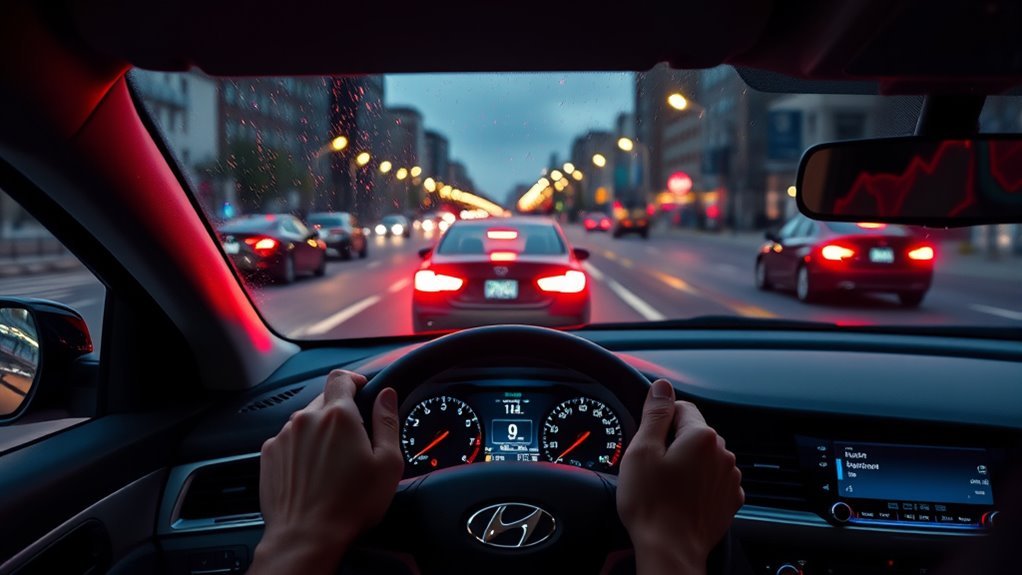
The system is designed for supported front-collision scenarios, including traffic slowing ahead, a pedestrian or cyclist entering the path, or an oncoming-traffic conflict during certain turns. It is not a self-driving system and cannot overcome limited tire grip, poor visibility, abrupt cut-ins, or blocked sensors.
Is FCA the Same as Forward-Collision Warning or Automatic Emergency Braking?
Hyundai uses Forward Collision-Avoidance Assist (FCA) as the umbrella name for the Sonata’s forward-crash support. The warning stage serves the role commonly called forward-collision warning (FCW), while the braking stage is the function commonly described as automatic emergency braking (AEB). On the 2026 Sonata, Hyundai packages these functions together under FCA rather than treating them as separate guarantees.
This distinction matters when you compare used cars or third-party listings. A seller may say “forward-collision warning” or “automatic braking,” but those phrases do not prove which Hyundai FCA functions, detection targets, or junction features are installed. Verify the exact model year, window sticker, Driver Assistance menu, and owner’s manual.
What Does IIHS Testing Show About Sonata FCA?
The Insurance Institute for Highway Safety lists standard Forward Collision-Avoidance Assist on the 2026 Sonata. IIHS gives the system an Acceptable rating for vehicle-to-vehicle front crash prevention and a Good rating for pedestrian front crash prevention. Those ratings apply to all 2024–2026 Sonata models in the IIHS evaluation.
| IIHS Test Area | Published Result | What It Means for You |
|---|---|---|
| Passenger-car target | Collision avoided in the listed 31, 37, and 43 mph centered and off-center tests. | The system performed strongly against the passenger-car target in controlled testing. |
| Motorcycle target | Collision avoided in the listed 31 and 37 mph centered/off-center tests; speed was reduced by 9 mph in the 43 mph centered test. IIHS lists the 43 mph off-center autobrake run as not tested. | Performance varied by speed and target position, so you must not assume every motorcycle conflict will be avoided. |
| Pedestrian target | Good overall rating, with collisions avoided in the listed child and adult day/night scenarios. | Controlled results are encouraging, but real roads add weather, glare, movement, and visibility limits. |
Read the complete IIHS 2026 Hyundai Sonata evaluation before treating any single score as a guarantee. Test results describe controlled scenarios, not every situation you may face.
[Products Worth Considering]

This 121-piece mechanics tool set equips you for automotive repairs, household fixes, and garage projects with a versatile mix of sockets, wrenches, hex keys, and bits. It includes both metric and SAE sizes, a spark plug socket, extension pieces, and a ratchet with quick-release functionality to help tackle fasteners in tight or recessed spaces. The tools are organized in a rugged molded case for easy storage, transport, and quick size identification.
How to Enable and Customize Forward Collision-Avoidance on the Sonata
On the 2026 U.S. Sonata, the owner’s manual uses the infotainment path below. Older model years can use different labels, so treat this as a 2026 path rather than a universal Sonata menu.
- Turn the vehicle on.
- Open Setup on the infotainment screen.
- Select Vehicle.
- Choose Driver Assistance.
- Open Driving Safety.
- Make sure Forward Safety is selected.
The 2026 Sonata owner’s manual says the Forward Safety setting includes the Basic function, Junction Turning, and Direct Oncoming. For model-specific wording, open the 2026 Sonata manual through Hyundai’s Manuals & Warranties portal. If you need older-year menu paths, see our Hyundai Sonata FCA settings guide.
Pro Tip: The 2026 Sonata owner’s manual says FCA turns back on when the engine restarts, while Forward Safety Warning Timing keeps its last setting. Recheck the menu after startup if you need to confirm the behavior of your specific vehicle.
Which Forward Safety Modes Can a Sonata Have?
Your Sonata’s FCA functions depend on model year, market, trim, and equipment. Hyundai’s 2026 U.S. specification sheet confirms Junction Turning across the listed trims, while the 2026 Sonata owner’s manual says the Forward Safety setting includes Basic, Junction Turning, and Direct Oncoming. Hyundai’s public trim grid still brands the feature as FCA-JT, so verify the exact vehicle’s menu and manual rather than assuming every older Sonata has the same function set.
Basic Function Overview
The Basic function monitors supported road users ahead and may warn or assist with braking when collision risk rises. It combines the roles many drivers associate with forward-collision warning and automatic emergency braking, although Hyundai uses the FCA name for the complete system.
Junction Turning Behavior
Junction Turning can assist when you turn left across oncoming traffic at an intersection with the turn signal on. Hyundai describes it as helping avoid a collision with an oncoming vehicle or powered two-wheeler in an adjacent lane by applying emergency braking. Hyundai’s 2026 U.S. Sonata page says the function operates when your Sonata is traveling about 6–19 mph and the oncoming vehicle is about 19–44 mph.
Hyundai’s 2026 U.S. Sonata specification sheet lists Junction Turning as standard across all listed trim groups. Older model years and non-U.S. cars still require vehicle-specific verification.
Direct Oncoming Response
Direct Oncoming is described in the 2026 Sonata owner’s manual as helping reduce collision speed when a vehicle or powered two-wheeler approaches from the opposite direction. The public 2026 U.S. trim specification names FCA with Junction Turning rather than listing Direct Oncoming as a separate trim-grid item. Check the vehicle’s manual and Driver Assistance menu if you are verifying equipment on a specific car.
Note: Hyundai manuals cover multiple trims, markets, and equipment packages. If a menu item is missing from your Sonata, the function may not be equipped on that vehicle or may use different regional wording.
How Should You Set FCA Warning Timing and Volume?
The 2026 Sonata owner’s manual lists Standard and Late for Forward Safety Warning Timing. Use Standard for normal driving. Late delays the initial warning and is intended for light traffic or slower driving when Standard feels too sensitive.
| Setting | Best Use | What to Know |
|---|---|---|
| Standard | Daily driving and mixed traffic. | Hyundai recommends this setting for normal driving conditions. |
| Late | Light traffic or low-speed driving when warnings feel too sensitive. | Warnings occur later, so do not use this to compensate for close following. |
| Warning Volume | Adjusting alert loudness. | Hyundai notes that driver-assistance warning methods may affect other assistance systems too. |
| Driving Safety Priority | Lowering other audio when a driver-assistance warning sounds. | Availability depends on vehicle features and specifications. |
If you are buying a used Sonata, ask the seller to show the actual menu. Older Sonatas may use Normal, Late, or Later wording, so do not assume their timing choices match the 2026 Standard/Late menu simply because the system uses the same FCA name.
Maintenance, Sensor Care, and Common Issues
FCA depends on clear, undamaged sensor views. Hyundai says snow, rain, dirt, fog, heavy rainfall, glare, darkness, curves, hills, construction areas, unusual vehicles, road vibration, and sudden cut-ins can reduce detection or cause unexpected operation. The system may also need about 15 seconds after startup or camera initialization before it operates. Review the model-specific owner’s manual through Hyundai’s Manuals & Warranties portal for the complete malfunction and limitations list.
| Issue | What to Check | Best Fix |
|---|---|---|
| Camera obscured warning | Windshield area in front of the camera. | Remove snow, rain film, dirt, stickers, or windshield obstruction. |
| Sensor blocked or system-limited warning | Windshield camera area and any sensor area identified in the owner’s manual. | Remove visible snow, mud, rain film, or dirt gently without damaging the sensor area. |
| Warning remains after cleaning | Possible sensor damage, misalignment, software issue, or calibration problem. | Have the vehicle inspected by an authorized Hyundai dealer or qualified repair facility. |
| Unexpected alerts on curves or hills | Road geometry, adjacent-lane vehicles, shadows, or glare. | Keep distance, reduce speed, and stay ready to brake or steer. |
| Front-end repair or windshield replacement | Camera/radar alignment and genuine sensor-cover parts. | Ask whether camera or sensor inspection and calibration were completed after the repair. |
Which Sonata Trims Include Forward Collision-Avoidance?
For the 2026 U.S. Sonata, Hyundai’s specification sheet marks Forward Collision-Avoidance Assist with Pedestrian, Cyclist Detection and Junction Turning as standard on every listed trim group below.
| 2026 Sonata Trim Group | FCA Availability | What It Includes in the Spec Sheet |
|---|---|---|
| 2.5L SE / SEL Sport | Standard | Pedestrian, cyclist detection, and Junction Turning |
| 2.5T N Line | Standard | Pedestrian, cyclist detection, and Junction Turning |
| 2.0L Hybrid Blue / SEL | Standard | Pedestrian, cyclist detection, and Junction Turning |
| 2.0L Hybrid Limited | Standard | Pedestrian, cyclist detection, and Junction Turning |
For used Sonatas, verify by model year, trim, market, window sticker, and the actual Driver Assistance menu. A vehicle can have the FCA name but not every advanced sub-function found on newer Sonatas.
The practical question is not just “Does it have FCA?” It is “Which FCA functions are equipped, are the sensors clean and calibrated, and does the system show any warning lights?”
Buying Checklist: Questions to Ask at the Dealership
When shopping for a new or used Sonata, ask the seller to show the FCA menu and explain which functions are equipped. On a pre-owned car, windshield, bumper, or collision repairs deserve extra attention because sensor position, damage, or calibration can affect driver-assistance performance.
Pre-Owned System History
- Ask for records of camera, radar, windshield, bumper, or front-end repairs.
- Ask whether the vehicle has shown “camera obscured,” “Driver Assistance system limited,” “Check Driver Assistance system,” or similar warnings.
- Confirm whether sensor inspection or calibration was performed after relevant repairs.
- Check the vehicle identification number using Hyundai’s Safety Recalls and Service Campaigns lookup and confirm that applicable repairs are complete.
- Verify that the vehicle has current applicable software updates.
Demonstrate System Activation
Have the seller turn the vehicle on and show the Driver Assistance menu. Confirm that Forward Safety or Forward Collision-Avoidance Assist is selected, then ask them to explain each visible sub-function. Do not request a real-world emergency-braking demonstration. A menu walkthrough, warning-light check, and normal test drive are enough.
Confirm Warning Timing Settings
Ask the seller to show the warning timing and warning methods menus. The 2026 Sonata uses Standard and Late; older years can use different wording. Also confirm warning volume and Driving Safety Priority where those options are available.
Frequently Asked Questions
How does Forward Collision-Avoidance Assist work on the Hyundai Sonata?
It uses the front view camera and front radar to help detect supported targets ahead, such as vehicles, powered two-wheelers, pedestrians, and cyclists. If the system predicts a possible collision, it may warn the driver and may assist with braking to reduce collision speed or help avoid the crash.
Does Forward Collision-Avoidance prevent all accidents?
No. FCA is an assist system, not a guarantee. It can be limited by dirty sensors, weather, glare, darkness, curves, hills, unusual vehicles, sudden cut-ins, construction zones, and other conditions. You must stay alert and ready to brake or steer.
Is Forward Collision-Avoidance standard on the 2026 Sonata?
Yes, Hyundai’s 2026 U.S. Sonata specifications list Forward Collision-Avoidance Assist with Pedestrian, Cyclist Detection and Junction Turning as standard across the listed 2.5L, 2.5T, and 2.0L Hybrid trim groups.
What does Junction Turning mean?
Junction Turning can assist when you turn left across oncoming traffic at an intersection with the turn signal on. Hyundai says the 2026 Sonata function operates when the Sonata is traveling about 6–19 mph and the oncoming vehicle is about 19–44 mph. Availability and exact behavior can vary by model year and market.
Why is my Sonata showing a camera obscured or Driver Assistance system limited warning?
The windshield camera area, front radar cover, or another sensor area may be blocked by snow, rain, dirt, stickers, or other material. Clean the visible area gently. If the warning remains after the obstruction is removed, have the vehicle inspected.
Should I use Standard or Late warning timing on a 2026 Sonata?
Use Standard for typical driving. Choose Late only when Standard feels too sensitive in light traffic or at lower speeds. Late delays the warning, so never use it to justify following more closely.
Is Hyundai FCA the same as automatic emergency braking?
FCA is Hyundai’s broader name for forward-collision support. It includes a warning stage and may include automatic emergency-braking assistance when the system judges that collision risk is high enough. FCA is still a driver-assistance system, not a guarantee that every collision will be avoided.
Can you turn Forward Collision-Avoidance Assist off permanently?
The 2026 Sonata owner’s manual says Forward Collision-Avoidance Assist turns on again when the engine restarts. The exact menu and behavior can vary by model year and market, so check your Sonata’s owner’s manual.
Why does FCA seem unavailable just after startup?
The 2026 Sonata owner’s manual notes that Forward Collision-Avoidance Assist may not operate for about 15 seconds after the vehicle starts or the front-view camera initializes. A warning that remains after startup and sensor cleaning needs inspection.
Conclusion
The 2026 U.S. Hyundai Sonata has standard Forward Collision-Avoidance Assist with pedestrian detection, cyclist detection, and Junction Turning across the listed trims. Keep Standard warning timing unless you have a clear reason to choose Late, keep sensor views clean, and treat every alert as backup rather than permission to follow closely. Before buying a used Sonata, verify the exact menu functions, check for warning lights, and review repair, calibration, recall, and service records.
Sources
- Hyundai USA — 2026 Sonata — supports FCA-JT as standard on all trims, the basic warning/braking description, system limitations, and published Junction Turning speed ranges.
- Hyundai USA — 2026 Sonata Features & Specs — supports trim-by-trim SmartSense availability for Forward Collision-Avoidance Assist with pedestrian, cyclist, and Junction Turning detection.
- HyundaiNews — 2026 Sonata Features and Specifications — supports FCA availability across the 2.5L, 2.5T, and 2.0L Hybrid trim groups.
- Hyundai Manuals & Warranties — use the model-specific 2026 Sonata owner’s manual for Forward Safety, Standard/Late warning timing, Direct Oncoming, sensor care, warning messages, restart behavior, and operating limitations.
- IIHS — 2026 Hyundai Sonata safety ratings — supports the Acceptable vehicle-to-vehicle and Good pedestrian front-crash-prevention ratings and the published test details.
- Hyundai — Safety Recalls and Service Campaigns — supports VIN-specific recall and campaign checks for new and used Sonata shoppers.