Quick Answer: How to Prevent Hyundai Sonata Hydroplaning
Last updated: September 16, 2026
To reduce Hyundai Sonata hydroplaning risk, slow down before pooled water, switch off cruise control, increase your following distance, and avoid sudden braking or steering. Inflate each cold tire to the pressure printed on your own Sonata’s Tire and Loading Information Label inside the driver’s door area. NHTSA says a tire should be replaced at 2/32 inch or when its wear bars are flush. If you regularly drive in heavy rain, Michelin notes that planning replacement around 4/32 inch can provide a larger wet-weather safety margin because water evacuation and wet-road performance have already declined. If the car starts to hydroplane, ease off the accelerator, hold the steering wheel steady, and wait for the tires to regain grip.
| Check or Situation | What to Do |
|---|---|
| Tire pressure | Use the cold-pressure value on the driver-door label |
| Tread near 4/32 inch | Consider replacement if frequent heavy-rain driving makes extra wet-weather margin important |
| Tread at 2/32 inch or wear bars | Replace the tire |
| Cruise control | Switch it off on wet roads |
| Standing water | Slow before reaching it and avoid it when possible |
| Unknown or moving water | Turn around and use another route |
| Hydroplaning begins | Ease off the gas, hold steady and avoid sudden inputs |
What Hydroplaning Is and Why It’s Dangerous for Hyundai Sonata Drivers
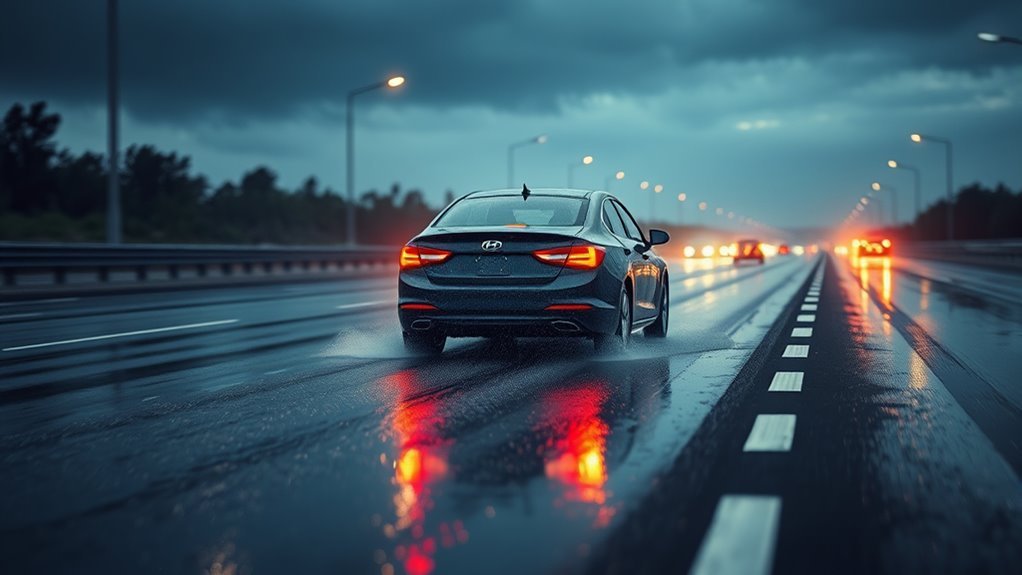
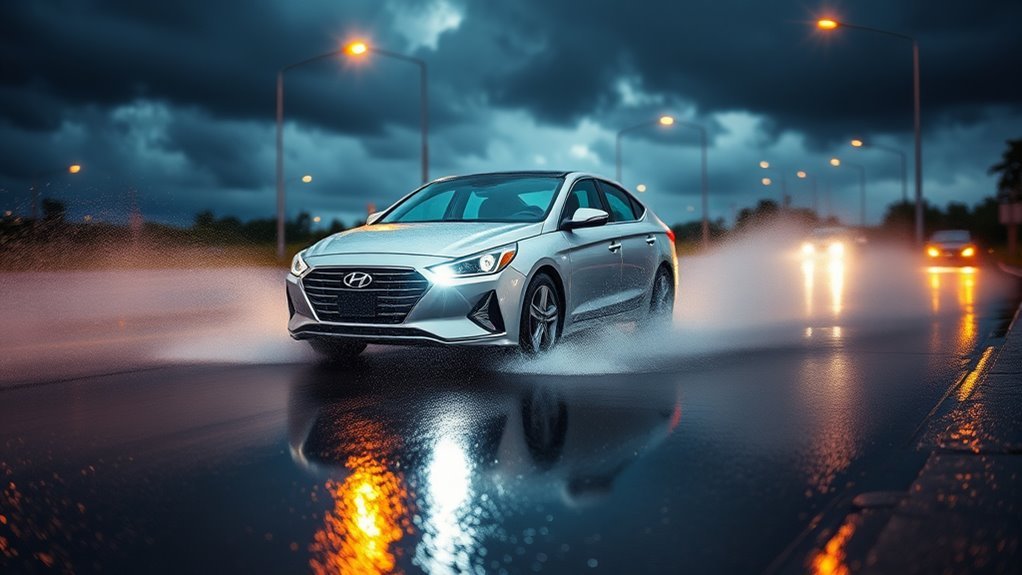
Hydroplaning happens when a tire cannot move water away from its contact patch quickly enough. A layer of water then separates part or all of the tire from the pavement. Steering, braking and acceleration response may become weak or unpredictable until road contact returns.
Hydroplaning does not begin at one guaranteed speed. The Pennsylvania Driver’s Manual says hydroplaning can occur at speeds as low as 35 mph when water is about 1/10 inch deep. Treat that as an example, not a Hyundai Sonata threshold: water depth, vehicle speed, pavement drainage, tire design, tread depth and inflation pressure all affect when grip may be lost.
Common warning signs include a light or vague steering feel, unexpected drifting and reduced response to small steering inputs. The safest response is to stay calm, reduce throttle gradually and avoid abrupt braking or steering.
Quick Pre-Drive Checks: Tires, Wipers, Lights, and Mirrors
Before driving in rain, spend two minutes checking the parts that affect tire grip and visibility. Measure cold tire pressure, inspect the tread at several locations, test the wipers, fill the washer reservoir, clean the lights and mirrors, and switch off cruise control before entering a wet road.
Tire Pressure & Tread
Check all four tires when they are cold. NHTSA TireWise defines this for routine pressure checks as the car not having been driven for at least three hours. Set each tire to the pressure printed on the Sonata’s Tire and Loading Information Label inside the driver’s door area. The number molded into the tire sidewall is a maximum limit, not the normal inflation target for your car.
Use a tread-depth gauge on the inner, center and outer grooves of every tire. Take readings at several points around each tire because wear may not be even. Use the lowest reading when deciding whether the tire needs service or replacement.
- Above 4/32 inch: Continue monthly inspections and watch for uneven wear.
- At or below 4/32 inch: Wet braking and water evacuation have declined. Consider replacement if heavy-rain driving is common; this is a wet-weather safety margin rather than the federal wear-bar threshold.
- At 2/32 inch or flush with a wear bar: Replace the tire.
Michelin’s current tread-depth guidance notes that wet-road performance is already reduced around 4/32 inch compared with deeper tread, while NHTSA identifies 2/32 inch and flush treadwear indicators as the replacement point.
Feathering, cupping, center wear, shoulder wear or one-sided wear can point to inflation, alignment, balance or suspension problems. Have the cause diagnosed rather than replacing the tire without correcting the underlying fault.
Wiper Blade Condition
Worn wipers do not cause hydroplaning, but they can prevent you from seeing pooled water early enough to slow down safely. Replace a blade when it leaves streaks, skips across the glass, chatters or misses part of the windshield. For a more detailed inspection, see the Sonata storm wiper performance guide.
- Inspect the rubber edge for cracks, hardening or missing pieces.
- Run the washer and confirm that both blades clear the glass evenly.
- Fill the washer reservoir before a wet trip.
- Remove leaves, dirt and other debris from the lower windshield area.
Headlights And Mirrors
Clean headlights and mirrors before driving in rain. Confirm that the headlights, brake lights and turn signals work. Turn the headlights on when rain or road spray reduces visibility so other drivers can see your Sonata more easily.
| Component | Action |
|---|---|
| Headlights | Clean lenses and test operation |
| Mirrors | Clean and adjust before moving |
| Wipers | Check for streaking and missed areas |
| Tires | Measure cold pressure and tread depth |
| Cruise control | Switch it off on wet roads |
Hyundai Sonata Tire Tread: How It Affects Wet Traction and When to Replace
Tread grooves move water away from the tire’s contact patch. As the tread wears, the grooves hold and move less water, so the tire is more likely to lose contact with the pavement in heavy rain.
Do not treat 2/32 inch as an ideal wet-weather target. NHTSA identifies it as the point where a tire should be replaced and where tread wear indicators are flush. Drivers who regularly encounter heavy rain may choose to replace tires around 4/32 inch for a larger wet-weather safety margin. Michelin notes that wet-road braking and water-channeling performance have already declined by that point compared with deeper tread.
Measure every tire rather than judging the set by its best-looking tire. A front tire may wear differently from a rear tire, and one edge may be much shallower than the center. Replace any damaged tire that has exposed cord, a bulge, a deep cut or other structural damage regardless of its remaining tread depth.
Hyundai Sonata Tire Pressure: The Right PSI for Wet Driving and How to Check Monthly
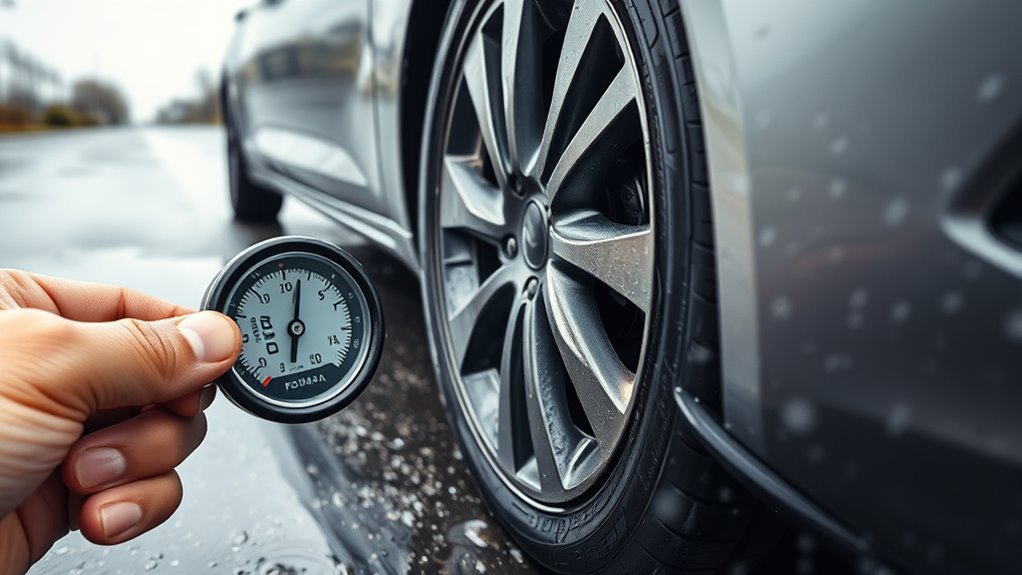
There is no single tire-pressure number that applies to every Hyundai Sonata. Model year, trim, tire size and market can change the recommended value. Use the Tire and Loading Information Label attached inside your own driver’s door area.
- Park the car for at least three hours so the tires are cold.
- Remove the valve cap and press a reliable gauge firmly onto the valve stem.
- Compare the reading with the driver-door label.
- Add or release air until the cold pressure matches the label.
- Repeat the check for every tire and reinstall the valve caps.
Check pressure at least once a month and before long trips. Do not release air from a warm tire merely because its reading is higher than the cold specification. Tire pressure normally rises as the tire warms during driving.
Do not wait for the TPMS warning light before checking tire pressure. NHTSA notes that TPMS warnings normally activate only after a tire becomes significantly underinflated, so a monthly gauge check is still necessary. If you need help understanding how the warning system works, see the Hyundai Sonata TPMS guide.
[Products Worth Considering]
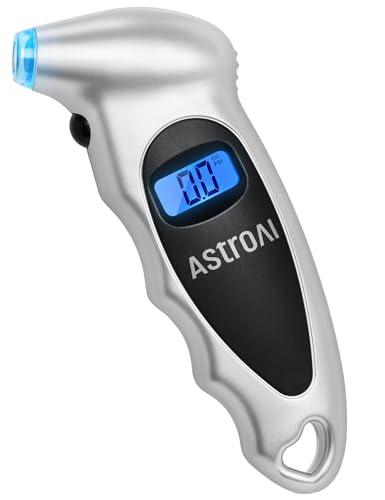
Accurate, Dependable Readings: Factory‑calibrated to ±1 PSI, so you can confidently match your vehicle’s recommended PSI (check the door jamb sticker). Ideal for monthly checks and road trips — consistent results every time, cold or warm.

PROCESS LEVEL ACCURACY: Each ETENWOLF’s digital tire pressure gauge is calibrated manually to ANSI B40.7 Grade 2A(plus-minus 1 PSI).Presta valve adapter not included, if used for bicycles, it must be purchased separately

PRO ACCURACY - mechanic recommended, performance tested, & calibrated accurate to professional ANSI 2A standards - with dual pressure sensors certified to ±0.50% FS (0.50 PSI), offering reliable readings up to 100 PSI w/ precise readout resolution of 0.10 PSI - so you can now maintain your tires with a shop-grade mechanic trusted tool
How to Choose Hyundai Sonata Tires for Heavy Rain
Start with the tire size, load index and speed rating approved for your Sonata. These specifications can vary by model year and trim, so confirm them on the vehicle label, in the owner’s manual or with a qualified tire installer.
After confirming fit, compare these wet-weather decision factors:
- Independent wet-braking results: Look for tests performed under controlled conditions.
- Hydroplaning resistance: Check straight-line and cornering results when available.
- Remaining tread: A highly rated tire still loses water-clearing capacity as it wears.
- Temperature range: Summer, all-season, all-weather and winter tires are designed for different operating conditions.
- UTQG traction grade: AA or A can provide a rough comparison of straight-line wet stopping, but the grade does not measure wet cornering or hydroplaning resistance.
Avoid choosing a tire only because its tread looks aggressive or its marketing uses words such as “rain,” “storm” or “all weather.” Verified test results, correct fit and current tread condition are more useful than appearance alone.
[Products Worth Considering]

Complete Kit To Quickly & Efficiently Replace A Blown Or Flat tire. Durable, Lightweight Alloy Spare Wheel & Tire Assembly – Includes a Modern Spare proprietary 18×4...
Rotate, Balance, and Align: Maintenance That Protects Wet Grip
Follow the tire-rotation interval in the owner’s manual for your Sonata’s model year and tire configuration. Rotation helps distribute wear, but it cannot repair a tire that is already damaged or worn below a safe depth.
Have the wheels balanced when new tires are installed or when you feel persistent speed-related vibration. Request an alignment inspection when the car pulls on a level road, the steering wheel sits off-center, one shoulder wears faster than the other, or the vehicle has hit a curb or severe pothole.
During each rotation or service visit, ask the technician to record the tread depth of all four tires. A written set of readings makes it easier to spot a developing alignment, suspension or inflation problem.
Driving Techniques for Puddles and Standing Water
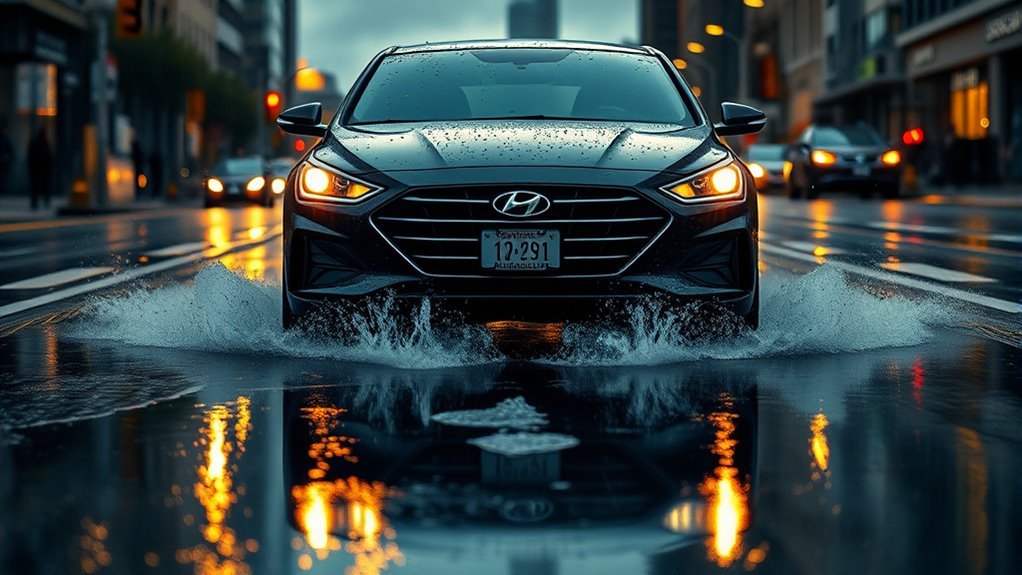
Slow down before reaching standing water. Do not wait until the tires enter the water to brake. Switch off cruise control, increase your following distance and make every steering, throttle and braking input gradually.
Never accelerate in an attempt to clear a puddle. If the water’s depth, current, road surface or exit point is uncertain, turn around and use another route. Never drive around a barricade or enter a visibly flooded road.
Slow Down Early
Scan well ahead for reflections, spray from other vehicles and sections where tire tracks disappear. These can indicate pooled water. Lift off the accelerator and reduce speed smoothly while the tires still have full contact with the road.
- Look as far ahead as visibility allows.
- Reduce speed before the water.
- Keep both hands on the steering wheel.
- Leave extra space behind the vehicle ahead.
- Avoid changing lanes in the deepest part of the water.
When safe, the tracks left by a vehicle ahead may contain less water, but do not follow closely to use them. A longer following gap is more important.
Avoid Deep Puddles
Treat unknown water as a possible flood hazard rather than an ordinary puddle. Water may hide a pothole, debris, a damaged shoulder or a washed-out road. Moving water can also push a vehicle away from its intended path.
If shallow water cannot be avoided, enter it slowly with the steering wheel steady. After leaving the water, test the brakes gently at low speed when traffic conditions allow. If braking feels abnormal, stop in a safe place and seek assistance.
If Your Sonata Starts to Hydroplane: Step-by-Step Recovery
If your Sonata starts to hydroplane, stay calm and avoid sudden reactions. Steering and braking response may be limited until the tires contact the pavement again.
- Ease off the accelerator gradually. Do not lift violently or press the gas.
- Hold the steering wheel steady. Avoid jerking or overcorrecting.
- Look where you want the car to go. Steer only as much as needed to stay on that path.
- Avoid braking during the loss of grip. Sudden braking can make the vehicle less stable.
- Wait for traction to return. Once the steering feels normal again, continue slowing and move to a safe position if needed.
If braking becomes unavoidable, use gentle, controlled pressure rather than slamming the pedal. The California DMV similarly advises slowing gradually and avoiding braking while the vehicle is hydroplaning. After recovery, continue at a much lower speed or leave the roadway at a safe location if rain or visibility remains severe.
What Sonata Driver-Assistance Systems Can and Cannot Do in Heavy Rain
ABS, Electronic Stability Control (ESC), traction control and available all-wheel drive can help manage braking, wheelspin or vehicle stability when the tires still have usable grip. They cannot force a hydroplaning tire back onto the pavement. Hyundai’s ESC guidance warns that ESC is not a substitute for safe driving and that hydroplaning on wet surfaces can still result in a severe collision.
For the same reason, do not rely on cruise control or Smart Cruise Control in poor weather. Hyundai’s current Sonata guidance says Smart Cruise Control is intended for highway use and should not be used in poor weather or on slippery roads. Equipment varies by model year and trim, so check the owner’s manual for your exact Sonata. For a deeper explanation of how these systems differ, see the Sonata traction control vs. stability control guide.
When to Seek Professional Tire Service
Arrange a tire inspection when any tire reaches approximately 4/32 inch and heavy-rain driving is common. Treat that as a wet-weather planning point rather than the universal legal limit. Replace a tire at 2/32 inch, when a tread wear bar is flush, or when structural damage is present.
Seek professional diagnosis if you notice:
- One-sided, cupped, feathered or patchy tread wear
- Persistent vibration that changes with road speed
- Pulling on a straight, level road
- An off-center steering wheel
- Frequent pressure loss
- Cracks, bulges, cuts, exposed cord or impact damage
A qualified technician can measure tread, inspect the tire internally when needed, check wheel balance, diagnose alignment or suspension faults, and confirm the correct pressure for the vehicle.
Frequently Asked Questions
What Two Things Should You Avoid Doing When Your Car First Hydroplanes?
Avoid sudden braking and abrupt steering. Ease off the accelerator gradually, hold the steering wheel steady and wait for the tires to regain contact with the road.
How Do You Stop a Car From Sliding in the Rain?
Reduce throttle gradually, look where you want the vehicle to go and make only small steering corrections. Do not slam on the brakes. Once traction returns, slow down further and move to a safe place if conditions remain poor.
At What Speed Can a Hyundai Sonata Hydroplane?
There is no exact speed that guarantees hydroplaning. PennDOT says a vehicle can hydroplane at speeds as low as 35 mph when water is about 1/10 inch deep, but that is an example rather than a Sonata-specific trigger. Water depth, tire condition, tread design, inflation pressure, vehicle speed and pavement drainage all affect the result.
Should You Use Cruise Control in the Rain?
No. Switch cruise control or Smart Cruise Control off in rain and on slick pavement. Manual speed control lets you reduce throttle immediately when traction or visibility changes, and Hyundai advises against using current Sonata Smart Cruise Control in poor weather or on slippery roads.
Does AWD Prevent Hydroplaning?
No. AWD can help distribute power when the tires have traction, but it cannot make a tire remove water from the road. An AWD Sonata can still hydroplane when speed, standing water or tire condition overwhelms the tread.
Can ABS, ESC, or Traction Control Prevent Hydroplaning?
No. ABS, ESC and traction control can help manage braking, wheelspin or vehicle stability when the tires have usable road contact, but they cannot create grip while a tire is riding on a layer of water. Hyundai specifically warns that hydroplaning can still cause a severe collision even on a vehicle equipped with ESC.
Can New Tires Still Hydroplane?
Yes. New tread improves water evacuation, but any tire can hydroplane when speed and water depth exceed its ability to maintain road contact.
How Much Tire Tread Is Needed for Heavy Rain?
Replace a tire at 2/32 inch or when its wear bars are flush. If you frequently drive in heavy rain, consider planning replacement at about 4/32 inch as an additional wet-weather safety margin because wet-road braking and hydroplaning resistance have already declined compared with deeper tread.
How This Guide Was Checked
This guide was updated using Hyundai Sonata owner guidance, current Hyundai driver-assistance limitations, NHTSA TireWise, California DMV guidance, the Pennsylvania Driver’s Manual and Michelin tread-depth guidance. It does not claim first-hand instrumented tire testing. Numeric thresholds such as 2/32 inch, 4/32 inch and the 35 mph hydroplaning example are therefore presented with their source and limitations rather than as unsupported Sonata-specific test results.
Authoritative Sources
- Hyundai Sonata Digital Owner’s Manual
- Hyundai USA: Current Sonata Features and Driver-Assistance Limitations
- NHTSA TireWise: Tire Pressure, Tread, Rotation and Safety
- California DMV: Hydroplaning Prevention and Recovery
- Pennsylvania Driver’s Manual: Wet Pavement and Hydroplaning
- Michelin: Tire Tread Depth and Wet-Weather Performance
Conclusion
The most effective way to reduce Hyundai Sonata hydroplaning is to combine lower wet-road speed with correctly maintained tires. Use the pressure on your own driver-door label, check pressure and tread monthly, switch off cruise control and avoid standing or flooded water.
If hydroplaning begins, ease off the accelerator, hold the wheel steady and avoid sudden braking or steering. Once grip returns, continue at a lower speed. If rain is severe enough that you cannot judge standing water or see the roadway clearly, move to a safe location or use another route rather than relying on AWD, ABS, ESC or driver-assistance systems to compensate.