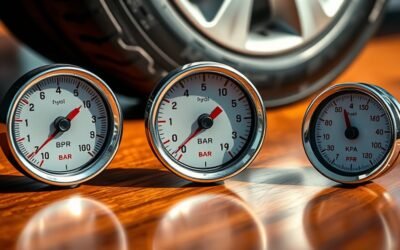
To read a tire inflator gauge, first identify the measurement unit: PSI, BAR, or kPa, based on your vehicle’s recommended pressure. Check the needle or digital display against this value to guarantee proper inflation. Remember, 32-35 PSI is common in the U.S., while 2.2-2.5 BAR is typical in Europe. If you’re unsure about conversions, online tools can help. Keep your tires cold for accurate readings, and stay tuned for more tips on maintaining safe tire pressure.
Understanding Tire Pressure Units: PSI, BAR, and kPa
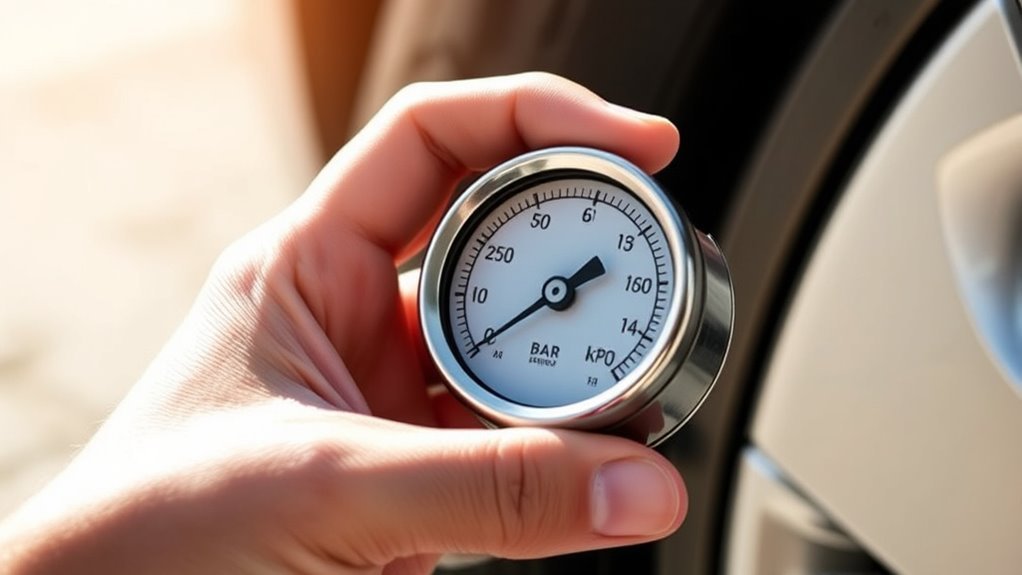
When you’re checking tire pressure, it’s important to understand the different units of measurement: PSI, BAR, and kPa. PSI, or pounds per square inch, is prevalent in the U.S., Canada, and the UK, with a recommended tire pressure typically between 32 to 35 PSI. In Europe, BAR is more common, where tire pressures range from 2.2 to 2.5 BAR, roughly equivalent to 31.9 to 36.3 PSI. The metric system utilizes kPa (kilopascals), which is standard in many regions, with tire pressures between 220 to 250 kPa. To maintain proper tire inflation, mastering the conversion—1 BAR equals about 14.5 PSI and 1 kPa equals approximately 0.145 PSI—ensures you can accurately monitor your tire pressure using a pressure gauge.
How to Read Your Tire Inflator Gauge Easily
Reading your tire inflator gauge correctly is essential for maintaining ideal tire pressure. To guarantee your vehicle’s tires are properly inflated, follow these steps:
- Identify the Unit: Know whether your vehicle uses PSI, BAR, or kPa for recommended pressure. Most passenger car tires recommend 32–35 PSI.
- Check the Gauge: Locate the needle or digital display on your tire inflator gauge. Make sure it indicates a pressure within the recommended range.
- Convert if Necessary: If your vehicle specifies BAR or kPa, remember that 1 BAR equals about 14.5 PSI and 1 kPa equals about 0.145 PSI.
Always measure tire pressure when tires are cold for the most accurate reading. Understanding PSI guarantees your tires perform at their best.
Step-by-Step Guide to Checking and Maintaining Tire Pressure
Maintaining proper tire pressure is essential for vehicle performance and safety. Start by checking the manufacturer’s recommended tire pressure, usually found on a sticker inside the driver’s door frame or in the manual, typically around 32–35 PSI for passenger cars. Verify your tires are cold for accurate readings; measure after parking for at least three hours or driving less than a mile. Use a pressure gauge to check tire pressure: remove the valve cap, press the gauge onto the valve stem, and note the reading in PSI, BAR, or kPa. If the pressure is low, use an air compressor to inflate the tire to the recommended level, rechecking afterward to avoid over-inflation. Regularly monitor tire pressure to enhance safety and efficiency.
Converting Between Tire Pressure Units: A Simple Guide

Understanding tire pressure units is essential for effective vehicle maintenance. Knowing how to convert between PSI, BAR, and kPa helps you guarantee your tires are at the recommended pressure. Here’s a simple guide to convert tire pressure measurements:
Effective vehicle maintenance starts with understanding tire pressure units and conversions between PSI, BAR, and kPa for optimal tire performance.
- BAR to PSI: Multiply the BAR value by 14.504 to get PSI.
- PSI to kPa: Multiply the PSI value by 6.895 to find kPa.
- kPa to PSI: Divide the kPa value by 6.895 to obtain PSI.
Using these conversions, you can accurately adjust your tire pressure using a gauge. Additionally, consider using online tools or mobile apps for quick and precise conversions, making your tire maintenance routine easier and more effective.
Tips for Accurate Tire Pressure Monitoring for Safety and Efficiency
Accurate tire pressure monitoring is crucial for both safety and efficiency while driving. Regularly check your tire pressure when the tires are cold, ideally after parking for three hours or driving less than a mile. Refer to your owner’s manual or the driver’s side door jamb for the manufacturer’s recommended PSI, guaranteeing peak performance. Document the correct PSI for each tire, as front and rear tires may require different levels. Use a reliable pressure gauge; digital models often yield clearer readings. After inflating, recheck the tire pressure. If using a gas station compressor, inflate to 4 PSI above the recommended value for hot tires, then allow cooling before taking final measurements to guarantee accurate readings.
Frequently Asked Questions
How to Read Gauge on Tire Inflator?
To read a tire inflator gauge, guarantee you select the correct gauge type, check tire pressure regularly, account for temperature effects, and avoid common mistakes. Maintain proper PSI for ideal tire performance and safety.
What Does kPa Mean on a Tire Inflator?
kPa on a tire inflator represents pressure measurement, essential for tire safety. Understanding kPa conversion guarantees inflator accuracy, aiding in tire maintenance and seasonal adjustments, ultimately reducing tire wear and enhancing vehicle performance.
What Is 30 to 35 PSI in kPa?
30 to 35 PSI translates to approximately 207 to 241 kPa. For peak tire performance and safety, confirm your inflator’s gauge accuracy, considering seasonal changes and common mistakes during tire maintenance to avoid mishaps.
How Many Kp Is 40 PSI?
So, if you’re still living in the PSI dark ages, 40 PSI translates to about 275.8 kPa. Remember, accurate gauge readings are essential for tire maintenance and safety. Regular checks prevent tire wear and guarantee emergency preparedness!
Conclusion
To sum up, mastering your tire inflator gauge isn’t just a skill; it’s a superpower! With a flick of your wrist, you can effortlessly navigate PSI, BAR, and kPa like a seasoned pro. By following our step-by-step guide and keeping your tires in tip-top shape, you’ll guarantee safety and efficiency on every journey. So, grab that gauge, and let’s inflate those tires to perfection! Your vehicle—and your adventures—will thank you for it!