To convert PSI to bar, divide the PSI value by 14.5038. For a quick estimate, multiply PSI by 0.06895. For example, 30 PSI is about 2.07 bar, and 35 PSI is about 2.41 bar. If you are converting tire pressure, use the conversion only after checking the vehicle manufacturer’s recommended pressure on the door placard or in the owner’s manual.
Quick Answer
To convert PSI to bar, use bar = PSI ÷ 14.5038. A quick shortcut is 1 PSI ≈ 0.06895 bar. So, 32 PSI equals about 2.21 bar, while 2.5 bar equals about 36.26 PSI.
Key Takeaways
- PSI to bar formula: bar = PSI ÷ 14.5038.
- Bar to PSI formula: PSI = bar × 14.5038.
- Common tire example: 32 PSI is about 2.21 bar.
- Safety rule: for tires, follow the vehicle placard or owner’s manual, not the maximum PSI printed on the tire sidewall.
At a Glance
| Time Required | Less than 1 minute |
| Difficulty | Easy |
| Tools Needed | Calculator, pressure gauge, or conversion chart |
| Cost | Free, unless you need to buy a pressure gauge |
What Is PSI and Why Is It Important?
PSI stands for pound-force per square inch. It measures how much force is applied over one square inch of area. In everyday use, people often say “pounds per square inch,” but the technical pressure unit is pound-force per square inch.
PSI is common in the United States for tire pressure, air compressors, pressure washers, pneumatic tools, and some hydraulic systems. According to the NIST Guide to the SI conversion factors, 1 psi equals 6.894757 kilopascals (kPa).
What Is Bar Pressure?
Bar is a metric pressure unit equal to 100,000 pascals, or 100 kilopascals. It is not the SI base pressure unit; the SI pressure unit is the pascal. However, bar is widely used for tires, weather-related pressure, industrial equipment, and European vehicle pressure labels.
The unit symbol is normally written lowercase as bar. Many search queries use uppercase “BAR,” but in technical writing, lowercase “bar” is the cleaner style.
PSI to Bar Formula

The easiest way to convert PSI to bar is:
bar = PSI ÷ 14.5038
You can also use the multiplier version:
bar = PSI × 0.0689476
Both formulas give the same result. For example:
- 30 PSI ÷ 14.5038 = 2.07 bar
- 32 PSI ÷ 14.5038 = 2.21 bar
- 35 PSI ÷ 14.5038 = 2.41 bar
Note: For most everyday pressure checks, rounding to two decimal places is enough. For tire gauges that display only one decimal in bar, 32 PSI can be set as about 2.2 bar.
[Products Worth Considering]

This custom-fit truck bed mat is designed for 2005-2023 Toyota Tacoma 5FT beds, using 3D scanning for full coverage and a precise fit. Its anti-slip texture helps keep cargo in place, while the high-edge design helps shield the bed from dirt, mud, rain, snow, and everyday wear. Made from durable recyclable TPE, it is built to stay flexible, resist curling, and protect your truck bed over time.

The JACO ElitePro Digital Tire Pressure Gauge delivers shop-grade accuracy with a clear digital readout, making it easy to maintain proper tire pressure for safer driving and better performance. Built with rugged brass and steel components, a protective guard, and a flexible air hose, it is designed for reliable use across cars, trucks, motorcycles, bikes, RVs, and trailers. The lock-on display, built-in bleeder valve, and bright backlit screen add convenience in any lighting condition.

The ETENWOLF T300 digital tire pressure gauge delivers accurate readings for cars, trucks, RVs, bikes, and heavy-duty vehicles with a wide pressure range and reliable calibration. It is built to perform in extreme temperatures, includes an LED light for dark conditions, and uses replaceable AAA batteries for long-term convenience. Its durable design and automatic shut-off make it a practical, dependable tool for everyday tire maintenance.
PSI to Bar Conversion Chart
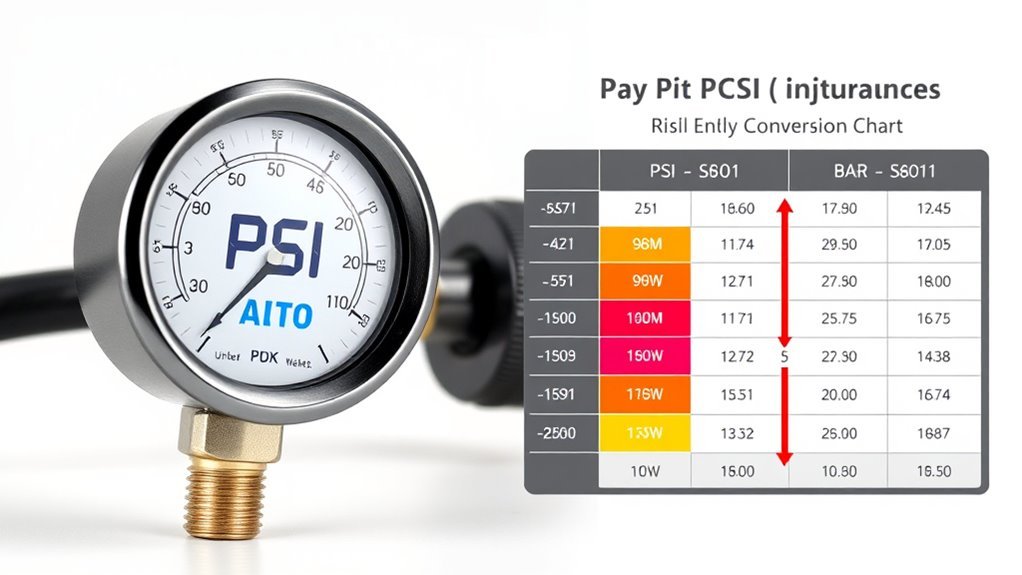
Use this chart for quick PSI to bar conversions. Values are rounded to two decimal places for practical use.
| PSI | Bar | Common Use |
|---|---|---|
| 10 PSI | 0.69 bar | Low-pressure equipment |
| 20 PSI | 1.38 bar | Light-duty pressure checks |
| 25 PSI | 1.72 bar | Some light tire or equipment settings |
| 30 PSI | 2.07 bar | Common passenger-vehicle example |
| 32 PSI | 2.21 bar | Common tire-pressure example |
| 35 PSI | 2.41 bar | Common tire-pressure example |
| 40 PSI | 2.76 bar | Higher vehicle or equipment setting |
| 50 PSI | 3.45 bar | Compressors and equipment |
| 60 PSI | 4.14 bar | Higher-pressure applications |
| 100 PSI | 6.89 bar | Shop air and industrial equipment |
| 1000 PSI | 68.95 bar | High-pressure systems |
[Products Worth Considering]

This digital tire pressure gauge delivers highly accurate readings with a bright backlit LCD for easy use in any lighting condition. Designed for cars, trucks, SUVs, and motorcycles, it offers multiple unit options, ergonomic handling, and dependable AAA battery power for everyday checks and roadside confidence.
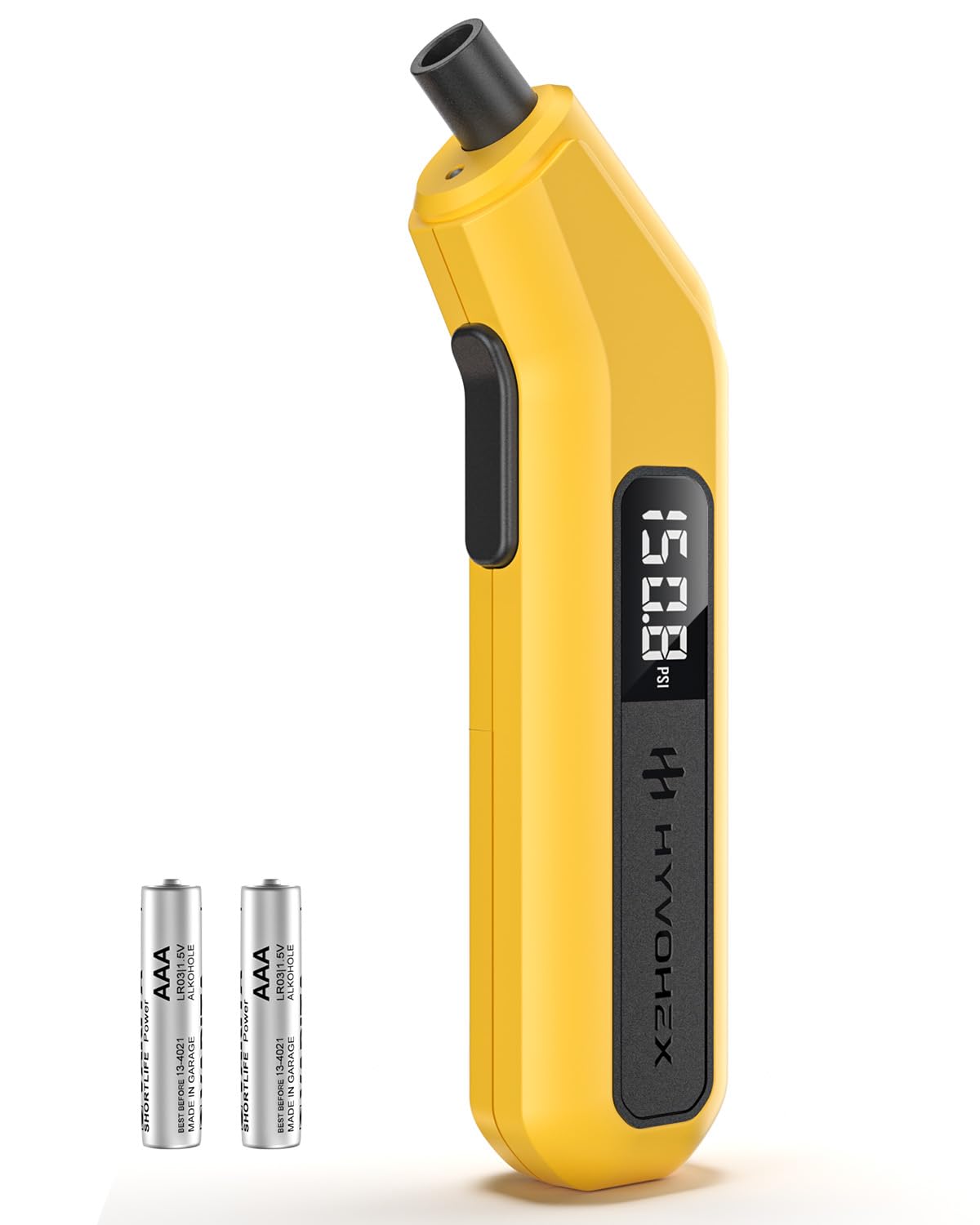
HYVOHEX digital tire pressure gauge delivers fast, accurate readings with an easy-to-read LED backlit display and a high-sensitivity sensor for reliable tire checks. Its valveless one-click operation, rotating valve head, and broad compatibility make it a practical tool for cars, bikes, and trucks. Built with a durable rubber shell and aluminum nozzle, it is compact enough to keep in your glove box or tool bag.

RUGGED DESIGN: The stainless steel components prevent rust and corrosion while the precision-crafted nozzle seamlessly seals onto the valve stems for highly accurate readings (±2% span). We also provide 4 valve stem caps for convenient replacement.
How to Convert PSI to Bar Step by Step
- Write down the PSI value. Example: 32 PSI.
- Divide by 14.5038. Example: 32 ÷ 14.5038 = 2.206.
- Round for the tool you are using. 2.206 bar becomes 2.21 bar, or about 2.2 bar on a gauge that shows one decimal place.
Pro Tip: When converting tire pressure, round carefully but do not guess the target pressure. First find the manufacturer’s recommended cold tire pressure, then convert that exact number if your gauge uses bar.
[Products Worth Considering]
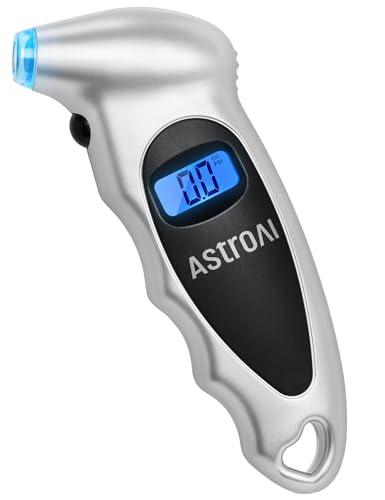
Accurate, Dependable Readings: Factory‑calibrated to ±1 PSI, so you can confidently match your vehicle’s recommended PSI (check the door jamb sticker). Ideal for monthly checks and road trips — consistent results every time, cold or warm.

1. LONG ZINC ALLOY DUAL HEAD DESIGN : Straight foot air chuck are deisghed for inner wheels or difficult reached valve as well as the 30°reverse chuck are for outer wheels.A good choice for testing your tire pressure also a great father's day gift

Enhanced Visibility in Low Light: Features a green backlit LCD screen and integrated flashlight, allowing for clear reading of tire pressure even in dark or dimly light conditions.
Bar to PSI Conversion
If your pressure is listed in bar and your gauge uses PSI, reverse the formula:
PSI = bar × 14.5038
Examples:
- 2.0 bar × 14.5038 = 29.01 PSI
- 2.2 bar × 14.5038 = 31.91 PSI
- 2.5 bar × 14.5038 = 36.26 PSI
- 3.0 bar × 14.5038 = 43.51 PSI
What Are Common PSI to Bar Values?
For quick mental estimates, remember that every 10 PSI is about 0.69 bar. That means 30 PSI is a little over 2 bar, 40 PSI is a little under 2.8 bar, and 50 PSI is about 3.45 bar.
For tire pressure, many passenger vehicles have recommended pressures near the low-to-mid 30 PSI range, but that is only a rough example. The correct pressure for your specific vehicle is the value printed on the Tire and Loading Information Label, usually on the driver’s door edge or door post, or in the owner’s manual.
Tire Pressure Safety When Converting PSI to Bar
Tire pressure is one of the most common reasons people convert PSI to bar. The conversion is simple, but the target pressure must come from the right place. The National Highway Traffic Safety Administration explains that the correct tire pressure is the manufacturer’s listed pressure, not the number molded into the tire sidewall.
Warning: Do not inflate tires to the maximum PSI printed on the tire sidewall unless the vehicle manufacturer specifically instructs it. That sidewall number is a tire limit, not the recommended everyday pressure for your vehicle.
Check Tires When They Are Cold
For the most accurate tire reading, check pressure when the tires are cold. NHTSA defines cold tires as tires that have not been driven on for at least three hours. Driving heats the tires and can temporarily raise pressure, which may make a warm reading look higher than the true cold pressure.
Remember kPa on Tire Labels
Some vehicle labels show tire pressure in PSI and kPa instead of bar. Since 1 bar = 100 kPa, a label showing 220 kPa equals 2.2 bar. This makes bar and kPa easy to compare once you know the relationship.
TPMS Is Not a Replacement for Pressure Checks
A tire pressure monitoring system can warn you when a tire is significantly underinflated, but it should not replace regular pressure checks with a gauge. The federal TPMS standard describes these systems as warnings for significant under-inflation, not as a substitute for routine maintenance.
FuelEconomy.gov states that keeping tires inflated to the proper pressure can improve gas mileage by 0.6% on average and up to 3% in some cases.
Tips for Accurate PSI and Bar Pressure Management
Use a Reliable Pressure Gauge
A small gauge error can matter, especially for tires and calibrated equipment. Use a gauge that matches the pressure range you need, and replace damaged or inconsistent gauges.
Round Consistently
For general use, two decimal places in bar are usually enough. For example, 35 PSI converts to 2.41 bar. If your gauge only shows one decimal place, 2.41 bar will display as about 2.4 bar.
Follow Equipment Labels
Whether you are filling a tire, setting a compressor, or checking a pressure washer, use the pressure listed by the vehicle or equipment manufacturer. Conversion helps you understand the units; it does not change the safe operating limit.
Common Mistakes to Avoid
- Mixing up bar and PSI: 2.5 bar is not 2.5 PSI. It is about 36.26 PSI.
- Using 14.7 instead of 14.5038: 14.7 is close to atmospheric pressure in PSI, but it is not the correct bar-to-PSI conversion factor.
- Using the tire sidewall max as the target: always use the vehicle placard or owner’s manual for tire pressure.
- Checking hot tires without context: warm tires can read higher than cold tires.
- Over-rounding: 32 PSI is 2.21 bar, not simply “2 bar.”
Frequently Asked Questions
How do you convert PSI to bar?
Divide the PSI value by 14.5038. For example, 30 PSI ÷ 14.5038 = 2.07 bar. You can also multiply PSI by 0.0689476.
Is 1 bar 14.5 or 14.7 PSI?
1 bar is about 14.5038 PSI, so 14.5 PSI is the better rounded value. The number 14.7 PSI is close to standard atmospheric pressure, but it is not the correct bar-to-PSI conversion factor.
What is 32 PSI in bar?
32 PSI is about 2.21 bar. The calculation is 32 ÷ 14.5038 = 2.206, which rounds to 2.21 bar.
What is 2.5 bar in PSI?
2.5 bar is about 36.26 PSI. The calculation is 2.5 × 14.5038 = 36.2595 PSI.
Should I use the PSI on my tire sidewall?
No. The number on the tire sidewall is usually the tire’s maximum pressure limit, not the recommended everyday pressure for your vehicle. Use the pressure listed on the vehicle placard or in the owner’s manual.
Why does tire pressure change in the morning?
Tire pressure changes with temperature. Cold morning air can lower tire pressure, and driving can warm the tires and raise the reading. For the most accurate check, measure tire pressure when the tires are cold.
Conclusion
Converting PSI to bar is simple once you remember the key formula: bar = PSI ÷ 14.5038. For quick estimates, 1 PSI is about 0.06895 bar. Use the chart for common values, and use the reverse formula when you need to convert bar back to PSI. For tires, the most important step is not the math—it is using the correct manufacturer-recommended cold pressure before you convert.
Sources
- NIST Guide to the SI, Appendix B.8 — supports psi, bar, pascal, and kilopascal conversion factors.
- BIPM SI Brochure — supports SI unit context and official international measurement guidance.
- NHTSA TireWise — supports tire placard, cold tire pressure, and tire safety guidance.
- FuelEconomy.gov Vehicle Maintenance Tips — supports fuel-economy benefits of proper tire inflation.
- 49 CFR 571.138 Tire Pressure Monitoring Systems — supports TPMS under-inflation warning context.