If your Camry’s transmission is slipping, ease off the accelerator and avoid driving farther than necessary. True slipping usually means engine RPM rises without matching vehicle speed, the car hesitates before moving in Drive or Reverse, or a conventional automatic flares between shifts. A Camry hybrid’s eCVT can hold higher engine RPM during hard acceleration while the car continues gaining speed normally, which is not the same as a conventional gear slipping. Check warning lights and leaks first, identify the model year and powertrain, and scan the correct modules before approving fluid service or major repairs.
Last updated: September 1, 2026
Source basis: This guide uses Toyota owner and maintenance information, Toyota technical information hosted by NHTSA, NHTSA safety resources, RepairPal, Kelley Blue Book, and general transmission-diagnosis guidance. Exact fluid specifications, diagnostic procedures, and repair steps vary by VIN, model year, engine, and drivetrain.
Quick Answer
If your Camry revs without gaining speed, delays engagement, shifts harshly, leaks fluid, smells burnt, or loses normal acceleration, stop hard acceleration and arrange a diagnosis. Do not keep driving if the car can no longer accelerate reliably. On a 2025 or 2026 U.S. Camry, higher engine RPM can be normal because every model uses Toyota’s hybrid eCVT. On certain 2012–2014 Camrys with the U760E automatic, a brief shudder under light throttle around 25–50 mph can also match Toyota’s documented torque-converter condition rather than classic transmission slipping.
Key Takeaways
- Common causes of true slipping include low or degraded fluid, leaks, overheating, worn internal parts, solenoid or sensor faults, and engine problems that mimic transmission trouble.
- Many newer Camrys use sealed fluid-level procedures, so checking or correcting the level may require a model-specific service method rather than a dipstick.
- The 2025 and 2026 U.S. Camry use an all-hybrid powertrain with an eCVT, so normal hybrid engine-speed behavior must be separated from actual loss of propulsion.
- Certain 2012–2014 Camrys with the U760E automatic were covered by Toyota technical guidance for a brief torque-converter shudder under light throttle around 25–50 mph.
- If the Camry revs but barely moves, smells burnt, leaks heavily, or shows a transmission or hybrid-system warning, stop driving and arrange a tow or professional inspection.
What to Check First
| RPM rises, speed does not | Ease off the accelerator. Note whether it happens during a conventional shift or only during hard hybrid acceleration. |
| Delay into Drive or Reverse | Check for warning lights and leaks. Repeated delay needs prompt diagnosis. |
| 2012–2014 light-throttle shudder | If it occurs briefly around 25–50 mph, compare the symptom with Toyota’s U760E torque-converter guidance before calling it generic transmission slip. |
| Burnt smell or dark fluid | Stop driving if performance is poor. Do not authorize a flush before the unit is inspected. |
| Warning light with poor acceleration | Scan the engine, transmission, ABS, and hybrid modules with a capable tool. |
| Heavy leak or car barely moves | Shut the vehicle down safely and arrange a tow. |
What Does Transmission Slipping Feel Like in a Toyota Camry?

When a Camry hesitates after you shift into Drive or Reverse, repeated delayed engagement can indicate low hydraulic pressure, an electronic control fault, or internal wear. You may also feel an RPM flare between shifts, a pause before the car moves, a hard shift, or a bucking sensation during acceleration.
In a conventional automatic Camry, engine speed that rises during a shift while road speed stalls is a classic slipping symptom. In a hybrid Camry, the engine may hold a steady high RPM while the eCVT blends engine and electric-motor output. That can be normal under hard acceleration. It becomes concerning when acceleration is weaker than usual, the behavior changes suddenly, warning lights appear, or you hear new whining or grinding.
Watch for these warning signs:
- Delayed engagement: The Camry takes noticeably longer than usual to move after shifting into Drive or Reverse.
- RPM flare: The tachometer rises during a conventional-automatic shift, but road speed does not follow.
- Harsh or erratic shifting: The car bangs, shudders, or hunts between gears.
- Burnt smell: A burnt odor can indicate overheated or damaged fluid or friction material.
- Fluid spots: Red, pink, or brown fluid may be transmission fluid, although fluid color alone does not identify the leak.
- Unusual noise: New whining, humming, grinding, or clunking can indicate a mechanical or hydraulic problem.
- Warning lights: A check-engine, transmission, hybrid-system, ABS, or traction-control light means the relevant modules should be scanned before parts are replaced.
If the main symptom is a hard bang or rough gear change rather than RPM flare, see the Camry hard-shifting guide. If the car hesitates without a clear rise in RPM, compare the symptoms with the Camry transmission hesitation guide. Keeping those symptoms separate helps prevent a transmission replacement from being recommended for an engine, mount, sensor, or control-system problem.
Warning: Do not keep driving if the Camry revs but barely moves, loses acceleration in traffic, has a strong burnt smell, leaks heavily, or shows a transmission or hybrid-system warning. Pull over safely and arrange a tow or professional inspection.
Which Camry Model Years Need Different Transmission Checks?
Start with the model year and powertrain because “Camry transmission slipping” does not describe one transmission design. Gas Camrys from 2012 through 2017 use conventional six-speed automatics, the redesigned 2018 gas Camry introduced Toyota’s Direct Shift eight-speed automatic, and the 2025–2026 U.S. Camry is hybrid-only with an eCVT. For a fuller breakdown, see the Toyota Camry transmission-type guide.
| Camry Type | What Can Feel Like Slipping | What to Check |
|---|---|---|
| Certain 2012–2014 gas Camrys with U760E | Brief shudder under light throttle around 25–50 mph | Compare the symptom with Toyota’s torque-converter bulletin and vehicle service history before assuming generic internal slip |
| 2012–2017 gas Camry | RPM flare between fixed-gear shifts, delayed engagement, harsh shifting, or shudder | Scan codes, inspect for leaks, and follow the six-speed automatic procedure for the exact VIN and model year |
| 2018–2024 gas Camry | RPM flare, delayed engagement, harsh or erratic fixed-gear shifts | Diagnose the Direct Shift eight-speed automatic using model-specific Toyota service information |
| Camry Hybrid | Engine holds higher RPM during strong acceleration | If vehicle speed continues rising normally, the RPM behavior may be normal; weak propulsion, warning lights, overheating, or new noise require diagnosis |
| 2025–2026 U.S. Camry | Sustained engine RPM without conventional shift steps | Remember that every U.S. model uses the hybrid eCVT; diagnose loss of propulsion rather than expecting conventional gear changes |
Toyota’s NHTSA-hosted warranty bulletin for certain 2012–2014 Camrys describes a brief intermittent U760E torque-converter shudder during light-throttle flex lock-up at approximately 25–50 mph. That historical program is not proof that every vibration on those model years comes from the torque converter, and a technical bulletin or warranty program is not the same as an open safety recall. See the 2012–2014 Camry shudder guide for the dedicated diagnostic discussion.
How Do You Diagnose Camry Transmission Slipping?
Diagnosing a slipping transmission is not just a matter of adding fluid. First confirm the symptom, identify the transmission type, inspect for leaks, and scan the correct modules. The result should show whether the fault is maintenance-related, electronic, hydraulic, mechanical, or outside the transmission.
| Camry Type | Behavior That May Be Normal | Behavior That Needs Diagnosis |
|---|---|---|
| Conventional automatic | Brief RPM changes during normal downshifts | RPM flare between shifts, delayed engagement, harsh shifts, or loss of acceleration |
| Hybrid eCVT/transaxle | Engine holds higher RPM during strong acceleration while speed continues to increase | Weak propulsion, sudden change in behavior, warning lights, overheating, or new noise |
- Confirm the symptom. Note whether it happens on a cold start, after warm-up, during acceleration, while selecting Drive or Reverse, uphill, or at highway speed. Record the speed, RPM, warning lights, temperature, and whether the issue repeats.
- Identify your Camry’s transmission type. Gas Camrys from 2012 through 2017 use conventional six-speed automatics, 2018 through 2024 gas cars use Direct Shift eight-speed automatics, and hybrid Camrys use a hybrid transaxle/eCVT. The 2025 and 2026 U.S. Camry is hybrid-only. Use the Camry transmission guide if you need to identify the correct family before diagnosis.
- Scan all relevant modules. A basic OBD-II reader may only retrieve engine-related codes. Use a tool that can access powertrain, transmission, ABS, traction-control, and hybrid-system data. Shift-solenoid, speed-sensor, temperature, misfire, throttle, and wheel-speed faults can lead to different repairs.
- Check for leaks before checking fluid level. Look under the vehicle for fresh oily fluid and inspect the transmission area, cooler hoses, axle seals, pan area, and case. Toyota’s 2024 Camry Warranty & Maintenance Guide includes inspection of automatic-transmission cooler hoses and connections and inspection of the transmission for leakage.
- Check fluid only with the correct procedure. Some older Camrys have a dipstick, while many newer configurations use a sealed service procedure. Do not guess the level, overfill the unit, or open a hot check plug without the model-specific Toyota procedure. Hybrid transaxle-fluid requirements also vary by model year; see the Camry Hybrid transaxle-fluid guide for that separate topic.
- Inspect fluid condition if it is safely accessible. Fluid color varies by type and age, so color alone is not a diagnosis. A burnt odor, metal debris, blackened fluid, or a confirmed low level is more significant.
- Rule out non-transmission causes. Engine misfires, throttle or airflow-sensor faults, wheel-speed or ABS problems, damaged mounts, and hybrid-system faults can feel like slipping, hesitation, or shuddering.
- Get a road-test and data-based diagnosis. A qualified shop can compare commanded operation with actual speed data, fluid temperature, pressure where applicable, and solenoid activity under load.
Note: Never crawl under a Camry supported only by a jack, and never open a hot transmission fill or check plug without the correct procedure. Hot fluid can burn, and an incorrect level can make drivability problems worse.
[Products Worth Considering]

This engine air filter is designed to fit select Lexus and Toyota hybrid models, helping maintain clean airflow to the engine for reliable performance. Built with high-fiber filter paper and a fine filtration layer, it offers strong dust capture while minimizing airflow resistance. It is a direct replacement for multiple OEM part numbers and is backed by warranty support.

The BLCKTEC 440 Bluetooth OBD2 scanner helps drivers and DIY mechanics quickly read and clear trouble codes, monitor live data, and check emissions readiness with confidence. Its color display, graphing capabilities, and battery and charging system testing make it a versatile diagnostic tool for OBD-compliant vehicles. Designed for plug-and-play convenience, it runs directly from your vehicle and includes support for report sharing and ongoing updates.

The FOXWELL NT301 is a plug-and-play OBD2 code reader designed to help drivers and home mechanics diagnose check engine light issues with ease. It reads fault codes, clears emissions-related warnings, displays live sensor data in graph form, and shows I/M readiness so you can quickly check vehicle status before an emissions test. With broad compatibility across many OBD2 vehicles and a clear color screen, it offers a practical, user-friendly way to monitor and troubleshoot engine performance.
How Can You Help Prevent Camry Transmission Slipping?
Follow the maintenance schedule for your exact year, engine, and drivetrain. Toyota provides model-specific manuals through its Owners Manuals and Warranties hub. Avoid using one universal interval or fluid specification when Toyota lists a different procedure for your Camry.
For the 2024 gasoline Camry, Toyota schedules maintenance in 5,000-mile or six-month increments. At 60,000 miles or 72 months, its guide lists inspection and adjustment of applicable fluid levels, inspection of automatic-transmission cooler hoses and connections, and inspection of the automatic transmission for signs of leakage. At that same service point, automatic-transmission fluid replacement is listed for specified special operating conditions such as towing or heavy vehicle loading and extensive idling or prolonged low-speed driving.
The practical rule is simple: use the manual for your exact Camry, account for severe-use conditions, and investigate leaks or changes in shift behavior early. A generic “change it every 30,000 miles” rule does not fit every Camry automatic transmission or hybrid transaxle.
| Maintenance Task | Frequency | Why It Matters |
|---|---|---|
| Check for fresh leaks | Monthly and before long trips | A small leak can lower fluid level and lead to overheating or delayed engagement |
| Follow Toyota scheduled maintenance | At the model-specific mileage and time intervals | Keeps inspections consistent and preserves service records |
| Inspect cooler hoses, connections, and the transmission case | At Toyota-specified service intervals on applicable models | Finds seepage before fluid loss causes drivability problems |
| Use the exact Toyota-specified fluid | Whenever service is performed | Fluid specifications differ by transmission and transaxle design |
| Replace fluid when the maintenance guide calls for it | Based on model year and operating conditions | Avoids relying on one universal service interval |
| Scan codes when warning lights appear | Immediately | Helps prevent unnecessary parts replacement and identifies control-system faults |
Pro Tip: Keep records showing the date, mileage, fluid specification, diagnostic codes, and repairs. Those details help a second shop verify the diagnosis and can support warranty or resale documentation.
When Should You Stop Driving and Call a Professional?
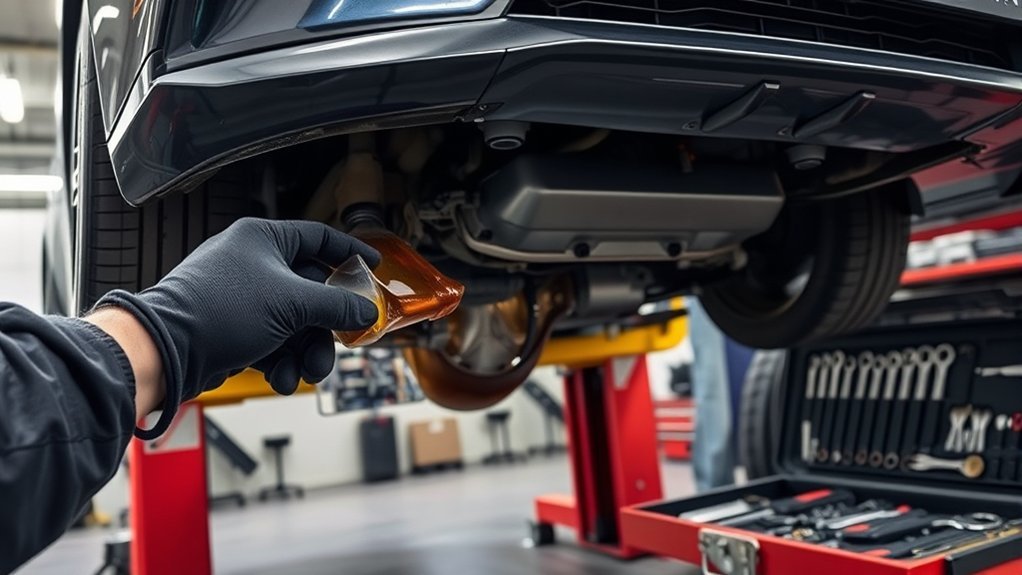
Call a professional if the Camry slips more than once, delays engagement, leaks fluid, smells burnt, enters a reduced-power mode, or shows a check-engine, transmission, ABS, traction-control, or hybrid-system warning. AAA notes that revving without matching acceleration can indicate slipping, while some CVTs and hybrids can produce similar engine-speed behavior without a fault. A sudden change, weak acceleration, or warning light still needs inspection.
Get professional help right away if you notice:
- Delayed response or sudden pauses during acceleration
- Engine RPM rising while vehicle speed barely changes
- Fresh oily fluid dripping under the car
- A burnt smell after driving
- Hard clunks when selecting Drive or Reverse
- Whining, humming, grinding, or repeated shuddering
- Speedometer, ABS, traction-control, or hybrid-system warnings
- Slipping that appears after the transmission warms up
A qualified shop can scan the correct modules, check fluid level with Toyota’s procedure, inspect for leaks, review live speed and temperature data, and determine whether the issue is fluid-related, electronic, or internal. Ask for the stored codes, test results, fluid findings, and an itemized estimate before authorizing major work. You can also check for open safety recalls through the NHTSA recall lookup using your VIN. Remember that a technical service bulletin or expired warranty-enhancement program may not appear as an open safety recall.
[Products Worth Considering]

This set of four ignition coils is designed to restore smooth engine performance and reliable starting for compatible Toyota, Scion, and Lexus applications. Built to meet or exceed OE specifications, these coil packs help reduce misfires, hesitation, and check engine light issues while supporting stronger ignition output. The direct-fit design makes installation straightforward, and the package includes a warranty for added peace of mind.

FOXWELL NT201 is an easy-to-use OBD2 scanner designed to help drivers quickly read and clear check engine codes, view live engine data, and check emissions readiness. Its color screen, one-key I/M readiness test, and broad compatibility with most gasoline vehicles since 1996 make it a practical tool for everyday diagnostics and maintenance. With plug-and-play operation and lifetime free updates, it offers a simple way to understand vehicle issues without expensive shop visits.

This GM TPMS relearn tool helps reset tire sensors, clear warning lights, and match tire positions after rotation quickly at home. Designed for Chevrolet, GMC, Cadillac, and Buick vehicles, it offers one-button operation, fast activation, and broad compatibility with many GM models. It is best suited for OE/OEM sensors and includes paper instructions plus video guidance for easier DIY use.
Should You Repair or Replace a Slipping Camry Transmission?
The right choice depends on the confirmed fault, model year, mileage, service history, vehicle value, and repair warranty. Start with the lowest-risk evidence: diagnostic codes, leak location, fluid level and condition, live data, and a written test result. Do not approve a transmission replacement based only on a symptom description.
RepairPal’s Toyota Camry estimate, updated August 7, 2026, places the average transmission-fluid change at about $222–$291 before taxes, fees, location differences, and related repairs. Its model-year estimates vary substantially, so treat that range as planning context rather than a quote. Kelley Blue Book lists a broad transmission-flush average of about $165–$290, but a flush is not automatically the correct service for a slipping or debris-contaminated unit.
Major repair or replacement costs much more. Kelley Blue Book gives a broad average of roughly $2,900–$7,100 for transmission replacement, depending on the vehicle, transmission, location, and whether the unit is rebuilt, remanufactured, or otherwise replaced. Get at least one detailed second opinion before approving a high-cost repair.
| Option | Best For | Evidence to Request |
|---|---|---|
| Leak repair and fluid correction | A confirmed leak with an incorrect fluid level | Leak location, fluid specification, and level-check procedure |
| Drain-and-fill service | Scheduled maintenance or degraded fluid without evidence of major failure | Manual requirement, correct fluid, and findings from the drained fluid |
| Solenoid, sensor, or wiring repair | Code- and test-confirmed electrical faults | Stored codes, live data, circuit tests, and post-repair verification |
| Rebuild or remanufactured unit | Confirmed internal wear on a car worth repairing | Failure findings, parts coverage, labor warranty, and torque-converter coverage where applicable |
| Used transmission | A budget repair on an older Camry | Donor mileage, exact compatibility, return terms, and written warranty |
Note: On a high-mileage Camry, compare the total repair cost with the car’s condition and market value. A warranted repair may still make sense, but repeated slipping, metal debris, and multiple major faults can make replacement or selling the vehicle more practical.
[Products Worth Considering]

The OBDMATE OM901 is a handheld car diagnostic scanner designed to read and clear fault codes across ABS, SRS, engine, and transmission systems. It also offers full OBD2 functions like live data, freeze frame, I/M readiness, VIN retrieval, O2 sensor testing, EVAP testing, and onboard monitoring, making it useful for quick troubleshooting and emissions checks. With a large screen, battery voltage monitoring, DLC pin testing, and a protective carrying case, it is a practical tool for DIY drivers and professionals alike.

The TOPDON VeriDiag X800 BT is a wireless bidirectional automotive diagnostic scanner designed for full-system troubleshooting, active testing, and advanced service resets. It supports broad vehicle coverage, live data viewing, AutoVIN identification, and lifetime free updates to help DIYers and professionals diagnose issues faster and with greater confidence.

This brake bleeder hose kit helps remove old brake fluid and air from motorcycle brake and clutch systems quickly and efficiently. Its one-way check valve prevents air from being drawn back into the system, while the easy-to-connect clips make bleeding simple for routine maintenance. Built for reliable use, it is a practical tool for keeping motorcycle braking performance responsive.
Frequently Asked Questions
Can a slipping Camry transmission be fixed?
Yes. A repair may be possible when the cause is a leak, incorrect fluid level, degraded fluid, wiring fault, sensor problem, or shift-solenoid issue. Damage to clutch packs, a torque converter, pump, valve body, gears, or a hybrid transaxle can require a rebuild or replacement.
Is it safe to drive a Camry with a slipping transmission?
Do not keep driving if the Camry struggles to accelerate, revs without moving, slips in traffic, leaks heavily, smells burnt, or shows a transmission or hybrid-system warning. A tow is the safer choice when drivability is poor or the symptom could leave you unable to accelerate.
How long can I drive with a slipping Camry transmission?
There is no dependable safe-distance rule. If the Camry cannot accelerate normally, slips repeatedly, smells burnt, leaks heavily, or shows a transmission or hybrid-system warning, stop driving and arrange a tow. If the symptom is mild and the car remains fully controllable, move it only as necessary to reach a safe location and arrange diagnosis rather than continuing normal driving.
Will changing transmission fluid fix slipping?
It may help when the cause is a confirmed low level, incorrect fluid, or fluid degradation without major internal damage. It will not repair worn friction parts, a failing torque converter, damaged gears, or a bad pump. If the fluid smells burnt or contains metal, get a diagnosis before authorizing a flush.
Why does my Camry slip after it warms up?
Heat can expose a pressure loss, solenoid fault, restricted flow, overheating problem, or internal wear that is less obvious when the fluid is cold. A shop should compare codes, fluid temperature, speed data, pressure where applicable, and leak points before recommending parts.
How can I tell normal Camry hybrid eCVT revving from slipping?
A hybrid eCVT may hold the engine at a higher, steady RPM during strong acceleration while vehicle speed continues to rise normally. Suspect a fault when acceleration is weak, propulsion drops, the behavior changes suddenly, warning lights appear, or new whining, grinding, overheating, or shuddering develops.
Does a 2012–2014 Camry shudder mean the transmission is slipping?
Not necessarily. Toyota documented a brief intermittent torque-converter shudder on certain 2012–2014 Camrys with the U760E transmission, typically under light throttle at approximately 25–50 mph. A vibration outside those conditions can have other causes, so confirm the VIN, exact symptom, stored codes, and service history before assuming the transmission is slipping.
Conclusion
If your Camry’s transmission is slipping, reduce load on the drivetrain and document exactly when the symptom occurs. First identify whether the car uses a conventional automatic or Toyota’s hybrid eCVT, then check warning lights and leaks and scan the relevant modules. Owners of certain 2012–2014 Camrys should also distinguish Toyota’s documented light-throttle torque-converter shudder from classic RPM flare. Stop driving if acceleration becomes unreliable, fluid is leaking heavily, or you smell burning. A diagnosis supported by codes, live data, fluid findings, model-year-specific Toyota information, and an itemized estimate is safer than guessing with additives, a flush, or major parts.
Sources
- Toyota 2024 Camry Warranty & Maintenance Guide — scheduled maintenance, fluid inspections, leakage checks, and special operating-condition guidance
- Toyota USA Newsroom: 2026 Toyota Camry — current U.S. all-hybrid lineup and eCVT powertrain context
- Toyota Owners Manuals and Warranties — official manual and warranty access by model year
- Toyota Warranty Policy Bulletin POL14-10 / ZE5 via NHTSA — certain 2012–2014 Camry U760E torque-converter shudder guidance
- AAA Club Alliance: How to Catch Transmission Problems Before They Get Expensive — slipping symptoms, hybrid/CVT behavior, maintenance, and when to seek inspection
- RepairPal Toyota Camry Transmission Fluid Change Cost — current Camry fluid-service estimate and model-year cost ranges
- Kelley Blue Book Transmission Repair and Replacement Prices — broad flush and replacement cost context
- NHTSA Recall Lookup — VIN-based recall and safety-information search