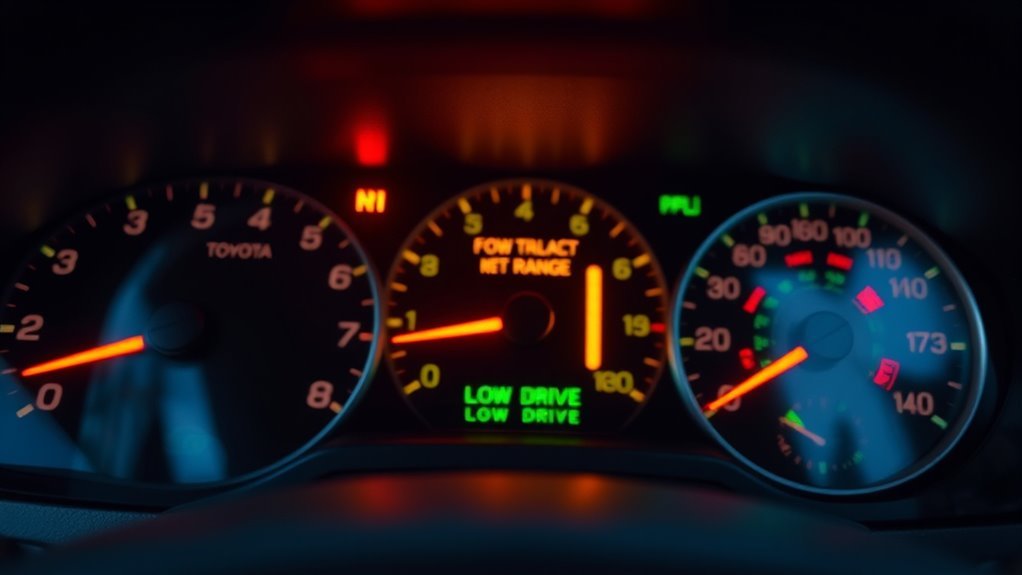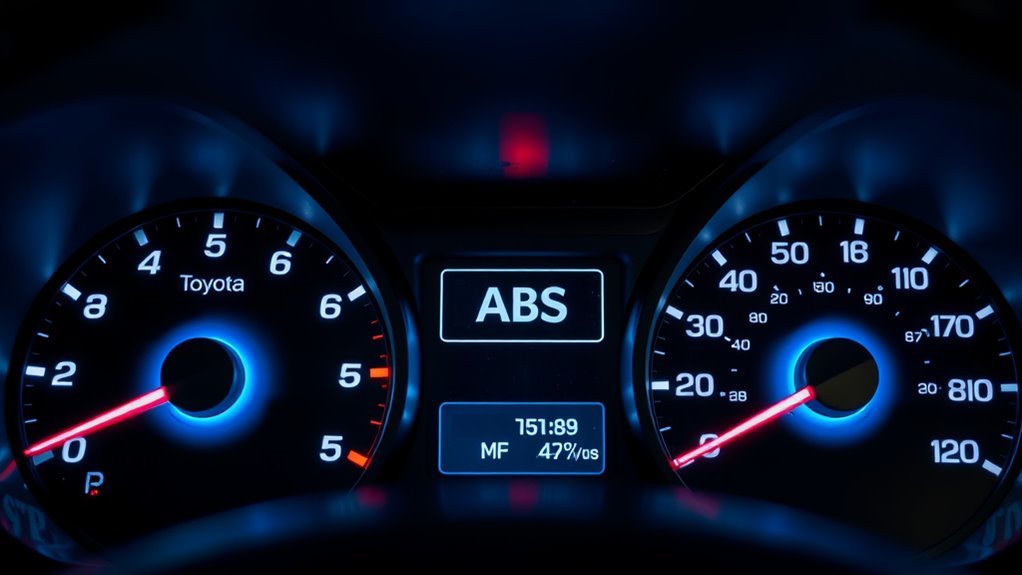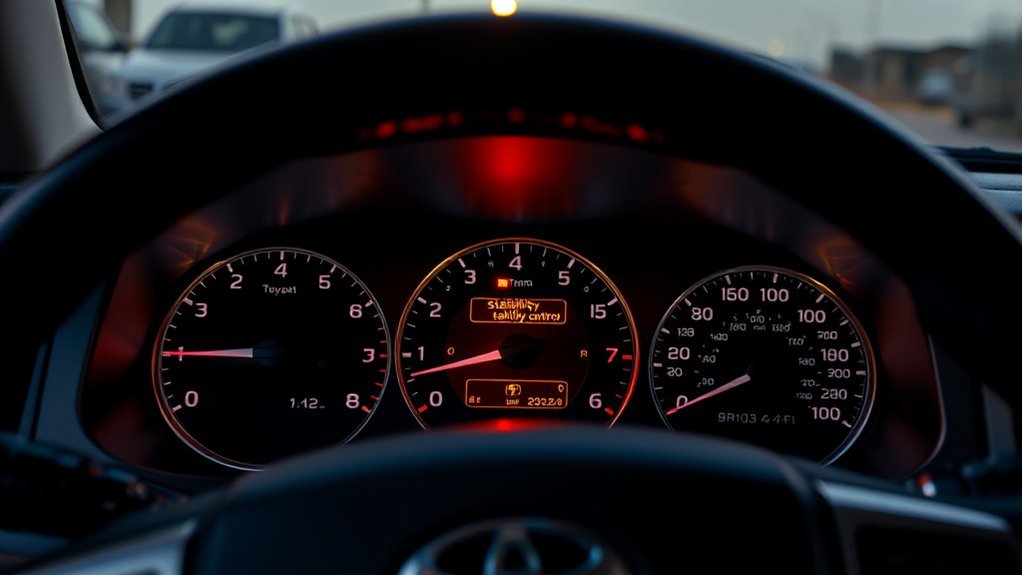
When your Land Cruiser’s VSC or TRAC OFF light comes on, it’s warning you that the vehicle’s stability or traction control is compromised and systems like ABS may be affected. You should slow down, avoid abrupt maneuvers, and restart the engine to see if the fault clears. Common causes are wheel‑speed sensors, ABS/skid ECU faults, or engine/emission issues that also trigger the check engine light. Keep driving cautiously and consult a scanner for codes—more details follow below.
What It Means When Your Land Cruiser’s VSC or TRAC OFF Light Comes On
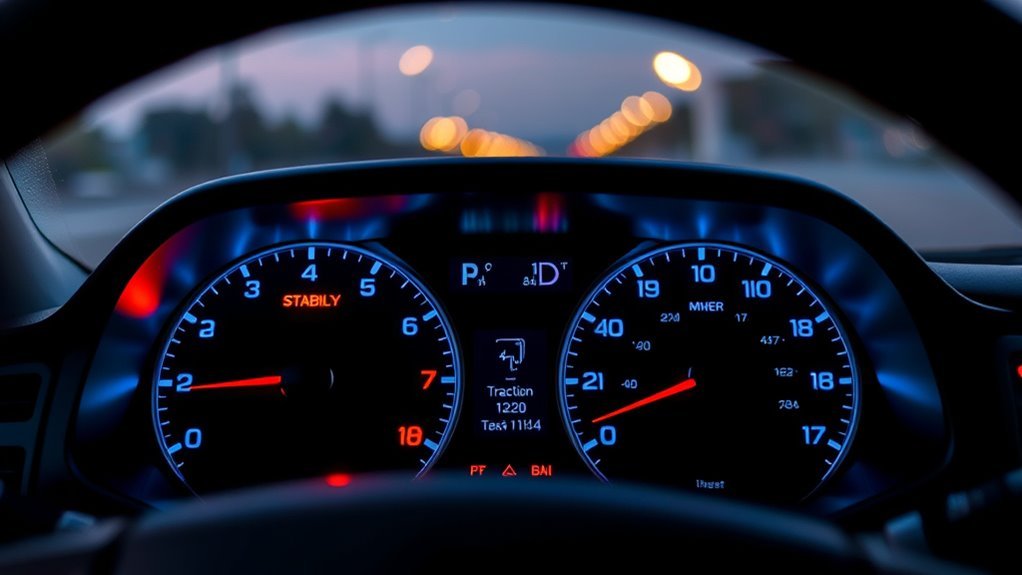
When your Land Cruiser’s VSC or TRAC OFF light comes on, it’s telling you the vehicle’s stability or traction control is compromised or deliberately disabled, which reduces the systems that prevent wheel slip and help maintain control in low-traction conditions. You’ll know the VSC light signals a stability control malfunction; the TRAC OFF light means traction control is turned off or has failed. Both can illuminate together, often with the Check Engine Light, pointing to shared faults in sensors, brake fluid level, engine or electrical subsystems. You should treat simultaneous warnings as a circuit-level or sensor issue rather than isolated quirks. Your liberation comes from understanding: these systems are automated traction management and stability control layers that protect handling and acceleration. Don’t dismiss intermittent indications; run a diagnostic scan, check fluid and connectors, and reset only after confirming root causes. If diagnostics flag faults or lights persist, get professional service to restore full stability control and traction management functionality.
Is It Dangerous? Immediate Steps to Take
Having the VSC light illuminate on your Land Cruiser means a stability control fault that can degrade handling and increase the likelihood of skids, especially on wet, icy, or loose surfaces, so you should treat it as a potentially hazardous condition. You’re facing real stability control risks; act decisively to preserve control and freedom on the road. Follow targeted VSC light troubleshooting and immediate safety steps.
A VSC warning signals reduced stability — slow down, avoid abrupt inputs, restart and seek prompt professional diagnosis.
- Safely reduce speed and avoid abrupt steering or braking — maintain a controlled lane position and head to a secure pull‑over spot.
- Restart the engine and scan for other warning lights (e.g., Check Engine) — their presence guides diagnostics and indicates systemic faults requiring pro attention.
- If the VSC light persists, don’t drive aggressively; have a qualified technician diagnose braking, wheel‑speed sensors, and traction systems promptly.
You’ll stay liberated by prioritizing safety and technical inspection: immediate conservative driving and professional diagnosis mitigate further damage and restore confident control.
Quick Checks: Gas Cap, Fluids, and Warning-Light Combos
Start by ensuring the gas cap is hand-tight—about 19% of Check Engine Light cases are traced to a loose cap and it can also trigger the VSC light. Check brake and engine fluid levels next, since low brake fluid can illuminate the VSC light and signals potential braking faults that need immediate attention. If Check Engine, VSC, and TRAC OFF come on together, note the combination and retrieve DTCs from the ECM to guide targeted troubleshooting.
Check Gas Cap Tightness
Because a loose gas cap disrupts fuel-system pressure and emissions control, it can trigger the VSC light along with the Check Engine light, so you should always check cap tightness first when those warnings appear. You want quick, effective action: confirm the gas cap engages and maintains proper sealing to restore system integrity and avoid unnecessary diagnostics.
- Inspect the cap for cracks, worn threads, or a degraded seal; replace if compromised.
- Tighten until you hear clicks (manufacturer-specified) to guarantee proper sealing and pressure retention.
- Drive for a few cycles; many systems clear the warning if the leak stops—tightening resolves roughly 19% of CEL cases.
Act promptly to reclaim control and prevent cascading faults that limit your vehicle’s freedom.
Inspect Brake And Engine Fluids
If low fluid levels compromise hydraulic or electronic sensors, the VSC light can come on alongside other warnings, so check brake, engine oil, and transmission fluids immediately. You’ll perform a targeted brake inspection: verify reservoir level against MIN/MAX marks, inspect for discoloration or contamination, and confirm no external leaks at lines or calipers. For engine oil and transmission fluid, use the dipstick or sight glass per the manual, check fluid color and scent, and top to spec with manufacturer-grade fluid. This is essential fluid maintenance—don’t improvise. Low fluids degrade sensor feedback and traction control performance, limiting your mobility. If levels are correct but warnings persist, you’re entitled to prompt diagnostics; address the underlying fault to reclaim safe, liberated driving.
Note Concurrent Warning Lights
After you’ve checked fluids, look for other warning lights that appear with the VSC lamp—those combos tell you more about the fault than any single light. You’ll use concurrent warning lights as a simple diagnostic filter before deeper system diagnostics. Check these quick items to free yourself from guessing and act decisively:
- If VSC and Check Engine illuminate, suspect engine or traction faults; start with the gas cap and scan codes.
- If VSC, TRAC OFF, and ABS come on together, prioritize brake-system checks: brake fluid level and wheel-speed sensors.
- If VSC plus low brake-fluid indication, address fluid and brake maintenance immediately.
Secure the gas cap, top fluids, and run OBD-II scans to regain control and restore safe mobility.
Top Causes: Wheel-Speed Sensors, ABS Faults, and Engine Problems
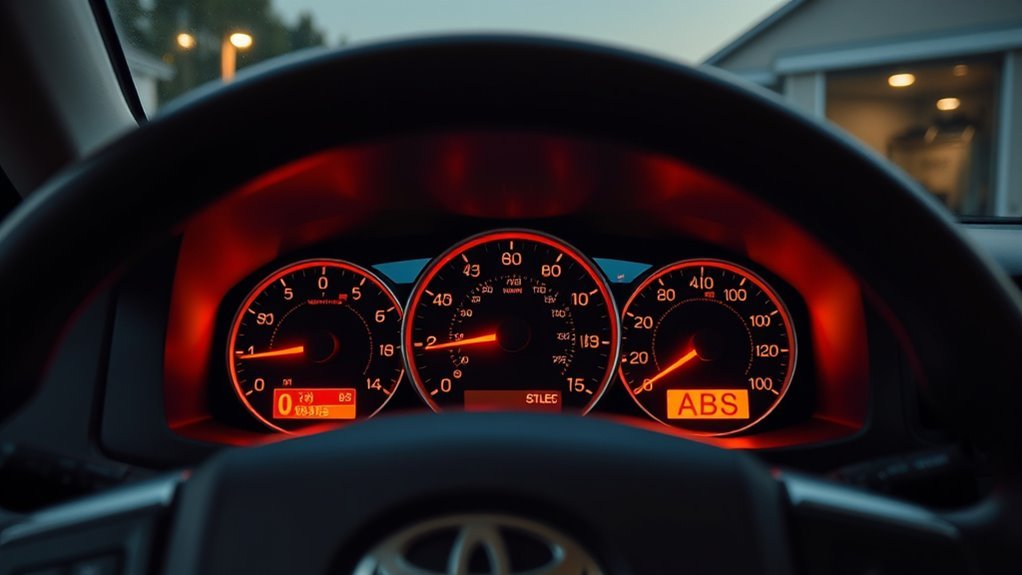
Start by checking the wheel-speed sensors, since faulty or contaminated sensors cause the majority of VSC/ABS faults and will often trigger the VSC light. If sensors test OK, inspect the ABS/skid control module for wiring damage, corrosion, or internal failure that can misinterpret wheel data. Also scan for engine/emission codes — an oxygen sensor or other engine fault can disable VSC and illuminate both VSC and Check Engine lights.
Wheel Speed Sensor Failure
One of the most common causes of a VSC light on a Land Cruiser is a failed wheel-speed sensor, which monitors each wheel’s rotational speed and feeds critical data to the vehicle stability control and ABS systems. You’ll see VSC, ABS, and Check Engine lights together when a sensor gives bad data. Environmental contamination—snow, ice, dirt—often corrupts readings. About 63% of VSC/ABS faults trace to sensors, so prioritize sensor maintenance and proper inspection with the right diagnostic tools.
- Check for contamination and wiring damage; clean or replace the sensor if compromised.
- Use specialized scanners to read Skid Control ECU codes inaccessible to standard readers.
- Replace failing sensors promptly to restore traction control and reclaim confident, liberated driving.
ABS Module Malfunction
Diagnose ABS module malfunctions quickly, since they can stem from failed wheel‑speed sensors, damaged wiring or connectors, or upstream engine issues that corrupt sensor inputs; any of these faults can trigger VSC/ABS warnings and reduce braking efficiency. You’ll run ABS diagnostics to read fault codes, verify wheel‑speed sensor outputs, and check continuity of harnesses and connectors. Use precise sensor calibration procedures where applicable to guarantee the controller receives accurate wheel speed data. If the ABS control unit reports inconsistent inputs despite good sensors, isolate the module and inspect power, ground, and CAN bus integrity. Addressing faults promptly lets you reclaim control and safety: repair connectors, replace sensors, or swap a faulty ABS unit so the Land Cruiser’s stability systems operate without compromise.
Engine/Emission Faults
When engine or emission faults occur, they can disable the VSC by corrupting sensor inputs or triggering fail‑safe modes, so you should treat any Check Engine Light alongside a VSC warning as a linked fault condition. You need prompt engine diagnostics and emissions testing to reclaim control and safety. Common causes combine braking and powertrain issues; act decisively.
- Wheel‑speed sensors — ~63% of VSC/ABS issues; contamination from snow or dirt corrupts signals and trips VSC.
- ABS faults — loss of reliable wheel‑speed data forces VSC to inhibit stability control; diagnose ABS module and wiring.
- Engine problems — misfires, faulty O2 sensors, or other ECM‑detected faults affect emissions and can disable VSC.
Run targeted diagnostics, clear codes, and repair affected sensors to restore liberated, dependable operation.
Reading Codes: OBD‑II vs ABS/Skid ECU
Although the dashboard OBD-II port and the Skid Control ECU both store fault information, they serve different systems and require different tools to read; OBD II Differences are critical when you diagnose VSC. You’ll use standard Diagnostic Tools on the under-dash port to pull P-codes from the Engine Control Module—those Pxxxx codes tell you engine/emission faults and are readable by generic code readers. The Skid Control ECU, however, stores ABS/VSC-specific codes that many OBD-II scanners won’t show. To access those, you’ll need a manufacturer-level scanner, ABS-capable tool, or the jumper method on the diagnostic connector to flash two-digit codes. Wheel speed sensors cause roughly 63% of ABS/VSC faults, so expect sensor tests with specialized kit. Clearing ABS/VSC codes also needs the proper reader or jumper routine; battery disconnect won’t clear them. Use the right tool for each system so you stay in control and free to fix what’s actually wrong.
Common DTCs That Trigger VSC/TRAC and What They Mean
Because VSC and TRAC tie into both engine and ABS systems, a range of DTCs can light those warnings and you should treat them as interrelated, not isolated, faults. You need to use diagnostic tools and sound troubleshooting techniques to pinpoint root causes fast. Key DTCs include engine, catalyst, and ABS codes that degrade control strategies and force VSC/TRAC disablement.
- P0031 / P0420 — O2 heater circuit low or catalyst efficiency below threshold; these hinder closed‑loop fueling and can prompt VSC/TRAC if the engine runs poorly.
- P0500 / C0210 — Vehicle speed or wheel speed sensor faults; loss of accurate speed input directly defeats traction and stability control.
- P0128 — Engine not reaching operating temperature; the ECU may limit systems to protect the drivetrain.
You’ll want a methodical scan of both OBD‑II and ABS/Skid ECUs, then follow targeted troubleshooting techniques to restore freedom from warning lamps.
Temporary Triggers Vs. Persistent Faults: Will the Light Reset?
You’ll often see the VSC light from temporary causes—loose gas cap, brief traction loss, or wet/icy roads—and it usually resets after you restart or once conditions normalize. If the lamp stays on, that persistence points to a real fault such as a bad ABS sensor, VSC module issue, or an engine/emissions problem when paired with the Check Engine Light. You should treat temporary triggers as transient but pursue professional diagnostics immediately for any persistent activation to prevent safety or drivetrain damage.
Temporary Causes Explained
If the VSC light comes on briefly and goes out after a restart, it’s often a temporary trigger—like a loose gas cap, a momentary sensor glitch, or loss of traction on slick surfaces—rather than a persistent fault. You should treat transient events as liberation from panic: verify basics, then monitor.
- Check basics: tighten the gas cap, confirm fluid levels, inspect for obvious damage; these simple actions often clear temporary sensor issues.
- Environmental factors: cold weather effects can freeze sensors or reduce tire grip, triggering VSC until temperatures normalize or traction returns.
- Diagnostics: if the light resets after restart, record occurrences and drive; recurrent illumination suggests deeper faults requiring professional scanning.
Act decisively: rule out temporary causes before escalating to repair.
When Persistent Faults Persist
When the VSC light stays on after a restart or comes back repeatedly across drives, treat it as a persistent fault that needs diagnosis rather than a transient event; persistent illumination usually signals a component or system-level problem—common culprits are wheel speed sensors, brake-fluid level or pressure issues, ABS module faults, or related wiring and connector failures. You should run VSC system diagnostics with an OBDII scanner to pull DTCs that pinpoint faults affecting traction control functions and stability. Don’t ignore it—liberation from risk requires intervention: check sensors, fluid, and wiring; if codes implicate the ABS module, replace or repair per spec. Below is a quick reference.
| Symptom | Likely Cause | Action |
|---|---|---|
| Persistent VSC light | Wheel speed sensor | Inspect/replace |
| VSC + CEL | Low brake fluid | Top/bleed system |
| Intermittent faults | Wiring/connectors | Repair/clean |
| No codes | ABS module | Professional test |
Driving Advice When VSC or TRAC OFF Is Illuminated
Although the VSC or TRAC OFF indicator doesn’t always mean the car is undrivable, you should slow down, avoid sudden acceleration and sharp turns, and treat traction as compromised—especially on wet, icy, or loose surfaces. You’re responsible for maintaining control when traction control or stability systems are impaired; act decisively and conserve momentum.
- Reduce speed progressively, increase following distance, and avoid lane changes that require abrupt steering inputs—this minimizes demand on degraded systems.
- Use smooth throttle modulation and gentle braking; sudden inputs can trigger slip and defeat any remaining electronic assistance, exposing you to loss of control.
- Restart the vehicle safely; if lights persist, monitor other warnings (e.g., Check Engine) and proceed to a qualified technician.
You should never push for performance or off-road extremes with VSC/TRAC disabled. Prioritize predictable inputs and retreat to safe environments where you can secure professional diagnostics, reclaiming freedom through informed, controlled action.
DIY Fixes You Can Try : And When to Stop
Before you dig deeper, perform a few targeted checks you can do safely: confirm the gas cap is tight, verify brake fluid is within spec, scan for diagnostic trouble codes with an OBD-II reader, and visually inspect wheel speed sensors and their wiring for dirt or damage. You’ll resolve many issues this way — a loose gas cap causes ~19% of CEL incidents and can trigger VSC, and contaminated or damaged wheel speed sensors account for about 63% of VSC/ABS faults. Use the code reader to guide targeted actions rather than guessing.
Address single, low-risk items: tighten the cap, top fluid to spec, clean connectors with electrical contact cleaner, and reseat sensor plugs. Avoid swapping major components or driving extensively with active warnings. Don’t fall for common misconceptions or troubleshooting myths that encourage random part replacement; they waste time and money. If lights remain after controlled checks, stop and get professional diagnosis to prevent escalation.
What a Shop Will Do and Typical Repair Costs
A shop will start by running a diagnostic scan to pull VSC/ABS and engine codes, a service that typically costs $60–$100 and directs all subsequent work. You’ll get clear diagnostic procedures and a prioritized list of faults. Technicians will inspect wheel speed sensors, ABS components, brake fluid level, and engine sensors like O2 sensors to isolate the trigger.
- Sensor and fluid fixes: replace wheel speed or O2 sensors, top off brake fluid — repair estimates typically $150–$400.
- ABS/module work: repair or rebuild ABS components — repair estimates commonly $300–$800 depending on parts.
- ECU or complex labor: skid control ECU replacement or extensive wiring repairs — expect high labor at $100–$150/hr, total costs can exceed $800.
You’ll receive a written quote before work starts. Choose repairs that restore control and freedom; refuse unnecessary upsells. The shop’s diagnostic report empowers you to decide efficiently.
Frequently Asked Questions
What Causes the VSC Light to Come On?
It’s caused by malfunctions in the brake system or traction control, often from faulty wheel speed sensors, electrical or O2 sensor failures, loose gas caps, or environmental interference that disrupts sensor signals and stability functions.
Is It Safe to Drive With a VSC Warning Light on a Toyota?
Sometimes coincidence makes systems reveal themselves: you can drive short distances with a VSC warning, but you shouldn’t. Disablement of VSC features compromises driving safety; get diagnostics and repairs promptly to restore control and freedom.
What Does VSC Mean on a Toyota Land Cruiser?
VSC stands for Vehicle Stability Control; you’ll rely on VSC functionality to keep traction and control. The VSC system limits power and brakes individual wheels when needed; check faults promptly so you can drive freely and safely.
Conclusion
When your Land Cruiser’s VSC or TRAC OFF light comes on, don’t panic—but don’t ignore it. It’s a warning that stability or traction control has reduced functionality, often from wheel‑speed sensors, ABS faults, or engine issues. Check basics (gas cap, fluids), note other lights, and read codes (OBD‑II and ABS ECU). You can try simple fixes, but if the fault persists, get it diagnosed. Think of the light as a cautious co‑pilot tapping your shoulder—heed it.