
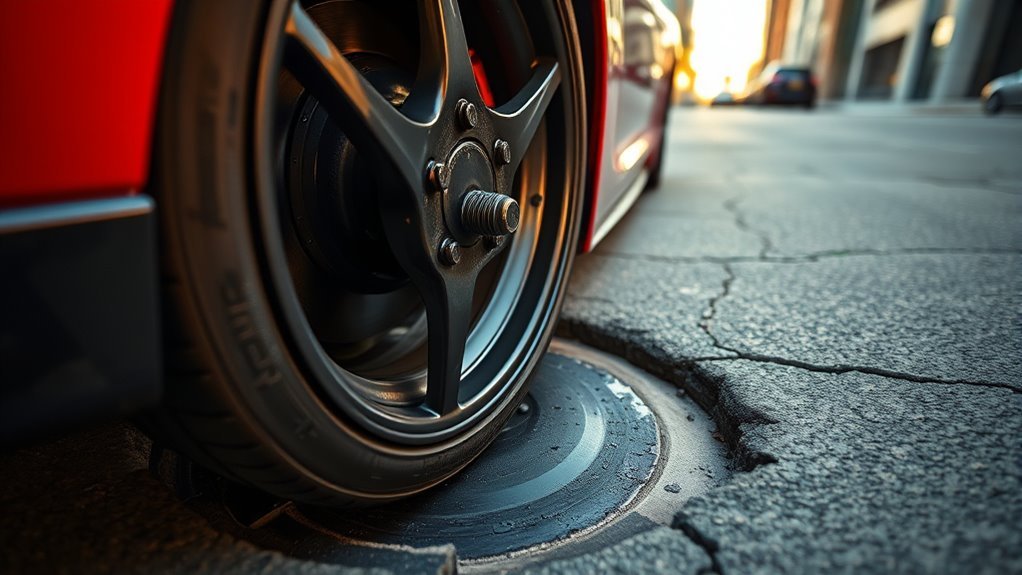
You should treat potholes as immediate threats to your low‑slung Supra: safely stop and inspect tires, rims, and visible suspension for bulges, cracks, bends, leaks, or loose components. Reinflate tires to spec, drive slowly, and avoid sharp inputs or sudden maneuvers. Log vibration frequencies, noises, and speeds; spin wheels on jack stands and check inner rim edges for damage. Limit speeds on rough roads and consider towing if severe damage’s suspected — further steps outline checks, repairs, and upgrades.
Immediate Checklist After Hitting a Pothole (What to Do Now)

After you hit a pothole, pull over safely and inspect the tires and wheels for visible damage—look for bulges, cuts, cracks, or bent rims—then check for abnormal vibrations, noises, or changes in handling that could indicate broken suspension or misalignment; also glance under the car at lower control arms and visible suspension components for bends or deformation, note any pulling to one side while driving, and schedule a professional inspection promptly to uncover hidden damage and prevent further failure.
You’ll document immediate signs: tire anomalies, rim deformation, steering pull, or new noises. Assess ride quality at low speed to detect vibration sources without reproducing incident conditions. Consider how pothole impact altered wheel alignment and suspension geometry. Use defensive driving techniques afterward, reduce speed, and get a qualified mechanic to verify and repair damaged components.
How to Reproduce and Document Symptoms Safely
When you need to confirm post-pothole issues, start by establishing a controlled baseline on a smooth, flat surface so you can distinguish new symptoms from normal behavior; drive at varying low speeds and note steering feel, vibration frequency, noise sources, and any pulling. You’ll reproduce symptoms by intentionally driving over minor, similar irregularities at low speed, keeping steering neutral and inputs minimal. Use a passenger to log observations in real time—record timestamps, speed, surface type, and precise symptom descriptors. Focus on documenting vibrations with frequency notes and locating sources (wheel, strut, chassis). Repeat maneuvers to verify consistency. Preserve the log and audio/video if possible. Deliver this concise dossier to your mechanic to empower accurate, rapid diagnosis and remediation.
Quick Garage Checks: Tires, Rims, Inner Edge, and Balance
Check tire pressure and tread before any road run; underinflation and uneven wear raise the risk of sidewall bulges and punctures from potholes. Inspect the inner rim edge for scraping, dents, or cracks that can compromise the bead seal. Finally, spin and balance each wheel to identify vibrations—unbalanced wheels amplify impact forces and accelerate damage.
Tire Pressure And Tread
Because potholes transmit sudden shocks through the wheel, you should keep tire pressure at the manufacturer’s spec to prevent sidewall bulges and blowouts. You’ll check tire pressure before drives, correcting psi when cold, and monitor tread depth to at least 2/32″. Maintain even wear to preserve traction and control over sharp impacts.
| Check | Target |
|---|---|
| Tire pressure | Manufacturer psi (cold) |
| Tread depth | ≥ 2/32″ |
| Balance | Periodic (per service) |
Inspect for uneven wear patterns that signal alignment issues worsened by potholes. Don’t ignore vibrations — unbalanced tires amplify damage after impacts. Act to restore proper pressure, replace tires with insufficient tread depth, and re-balance wheels. These steps free you from avoidable risk and keep your Supra responsive.
Inner Rim Edge Check
Maintaining correct tire pressure and even tread wear also helps reveal hidden rim damage, so inspect the inner rim edge each time you do a quick garage check. You should inflate tires to spec before inspection; low pressure masks deformities and increases stress on the inner bead. Visually and manually check for cracks, bends, or sharp nicks along the inner rim edge that can compromise seal integrity. Run a soap-and-water bead test to detect slow leaks originating at a deformed edge. If you feel vibrations or notice handling changes after a pothole impact, prioritize a close rim inspection and alignment check. Document any rim damage and replace or repair promptly; a compromised inner edge threatens safety, ride quality, and your independence on the road.
Wheel Balance And Spin
One quick spin of each wheel on jack stands will reveal imbalance, letting you spot uneven weight distribution before it causes vibration or accelerated wear. You’ll inspect tires, rims, and inner edges while noting lateral wobble or hops that signal bent rims or lost weights. Use a tire pressure gauge to confirm correct inflation—pressure deviations mask balance problems and invite sidewall bulges. If spinning shows irregular motion or you feel steering-wheel or gas-pedal vibration issues on-road, schedule a professional wheel balance and wheel alignment check. Technicians will dyno-balance assemblies, replace compromised rims, and correct toe/camber where pothole impacts distorted geometry. These quick garage checks free you from avoidable breakdowns and prolong precise, confident handling.
Inspect Suspension and Steering: Control Arms, Ball Joints, and Tie Rods
Check the lower control arms for bends, cracks, or mounting play since they keep wheel alignment and suspension geometry intact. Inspect ball joints for looseness or torn boots that allow moisture and accelerate wear. Test tie rod play at the rack and outer ends—any axial or radial movement warrants immediate replacement.
Check Lower Control Arms
Inspect the lower control arms for bends, cracks, or mounting damage after a pothole impact, since any deformation directly alters wheel alignment and suspension geometry. You’ll perform a lower control arm inspection visually and by feel, checking for metal distortion, fractured welds, and torn bushings that compromise suspension performance enhancements. Push and pry the arm to detect play at the bushing mounts; excessive movement signals replacement. Note corrosion around bolt holes and mounting points that can weaken the assembly. Avoid conflating this check with ball joint diagnostics; focus here on arm integrity and bushing condition. Document any deviations, measure camber/caster if alignment feels off, and replace damaged arms promptly to restore handling, minimize tire wear, and preserve your Supra’s liberated driving character.
Inspect Ball Joints
Feel the ball joints for play and listen for creaks after a pothole impact, since worn or loose joints will compromise steering precision and tire alignment on a low car like the Supra. You’ll perform targeted ball joint maintenance: jack the wheel, secure the car, and pry the control arm while observing joint movement. Any vertical or lateral play beyond manufacturer spec is a fail. Inspect rubber boots for tears or grease loss—damaged boots are primary wear indicators. Note clunks, vibration, or uneven tire wear as operational signs of impending failure. Replace joints showing play or breached boots; don’t delay. Schedule these checks as part of routine suspension inspections to preserve handling, maintain freedom of spirited driving, and prevent cascading damage to adjacent components.
Test Tie Rods Play
After evaluating ball joints and control arms for play and boot damage, move to the tie rods: grab the steering wheel and rock it gently left and right while watching the outer tie rod ends for excessive movement or gap at the stud; any visible axial or rotational play indicates wear. You’ll also check inner tie rod looseness; both affect steering responsiveness and alignment. Replace worn tie rods promptly to prevent uneven tire wear and degraded control. Liberation-focused drivers treat precise maintenance as freedom.
| Component | What to look for |
|---|---|
| Outer tie rod | Axial/rotational play, stud gap |
| Inner tie rod | Looseness, axial movement |
| Result | Uneven tire wear, poor steering responsiveness |
| Action | Replace promptly, re-align wheels |
Short-Term Fixes, Driving Limits, and When to Tow
When you strike a pothole in a low Supra, quickly reinflate the tires to recommended pressure and do a visual check for sidewall cuts, rim bends, leaking fluid, or loose suspension components before driving further; limit speed to about 20 mph (32 km/h) over uneven surfaces to minimize additional stress. Use temporary repairs—sealants for minor tire punctures, straightening small rim deformations, and tightening visible fasteners—to stabilize the car for a controlled move to a safe location. Observe driving precautions: reduce steering inputs, avoid hard braking, and note vibrations or pull that indicate alignment or damage. If you hear abnormal suspension noises, detect fluid leaks, or feel severe vibration, don’t risk it—tow the vehicle to a shop for professional inspection.
Preventive Driving and Upgrades for Low Toyota Supras
If you want to reduce pothole risk and repair costs, start by keeping tire pressures within manufacturer specs and inspecting sidewalls and tread regularly, since low-profile tires on lowered Supras are more prone to bulges and blowouts. You’ll also adopt driving habits and hardware that free you from constant repair cycles.
- Monitor pressures daily and choose tire enhancements like wider, reinforced tires to improve grip and distribute impact loads.
- Invest in adjustable suspension upgrades to raise ride height on poor roads and lower for performance, retaining control.
- Fit skid plates and reinforced undercarriage components to deflect impacts and prevent costly oil- and exhaust-system damage.
- Use defensive scanning, reduce speed over suspect pavement, and plan lines to avoid hazards while preserving mobility.
Frequently Asked Questions
Does FSD 14 Avoid Potholes?
Yes — you’ll find FSD 14 uses pothole detection and sensor fusion to steer and adjust speed, and it factors suspension tuning data to minimize impact; you should still stay alert and update software for best results.
How Do Low Sports Cars Go Over Speed Bumps?
You cross speed bumps slowly, angled diagonally, and lift off before the crest to “bump and roll.” You’ll adjust suspension tuning and maintain proper tire pressure so you avoid scraping, preserve freedom, and minimize damage.
What Is the Best Way to Drive Over a Pothole if You Can’t Swerve?
Brace boldly: you’ll brake before impact, keep wheels straight, release pressure off the brakes just prior, and roll over smoothly to reduce pothole impact, preserving tire protection and liberating control with precise, confident technique.
Conclusion
You’ve treated your Supra like a precision instrument; now treat the pothole like a fault in its tuning. Inspect tires, rims, and suspension immediately, document symptoms rigorously, and reproduce issues safely to isolate failures. Apply short-term fixes sparingly, respect new driving limits, and tow if integrity’s compromised. Preventive upgrades and sharper driving are the new calibration—each avoided pothole a notch tightened on the instrument, keeping performance true and risks minimal.