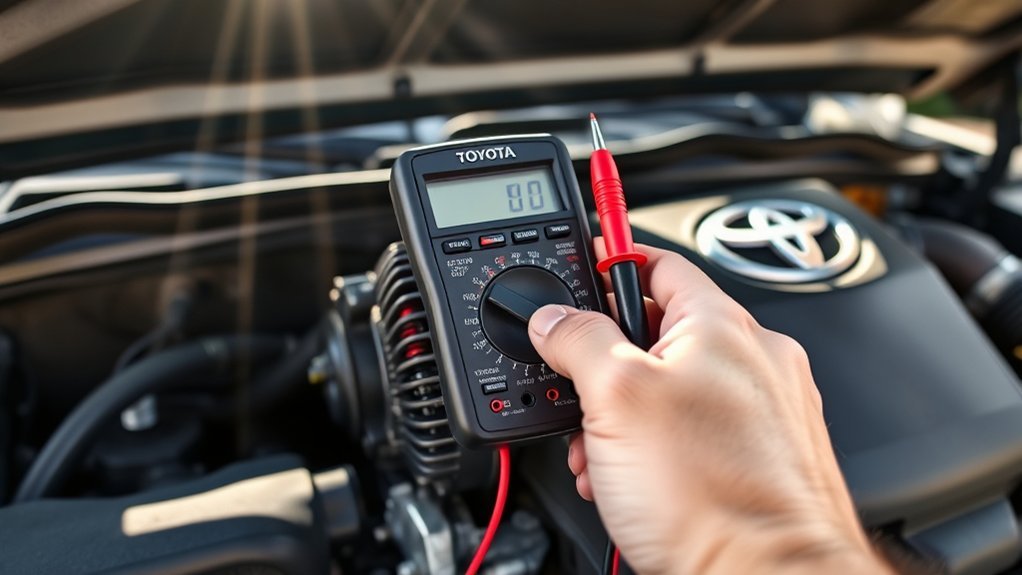
To test your Toyota Tacoma’s alternator with a multimeter, start by setting the multimeter to DC voltage mode. Connect the black lead to the negative battery post and the red lead to the positive post. With the engine running, you should see voltage between 13.7 and 14.7 volts. If it’s below 13 volts, your alternator may not be charging properly. For a thorough assessment, further diagnostics can reveal more insights into potential issues.
The Importance of Alternator Testing in Your Tacoma
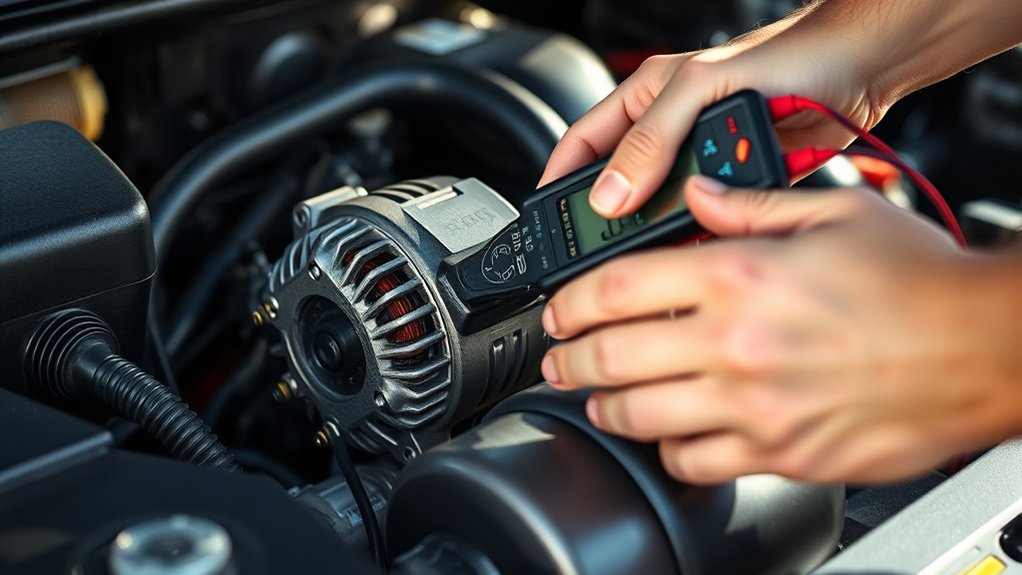
When you own a Toyota Tacoma, keeping your alternator in check is vital for reliable vehicle performance. Regular alternator testing guarantees it maintains the necessary voltage stability, ideally over 13V, to support your Tacoma’s electrical systems. A failing alternator can cause increased AC ripple voltage, risking damage to sensitive electronics and leading to erratic vehicle performance. You should test the alternator with a digital multimeter at around 1500 RPM; aim for an AC reading of no more than 0.09 volts. Higher readings may point to diode failure, compromising alternator performance. Proper functionality is essential, as a malfunctioning alternator can prevent your battery from charging, resulting in starting issues. By understanding how to test your alternator, you can pinpoint potential problems early, saving both time and money on repairs while making sure your Tacoma runs smoothly.
Essential Tools Needed for Alternator Testing
To effectively test your Tacoma’s alternator, you’ll need a few essential tools. A digital multimeter (DMM) with specific features is vital for accurate voltage measurements, while a quality battery tester enhances reliability. Don’t forget personal protective equipment (PPE) to guarantee safety during the process.
Essential Testing Equipment
Testing the alternator on a Toyota Tacoma requires specific tools to guarantee accurate diagnostics. You’ll need a digital multimeter (DMM) for precise voltage measurements and to assess alternator performance. Set your DMM to the lowest AC voltage range to identify any potential diode issues. A battery tester with load test capability is also vital for evaluating battery health, which is essential for accurate alternator diagnostics. High-quality tools from reliable brands like Midtronics or Foxwell provide dependable results. Don’t forget personal protective equipment (PPE) like gloves and goggles when working with batteries.
| Tool Type | Purpose | Recommended Brands |
|---|---|---|
| Digital Multimeter | Voltage measurement | Midtronics, Foxwell |
| Battery Tester | Battery health assessment | Midtronics, Foxwell |
| Personal Protective Equipment | Safety while testing | N/A |
Recommended Multimeter Features
A digital multimeter designed for automotive use should feature essential capabilities to effectively diagnose the Toyota Tacoma alternator. Look for multimeter accuracy in both AC and DC voltage measurements. Set the multimeter to the lowest AC voltage range to detect any diode faults, ideally reading below 0.09 volts AC at 1500 RPM. For DC voltage, verify readings exceed 13 volts while the engine runs to confirm proper alternator function. It’s vital that your multimeter provides voltage stability to guarantee reliable measurements. Using a quality battery tester alongside your multimeter can help assess the overall health of the battery and electrical system, enhancing your diagnostic process. Investing in these features will empower you to troubleshoot effectively.
Additional Testing Tools
When diagnosing a Toyota Tacoma alternator, having the right tools on hand can make all the difference. Essential tools guarantee effective battery maintenance and enhance testing safety. Here’s a quick reference:
| Tool | Purpose | Benefits |
|---|---|---|
| Digital Multimeter | Measures voltage and alternator performance | Accurate AC/DC readings |
| Battery Tester | Assesses battery health under load | Guarantees ideal alternator function |
| Voltmeter Probes | Quick voltage checks at terminals | Fast diagnostics |
| Hydrometer | Measures specific gravity of battery electrolyte | Indicates battery health |
Consider utilizing auto parts store services for free testing of batteries and alternators. This approach provides accurate assessments without additional costs, keeping your vehicle in top shape.
Getting Your Tacoma Ready for a Multimeter Test
Before you begin the multimeter test on your Toyota Tacoma, make certain the vehicle is parked on a level surface with the engine off to prevent accidents. Safety precautions are essential, so make sure your workspace is clear and free from hazards. Gather a digital multimeter and set it to the lowest AC voltage range for precise readings during the alternator test.
Next, check your battery health. A weak battery can skew your results, so it’s important to verify its condition before proceeding. Connect the black lead of the multimeter to the negative battery post and the red lead to the positive post, setting up for the test. Once connected, start the engine and let it idle at approximately 1500 RPM to simulate normal operating conditions. This preparation is critical for obtaining accurate readings and guaranteeing a successful alternator test.
Step-by-Step Guide to Measuring DC Voltage
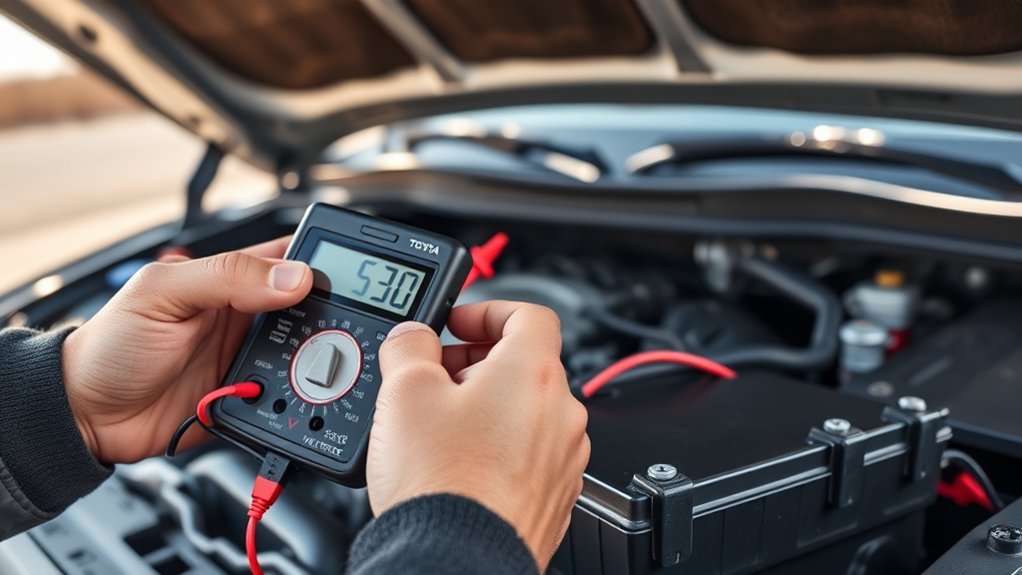
To measure the DC voltage from your Toyota Tacoma’s alternator, you need to prepare your multimeter properly. Start by selecting the appropriate settings and then set up your test to guarantee accurate readings. Once you’ve done that, interpreting the voltage will help you determine the alternator’s health.
Preparing the Multimeter
Prepare your digital multimeter by setting it to the DC voltage mode, ensuring it’s on the lowest range for the most accurate readings. This step is essential for accurate multimeter calibration, allowing you to detect any issues effectively.
- Connect the black lead to the negative battery post.
- Attach the red lead to the positive battery post for proper lead connection.
- Start your Toyota Tacoma and let it idle before increasing the engine speed to about 1500 RPM.
A healthy alternator should produce a voltage reading above 13 volts DC. After the initial reading, consider turning on electrical loads like headlights to check for voltage fluctuations, as these can indicate potential alternator problems.
Setting Up the Test
Once you’ve confirmed the vehicle is in park with the engine off, set your digital multimeter to the DC voltage setting. Connect the black lead to the negative battery post and the red lead to the positive post. You should see a resting voltage around 12.6 volts. Start the engine and let it idle; then raise the RPM to about 1500. Record the voltage, which should ideally range from 13.7 to 14.7 volts. If it drops below 13 volts, you may face voltage fluctuations indicating a failing alternator, impacting its lifespan. To further diagnose, turn on electrical accessories and monitor for significant drops.
| Step | Action | Expected Result |
|---|---|---|
| 1 | Set multimeter to DC voltage | Ready for testing |
| 2 | Measure battery voltage | ~12.6 volts |
| 3 | Measure at 1500 RPM | 13.7 – 14.7 volts |
Interpreting Voltage Readings
While measuring DC voltage, it’s crucial to understand what the readings indicate about your alternator’s performance. A healthy alternator should produce voltage between 13.5 to 14.5 volts DC when the engine runs at about 1500 RPM. If you see readings below 12.6 volts, it suggests the alternator isn’t effectively charging the battery.
Keep an eye on voltage stability as you test:
- If voltage fluctuates greatly when you turn on accessories, it may indicate alternator or battery issues.
- A stable voltage confirms that the alternator is functioning properly.
- Note any drastic drops that could signal potential problems.
Understanding these readings helps guarantee your Tacoma’s electrical system remains reliable and efficient.
What Do My Voltage Readings Mean?
How can you interpret the voltage readings from your Toyota Tacoma’s alternator test? A reading above 13 volts while the engine runs indicates proper charging functionality, reflecting good voltage stability. If your reading dips below 12.6 volts, it suggests the alternator isn’t adequately charging the battery, jeopardizing battery health.
Watch for AC voltage; if it exceeds 0.09 volts, this may signal diode failure, which can cause ripple in the DC output. Erratic or fluctuating readings often complicate diagnostics but indicate potential issues with either the alternator or battery health.
When testing with electrical loads like headlights, expect some voltage fluctuations, but consistent stability is key to evaluating performance. Remember, your readings are critical; they not only reveal the alternator’s condition but also your vehicle’s overall electrical reliability.
How to Diagnose Diode Issues and AC Ripple Effects
To diagnose diode issues in your Toyota Tacoma’s alternator, check for common failures that can increase AC ripple. Use a multimeter to measure AC voltage while the engine runs; readings above 0.09 volts signal potential diode failure. Understanding the impact of AC ripple on your vehicle’s electronics is essential for maintaining peak performance.
Common Diode Failures
Diode failures in the alternator can lead to significant issues, particularly with increased AC ripple affecting your vehicle’s electronics and battery charging. To diagnose these problems effectively, keep an eye on the following:
- Monitor voltage fluctuations under different electrical loads.
- Use a digital multimeter set to the lowest AC voltage range; readings above 0.09 volts AC may indicate failing diode types.
- Regularly test the alternator’s AC output to catch issues early.
Impact of AC Ripple
While diagnosing alternator issues, understanding the impact of AC ripple is essential for ensuring your vehicle’s electrical system operates efficiently. An alternator generates three-phase AC current, which is converted to DC through six diodes. Any diode failure can increase ripple voltage, causing your vehicle’s electronics to malfunction. During testing, use a digital multimeter to measure AC voltage across the battery terminals; readings above 0.09 volts AC at 1500 RPM indicate potential diode faults. Proper grounding is vital, as poor connections can lead to inaccurate readings.
| Reading Type | Acceptable Range | Possible Issue |
|---|---|---|
| AC Ripple | ≤ 0.09 V AC | Healthy Diodes |
| AC Ripple | > 0.09 V AC | Faulty Diodes |
| Diode Testing | Check Voltage | Confirm Diode Status |
Identifying and Fixing Common Alternator Issues
When diagnosing common alternator issues in your Toyota Tacoma, start by measuring the voltage at the battery terminals with the engine running; it should be above 13 volts. If it’s low, you might be facing a charging problem. Use a multimeter to check for AC ripple; readings above 0.09 volts AC suggest potential diode failure.
Regularly inspect the alternator’s connections and grounding to prevent performance issues. Here are some common symptoms and troubleshooting techniques to take into account:
- Listen for unusual noises like grinding or squealing, indicating mechanical failure.
- Check for loose or corroded connections that can disrupt performance.
- Verify the alternator produces the correct amperage even if the diode test fails.
Addressing these issues promptly can help maintain your Tacoma’s reliability and performance.
Additional Tests to Confirm Alternator Functionality

To guarantee your Toyota Tacoma’s alternator is functioning properly, several additional tests can provide valuable insights. First, measure the battery voltage with the engine running; it should be above 13 volts. This confirms the alternator is charging correctly. Next, switch your multimeter to the AC voltage setting for a diode test. Readings above 0.09 volts AC suggest potential diode failure.
For load testing, check the battery’s voltage while the alternator is active; it should remain above 13 volts under load. Additionally, you can perform a disconnect battery test: if the engine stalls when you remove the negative terminal, the alternator is likely failing. Finally, check for a magnetic field by using a ferrous object; strong attraction indicates power generation. These advanced testing techniques and troubleshooting tips will guarantee your alternator’s functionality remains ideal.
When to Consider Alternator Replacement?
How can you tell if it’s time to replace your Toyota Tacoma’s alternator? Watch for these alternator symptoms that signal it’s time for a change:
- Voltage readings drop below 13 volts while the engine’s running, indicating inadequate charging.
- Noticeable voltage fluctuations, especially with electrical loads like headlights, suggest a failing alternator.
- Persistent battery issues, such as difficulty starting or slow cranking, despite having a new battery, may point to alternator failure.
Additionally, if you find a high AC voltage reading over 0.09 volts during testing, this could indicate diode failure. A failed magnetic field check or any physical damage also necessitates replacement. Ignoring these signs can lead to unreliable vehicle operation, so it’s essential to address any concerns promptly. Keep your Tacoma running smoothly by staying vigilant about your alternator’s health.
Tips for Maintaining Your Tacoma’s Electrical System
Maintaining your Tacoma’s electrical system is vital for peak performance and reliability. Start with regular battery maintenance—check the voltage with a digital multimeter. It should stay above 12.4V when the engine’s off. When running, verify the alternator’s output exceeds 13V to confirm proper charging. Inspect and clean battery terminals to prevent corrosion, which disrupts electrical flow. Conduct periodic load tests to identify weak cells that could hinder performance under heavy loads. Proper grounding connections are essential; make sure they’re secure to avoid voltage drops that can affect all electrical components. If you’re considering electrical upgrades, keep these checks in mind to support increased demands. A well-maintained system not only enhances reliability but also extends the lifespan of your Tacoma’s electrical components. Stay proactive, and you’ll reap the benefits of a robust electrical system.
Frequently Asked Questions
How Do I Know if My Toyota Alternator Is Bad?
You can tell your Toyota alternator’s bad by observing symptoms like dimming headlights or dashboard warning lights. Use testing techniques like voltage measurements and the battery disconnection test to confirm its functionality.
Conclusion
By regularly testing your Tacoma’s alternator, you guarantee a reliable ride, free from the worry of unexpected breakdowns. Picture yourself cruising down the road, the engine purring, lights shining bright—all thanks to a healthy electrical system. Keep your multimeter handy and follow those steps to maintain your Tacoma’s performance. Regular checks not only prolong your alternator’s life but also enhance your overall driving experience, letting you focus on the journey ahead without any electrical hiccups.