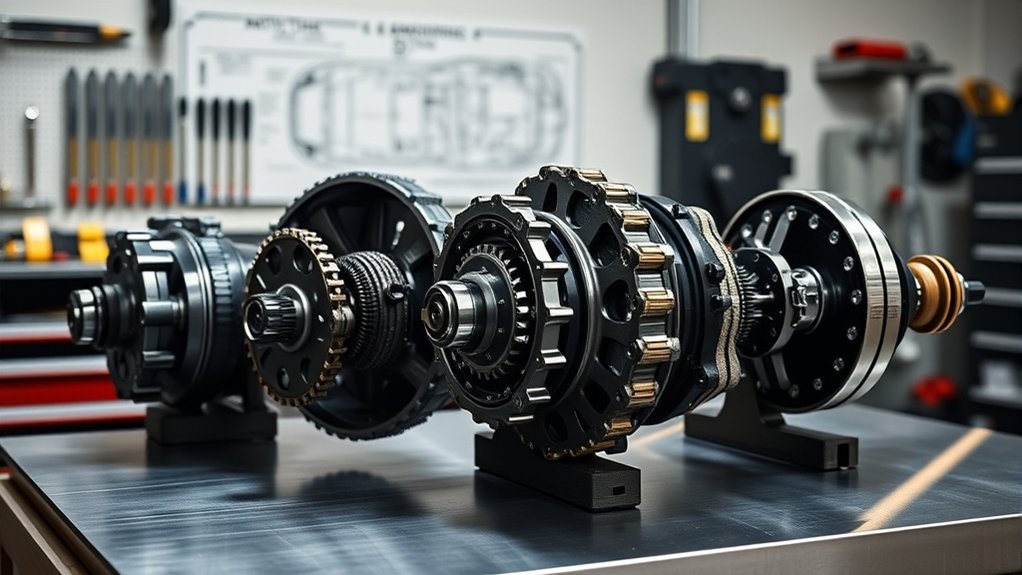
An open differential allows wheels on the same axle to rotate at different speeds, enhancing smooth handling during turns on paved roads. It works well for everyday driving but struggles in low-traction situations. In contrast, a locked differential guarantees both wheels turn at the same speed, maximizing traction on slippery or off-road surfaces. While locked differentials offer greater performance in tough conditions, they require more maintenance and can compromise handling on paved roads. Explore further to understand more nuances between these systems.
What Is an Open Differential and How Does It Work?
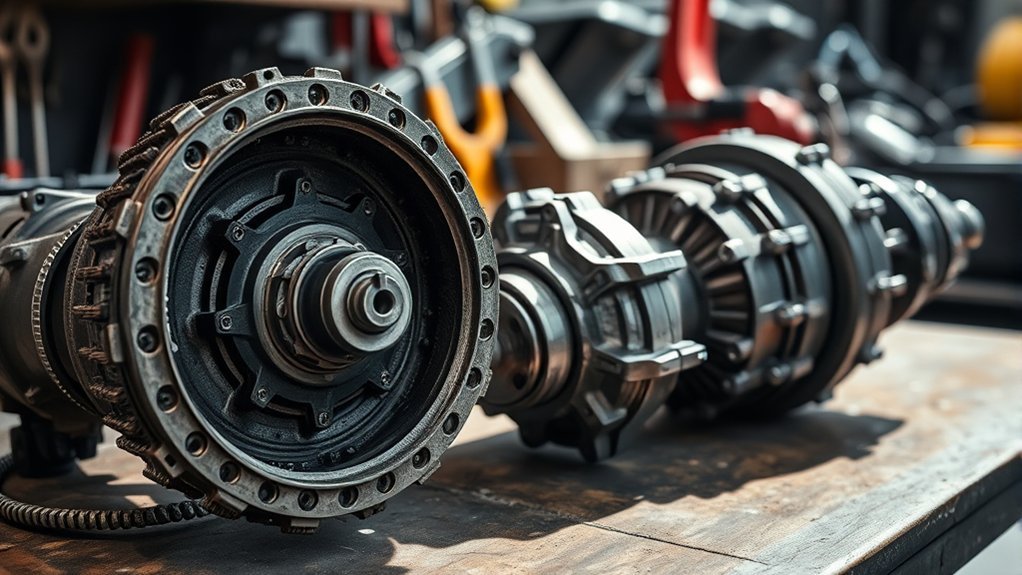
An open differential is a critical component in modern vehicles, enabling smooth and efficient handling during turns. It employs open differential mechanics to allow each wheel on the same axle to rotate at different speeds. This design is essential for maintaining control and stability, particularly when cornering. Through precise torque distribution, the system transmits power to the wheel with less resistance, making it effective for normal driving conditions on paved roads.
While commonly factory-installed due to its simpler design and lower repair costs, an open differential can struggle in low-traction situations like snow or mud. Here, one wheel may spin freely, leaving the other stationary. This limitation can lead to challenges in traction. However, for inexperienced drivers, open differentials provide added safety, reducing the risk of fishtailing during acceleration in slick conditions. Consequently, understanding their function enhances your driving experience and vehicle performance.
Benefits of Open Differentials for Traction
Open differentials enhance stability during turns by allowing each wheel to rotate at different speeds, which is essential on slick surfaces. This design also promotes smooth handling on roads, reducing the risk of fishtailing and improving control. By efficiently managing power distribution, open differentials make everyday driving safer and more comfortable.
Stability During Turns
When maneuvering turns, maintaining stability is essential, especially on slick surfaces, and open differentials excel in this regard. By allowing each wheel to rotate independently, they enhance turning dynamics, reducing tire scrub and improving control during cornering. This independent rotation is vital for driver confidence, particularly in challenging conditions like wet or uneven terrain. Open differentials route power to the wheel with less resistance, effectively enhancing traction without compromising stability. Their simpler mechanical design not only leads to lower repair costs but also guarantees smoother performance in regular driving. For inexperienced drivers, open differentials provide a safer, more predictable experience during turns compared to locking differentials, making them a reliable choice for everyday use.
Smooth Handling on Roads
While traversing everyday roads, the advantages of open differentials become evident in their ability to enhance traction and smooth handling. Their design allows wheels to rotate at different speeds, which improves road performance, especially during turns. This prevents tire scrub and reduces wear, contributing to driving comfort. In wet or slick conditions, open differentials direct power to the wheel with more traction, minimizing the risk of fishtailing and guaranteeing stability. Additionally, they facilitate easier cornering, resulting in more predictable vehicle behavior at higher speeds. With their simpler design, open differentials also incur lower repair costs, making them the preferred choice for daily driving. Overall, they assure reliability and maintain traction on typical road surfaces without compromising drivability.
Key Features of Locking Differentials
Locking differentials are engineered to maximize traction by ensuring both wheels on the same axle rotate at the same speed, which is essential in demanding terrains. These systems feature a locking mechanism that can be either automatic or selectable, giving you the flexibility to engage it based on your driving conditions. In challenging off-road scenarios, especially in mud, snow, or rocky environments, locking differentials excel, providing vital traction enhancement when you need it most. However, it’s important to note that when engaged, these differentials can create drivability issues on paved roads due to restricted wheel differentiation during turns. Brands like ARB and Detroit Locker are well-regarded for their robust performance under extreme conditions, but they require driver adaptation and awareness to use effectively. Understanding these key features will empower you to make informed decisions about when and how to utilize locking differentials for peak performance.
How Locking Differentials Enhance Off-Road Performance
Locking differentials markedly improve traction control by ensuring both wheels on the same axle rotate at the same speed, especially in low-traction scenarios like mud or snow. This feature enhances your ability to navigate obstacles effectively, maintaining stability and reducing the risk of getting stuck. With selectable engagement options, you can adapt to varying terrains, optimizing performance whether you’re on rough trails or smooth roads.
Improved Traction Control
When off-roading, ensuring both wheels on the same axle rotate at the same speed can be the difference between maneuvering obstacles and getting stuck. Locking differentials provide significant traction enhancement in low-traction scenarios like mud or snow by delivering consistent torque to both wheels. This prevents power diversion to the wheel with less resistance, essential for overcoming demanding terrains. You can engage or disengage these differentials as needed, allowing for ideal traction in off-road conditions and smoother handling during regular driving. Automatic locking differentials further improve drivability, engaging based on vehicle speed and turning. In extreme situations, they enhance vehicle stability and control, enabling slow, steady crawling over rugged surfaces without losing traction.
Enhanced Obstacle Navigation
While steering through challenging terrains, having both wheels on the same axle work in unison greatly enhances your off-road capabilities. Locking differentials guarantee that both wheels rotate at the same speed, providing maximum traction essential for obstacle clearance. This design prevents one wheel from spinning faster than the other, maintaining power delivery to the wheel with traction, which is critical for maneuvering uneven surfaces without getting stuck. Engaging a locking differential allows your vehicle to crawl over obstacles smoothly, enhancing control and stability. Particularly effective in low-speed situations, locking differentials enable terrain adaptability, letting you tackle tricky conditions without losing momentum. This flexibility empowers you to optimize your off-road performance precisely when you need it most.
Comparing Posi-Traction and Limited Slip Differentials: Key Differences Explained
Understanding the differences between Posi-Traction and Limited Slip Differentials is essential for selecting the right system for your vehicle’s performance needs. Posi-Traction, often found in performance vehicles, uses clutches to manage torque distribution, delivering Posi-Traction advantages like aggressive traction in slippery conditions while allowing some differentiation during turns. Conversely, Limited Slip Differentials utilize various mechanisms, such as gears or viscous fluid, to adapt torque transfer, making them effective for moderate off-roading and diverse terrains.
While both systems maximize traction, Posi-Traction typically offers a more assertive response, whereas Limited Slip Differentials provide smoother shifts and less abrupt engagement. Additionally, maintenance can differ considerably; Limited Slip systems may require specialized fluids, leading to higher upkeep, while Posi-Traction’s simpler design often necessitates less frequent servicing. Evaluating these factors helps you choose the differential that best aligns with your driving style and conditions.
How to Select the Right Differential for Your Vehicle
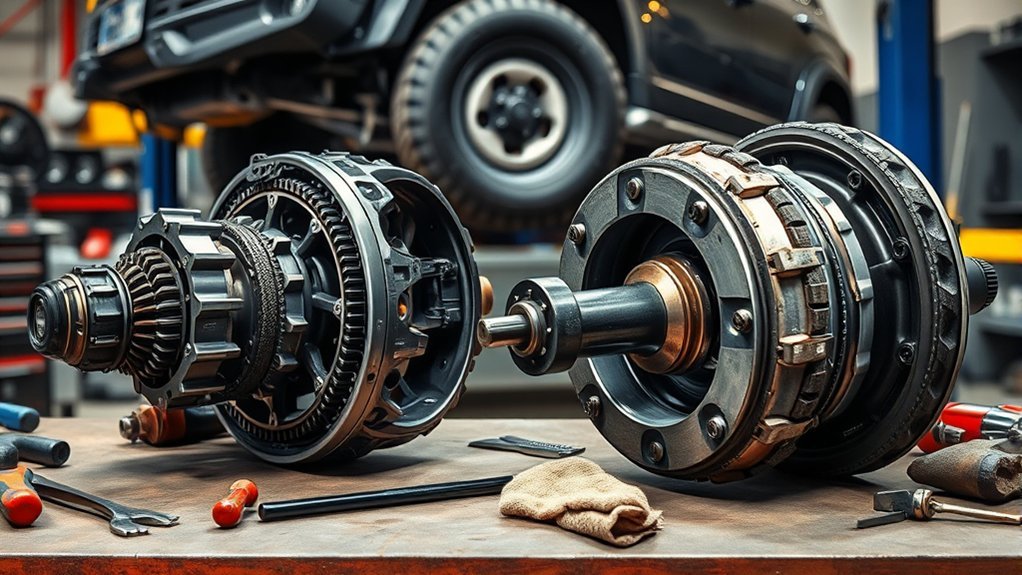
Selecting the right differential for your vehicle requires a clear assessment of your driving needs and conditions. Consider your primary driving scenarios: if you often face slippery or off-road terrains, a locking differential might be essential. On the other hand, open differentials suit daily road use.
Evaluate the following factors:
| Criterion | Open Differential | Locked Differential |
|---|---|---|
| Driving Conditions | Everyday roads | Off-road, slippery terrain |
| Vehicle Weight & Power | Lighter vehicles | Heavier, high horsepower |
| Driver Experience | Novice-friendly | Experienced control |
Also, assess maintenance demands and compatibility with your vehicle model. Your differential type should align with your driving preferences to optimize performance and reliability. The right choice liberates your driving experience, ensuring you have the traction you need when you need it.
Driving Scenarios: Open vs. Locked Differentials in Action
When maneuvering through diverse driving scenarios, the choice between open and locked differentials greatly impacts performance. Open differentials shine in everyday driving, allowing wheels to spin at different speeds during turns, which enhances stability on slick roads. However, in low-speed, slippery conditions like mud or snow, locked differentials provide off-road advantages by ensuring both wheels turn together, maximizing traction and preventing one wheel from spinning freely.
In situations where one wheel is off the ground, locked differentials maintain power to both wheels, effectively overcoming handling challenges that open differentials might face, such as immobilization. While locked differentials excel in extreme conditions, they can complicate high-speed cornering and require more driver skill. Ultimately, understanding these dynamics allows you to choose the right differential for your driving needs, ensuring you maintain control and performance in various environments.
Maintenance Considerations for Differentials
When maintaining differentials, you’ll want to focus on common tasks like fluid changes and inspections for wear and tear. Open differentials usually require less frequent maintenance, while locking differentials may need more attention due to their complexity. Keeping an eye on these factors can greatly enhance performance and extend the lifespan of your differential system.
Common Maintenance Tasks
Maintaining your differential is vital for peak vehicle performance and longevity. Regularly inspect and change the differential fluid to avoid wear and overheating, as dirty or low fluid compromises function. Conduct gear inspections to detect wear or damage early, preventing costly repairs. Check for leaks around seals and gaskets; any fluid loss can undermine the lubrication system’s integrity. For locking differentials, confirm the locking mechanism operates correctly—test it safely to avoid traction loss. Finally, maintain proper torque specifications on differential housing bolts. This prevents leaks and guarantees structural integrity, especially after maintenance work. By staying proactive with these tasks, you enhance your vehicle’s reliability and performance.
Fluid Change Intervals
Regular fluid changes are critical for maintaining your differential’s performance and longevity. Typically, you should schedule a fluid change every 30,000 to 60,000 miles, depending on your vehicle and driving conditions. Using the manufacturer-recommended fluid type is essential, as improper oils can hinder performance. For locked differentials, inspect and change fluids more frequently due to increased wear from locking mechanisms. Neglecting these changes can lead to friction, heat buildup, and severe damage over time.
| Differential Type | Fluid Change Interval | Maintenance Frequency |
|---|---|---|
| Open Differential | 30,000 – 60,000 miles | Every 2-4 years |
| Locked Differential | 15,000 – 30,000 miles | Every 1-3 years |
| Heavy Use | 15,000 miles | Annually |
Wear and Tear Signs
Neglecting fluid changes can lead to significant wear and tear on your differential. For open differentials, listen for unusual differential noise or vibrations; these can signal bearing issues or gear problems. If you notice these signs, timely inspection is essential to prevent further damage. Locked differentials, while advantageous for traction, are more susceptible to wear. Difficulty in engaging or disengaging the lock mechanism indicates excessive strain on the components, necessitating regular checks. Both types require consistent maintenance to guarantee peak performance, but locked differentials demand more attention due to their complexity. Stay proactive with fluid changes and inspections to maintain your vehicle’s efficiency and prolong the lifespan of your differential.
Safety Implications of Using Open and Locking Differentials
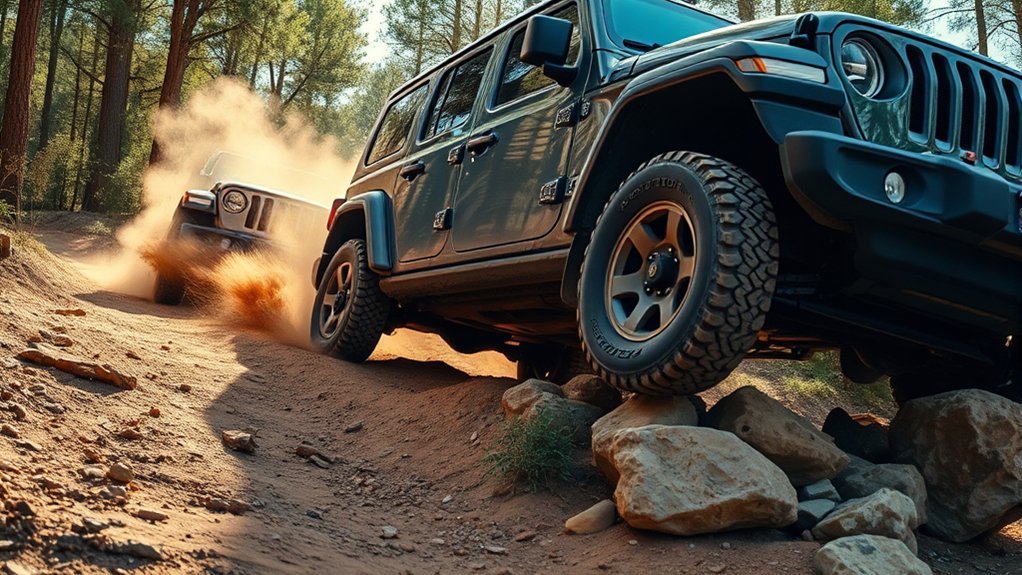
When considering the safety implications of open versus locking differentials, it’s vital to understand how each design affects vehicle stability and control. Open differentials excel in stability during cornering, allowing for independent wheel rotation, which is essential for preventing tire scrubbing on wet or slick surfaces. This makes them safer, especially for inexperienced drivers. In contrast, while locking differentials provide superior traction control in off-road scenarios, they can compromise handling. If one tire loses traction, you risk losing control, particularly during high-speed maneuvers, increasing the likelihood of fishtailing. Furthermore, the complexity of locking differentials can lead to higher repair costs and maintenance challenges, further impacting overall vehicle safety. Ultimately, your choice of differential type should align with your driving conditions and skill level to guarantee the best safety on the road.
What Are the Drawbacks of Locking Differentials?
Although locking differentials offer significant traction advantages in off-road conditions, they come with notable drawbacks that can impact everyday driving. The locking mechanism can lead to drivability issues on paved roads, resulting in handling problems and increased tire wear. When you engage the locking differential, especially in tight corners, you’ll notice reduced steering control, which can be particularly challenging for inexperienced drivers.
Additionally, the “jerky” driving experience on pavement stems from the locking of both wheels, causing a loss of traction during acceleration. If one wheel slips, the locking differential doesn’t allow for differentiation, making it easier for your vehicle to become stuck, therefore amplifying traction limitations. Regular maintenance is essential, as the complexity of these systems can lead to increased wear and potential failure if neglected. In conclusion, while beneficial in specific scenarios, locking differentials pose significant challenges in daily driving situations.
Frequently Asked Questions
Is Open or Locked Differential Better?
Choosing between open and locked differentials depends on your needs. If you’re after performance enhancement and traction control on varied terrains, locked differentials excel. However, for everyday driving, open differentials provide better stability and handling.
What’s Better, Open or Closed Diff?
For ideal vehicle performance, an open differential suits everyday driving, enhancing traction control during turns. However, if you seek off-road capability, a locked differential excels, ensuring maximum traction when traversing challenging terrains. Choose based on your needs.
What Is the Problem With Open Diff?
The problem with an open differential is its tendency to cause traction loss, especially on slippery surfaces. This design can lead to uneven tire wear, as one wheel spins freely while the other remains stationary.
Conclusion
In conclusion, choosing between open and locking differentials boils down to your driving needs. If you’re traversing everyday roads, open differentials are likely your best bet. However, if you’re hitting the trails, locking differentials can give you the edge. Remember, it’s important to weigh the benefits and drawbacks, as each type has its own strengths and weaknesses. Ultimately, knowing when to use each system can be the difference between cruising smoothly and getting stuck in a tight spot.