Last updated: August 19, 2026 · Author: [VERIFY: add real author/byline]
A Hyundai Sonata engine misfire usually feels like shaking at idle, hesitation when you press the accelerator, reduced power, poor fuel economy, or a flashing/steady check engine light. The right fix depends on the trouble code, the cylinder involved, and whether the cause is ignition, fuel delivery, air leaks, sensor feedback, or internal engine condition.
Quick Answer
To diagnose a Hyundai Sonata engine misfire, scan for OBD-II codes first, then inspect the spark plugs, ignition coils or wires, injector operation, fuel pressure, intake leaks, and compression. If the check engine light is flashing, stop driving as soon as it is safe because severe misfires can damage the catalytic converter — and if the code is P1326, treat it as a knock-sensor/engine-protection warning, not a routine misfire.
Key Takeaways
- Start with the OBD-II codes: P0300 means random/multiple misfires, while P0301 through P0306 point to a specific cylinder.
- Ignition faults are common, but do not replace coils, plugs, injectors, or oxygen sensors until testing points in that direction.
- A flashing check engine light means the misfire may be severe enough to damage the catalytic converter.
- P1326 is not a normal misfire code; on affected Hyundai models it is tied to the Knock Sensor Detection System (KSDS) and puts the car into a reduced-power limp mode as a bearing-wear protection measure.
- 2020–2021 Sonata 1.6L T-GDI models have a documented misfire condition tied to high-pressure injector tip seals (Hyundai TSB 21-EM-010H).
At a Glance
| Time Required | 30 minutes to 2 hours for basic diagnosis |
| Difficulty | Beginner to intermediate, depending on access and testing tools |
| Tools Needed | OBD-II scanner, flashlight, socket set, spark plug socket, multimeter, fuel-pressure gauge, and compression tester if needed |
| Cost | About $0–$150 for DIY testing tools and basic parts; more if professional diagnostics or major repairs are needed `[VERIFY: current typical parts/labor pricing]` |
Identifying Engine Misfire Symptoms in Your Hyundai Sonata

A misfire happens when one or more cylinders do not burn the air-fuel mixture correctly. In a Hyundai Sonata, you may notice rough idling, shaking through the seat or steering wheel, hesitation on acceleration, lower fuel economy, a fuel smell from the exhaust, or a check engine light. Under load, such as climbing a hill or merging onto the highway, the problem may feel worse.
The check engine light gives an important clue. A steady light means the vehicle has stored a fault code and needs diagnosis. A flashing check engine light is more urgent because onboard diagnostic systems are designed to alert the driver when a malfunction may affect emissions or risk catalyst damage. If the light flashes, reduce power and stop driving as soon as it is safe.
Warning: Do not keep driving a Sonata with a flashing check engine light, heavy shaking, knocking noises, overheating, low oil pressure, or a strong raw-fuel smell. These symptoms can turn a small repair into catalytic converter or engine damage.
Read the OBD-II Codes First
Before replacing parts, connect an OBD-II scanner and record every stored, pending, and permanent code. Also save the freeze-frame data, including engine speed, load, coolant temperature, and vehicle speed when the code set. Federal OBD rules require monitored emission-related failures to store diagnostic trouble codes and illuminate the malfunction indicator light when thresholds are met, so the scan data is your best starting point.
- P0300: Random or multiple-cylinder misfire.
- P0301: Cylinder 1 misfire.
- P0302: Cylinder 2 misfire.
- P0303: Cylinder 3 misfire.
- P0304: Cylinder 4 misfire.
- P0305/P0306: Cylinder 5 or 6 misfire on older V6 Sonata engines.
- P0171/P0174: Lean condition that can point to vacuum leaks, low fuel delivery, or air-metering problems.
- P0420: Catalyst-efficiency code that may appear after long-term misfiring.
- P1326: Hyundai knock-sensor detection system code tied to possible bearing-wear protection logic on affected vehicles — not a normal spark/fuel misfire code. See the dedicated section below before treating it like a routine misfire.
If your scanner can show live misfire counters or Mode $06 data, use it to identify whether the misfire stays on one cylinder, moves between cylinders, or happens across the whole engine. That pattern tells you what to test next.
Immediate Steps to Diagnose Engine Misfires
Use this order to avoid unnecessary parts swapping:
- Confirm the code pattern. A single-cylinder code points you toward that cylinder’s plug, coil, injector, wiring, or compression. P0300 often points to a shared issue such as a vacuum leak, fuel-pressure problem, contaminated fuel, air-metering fault, or multiple worn ignition parts.
- Check simple basics. Verify the oil level, coolant level, battery voltage, grounds, loose intake hoses, disconnected vacuum lines, and obvious damaged wiring.
- Inspect ignition parts. Remove and inspect the spark plug from the affected cylinder. Look for oil fouling, heavy carbon, cracked porcelain, worn electrodes, or an incorrect gap.
- Swap only when it makes sense. On coil-on-plug engines, move the ignition coil from the misfiring cylinder to another cylinder, clear the code, and see whether the misfire follows the coil. On older models with spark plug wires, inspect wire condition and resistance.
- Check fuel delivery. Listen for injector clicking, test injector power and control, and check fuel pressure if the misfire appears under load or affects multiple cylinders.
- Look for unmetered air. Intake leaks, cracked PCV hoses, loose clamps, or a leaking intake manifold gasket can cause lean misfires.
- Test mechanical health. If spark and fuel check out, perform a compression test or leak-down test to rule out valve, piston-ring, timing, or head-gasket problems.
Pro Tip: When diagnosing a single-cylinder misfire, change only one variable at a time. If you move both the plug and coil together, you will not know which part caused the problem if the misfire moves.
[Products Worth Considering]

The ANCEL AD410 PRO combines engine diagnostics and 12V battery testing in one easy-to-use tool, helping you read and clear check engine codes while checking battery health, cranking, and charging performance. It also provides live data, freeze frame details, and I/M readiness checks to help you diagnose issues faster and prepare for emissions testing. With plug-and-play operation, a clear screen, and broad vehicle compatibility, it is a practical solution for home mechanics and everyday drivers.

This ignition coil and spark plug set is designed to restore reliable starting, smooth acceleration, and consistent engine performance for a wide range of Kia and Hyundai vehicles. Built with quality materials and compatible with multiple OE reference numbers, it helps address common symptoms like shaking, sluggish response, and hard starts. It is a practical replacement solution for drivers looking to refresh worn ignition components and improve drivability.

This ignition coil and spark plug set is designed to restore smooth starting, stronger acceleration, and more reliable engine performance for a wide range of Toyota, Scion, Lexus, and Pontiac models. Built with quality materials and engineered to match OE fitment, it helps address common misfire, shaking, and fuel economy issues when your ignition system is worn. It is an ideal replacement choice for drivers looking to refresh their tune-up with dependable components.
How Ignition Components Cause Engine Misfires
Ignition problems are among the most common causes of Hyundai Sonata misfires. The spark plug must fire at the right time with enough energy to ignite the compressed air-fuel mixture. If the plug, coil, boot, wire, or connector fails, the cylinder may misfire more under load than at idle.
[Products Worth Considering]

This plug-and-play OBD2 scanner helps drivers quickly read and clear engine error codes while providing live data, freeze frame information, I/M readiness, and MIL status for more confident troubleshooting. It adds a built-in voltage test and clear status indicators to support electrical checks and faster diagnostics, making it a practical choice for home users, car enthusiasts, and repair professionals. Compatible with most OBDII vehicles since 1996 and designed with an easy-to-use interface, it offers broad coverage and simple operation in one compact tool.

The AstroAI M4K0R Digital Multimeter delivers accurate TRMS measurements for AC/DC voltage, current, resistance, continuity, diode testing, and battery checks, making it a versatile tool for home and automotive troubleshooting. Its non-contact voltage detection, backlit LCD, flashlight, data hold, and auto-ranging design help simplify everyday electrical diagnostics while supporting safer use with audible and visual alarms. Built with double ceramic fuses and a protective silicone cover, it is designed for reliable performance and added protection during demanding tasks.

[Vehicle Fitment-1]: Ignition Coil Pack and Spark Plugs Direct replacement Compatible with Hyundai Sonata 2011-2014 2.4L L4 | Santa Fe Sport 2013-2015 2.4L L4 | Tucson 2014-2015 2.4L L4 | Accent 2020-2021 1.6L L4. Precision-engineered for exact OE fit.
Spark Plug Functionality
Spark plugs wear over time, and worn electrodes need more voltage to fire. A plug can also be fouled by oil, fuel, carbon, or coolant. Check the correct plug type, gap, and replacement interval for your exact model year and engine in the Hyundai owner’s manual or Hyundai maintenance schedule because Sonata engines vary by year.
- Dry, black soot: Rich mixture, weak spark, or too much idling.
- Wet fuel smell: No spark, injector issue, or repeated failed starts.
- Oil fouling: Possible valve-cover leak into the plug well, worn rings, or valve-seal issue.
- White deposits or overheating marks: Possible lean condition, wrong plug heat range, or overheating.
Ignition Coil Performance
Many modern Sonata engines use coil-on-plug ignition, while some older engines use plug wires or different coil arrangements. A weak coil may work at idle but fail under load. Check for cracked coil housings, torn boots, corrosion in the connector, oil in the plug well, and carbon tracking on the boot or plug porcelain.
For a cylinder-specific misfire, a coil swap test is often useful. Move the suspect coil to a different cylinder, clear the code, and drive under the same conditions. If P0302 changes to P0304 after moving the coil from cylinder 2 to cylinder 4, the coil is likely the cause.
Step-by-Step Guide to Diagnosing Fuel Injectors
A clogged, leaking, or electrically faulty injector can create a misfire even when spark is strong. Sonata engines vary, so the number of injectors and access points depend on whether you have a four-cylinder, turbocharged engine, hybrid engine, or older V6. Hybrid and plug-in hybrid Sonata owners should confirm their exact engine and check their VIN for any hybrid-specific service campaigns before assuming the same injector layout as a standard gasoline model. `[VERIFY: hybrid/PHEV-specific campaign numbers]`
- Listen for injector operation. With the engine running, use a mechanic’s stethoscope or long screwdriver to listen for a steady clicking sound at each injector.
- Check the connector. Look for loose pins, corrosion, damaged insulation, or oil intrusion.
- Test power and pulse. A multimeter or noid light can confirm that the injector is receiving voltage and a control signal.
- Compare cylinder behavior. If your scan tool supports cylinder balance or injector shutoff testing, compare RPM drop between cylinders.
- Check fuel pressure. Low fuel pressure or low volume can cause lean misfires, especially during acceleration.
- Avoid harsh shortcuts. Injector cleaners may help light deposits, but they will not fix an open circuit, stuck injector, low fuel pressure, or mechanical engine problem.
Known issue: Hyundai Technical Service Bulletin 21-EM-010H (September 2021) covers certain 2020–2021 Sonata (DN8a) vehicles with 1.6L T-GDI engines that may show a check engine light along with a popping noise, an abnormal smell from the engine bay, rough running, or reduced power. The bulletin traces this to burnt high-pressure injector tip seals and outlines an inspection-and-replacement procedure. If your Sonata falls in this range, ask a dealer or qualified shop to check specifically for this condition before assuming a standard coil or fuel-pressure fault.
Note: On many newer Hyundai models, the fuel filter is not treated like an old-style routine service part. Hyundai advises inspection or replacement when symptoms such as restricted fuel flow, surging, loss of power, or hard starting appear.
[Products Worth Considering]

Upgraded Universal Fuel Injector Tester and Cleaner Tool Kit---Operates injectors individually to diagnose fuel delivery problems on petrol vehicles with electronic fuel injection, such as blockage, leakage, damage, and burnout of the injectors. The included 8-size cleaning adapters combined with the tester pulse mode can quickly clean the injectors. TURN OFF THE ENGINE BEFORE USE.

Upgraded Universal Fuel Injector Tester and Cleaner Tool Kit---Operates injectors individually to diagnose fuel delivery problems on petrol vehicles with electronic fuel injection, such as blockage, leakage, damage, and burnout of the injectors. The included 8-size cleaning adapters combined with the tester pulse mode can quickly clean the injectors. TURN OFF THE ENGINE BEFORE USE.

Stop Fuel Waste at Record High Prices: Every Drop That Doesn’t Burn Costs You Money. A faulty injector can silently waste 20–30% of your fuel without ever triggering a check engine light –no code, no warning. Don’t let a clogged, leaking, or poorly atomized injector drain your wallet. The JT200 fuel injector tester helps you pinpoint the exact faulty injector causing abnormal fuel consumption. Fix the real problem, restore proper combustion, and start saving at every fill-up – even with gas prices at historic highs. A must-have tool for every car owner. (NOT FOR GDI OR DIESEL INJECTORS)
Why Oxygen Sensors Matter for Diagnosing Misfires
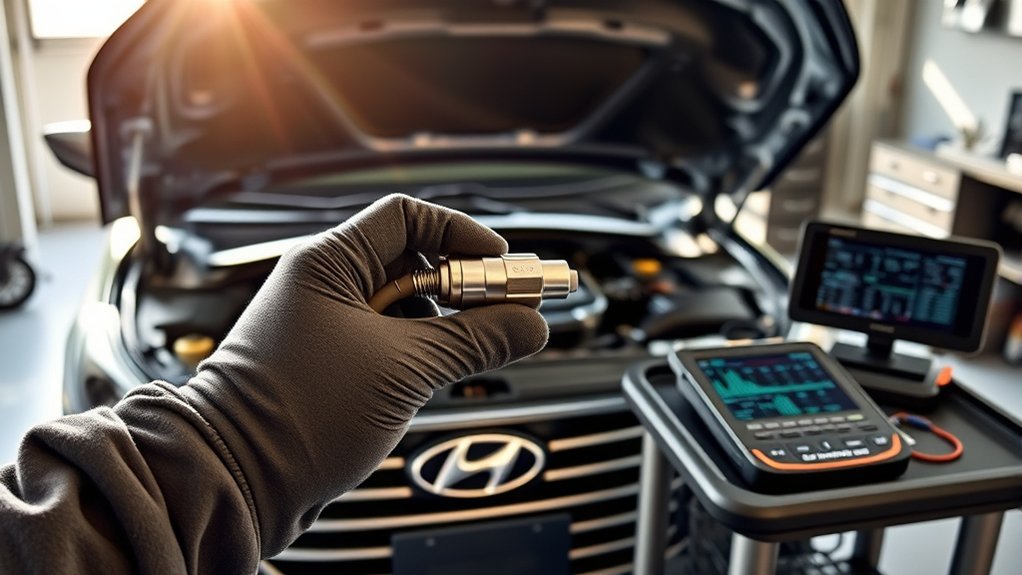
Oxygen sensors and air-fuel ratio sensors help the engine computer adjust fuel trim, but they are not the first part to replace for a misfire. A bad upstream sensor can skew fuel trim and contribute to a rich or lean mixture. A downstream oxygen sensor mainly monitors catalyst performance. Misfires themselves can also confuse oxygen-sensor readings because unburned oxygen and fuel enter the exhaust.
Role in Air-Fuel Mixture
The upstream oxygen or air-fuel ratio sensor reports exhaust oxygen content so the engine control module can adjust fuel delivery. If the sensor is biased, slow, contaminated, or paired with an exhaust leak, the engine may run too rich or too lean. Either condition can make a misfire worse.
Impact on Emissions Control
Misfires increase emissions and can send unburned fuel into the exhaust. That can overheat and damage the catalytic converter. If you see misfire codes together with catalyst-efficiency codes, repair the misfire first, then recheck the catalyst after a proper drive cycle.
Diagnostics for Misfire Issues
Use live data before replacing oxygen sensors. Compare short-term and long-term fuel trims at idle and at 2,500 RPM. If fuel trims are strongly positive at idle but improve at higher RPM, suspect a vacuum leak. If trims stay positive under load, check fuel delivery or air-metering data. If trims are strongly negative, look for leaking injectors, excessive fuel pressure, or biased sensor input.
Effective Testing Methods for Spark Plugs and Wires
The best ignition test depends on the Sonata engine design. Late-model engines commonly use coil-on-plug ignition, while some older engines may use spark plug wires. Use the correct service information for your year, engine size, and market.
- Visual inspection: Check for cracked porcelain, oil in plug wells, torn boots, corrosion, and carbon tracking.
- Plug comparison: Compare the misfiring cylinder’s plug against the others. One plug that looks very different is a clue.
- Coil swap test: Move the coil to a different cylinder and see whether the misfire code follows.
- Wire resistance test: If your Sonata uses plug wires, measure resistance and inspect for arcing or hardened insulation.
- Spark test: Use a proper ignition tester rather than grounding a plug against the engine by hand.
Common Misfire Causes by Symptom
| Symptom or Code Pattern | Most Likely Areas to Check | Next Test |
|---|---|---|
| P0301, P0302, P0303, or P0304 only | Spark plug, coil, injector, connector, compression on that cylinder | Swap coil or plug, then test injector and compression |
| P0300 random misfire | Vacuum leak, low fuel pressure, dirty throttle body, MAF/MAP data, multiple worn plugs | Check fuel trims, inspect intake hoses, test fuel pressure |
| Misfire mostly under acceleration | Weak ignition coil, worn plug, low fuel pressure, restricted exhaust | Load-test ignition and check fuel pressure under demand |
| Rough idle that smooths out at higher RPM | Vacuum leak, PCV hose, intake gasket, dirty throttle body | Smoke test intake and compare fuel trims |
| Misfire plus coolant loss or white smoke | Head gasket, coolant intrusion, cracked component | Compression, leak-down, and cooling-system pressure test |
| 2020–2021 1.6T with popping/smell and reduced power | High-pressure injector tip seals (TSB 21-EM-010H) | Dealer/shop inspection per bulletin procedure |
| Flashing MIL with P1326 | Hyundai KSDS/bearing-wear protection logic on affected vehicles | Stop driving and check Hyundai/NHTSA campaign status by VIN |
The fastest misfire diagnosis is not “replace the usual parts.” It is finding whether the misfire follows the spark, follows the fuel, follows an air leak, or stays with the cylinder mechanically.
When P1326 Appears on a Hyundai Sonata
P1326 deserves special attention because it is often confused with normal misfire codes. On affected Hyundai vehicles, P1326 is tied to the Knock Sensor Detection System (KSDS), engine-monitoring software designed to detect vibration patterns that may precede excessive connecting-rod bearing wear. When the code sets, the vehicle typically enters a protective limp mode with engine speed capped around 1,800–2,000 RPM. Hyundai’s connecting-rod-bearing-debris safety recall (RCONL 15V568) specifically named 2011–2012 Sonata 2.4L and turbocharged 2.0L GDI vehicles, and Campaign 953 later extended the KSDS software update to a wider range of affected vehicles; other Hyundai campaigns cover additional Sonata Hybrid, Plug-In Hybrid, Tucson, Santa Fe, Elantra, and Veloster models. `[VERIFY: current Campaign 953 model-year range by VIN lookup, since sources describe it as broader than the original 2011–2012 recall]`
If your Sonata has P1326, a blinking check engine light, reduced power, or engine protection mode, do not keep driving while treating it like a regular spark plug misfire — and do not clear the code before a dealer sees it, since dealers typically require an active P1326 code to run the Bearing Clearance Test that determines warranty eligibility for an engine replacement. Check your VIN with Hyundai’s recall and service campaign lookup and the NHTSA recall lookup, then contact a Hyundai dealer for the correct inspection procedure.
When to Stop DIY Diagnosis and Call a Pro
Basic checks are safe for many DIYers, but some misfires need professional testing. Stop and get help if the engine knocks, the vehicle enters limp mode, the check engine light flashes repeatedly, compression is low, fuel pressure testing requires special equipment, or the misfire remains after ignition and injector checks. A shop with a scan tool, oscilloscope, smoke machine, fuel-pressure equipment, and leak-down tester can isolate the cause faster than repeated parts replacement, and most shops charge a diagnostic fee before repair costs. `[VERIFY: current typical diagnostic fee range]`
Frequently Asked Questions
How do I diagnose what is causing a misfire in my Hyundai Sonata?
Scan for OBD-II codes first, record freeze-frame data, and identify whether the misfire is random or cylinder-specific. Then inspect the spark plug and coil for the affected cylinder, test injector operation, check for vacuum leaks and fuel-pressure problems, and perform compression testing if spark and fuel are good.
What years are affected by the P1326 Hyundai Sonata issue?
Do not rely on model year alone. The original connecting-rod-bearing recall named 2011–2012 Sonata vehicles, and Campaign 953 later extended the KSDS software update to a wider range of Theta II-engine vehicles. Specific P1326 service procedures and warranty programs can depend on engine, VIN, campaign completion, and vehicle history. Check the exact VIN through Hyundai or NHTSA and contact a Hyundai dealer if P1326 is stored.
What causes a Hyundai Sonata to misfire?
Common causes include worn spark plugs, weak ignition coils, damaged plug wires or boots, clogged or leaking injectors, low fuel pressure, vacuum leaks, dirty air-metering sensors, exhaust restrictions, and low compression. On 2020–2021 1.6T models, a documented cause is burnt high-pressure injector tip seals (TSB 21-EM-010H). The code pattern and live scan data help separate these causes.
Can a bad oxygen sensor cause a misfire?
A faulty upstream oxygen or air-fuel ratio sensor can contribute to a rich or lean mixture, but oxygen sensors are not the most common first cause of a misfire. Check fuel trims, sensor codes, exhaust leaks, ignition parts, fuel pressure, and injector operation before replacing oxygen sensors.
Is it safe to drive a Hyundai Sonata with a misfire?
It depends on severity. A light, intermittent misfire should still be diagnosed soon. A flashing check engine light, strong shaking, loss of power, fuel smell, overheating, knocking, or P1326 warning means you should stop driving as soon as it is safe and arrange diagnosis or towing.
Should I replace all spark plugs or only the misfiring cylinder’s plug?
If the plugs are near the scheduled replacement interval, replacing the full set is usually sensible. If the plugs are newer, inspect the misfiring cylinder first and test before replacing parts. Always use the plug type and gap specified for your exact Sonata engine.
Conclusion
Diagnosing a Hyundai Sonata engine misfire is a process of narrowing the fault, not guessing. Start with OBD-II codes and freeze-frame data, then test ignition, fuel delivery, intake leaks, sensor feedback, and mechanical compression in order. A steady check engine light gives you time to diagnose carefully, but a flashing light or P1326 warning should be treated as urgent. With a clear testing path, you can fix the real cause and keep your Sonata running smoothly.
Sources
- Hyundai Owner’s Manuals — model-specific operating, maintenance, and service-reference information.
- Hyundai USA Maintenance Schedule — official maintenance schedule lookup by vehicle.
- Hyundai Campaign 953 — official description of the Knock Sensor Detection System software update for listed Hyundai vehicles.
- Hyundai Recall and Service Campaign Lookup — VIN-based lookup for Hyundai safety recalls and service campaigns.
- NHTSA Recalls — official U.S. vehicle recall lookup and safety-recall information.
- 40 CFR § 86.1806-17 — federal onboard diagnostic requirements for detecting malfunctions, storing trouble codes, and alerting drivers.
- Hyundai TSB 21-EM-010H (NHTSA-hosted) — official bulletin on 2020–2021 Sonata 1.6L T-GDI high-pressure injector misfire condition.