Your Tacoma’s catalytic converter uses platinum, palladium and rhodium-coated honeycomb surfaces to catalyze reduction of NOx to N2 and oxidation of CO and unburned hydrocarbons to CO2, lowering toxic emissions while preserving engine performance. Upstream and downstream oxygen sensors feed the ECM so it can maintain the ideal air–fuel ratio for efficient reactions; failures or clogs cause heat, odor, loss of power and codes. Keep scanning and inspecting to learn more about diagnosis and repair options.
What the Toyota Tacoma Catalytic Converter Does
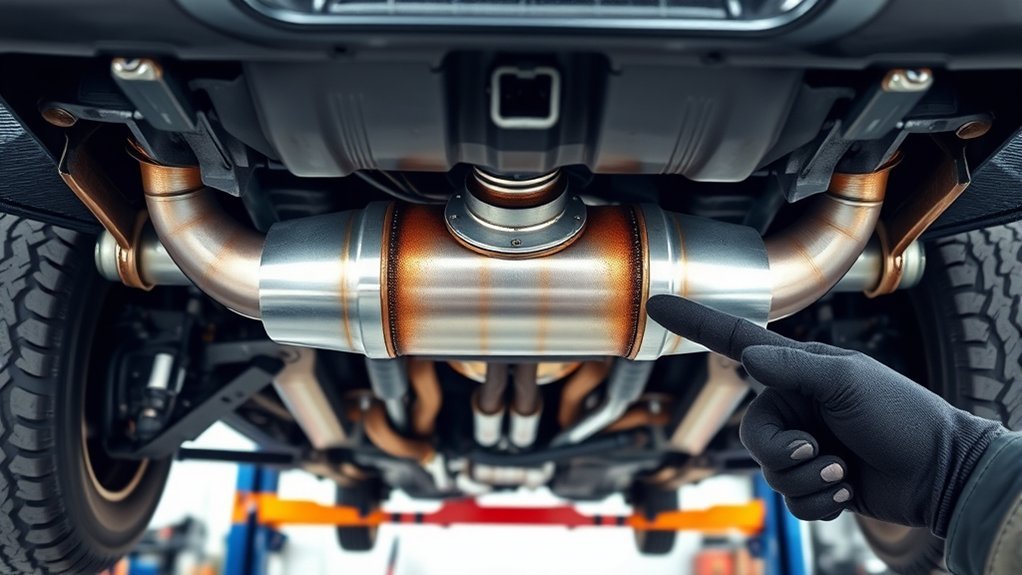
The catalytic converter on your Toyota Tacoma converts harmful exhaust pollutants into less toxic gases by catalyzing redox reactions over surfaces coated with platinum, palladium, and rhodium. You rely on catalytic converter materials to drive rapid oxidation of carbon monoxide and hydrocarbons and reduction of nitrogen oxides, achieving up to 90% conversion efficiency for those species. You’ll notice that effective emissions reduction techniques combine precise catalyst formulations, durable washcoat adhesion, and optimized substrate geometry to maximize contact time and minimize backpressure. When the converter functions, your engine maintains designed performance and fuel efficiency; when it fails, you’ll see a check engine light, poor acceleration, and odd noises like rattling. You should perform regular diagnostics and maintenance to preserve catalytic activity and extend service life, since under normal operation the unit is intended to last the engine’s life. These measures free you from unnecessary emissions burdens while keeping compliance and vehicle responsiveness intact.
Where the Converter Sits in the Tacoma’s Exhaust System
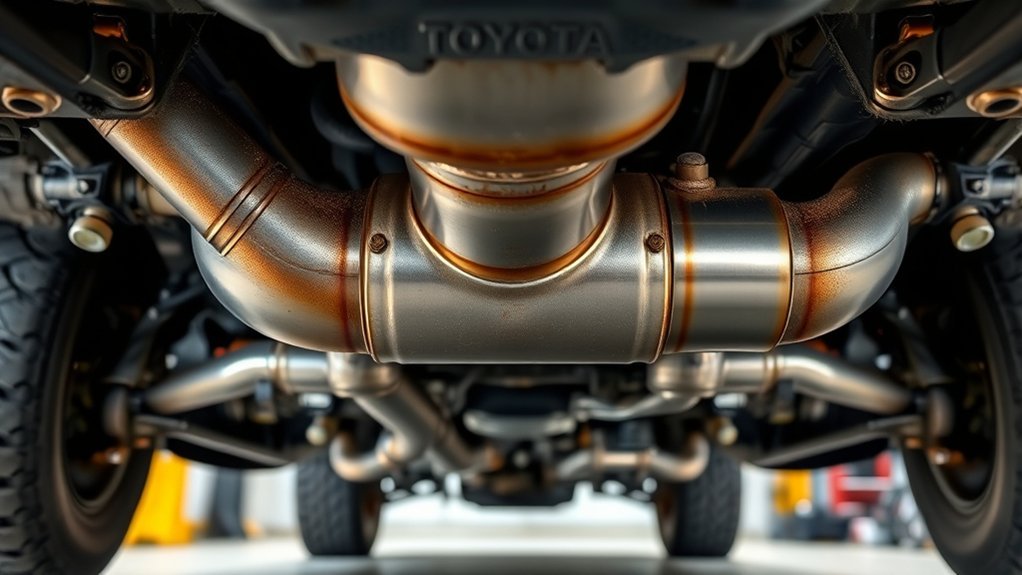
Because it sits between the engine and the muffler, your Tacoma’s catalytic converter is mounted under the vehicle near the front, where it can intercept hot exhaust gases early for efficient treatment. You’ll find converter placement either welded into the exhaust manifold or as a discrete canister downstream, depending on model year and engine. It’s integrated into the exhaust system to work with oxygen sensors that monitor composition and enable closed‑loop control. You should inspect it regularly: overheating, clogging, or physical damage degrades performance and freedom from emissions constraints.
| Location | Type | Vulnerability |
|---|---|---|
| Front underbody | Manifold-mounted | Theft, heat |
| Mid-pipe | Separate canister | Accessibility |
| Near O2 sensors | Sensor-integrated | Diagnostic impact |
| Close to engine | High temperature | Structural stress |
Understand placement to protect the unit, maintain emissions control, and assert your right to reliable mobility.
The Reduction and Oxidation Reactions Inside the Converter
Now that you know where the converter sits in the exhaust stream, look at what happens inside it: reduction and oxidation reactions strip pollutants from exhaust gases. You’ll see two coordinated processes: reduction reactions target nitrogen oxides (NOx), removing oxygen atoms and returning inert nitrogen (N2) and O2 by electron transfer, while oxidation reactions convert carbon monoxide (CO) to carbon dioxide (CO2) and oxidize hydrocarbons (HC) to CO2 and H2O. The converter’s ceramic honeycomb gives immense surface area so platinum, palladium and rhodium catalysts can accelerate these redox reactions without being consumed. You’ll appreciate that the precious metals lower activation energy, letting the reactions proceed quickly at exhaust temperatures and achieving up to about 90% reduction in harmful emissions. This efficiency liberates you from excess pollution impact and helps the Tacoma meet strict regulations. The internal balance between reduction reactions and oxidation reactions is critical: each must proceed in the right zone and proportion to maintain ideal conversion.
How Oxygen Sensors and the ECM Support Converter Function
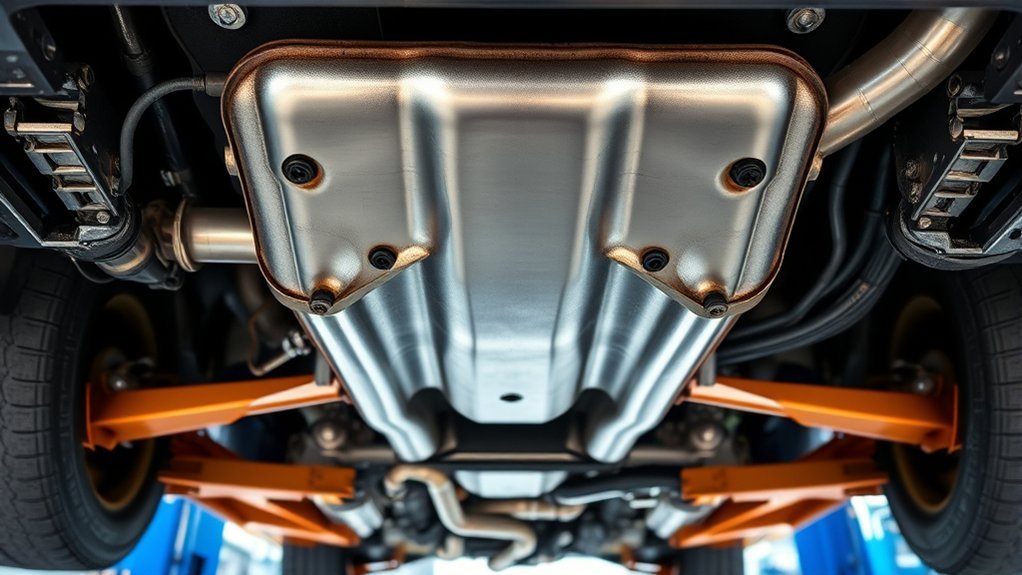
You rely on upstream and downstream oxygen sensors to monitor exhaust O2 levels and feed real-time data to the ECM. The ECM uses that input to precisely trim fuel injection and ignition timing, holding the air/fuel ratio where the catalytic converter converts up to ~90% of harmful gases most efficiently. By comparing pre- and post-converter oxygen signals, the ECM also flags converter inefficiency or clogging for diagnostics.
Oxygen Sensor Role
While driving, the oxygen sensors continuously sample exhaust oxygen content and send real-time voltage signals to the ECM so it can maintain the ideal air-fuel ratio for the catalytic converter. You rely on upstream and downstream sensors to confirm converter efficiency; upstream data guides mixture adjustments, downstream verifies conversion. Faulty sensors raise emissions, stress the catalyst, and shorten its life. You should know oxygen sensor types and follow sensor calibration to guarantee accurate readings and liberation from unnecessary replacements.
| Location | Purpose | Diagnostic Role |
|---|---|---|
| Upstream | Mixture feedback | Adjusts fuel delivery |
| Downstream | Converter verification | Detects catalyst inefficiency |
| Combined | Emissions control | Protects converter operation |
ECM-Air/Fuel Management
Because the ECM constantly monitors oxygen sensor feedback, it actively adjusts fuel injection timing and duration to keep the Tacoma’s air-fuel ratio within a narrow target window, maximizing catalytic converter efficiency. You rely on precise ECM calibration to interpret sensor voltages and convert them into corrective fuel trim values that correct short-term and long-term deviations. Oxygen sensors report exhaust oxygen content; the ECM uses that stream to modulate injector pulse widths and maintain stoichiometry, preventing rich conditions that can overheat the converter or lean conditions that reduce reduction reactions. By understanding this control loop you reclaim control of emissions performance: guarantee sensors and ECM calibration are maintained, monitor fuel trim trends, and intervene when persistent corrections indicate sensor or system faults that threaten converter longevity.
Common Signs Your Tacoma’s Catalytic Converter Is Failing
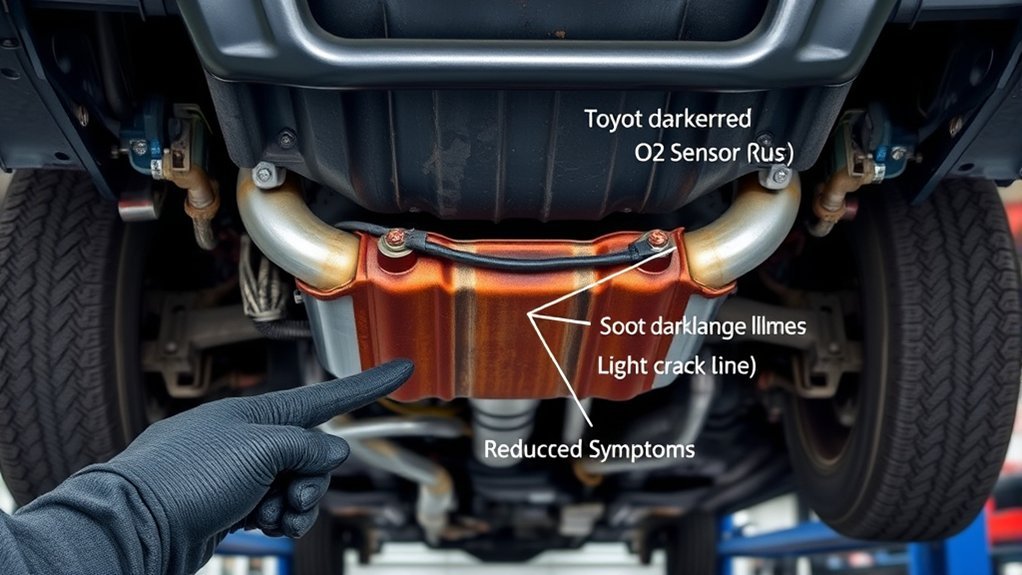
How can you tell when your Tacoma’s catalytic converter is failing? Look for clear, measurable indicators. Dark exhaust smoke signals incomplete combustion and a struggling converter; track frequency and conditions when smoke appears. A rotten egg or sulfur odor during operation points to failed chemical conversion—note duration and engine load. If you feel a pronounced lag in acceleration or difficulty gaining speed, the converter may be clogged and restricting flow. Excessive heat under the vehicle suggests internal blockage; quantify by touch only when safe or use infrared diagnostics. Your check engine light can indicate converter faults, but don’t rely solely on it—scan for relevant fault codes and correlate with symptoms. Maintain a disciplined catalytic converter maintenance routine and consider approved exhaust system upgrades only after diagnosing failure causes. These signs are diagnostic data: observe, record, and act decisively to preserve performance and free your driving experience from avoidable constraint.
Immediate Steps If Your Check Engine Light or Performance Changes
If your check engine light comes on or you notice sudden performance loss, start with quick, verifiable checks: confirm the gas cap is tight, scan for codes with an OBD-II reader, and monitor acceleration and idle for signs of misfire or hesitation. Act swiftly; a flashing check engine indicates a severe misfire risk that can destroy the catalytic converter and limit your mobility.
- Tighten the gas cap and recheck the light after a drive.
- Use an OBD-II reader to capture stored codes immediately.
- Note specific performance issues: loss of power, hesitation, rough idle.
- Avoid prolonged driving if the light flashes; tow to prevent converter damage.
- Schedule a certified mechanic or dealership multi-point inspection.
These steps give you agency: verify, document, and escalate. If minor fixes don’t clear codes or performance issues persist, book professional diagnostics promptly to protect emissions control and maintain your Tacoma’s operational freedom.
Diagnostic Steps for Tacoma Owners: Codes and Simple Inspections
When the check engine light comes on, plug an OBD-II scanner into your Tacoma to read DTCs and record the exact codes. Compare codes to OEM references to determine if they indicate catalytic converter efficiency, oxygen sensor faults, or related systems, then perform visual checks for dark exhaust, odors, or physical damage. Also monitor acceleration and fuel economy during a controlled drive to confirm performance-related symptoms before booking a certified mechanic.
Read And Interpret Codes
Start by connecting an OBD-II scanner to your Tacoma and retrieve the ECM’s stored DTCs; codes like P0420 and P0430 directly point to catalytic converter efficiency issues. Use DTC troubleshooting and scanner usage to prioritize diagnostics: identify affected bank, note freeze frame data, and record pending codes. Interpret codes as indicators, not final verdicts.
- Confirm bank identification and related oxygen sensor codes
- Check for pending vs. confirmed DTCs and their timestamps
- Review live PID data for O2 sensor response and short-term fuel trims
- Cross-reference DTCs with recent repairs or fault history
- If codes persist after repairs, escalate to advanced diagnostics (smoke test, sensor bench tests)
You’ll act with autonomy, using code data to guide decisive next steps.
Visual And Performance Checks
Having pulled codes and reviewed OBD-II data, move on to visual and performance checks to corroborate ECM indications and spot mechanical or flow issues the scanner can’t show. Perform a targeted visual inspection: examine the converter for dents, rust, or missing heat shields; inspect welds and hangers; check for oil or coolant contamination. Listen with the vehicle idling and during revs for rattling or roaring that suggests internal breakage or a missing substrate. Conduct a focused performance evaluation: note poor acceleration, hesitations, decreased fuel economy, and dark exhaust smoke, recording conditions and RPMs when symptoms occur. These direct checks, combined with DTCs, free you to decide repair, replacement, or further testing with backpressure gauges.
Causes of Converter Damage in Tacomas (Misfires, Towing, Impacts)
If you let engine misfires persist, tow beyond rated capacity, or expose the underside to impacts, the Tacoma’s catalytic converter can suffer rapid degradation. You’ll cause excess unburned fuel to enter the converter, raising internal temperatures and melting catalytic substrates. You’ll also elevate exhaust temperatures from overworked engines during heavy towing, and risk physical deformation or dislodgment from road impacts. Apply misfire prevention and towing tips: monitor spark plugs, ignition coils, and engine management sensors; respect tow limits; and protect the undercarriage.
- Misfires dump fuel into the converter, causing overheating and substrate collapse.
- Heavy towing raises exhaust flow and temperature, accelerating thermal breakdown.
- Exceeding designed exhaust flow (mods or loads) promotes clogging and backpressure.
- Impacts from debris or collisions can crack the housing or detach mounts.
- Regular maintenance of ignition and exhaust systems preserves catalytic integrity.
You deserve control over vehicle longevity; follow these technical safeguards to liberate your Tacoma from premature converter failure.
Repair vs. Replace: Choosing the Right Catalytic Converter for Your Tacoma
When you evaluate a Toyota Tacoma’s catalytic converter, focus first on the root cause and observable failures to decide between repair and replacement. You’ll distinguish wear-and-tear from theft, overheating, clogging, or structural damage; theft often mandates replacement, while some clogging or sensor faults may allow targeted repair. Measure converter efficiency and backpressure to quantify impact on performance and emissions before choosing. Replacement is prudent when overheating has melted substrates or flow is irreversibly restricted, since repairs won’t restore original conversion rates. If you seek performance gains, consider high-flow units to improve exhaust flow and horsepower, but weigh those benefits against replacement costs and emissions goals. For strict jurisdictions, California-legal converters guarantee cross-state compliance. Always consult a certified mechanic to verify compatibility with your Tacoma’s engine, assess brand reliability and warranty terms, and confirm that the chosen path restores legal emissions function and ideal converter efficiency.
Legal Requirements and Maintenance Tips to Extend Converter Life
After deciding between repair and replacement, you should also confirm legal obligations and adopt maintenance practices that extend your Tacoma’s converter life. You’ll face clear legal implications if you remove or replace the catalytic converter with non-compliant parts; many regions prohibit driving without one, and states with stringent emissions require California-legal converters. Follow maintenance best practices to maximize service life and avoid enforcement or costly replacements.
- Monitor engine health: address misfires and fuel trim anomalies immediately.
- Use high-quality fuel to reduce carbon buildup within the substrate.
- Inspect periodically for rattles, heat discoloration, or performance degradation.
- Repair exhaust leaks and sensor faults promptly to prevent catalyst damage.
- Install certified California-legal units where required to maintain compliance.
You’ll preserve emissions control and your freedom to drive unencumbered by violations. Apply these technical, concise actions routinely; they’re practical, liberating steps that reduce risk and extend converter longevity.
Frequently Asked Questions
What Is the Purpose of the Catalytic Converter in a Tacoma?
It converts toxic exhaust into less harmful gases to meet Tacoma emissions standards, and you should perform catalytic converter maintenance to prevent clogging or overheating, preserving performance, fuel economy, and your freedom to drive without restrictions.
What Are the Three Functions of the Catalytic Converter?
You reduce NOx to N2 and O2, oxidize CO to CO2, and convert unburnt hydrocarbons into CO2 and H2O; catalytic converter basics empower your emissions control systems, liberating cleaner operation and regulatory compliance.
Can a Toyota Tacoma Run Without a Catalytic Converter?
Yes — but don’t imagine freedom without cost: removing the catalytic converter upsets the exhaust system, degrades vehicle performance and fuel economy, risks engine damage, legal penalties, and likely makes your Tacoma unregistrable.
Can They Steal Your Catalytic Converter on a Tacoma Even if It Has a Shield?
Yes—you can still lose a catalytic converter on a Tacoma despite a shield. Catalytic converter theft exploits access points; you should strengthen vehicle security with locks, cages, and surveillance to deter determined thieves seeking valuable metals.
Conclusion
Understanding your Tacoma’s catalytic converter keeps emissions legal and engine performance ideal. Notably, catalytic converters can cut CO emissions by up to 90% when functioning properly, underscoring their impact. You’ll want to monitor oxygen sensor readings, watch for misfire codes, and inspect for physical damage; timely repairs or OEM-equivalent replacements prevent costly downstream damage. Follow emission regulations, avoid prolonged towing if possible, and perform routine maintenance to maximize converter lifespan.