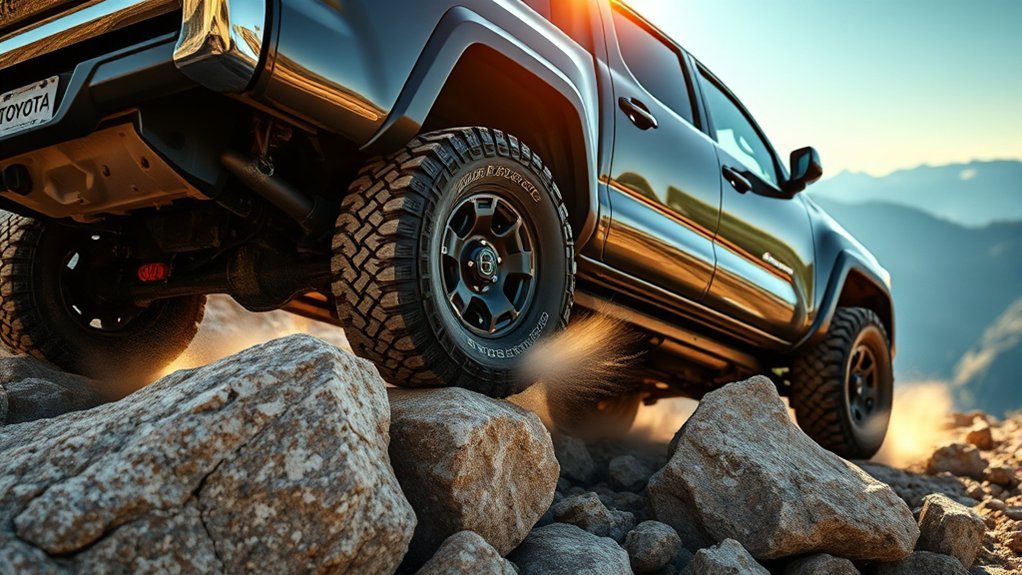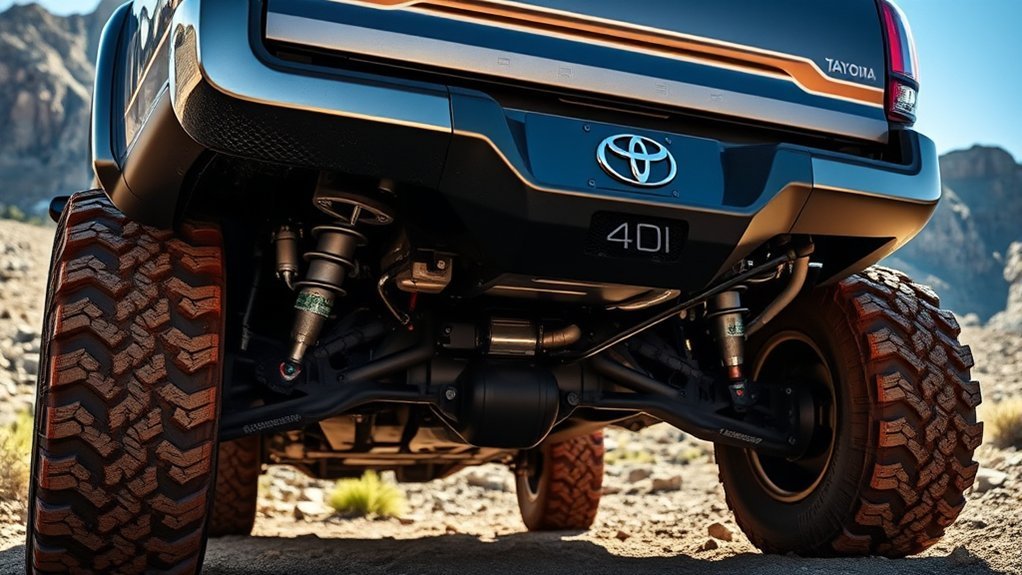
The Toyota Tacoma’s 4WD system lets you tackle various terrains with ease. You can engage Four High while moving at speeds up to 65 mph, but Four Low requires a complete stop and shifting into neutral. This system enhances your control off-road, thanks to features like Multi-Terrain Select and Downhill Assist Control. Regular maintenance, such as tire rotation and checking for vibrations, is essential for peak performance. Stick around to discover tips and insights for maximizing your 4WD experience!
How The 2024 Tacoma’s 4WD System Works
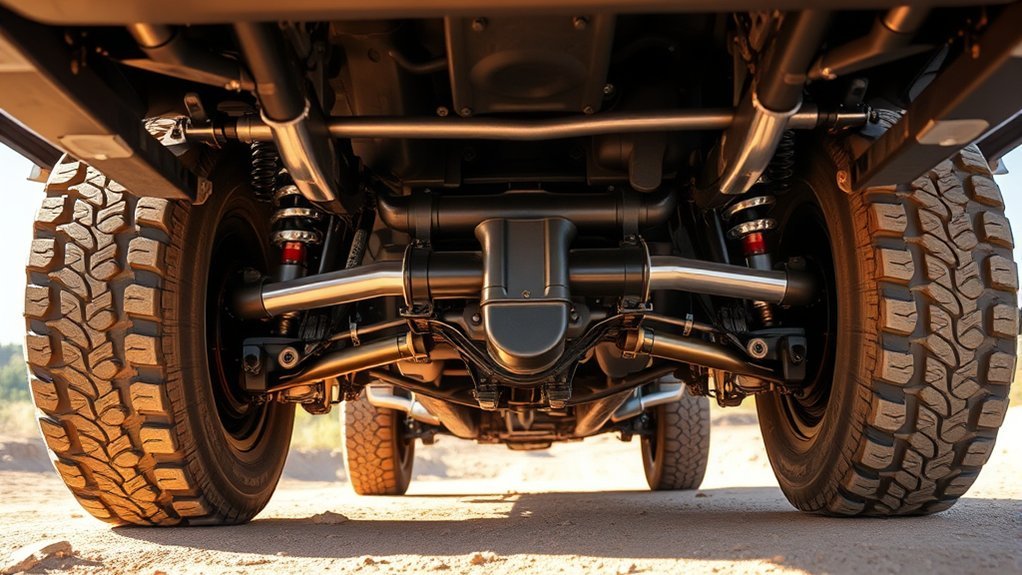
The 2024 Toyota Tacoma’s 4WD system is designed to give you peak control and performance in various driving conditions. With options for engaging four high and four low, this system guarantees ideal four-wheel performance when you need it most. To activate four high, simply keep your speed under 65 mph; it’s that easy. If you require more traction management, shift into four low by stopping, switching to neutral, and pressing the release button. Disengaging four low is just as straightforward—come to a complete stop, shift back to neutral, and return to four high. This intuitive system, combined with features like multi-terrain select and downhill assist control, enhances your off-road capabilities, allowing you to navigate diverse landscapes with confidence. Embrace the freedom of exploration, knowing your Tacoma is equipped to handle whatever comes your way.
How To Engage Four High
Engaging Four High in your 2024 Toyota Tacoma is a straightforward process that enhances traction in slippery conditions. To effectively engage, you need to be in motion; attempting this while stationary will cause the indicator light to blink. Make sure you’re driving at a speed of 65 mph or less as you shift the transmission into drive and move forward. This movement is vital for proper engagement.
Mastering these engagement techniques not only improves your handling in off-road scenarios but also helps you tackle traction challenges with ease. Regular practice of engaging Four High is essential for maintaining your 4WD system’s functionality and preventing mechanical issues over time. Embrace the freedom of your Tacoma by confidently switching to Four High, ensuring you’re ready for whatever terrain lies ahead.
How To Safely Switch To Four Low
Mastering Four High sets the stage for tackling more challenging terrains, which is where Four Low comes into play. To safely switch to Four Low in your 2024 Toyota Tacoma, follow these steps for ideal traction management and drivetrain safety:
- Confirm you’re in Four High and come to a complete stop.
- Shift into neutral.
- Press the release button on the shift lever while in neutral.
- Look for engagement indicators; yellow lights on the dashboard confirm your shift into Four Low.
- Avoid engaging Four Low on non-slippery surfaces to prevent drivetrain binding.
Disengaging Four Low: Essential Steps

To disengage Four Low effectively, you need to come to a complete stop and shift your transmission into neutral. Once in neutral, switch from Four Low back to Four High, ensuring a smooth changeover. If the Four Low indicator light keeps blinking, simply shift back into drive and move forward to finalize the disengagement.
Proper Stopping Procedure
When you need to disengage Four Low in your 2024 Toyota Tacoma, it’s essential to follow the proper stopping procedure to secure smooth operation of the 4WD system. Adhering to these stopping techniques guarantees safety precautions are met:
- Come to a complete stop.
- Shift the transmission into neutral.
- Move the selector back to Four High.
- If the Four Low indicator light blinks, shift into drive and move forward while keeping the steering straight.
- Avoid engaging Four Low on non-slippery surfaces to prevent binding issues.
Engaging After Disengagement
Engaging Four Low after you’ve successfully disengaged it is vital for maintaining peak performance in your Toyota Tacoma. To disengage Four Low, first come to a complete stop and shift your transmission to neutral. Then, move the selector back to Four High. If the yellow lights keep blinking, shift back to drive and move forward to finalize the disengagement. Remember, maintaining straight steering is essential during this process to avoid binding issues. It’s also important to use proper shifting techniques and only engage Four Low under suitable driving conditions—ideally on slippery surfaces—to prevent mechanical problems. Following these steps will guarantee a smooth change and keep your Tacoma running efficiently out on the road.
How Multi-Terrain Select Enhances Off-Road Capability
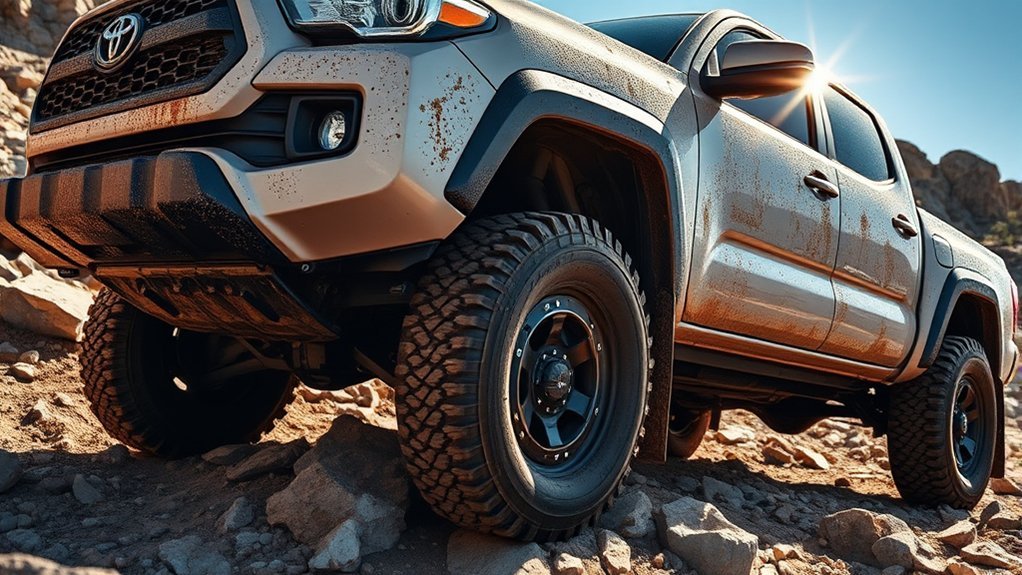
Multi-Terrain Select revolutionizes your off-road experience by allowing you to choose from various terrain modes, such as mud, sand, and rock. This system enhances your off-road confidence by optimizing traction and ensuring vehicle stability on diverse surfaces. By automatically adjusting engine output, transmission settings, and traction control, it provides seamless terrain adaptability.
- Navigate challenging landscapes with ease
- Reduce the risk of getting stuck
- Enjoy tailored responses to varied conditions
- Enhance control and handling on rugged terrains
- Experience a smoother ride in off-road adventures
With Multi-Terrain Select, you’ll feel empowered to tackle any environment, knowing your Tacoma is equipped to handle it. This technology not only boosts traction optimization but also elevates your overall driving experience, allowing you to explore with freedom and assurance. So, gear up and embrace the thrill of off-roading like never before!
Benefits Of Downhill Assist
When you tackle steep descents in your Toyota Tacoma, Downhill Assist Control gives you enhanced control and safety. This feature automatically manages braking at each wheel, helping you maintain traction on slippery surfaces. By focusing on steering instead of braking, you can navigate rugged terrain with confidence.
Enhanced Control On Slopes
As you tackle steep slopes in your Toyota Tacoma, the Downhill Assist Control feature proves invaluable for maintaining a steady pace. This system automatically applies the brakes to prevent rapid acceleration, enhancing your control during slope traversal. You can activate it easily with a button, allowing you to focus on steering and maneuvering obstacles without distraction.
Here are some benefits of using Downhill Assist:
- Maintains a steady speed on steep descents
- Enhances traction management on uneven terrain
- Keeps you focused on steering
- Provides a more confident off-road experience
- Increases overall safety during challenging inclines
With these advantages, you can embrace the freedom of off-roading without the worry of losing control.
Safety During Descents
While traversing steep or slippery descents, your safety is paramount, and the Downhill Assist Control feature in the 2024 Toyota Tacoma offers essential support. This system enhances your descent strategies by automatically applying brakes, keeping your vehicle from rolling too quickly. You can focus on steering without stressing over braking techniques, allowing for a smoother ride. Engaging when the vehicle is in four low, Downhill Assist boosts traction and stability on rugged terrains, making it invaluable in off-road situations. It prevents wheel lock-up and skidding, ensuring you navigate challenging landscapes with confidence. Embrace the freedom of exploration, knowing that safety’s on your side with this innovative feature.
Debunking Common 4WD Myths
Many misconceptions surround the Toyota Tacoma’s 4WD system, leading to confusion and potential issues for drivers. Here are some key points to clarify these 4WD misconceptions:
- You can’t engage 4WD while stationary; the Tacoma needs motion for four high engagement.
- Vibrations on dry pavement usually signal drivetrain stress, not pavement use.
- Part-Time 4WD isn’t meant for dry surfaces; it can cause damage during sharp turns.
- Many vibration complaints arise from improper tire rotation or mismatched tire sizes, not mechanical failures.
- Engaging 4WD on slippery surfaces is essential for peak performance; failing to do so can lead to serious problems.
Preventing Vibration Issues In 4WD
To keep your Tacoma’s 4WD system running smoothly, you need to pay attention to proper tire rotation and understand drivetrain mechanics. Regularly rotating your tires helps prevent uneven wear, which can lead to vibrations. Plus, knowing how your differential and transfer case work will make it easier to spot potential issues before they escalate.
Proper Tire Rotation
Proper tire rotation is crucial for maintaining your Toyota Tacoma’s balance and performance, especially in a 4WD system. Regularly rotating your tires helps prevent uneven wear, which can lead to vibration issues and negatively impact your vehicle’s driveline. Aim to rotate your tires every 5,000 to 7,500 miles to maximize tire lifespan and guarantee peak performance.
- Prevents uneven tread wear
- Reduces vibration causes
- Enhances traction and stability
- Improves handling on varied terrains
- Avoids misattributing vibrations to drivetrain issues
Understanding Drivetrain Mechanics
Understanding the intricacies of your Tacoma’s drivetrain mechanics is essential for preventing vibration issues in its 4WD system. Engaging Part-Time 4WD on dry surfaces can cause vibrations due to stressed drivetrain components, not the pavement itself. Proper tire rotation and matching sizes help mitigate uneven wear, which can lead to additional vibration causes.
| Drivetrain Component | Potential Vibration Cause |
|---|---|
| Differentials | Incorrect engagement or wear |
| Transfer Case | Lack of lubrication or damage |
| Tires | Mismatched sizes or uneven wear |
Many vibration complaints stem from user errors with the 4WD system. By understanding these mechanics, you can enhance your Tacoma’s performance and ride quality.
Maintenance Practices For Your 4WD System
Maintaining your Toyota Tacoma’s 4WD system is essential for guaranteeing peak performance and longevity. A proactive approach to maintenance will keep your vehicle ready for adventure. Here are some key practices to follow:
Keeping your Toyota Tacoma’s 4WD system well-maintained ensures optimal performance and readiness for any adventure ahead.
- Engage your 4WD system for at least 10 miles each month, especially on wet roads, to guarantee proper 4WD engagement.
- Rotate your tires regularly to maintain balance and ideal 4WD operation across various surfaces.
- Check tire pressure frequently; under-inflated tires can affect traction and drivetrain care.
- Use bumpy roads for engagement with older models that aren’t frequently used, to prevent mechanical issues.
- Regularly inspect mechanical levers and knobs to avoid them getting stuck, guaranteeing smooth operation.
User Feedback On Tacoma’s 4WD Experience
How do Tacoma owners really feel about their 4WD experience? Many drivers report high satisfaction, especially when tackling off-road adventures or maneuvering slick winter roads. However, user misconceptions often lead to complaints, particularly regarding vibrations when engaging 4WD on dry pavement. It’s essential to understand that these issues often stem from driver experiences rather than mechanical faults. Proper tire maintenance and rotation are vital to enhance your 4WD performance, as well as understanding the specifications of any modifications you make, like lift kits. Many owners discover that vibrations can arise from these alterations if not managed correctly. Ultimately, the key to a smooth 4WD experience lies in mastering engagement techniques and staying informed about your vehicle’s needs. With the right approach, you can reveal the full potential of your Tacoma’s 4WD system.
Frequently Asked Questions
What Are the Different 4WD Modes Available in the Tacoma?
In the Tacoma, you’ve got options like 2WD, 4WD High, and 4WD Low. These modes enhance off-road capabilities and support terrain management, letting you tackle diverse landscapes with confidence and freedom. Enjoy the adventure!
Can I Use 4WD on Pavement?
You shouldn’t use 4WD on pavement; it can cause wear and tear. While 4WD offers advantages like traction, its limitations on hard surfaces can lead to handling issues. Stick to it for off-road adventures instead!
How Does the Tacoma’s 4WD Compare to Competitors?
When you’re choosing a truck, consider this: Tacoma’s advantages lie in its robust 4WD system, often outshining competitor features. It’s designed for versatility and performance, ensuring you’re ready for any adventure ahead.
What Should I Do if the 4WD Indicator Light Stays On?
If your 4WD indicator light stays on, check for low fluid levels or malfunctioning sensors. Follow 4WD troubleshooting tips and consult a mechanic if the issue persists; it could indicate more serious underlying causes.
Are There Any Towing Restrictions With 4WD Engaged?
Engaging 4WD while towing can feel like releasing a beast! However, it’s essential to check your vehicle’s towing capacity. Remember, off-road performance may suffer, so always follow guidelines for safe towing practices.
Conclusion
In the world of off-roading, your Tacoma’s 4WD system is like a trusty compass, guiding you through rugged terrain and unpredictable conditions. By mastering its features, you not only enhance your driving experience but also forge a deeper connection with the road ahead. Just as a compass requires regular calibration, maintaining your 4WD system guarantees reliable performance. Embrace the journey, and let your Tacoma lead the way into uncharted adventures, where every path becomes a story waiting to be told.