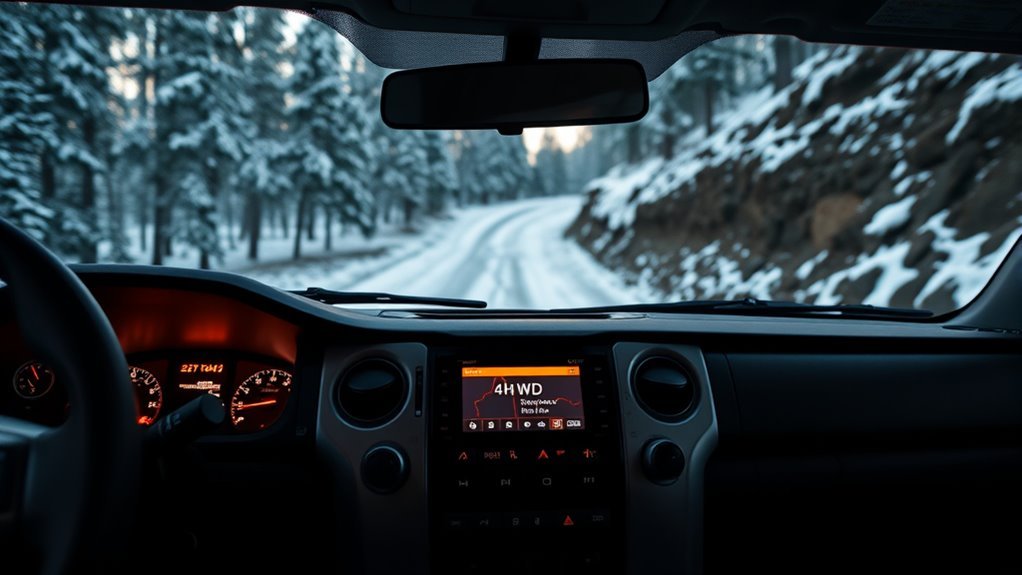
Use 4HI when you need higher-speed traction on slippery pavement or hard-packed snow and trails—it’s good up to about 55–70 mph and reduces wheel slip without heavy drivetrain stress. Switch to 4LO for low-speed, high-torque situations like deep mud, sand, steep climbs or technical rock crawling—keep it under about 15–30 mph and rely on engine braking. Shift properly and cycle modes to avoid binding; continue below to get shifting steps, techniques, and maintenance tips.
Quick Decision: 4HI Or 4LO (One‑Line Rule)

Need help deciding 4HI or 4LO? You pick 4HI when you need traction and speed on slippery, hard-packed surfaces—snow, ice, or packed gravel—up to about 70 mph; that balances control and momentum, showcasing 4HI benefits for confident cruising. Use 4LO only for low-speed, high-torque situations under ~30 mph: deep mud, sand, steep climbs, or when you’re crawling over obstacles. Don’t use 4HI on dry pavement—drivetrain binding will punish tight turns and parking, so shift back to 2WD for those maneuvers. Changing is simple: let off the gas briefly when moving between 2WD and 4HI to smooth engagement as conditions change. Be mindful of 4LO drawbacks—limited speed and drivetrain strain if misused—so reserve it for extreme, low-speed work. Choose based on speed and terrain: higher-speed slippery surfaces get 4HI; extreme low-speed torque needs get 4LO. Trust that rule and move with freedom.
What 4HI Does
In 4HI you get increased front-to-rear traction by locking the center differential so both axles share torque. You can maintain higher speeds on slippery surfaces—typically up to highway speeds—while retaining better directional control than 2WD. Don’t expect the low-end torque multiplication of 4LO, so use 4HI when grip and speed matter more than crawling power.
Increased Traction Front-To-Rear
When roads get slick, engage 4HI to split torque evenly between the front and rear wheels so you’ll maintain traction across all four corners. You’ll get clear traction improvement in slippery conditions: 4HI locks the center differential, sends equal power front-to-rear, and reduces wheel slip on snow, ice, mud, or loose dirt. Use it for active snow and icy roads where you may still travel at speed, and run 4HI regularly to keep the system free-moving and reliable. Expect binding during tight turns—it’s normal and shows the system prioritizes grip over nimble steering.
| Benefit | Condition | Note |
|---|---|---|
| Equal torque | Snow/ice | Maintains forward drive |
| Reduced slip | Mud/dirt | Better stability |
| Regular use | All seasons | Prevents freezing |
Higher-Speed Slippery Control
Although you’ll still be driving at speed, switch to 4HI to engage all four wheels and keep traction up to about 70 mph on snow, ice, wet roads, gravel, or loose mud. 4HI locks the center differential to split torque front-to-rear, reducing wheel spin during acceleration and improving straight-line stability; expect a slight binding feel in sharp turns because the driveline is prioritizing grip over free steering. You’ll notice improved snow performance and more predictable steering inputs when you need to maintain momentum. Use 4HI for highway-speed slippery control and loose surfaces where steady speed avoids hazards. Routine use in winter preserves the 4WD mechanism and aids traction management, freeing you to move confidently without overstressing the system.
Limited Torque Multiplication
Because 4HI balances power between the front and rear drives, it gives you limited torque multiplication that boosts traction without the low-speed gearing of 4LO. You get just enough limited torque to pull through snow, mud, or loose gravel while preserving drivetrain efficiency and allowing higher speeds. Engaging the center differential lets wheels slip appropriately during turns, reducing binding and tire wear compared with 4LO. Use 4HI when you need traction at pace—up to highway speeds—without sacrificing control.
| Benefit | Effect |
|---|---|
| Traction boost | Better grip on slippery surfaces |
| Speed range | Safe operation up to ~70 mph |
| Wear & efficiency | Lower tire wear; improved drivetrain efficiency |
When To Use 4HI (Examples & Speed Limits)
If you’re driving on snow or ice, engage 4HI to boost traction and stability—it’s suitable for speeds up to about 70 mph on slippery surfaces and especially useful on hard-packed snow, icy roads, or steep mountain approaches like ski-resort access. In snowy conditions and on icy surfaces, 4HI distributes torque to maintain directional control while allowing necessary wheel slip; that balance prevents drivetrain binding you’d get on dry pavement. Shift in and out of 4HI below 50 mph when possible to reduce engagement shock and wear. Use 4HI for highway-speed travel over continuous slick patches, for hard-packed snow trails, and for ascending or descending moderate inclines where traction, not torque multiplication, is the priority. Avoid 4HI on dry asphalt or in tight, high-traction turns; doing so pins the driveline and creates stress. Employ 4HI as a tactical tool—move freely through winter terrain but switch out when surfaces regain grip.
What 4LO Does

When you engage 4LO you get a significant low-speed torque boost that lets the Tundra crawl over steep, slippery, or uneven terrain without wheel spin. It also uses lower gear ratios to amplify engine braking, giving you more control on descents. Use it only at low speeds to avoid excess heat and drivetrain strain.
Low-Speed Torque Boost
Engage 4LO to get a large, controlled torque increase at low speeds — it sends more power to the wheels through lower gear ratios so the engine can hold higher RPMs without you speeding up, which is essential for crawling over obstacles, starting in deep snow or mud, and climbing steep pitches. You’ll exploit low speed advantages: higher torque at the wheels reduces wheel spin and gives precise, steady acceleration from a standstill. Use 4LO below about 15 mph to maintain traction and control when torque management matters most. The gearbox multiplies engine torque, letting you modulate throttle input for deliberate progress over terrain. That control frees you from panic braking or aggressive throttle, keeping momentum and confidence while maneuvering through demanding conditions.
Engine Braking Assistance
After using 4LO for low-speed torque, you’ll also rely on it for controlled engine braking on steep descents. 4LO’s lower gear ratios raise engine RPMs and multiply drivetrain resistance, letting the engine slow the truck without heavy brake input. You gain consistent engine performance and improved braking efficiency, so you can descend deliberately and preserve your brakes.
- Use 4LO on steep, rocky inclines to maintain steady speed and avoid reliance on the pedal.
- Let higher RPMs and drivetrain resistance prevent wheel lock-up and stabilize the vehicle.
- Employ 4LO where gradual speed reduction and precise control are essential for safety.
Engage 4LO proactively; it frees you from constant brake modulation and lets terrain dictate pace.
When To Use 4LO (Examples & Speed Limits)
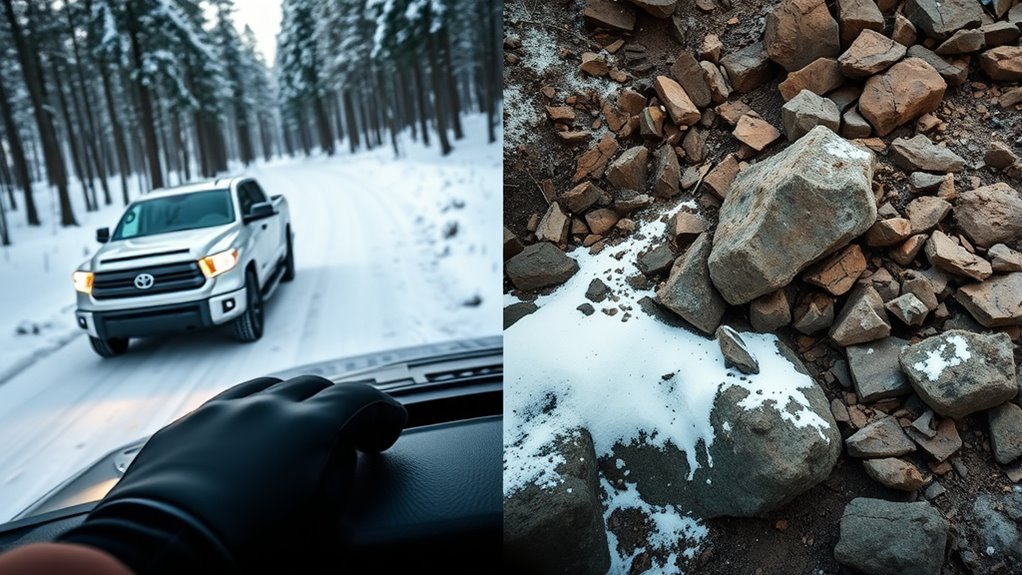
If you’re tackling steep, technical terrain or stuck in deep mud or snow, shift into 4LO to get maximum torque and controlled, low-speed power—generally keep speeds under about 15 mph. Use 4LO scenarios when you need deliberate crawling: climbing loose rock pitches, picking your way through root-strewn trails, or extracting the truck from deep ruts. 4LO reduces wheel spin during acceleration, giving you traction challenges management without overheating drivetrain components.
Apply 4LO for steep descents too; the increased engine braking lets you control speed and save your brakes. Because lower gear ratios lower transmission stress, you can crawl over obstacles with less risk of gearbox shock. Don’t use 4LO for highway or moderate off-road speeds—its torque and gearing are optimized for low-speed, high-traction work. When conditions demand maximum traction and control, engage 4LO and move deliberately; it’s your tool for liberation from terrain that would otherwise stop you.
How To Shift Between 2H, 4HI, And 4LO Safely (Step‑By‑Step)
Shift smoothly between 2H, 4HI, and 4LO by following specific speed and gear steps to avoid drivetrain shock and binding. You’ll use clear shifting techniques to preserve freedom on and off road while minimizing drivetrain strain. To engage 4HI, keep speed under 50 mph, let off the gas briefly, then turn the switch or lever to 4HI; engagement is immediate. To return to 2H, drive straight, release throttle briefly, and switch back to avoid binding. To enter 4LO, stop fully, shift the transmission to neutral, then select 4LO; only use it for low-speed maneuvers.
- Always pause throttle momentarily when switching between 2H and 4HI.
- Stop and select neutral before engaging 4LO.
- Maintain a straight path when disengaging 4HI to prevent binding.
Consult your owner’s manual for model-specific limits. These steps are technical, direct, and enable confident, liberated control of your Tundra.
Driving Technique: Cornering, Throttle & Braking In 4HI Vs 4LO
Now that you know how to move between 2H, 4HI and 4LO, you’ll also need to adjust how you steer, modulate throttle, and apply brakes in each mode. In 4HI use cornering techniques that favor wider arcs and controlled speed — you can sustain up to about 55 mph, but let off the gas briefly entering turns to reduce drivetrain strain and prevent binding on tight, dry-radius maneuvers. Your braking methods in 4HI should be smooth and progressive to maintain traction.
In 4LO adopt an entirely different mindset: keep speeds under 15 mph, prioritize slow, deliberate steering, and employ precise throttle control. Apply throttle gradually to exploit maximum torque without inducing wheel spin in sand or mud; abrupt inputs transfer shock into the drivetrain. On descents rely more on engine braking and light, measured brake inputs to avoid lockup and overheating. These practical adjustments free you to push terrain limits while protecting mechanicals.
Common Mistakes, Troubleshooting & Tundra 4WD Maintenance
When you rely on your Tundra’s 4WD, common mistakes—like running 4HI on dry pavement, neglecting regular mode cycling, or using improper tire pressures—quickly translate into drivetrain binding, premature wear, and reduced off‑road capability. You’ll avoid damage by reserving 4HI for slippery surfaces, using 4LO only for low‑speed extreme conditions, and following your owner’s manual for shift speeds. Troubleshooting techniques should start with simple checks: confirm tire pressure, cycle 2WD/4HI/4LO, and listen for unusual noises.
- Check tire pressure and adjust for conditions (street vs off‑road).
- Cycle modes regularly to keep transfer case and actuators functional.
- Inspect for leaks, worn u‑joints, and abnormal vibration.
Use maintenance tips and scheduled seasonal checks to liberate your vehicle from breakdowns: change fluids per spec, inspect drivetrain mounts, and tighten lug nuts. These practical steps focus drivetrain care, reduce failures, and keep you confident off the beaten path.
Frequently Asked Questions
When to Use 4H and 4L Tundra?
Use 4H for slippery roads or light off road performance at speed; switch to 4L for low-speed crawling, deep mud or steep grades to maximize torque and towing capacity. Don’t use 4WD on dry pavement.
What Mph Should You Turn 4HI on Tundra?
Think of 4HI as a reliable anchor: you’ll engage it up to about 70 mph, but you’ll usually shift below 50 mph for smoother changes. Mention 4HI benefits and 4HI limitations when choosing engagement.
Conclusion
Remember the one-line rule: use 4HI for slippery high-speed situations and 4LO for low-speed, high-torque needs. 4HI keeps you stable on wet, snowy, or loose surfaces up to highway speeds; 4LO gives max traction and engine braking for steep, rocky, or deep-mud climbs under 25 mph. Shift using the procedure above to avoid drivetrain stress. Example: a driver switched to 4LO on a steep, rutted trail and crawled past a washed-out section without burning the clutch—practical, safe, effective.