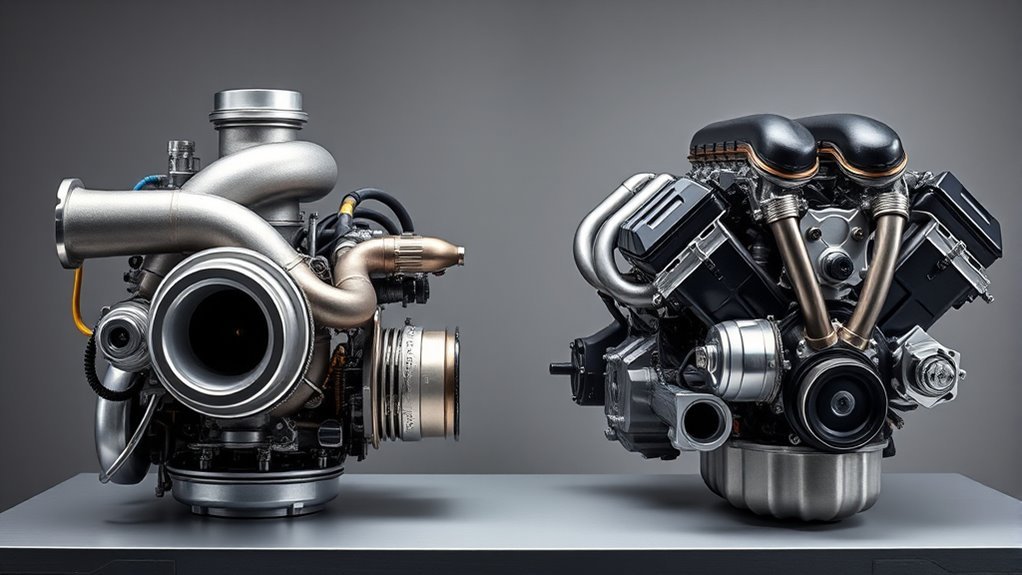
You’ll pick turbocharged if you want compact, high‑output efficiency and stronger low‑end torque from a smaller displacement; the turbine forces extra air for higher volumetric efficiency and better high‑altitude performance but adds complexity, stricter oil care, and potential repair costs. You’ll pick naturally aspirated if you want immediate, linear throttle response, simpler maintenance, and often longer life with fewer failure points. Keep going and you’ll get detailed comparisons of performance, maintenance, costs, and suitability.
How Turbo and Naturally Aspirated Engines Work
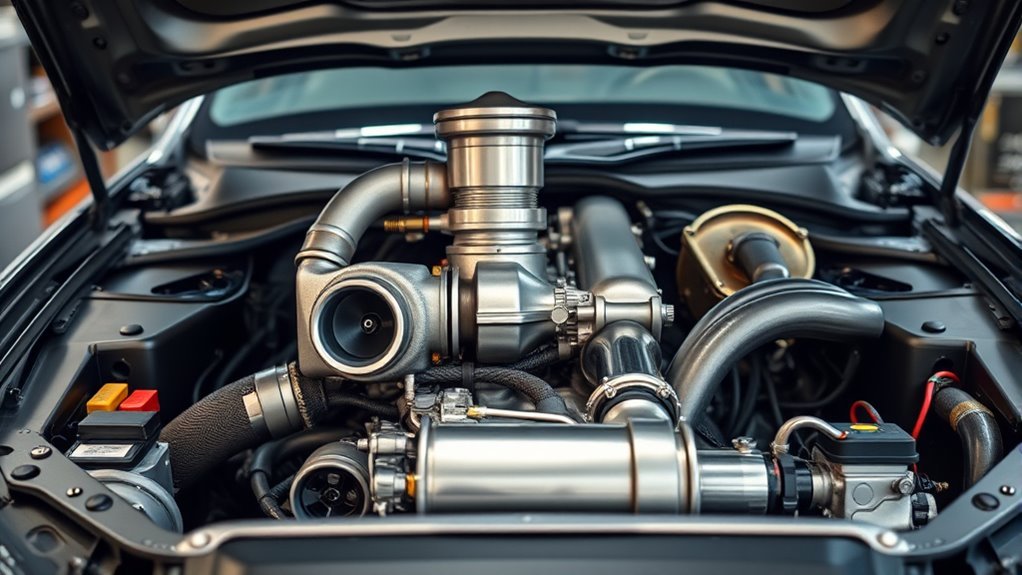
Although both engine types compress an air-fuel mixture for ignition, they do so by different means: a turbocharged engine uses exhaust-driven turbine and compressor stages to force extra air into the cylinders, increasing oxygen density and power for a given displacement, while a naturally aspirated engine depends on atmospheric pressure and the piston’s downward stroke to draw air in, yielding direct, linear throttle response without turbo lag. You’ll see that turbocharged systems raise volumetric efficiency via forced induction, so smaller displacement delivers higher peak power and improved engine efficiency under load, though transient response can lag as the turbine spools. You’ll also find naturally aspirated layouts favor predictable, immediate throttle feel and consistent performance characteristics across rev ranges, with simpler breathing dynamics and lower system complexity. When you evaluate either, weigh the trade-offs: turbocharging optimizes compact power and efficiency; natural aspiration preserves linear control and simpler maintenance, aligning mechanical freedom with your driving intent.
Quick Decision Guide: Which Engine Fits Your Needs?
Want a clear rule of thumb to pick between turbocharged and naturally aspirated engines? You want performance with efficiency and are comfortable with more maintenance, pick turbocharged: it delivers higher power from smaller displacement, better fuel economy, and maintains output at altitude. Prefer immediate throttle response, simpler upkeep, and evocative engine sound, pick naturally aspirated: it’s mechanically straightforward and reliably predictable.
| Priority | Recommendation |
|---|---|
| Fuel efficiency + power | Turbocharged |
| Instant throttle response | Naturally aspirated |
| Mechanical simplicity | Naturally aspirated |
| High-altitude performance | Turbocharged |
Assess your use: if you crave liberation through sustained power, turbocharged gives scalable boost when you demand it. If you seek liberation through direct control and pure engine sound feedback, naturally aspirated grants linear throttle response and lower maintenance complexity. Choose based on which form of freedom you value: boosted versatility or tactile, reliable engagement.
Turbo vs Naturally Aspirated: Power, Torque & Altitude
When you compare turbocharged and naturally aspirated engines on power, torque and altitude performance, the turbo wins for outright output and altitude resilience by compressing intake air to force more fuel into smaller displacement, yielding higher torque—often at lower RPMs—and better fuel efficiency; naturally aspirated engines, however, deliver immediate throttle response and a linear—predictable—power curve, but they lose power as altitude reduces air density. You’ll find turbos deliver superior peak power and torque density, allowing smaller engines to match or exceed larger NA units while reducing vehicle mass and improving boost efficiency. At elevation, turbochargers compensate for reduced atmospheric pressure, maintaining usable power where NA engines steadily fall off. You should expect torque to arrive earlier in the rev range with a turbo, improving acceleration and liberation from rpm hunting, while NA engines reward precise throttle control with instantaneous throttle response and a more transparent power delivery. Choose based on mission: altitude and efficiency favor turbo; raw immediacy favors naturally aspirated.
Ownership: Common Failures, Maintenance Schedule & Lifespan
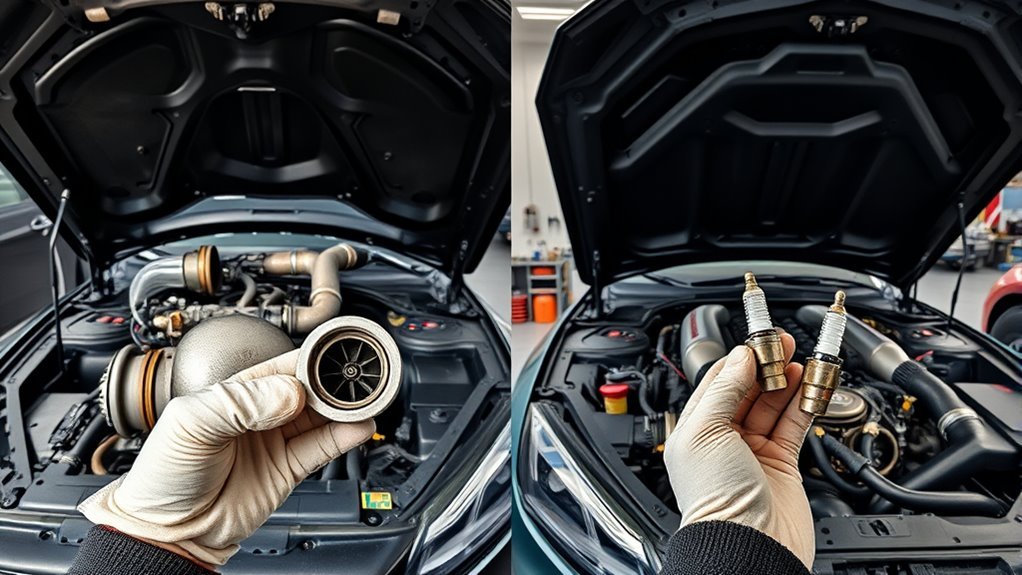
If you own a turbocharged car, expect a stricter maintenance rhythm and targeted inspections compared with a naturally aspirated (NA) vehicle: turbos run hotter and spin faster, so you’ll change oil every ~5,000–7,500 miles, monitor oil pressure and feed lines, and inspect the turbocharger, intercooler, and boost control plumbing regularly to avoid oil-starvation or overheating failures; NA engines, with fewer high-speed rotating parts and lower thermal stress, typically follow simpler schedules (oil and air-filter changes every ~7,500–10,000 miles) and often reach 200,000+ miles with routine care.
You’ll prioritize maintenance tips that reduce turbocharger failures: high-quality oil, timely changes, warm-up/cool-down habits, and regular inspections of seals, housings, and intercooler plumbing. Operational stress shortens component life; manage boost responsibly. NA engines grant greater engine longevity under routine service and lower inspection burden. Table below contrasts common failure points, interval focus, and longevity expectations to help you choose maintenance regimes that free you from avoidable breakdowns.
| System | Common Failure | Interval Focus |
|---|---|---|
| Turbocharged | Turbocharger failures | 5k–7.5k mi oil |
| NA | Intake wear | 7.5k–10k mi oil |
| Both | Seals/plumbing | Inspect regularly |
Cost Comparison: Buy Price, Fuel Costs & Repair Risks
Although turbocharged cars often cost more up front due to added components and engineering, they can deliver lower fuel bills over time by extracting more power from less displacement; you should weigh that initial premium against likely higher repair and maintenance exposure from the turbo system, which raises both the probability and cost of component failures compared with simpler naturally aspirated engines. You’ll usually pay less for an NA car at purchase because its architecture is simpler and manufacturing costs are lower. Turbo engines improve cost efficiency in operational use: they can burn less fuel for equivalent output, yielding measurable long term savings in fuel expenditure and emissions compliance. However, turbo systems introduce additional failure modes—worn bearings, oil contamination, boost control faults—and repair bills tend to be higher and more frequent. If you value liberation from recurring costs and want predictable ownership, an NA engine minimizes repair risk. If you prioritize operational efficiency and accept higher maintenance exposure, a turbo can be the rational choice.
Frequently Asked Questions
Should I Avoid a Turbocharged Engine?
Not necessarily; you should weigh turbo reliability versus performance gains, since you’ll accept higher maintenance costs and more careful servicing for greater power and efficiency, but you’ll avoid it if you want simplicity and immediate throttle response.
Do NA Engines Last Longer Than Turbo Engines?
Absolutely — NA engines generally last longer than turbos. You’ll gain better engine longevity in performance comparison terms; simpler designs reduce stress and maintenance, freeing you from frequent rebuilds and preserving long-term reliability.
Which Is Better Naturally Aspirated v8 or V6 Turbo?
You’ll choose based on goals: performance comparison favors V6 turbo for higher peak power and engine efficiency, while naturally aspirated V8 gives linear throttle, simpler maintenance, iconic sound—pick freedom: raw feel or efficient, punchy performance.
Conclusion
You’ve seen how turbos force more air while naturally aspirated engines breathe freely; now decide by your priorities. Think of a turbo as a tightly wound spring—compact, potent, but needing careful handling—while an NA engine is a steady heart that’s simpler to read and repair. Choose based on driving style, altitude, and tolerance for maintenance and repair risk. Keep service regular, monitor boost or compression, and you’ll get reliable power for years.