You should use DOT 4 in your Toyota Tundra for better heat resistance, firmer pedal feel, and OEM-specified performance; it has higher dry/wet boiling points than DOT 3, so it resists vapor lock and fade during heavy loads. Both fluids are glycol-based and hygroscopic, so you’ll need a full flush and bleed every 12–24 months to limit moisture and corrosion. Don’t mix with DOT 5 silicone, and keep looking for service and compatibility details below.
Quick Answer: DOT 3 or DOT 4 for Your Tundra?
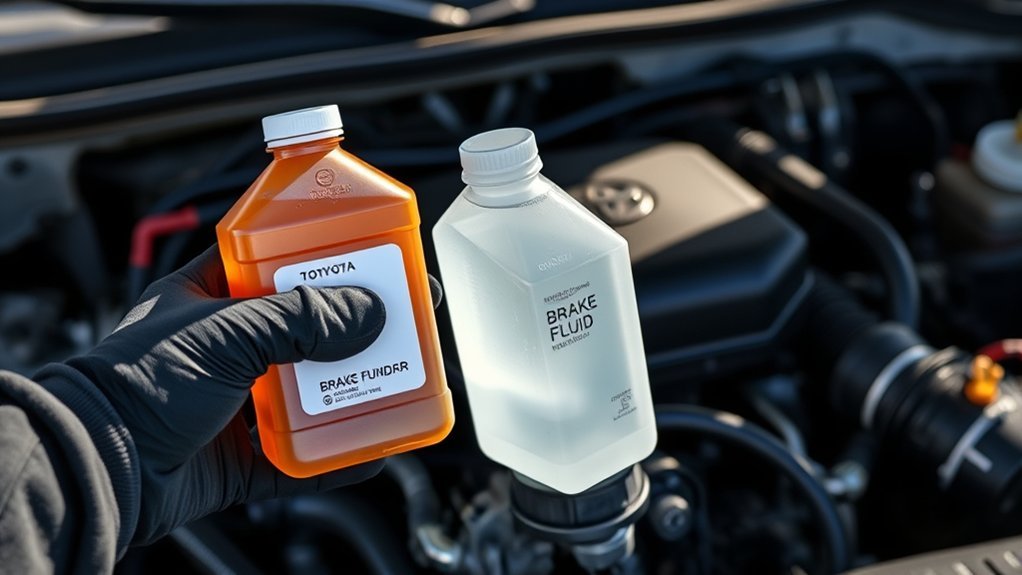
Most Tundras use DOT 4 brake fluid; it has a higher boiling point than DOT 3 and handles heavier, repeated braking without vapor lock, so you should prefer DOT 4 when replacing or topping up fluid. You’ll find DOT 4 is backwards compatible with DOT 3, so switching won’t harm systems built for DOT 3. For Tundra maintenance, prioritize regular fluid changes: flush DOT 4 every 1–2 years to remove absorbed moisture and preserve hydraulic integrity. Owners report crisper pedal feel and improved stopping under load after upgrading from DOT 3 to DOT 4, which matters if you tow, haul, or drive aggressively. Don’t use DOT 5 silicone fluid in a Tundra with ABS; it can introduce compatibility and performance failures. Your objective is freedom from failure: choose DOT 4, schedule consistent flushing, and inspect lines and reservoirs for contamination. That disciplined approach to brake fluid and Tundra maintenance keeps your braking system reliable and the vehicle under your control.
How DOT 3 and DOT 4 Differ: Boiling Point, Chemistry, Moisture
You’ll notice DOT 4 has higher dry and wet boiling points than DOT 3, giving better resistance to vapor lock under heavy braking. Both fluids are glycol-based, but DOT 4 includes stabilizing additives that improve high-temperature performance. Keep in mind DOT 4 absorbs moisture faster than DOT 3, which lowers its boiling points over time and shortens service intervals.
Boiling Point Differences
Because braking generates heat rapidly, the fluid’s boiling point determines how reliably your Tundra will stop under heavy loads. You’ll see DOT 3 at about 205°C dry / 140°C wet and DOT 4 at roughly 230°C dry / 155°C wet. Those higher DOT 4 values directly improve brake performance during towing, steep descents, or repeated stops, reducing vapor formation and fade. DOT 4’s additives raise resistance to thermal breakdown, extending effective fluid longevity under stress, but it still absorbs moisture faster than DOT 3, so you’ll need more frequent changes to preserve those boiling-point benefits. You can upgrade to DOT 4 for tougher duty, but don’t downgrade from DOT 4 to DOT 3 if you want consistent, liberated stopping power.
Chemical Makeup & Moisture
1 key difference you should know is chemistry: DOT 3 is a glycol-ether–based fluid, while DOT 4 uses similar glycol roots but adds proprietary additives that raise its dry and wet boiling points and improve short-term thermal stability. You’ll value the chemical properties: DOT 3 has a dry boiling point ~205°C (401°F) and wet ~140°C (284°F); DOT 4’s dry ~230°C (446°F) and wet ~155°C (311°F). Both are hygroscopic, so moisture ingress lowers boiling points and degrades fluid performance. DOT 4 absorbs moisture faster but retains higher wet boiling characteristics, making it better for demanding use if you maintain it. Test moisture content regularly and replace fluid per service intervals to preserve braking reliability and your freedom to push driving limits.
What Toyota Recommends for the Tundra (And Why It Matters)
When towing or driving hard, Toyota specifies DOT 4 brake fluid for the Tundra because its higher boiling point resists vapor lock and preserves pedal feel under heavy braking. You should follow that guidance: it’s rooted in brake system maintenance and fluid performance analysis showing DOT 4 reduces fade risk and protects ABS functionality. Change fluid every two years to limit moisture ingress and corrosion; that schedule sustains performance and component longevity.
- DOT 4 offers higher wet/dry boiling points, improving braking consistency during sustained heavy use.
- Toyota’s two-year service interval mitigates hygroscopic absorption, maintaining hydraulic pressure integrity.
- Backward compatibility with DOT 3 lets you upgrade without hardware changes, empowering smarter choices.
- Using the recommended fluid preserves ABS calibration and reduces pedal-loss incidents, lowering repair costs.
Adopt Toyota’s spec to maximize safety, retain system integrity, and liberate yourself from preventable failures through disciplined maintenance.
Compatibility: What Not to Mix With DOT 3/Dot 4
Don’t mix DOT 3 or DOT 4 with DOT 5 silicone fluid — it’s chemically incompatible and can cause seal swelling and brake failure. Be especially cautious with ABS systems, where silicone’s immiscibility and lack of moisture absorption can produce air pockets and erratic modulation. Also avoid substituting DOT 5.1 without a full system flush and confirming the manufacturer’s specification.
Avoid DOT 5
Because DOT 5 is silicone-based and chemically incompatible with the glycol-based DOT 3 and DOT 4, you must never mix them in a Toyota Tundra’s brake system. You need clear brake fluid compatibility knowledge to keep control and avoid silicone based issues that compromise safety. Don’t subvert manufacturer specs; mixing breeds failure modes.
- DOT 5 won’t absorb moisture like DOT 3/4, creating internal corrosion and erratic pressure response.
- Silicone droplets and glycol fluids separate, causing vapor pockets and pedal fade.
- ABS-equipped systems can experience pedal loss if DOT 5 is introduced; stick to specified glycol fluids.
- If conversion is attempted, purge and replace the entire hydraulic system per factory procedures—no shortcuts.
Silicone With ABS
Mixing silicone-based DOT 5 into an ABS-equipped Toyota Tundra creates incompatible fluid dynamics that can degrade pedal feel and hydraulic integrity, so you should only use the glycol-based fluid specified in your owner’s manual. You must avoid DOT 5 because silicone compatibility with ABS performance is poor: DOT 5 is non-hygroscopic, so it won’t mix with residual glycol fluids and can trap air, causing pedal loss and unpredictable ABS modulation. DOT 3 and DOT 4 are mutually compatible; they absorb moisture and maintain predictable compressibility for ABS control. Don’t swap fluids to chase corrosion or boiling-point myths—follow the spec. If you seek freedom from constraints, choose liberation through correct, spec-compliant maintenance that preserves safety and ABS performance.
Mixing With DOT 5.1
If you switch to DOT 5.1 in a Toyota Tundra that has been using DOT 3 or DOT 4, flush the entire brake system first to prevent contamination and preserve performance. You’ll gain improved moisture resistance and consistent boiling points, but you must respect brake fluid compatibility and performance considerations. DOT 5.1 is synthetic and compatible with DOT 3/DOT 4, yet you can’t mix it with DOT 5 (silicone). Complete flush eliminates glycol residue and prevents silicone introduction that can harm seals and ABS modules.
- Flush system fully before adding DOT 5.1 to avoid cross-contamination.
- Never mix DOT 5 (silicone) with DOT 3/4/5.1; incompatibility risks ABS failure.
- Verify manufacturer specs for approved fluids.
- Monitor fluid condition and boil point for liberated, reliable braking.
Braking When Towing or Hauling: DOT 3 Vs DOT 4
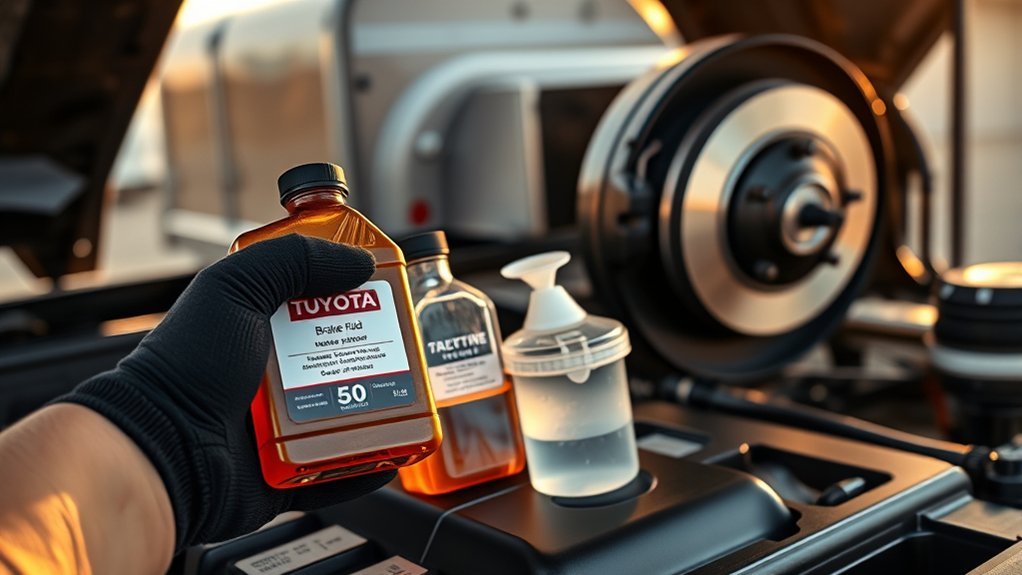
When you’re towing or hauling with a Toyota Tundra, choose DOT 4 brake fluid for its higher boiling point and more stable viscosity under heat, which reduces brake fade and improves ABS responsiveness compared with DOT 3. You’ll gain measurable towing performance and enhanced brake safety when you replace DOT 3 with DOT 4 for heavy-duty use. DOT 4 sustains hydraulic pressure under elevated temperatures, so pedal modulation stays firmer and fade onset delays during prolonged descents or heavy loads. Its viscosity profile preserves ABS cycle control, giving you crisper corrective pulses when trailer dynamics demand intervention. DOT 3 can suffice for unloaded driving but reaches vapor threshold sooner under stress, increasing stopping distance and risk. For liberation from compromised stopping power, specify DOT 4 in your service, monitor levels, and maintain factory-recommended seals and components. This upgrade improves braking efficiency and reduces failure risk without altering system hardware, provided the vehicle’s specification permits DOT 4 use.
Brake Fluid Life: Flush Intervals and Moisture Effects
Because brake fluid is hygroscopic and steadily absorbs water from the atmosphere, you should flush your Toyota Tundra’s system every 12–24 months to preserve boiling point and prevent corrosion. You need to respect brake fluid lifespan as a safety-critical parameter: moisture accumulation reduces wet and dry boiling points, raises vapor-lock risk, and accelerates internal corrosion that undermines calipers, lines, and ABS components. DOT 3 absorbs moisture more slowly than DOT 4, but both demand scheduled replacement to keep performance and prevent costly failures.
- Test and replace fluid within 12–24 months to maintain rated boiling point and system integrity.
- Prioritize proactive flushing when operating under heavy loads or high temperatures to minimize brake fade.
- Recognize that even small moisture accumulation materially degrades hydraulic performance and causes corrosion.
- Document service intervals and use compatible fluid to preserve warranty, control failure modes, and retain freedom from mechanical restriction.
How to Tell Your Fluid Needs Changing (Tests, Copper Strips, Feel)
Although brake fluid won’t show catastrophic failure before it degrades, you can detect decline with simple checks and quick tests that warn you well before a catastrophic loss of performance. Inspect color: a greenish tint is a clear brake fluid signs of moisture absorption and needs changing. Check for sediment in the reservoir; particles signal contamination that harms caliper action. Press the pedal—spongy or soft feel indicates absorbed moisture lowering boiling point.
Use copper test strips to assess degradation; high copper readings point to corrosion risk and system damage. Perform moisture testing with a handheld meter or test strips to quantify water content; anything above manufacturer limits mandates a flush. Track results and act before brake fade occurs.
| Check | What to look for |
|---|---|
| Visual | Greenish tint, sediment |
| Pedal feel | Spongy, soft |
| Copper strip | Elevated copper → corrosion |
| Moisture testing | %H2O above spec → flush |
How to Switch Safely From DOT 3 to DOT 4 (Parts, Bleeding, ABS)
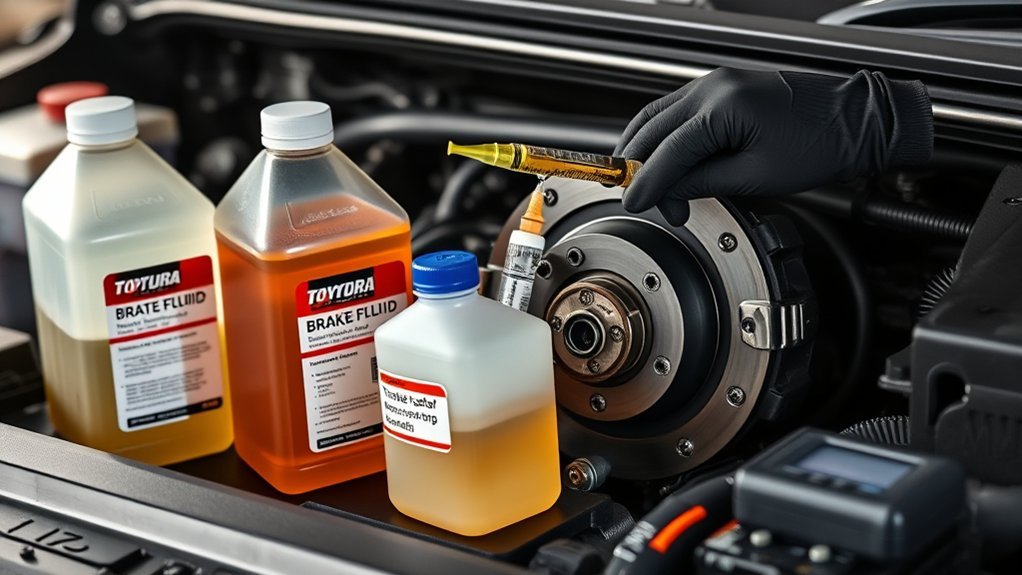
Having confirmed fluid degradation by color, pedal feel, or copper testing, you can move on to replacing DOT 3 with DOT 4—DOT 4 is backward compatible with DOT 3 but you must avoid any mixing during the change. You’ll need fresh DOT 4, a brake bleeder or suction tool, correct wrenches, and containers for old fluid. Confirm brake fluid compatibility with your Tundra’s specs before starting.
- Use the suction tool to fully drain the reservoir and dispose of contaminated DOT 3; partial drains risk mixing and reduced boiling point.
- Refill with DOT 4, then bleed each caliper in the manufacturer sequence—typically farthest wheel first—maintaining a clean, closed system to prevent moisture ingress.
- If equipped with ABS, perform ABS system cycling during bleeding so the module expels trapped old fluid; follow vehicle-specific cycling procedure.
- After service, verify fluid level, test pedal firmness, and monitor copper content per intervals to secure liberated, reliable braking performance.
Best DOT 3 & DOT 4 Picks for Tundra Owners
When you upgrade your Tundra’s brake fluid, pick a DOT 3 or DOT 4 with proven dry/wet boiling points, low hygroscopicity, and OEM compatibility; for heavy towing or repeated high-temperature stops, DOT 4 formulations like ATE Typ 200 or Motul RBF 600 offer higher dry boiling points and better moisture resistance, while Valvoline and Bosch remain solid DOT 3 options for routine use. You want fluids that sustain pedal firmness and resist vapor lock under load. Choose DOT 4 for performance upgrades that increase thermal demand; its elevated boil margin reduces fade when towing or climbing. For daily-driven Tundras, DOT 3 from reputable makers balances cost and reliability. Regardless, test fluid moisture content regularly and follow OEM change intervals as maintenance tips: use proper flushing, torque fittings, and bleed procedures to avoid contamination. Prioritize sealed containers, clear labeling, and batch traceability so your braking system stays predictable, safe, and liberating on every drive.
Frequently Asked Questions
Can You Mix Dot 3 and Dot 4 Brake Fluid on a Toyota?
Yes — you can mix DOT 3 and DOT 4 on a Toyota, but you’ll compromise brake fluid compatibility and fluid performance comparison shows DOT4’s higher boiling point is preferred; avoid mixing to preserve braking reliability and control.
Can You Use DOT 4 Brake Fluid in a Toyota?
Yes — you can use DOT 4 brake fluid in a Toyota; you’ll improve fluid performance comparison by choosing higher boiling point DOT4, maintain brake fluid compatibility with DOT3 systems, and avoid incompatible DOT5 variants for reliable liberation.
What Kind of Brake Fluid Does a 2014 Toyota Tundra Take?
Your 2014 Tundra takes DOT 3 or DOT 4 brake fluid; you can use DOT4 for higher boiling point but maintain brake fluid compatibility per Toyota maintenance guidelines, flushing every two years to preserve performance and safety.
Is DOT 3 or DOT 4 More Corrosive?
DOT 4 is less corrosive; you’ll prefer its superior corrosion resistance. Considering brake fluid properties, DOT 4 offers higher boiling points and better inhibitor stability, so you’ll reduce moisture-related degradation and extend component life.
Conclusion
Choose the fluid Toyota specifies, but know DOT 4 gives higher wet/dry boil resistance and better performance under heavy loads—think of it as upgraded armor for hot stops. Don’t mix glycol-based fluids with anything else, follow torque and bleeding procedures, and replace hoses or fittings that aren’t compatible. Test moisture and copper corrosion regularly; flush at recommended intervals or sooner if tow loads or moisture rise. Proper selection and maintenance keep braking crisp and safe.