
Last updated: July 31, 2026 · Verified against Toyota Tundra owner and maintenance guidance for representative 2003, 2004, 2021, and 2024 model years, plus current Toyota manual lookup and EPA disposal guidance.
Most Toyota Tundras from the 2004 model year onward use Toyota Super Long Life Coolant, commonly called pink SLLC, or a high-quality equivalent that matches Toyota’s specified chemistry. A verified 2003 Tundra manual instead lists Toyota Genuine Long Life Coolant, so first-generation owners should not assume every year uses the same formula. Match the coolant to the exact model year, powertrain, market, and cooling circuit. Do not choose by color alone, mix an unknown fluid, or open any pressurized cooling-system cap while the truck is hot.
Quick Answer
Use Toyota Super Long Life Coolant or a manual-approved equivalent in a Tundra that specifies SLLC. U.S.-market Toyota SLLC is premixed with 50% coolant and 50% deionized water. A 2003 Tundra manual specifies older Toyota Genuine Long Life Coolant, while the 2004 manual specifies SLLC, so verify early first-generation trucks individually. On 2022-and-newer trucks, identify whether you are checking the engine, intercooler, or hybrid inverter circuit before adding fluid. For many modern Tundras, the first engine-coolant service is at 100,000 miles or 120 months, then every 50,000 miles or 60 months.
Key Takeaways
- Use the exact coolant family and chemistry listed in the owner’s manual, not a color-only match.
- Toyota’s modern specification includes ethylene glycol, no silicate, amine, nitrite, or borate, and long-life hybrid organic acid technology.
- U.S.-market Toyota SLLC is already mixed 50/50 with deionized water; do not dilute a premixed bottle.
- Third-generation gas, turbo, and hybrid trucks can have more than one coolant reservoir and service interval.
- Only inspect or open the system after the truck has cooled completely, and recycle used coolant through an approved facility.
At a Glance
| Routine Check | Cold-engine level and condition check at the correct reservoir |
| DIY Level | Easy for visual inspection and a confirmed matching top-off; advanced for draining, bleeding, or hybrid-circuit service |
| Basic Supplies | Gloves, eye protection, clean funnel, rags, correct coolant, sealed drain container, and model-specific service information |
| Stop and Diagnose | Repeated level loss, overheating, oil contamination, sludge, a sweet odor, steam, or the wrong fluid in the system |
Which Coolant Does the Toyota Tundra Need?
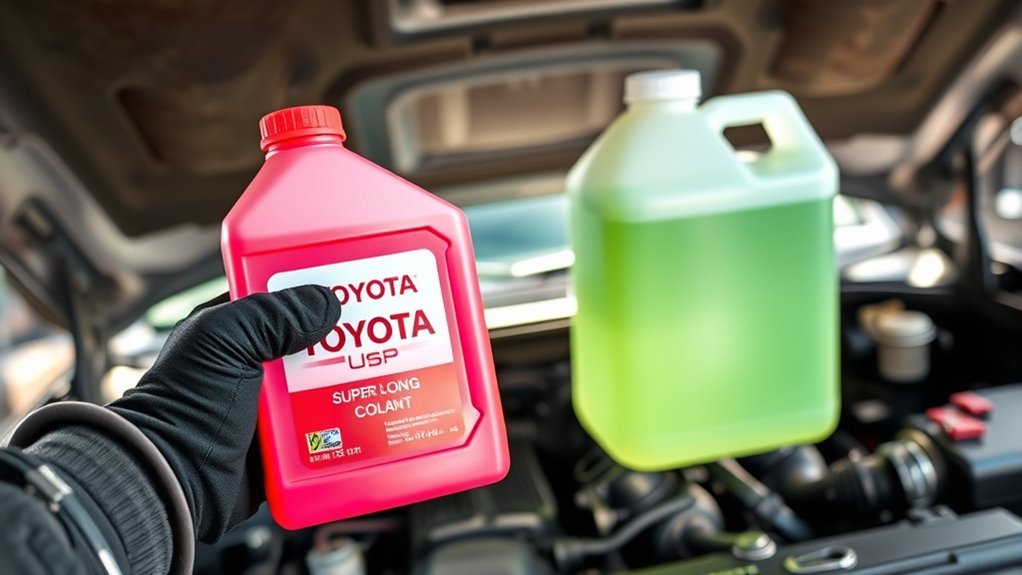
For a Tundra whose manual specifies SLLC, the lowest-risk choice is Toyota Super Long Life Coolant or a product that clearly matches Toyota’s required chemistry. Toyota describes that chemistry as a high-quality ethylene-glycol coolant that is non-silicate, non-amine, non-nitrite, and non-borate, with long-life hybrid organic acid technology. Toyota further describes that technology as a combination of low phosphates and organic acids.
For U.S.-market trucks, Toyota SLLC is premixed with 50% coolant and 50% deionized water. Canadian guidance commonly lists a 55/45 mixture for stronger freeze protection. Read the bottle before adding anything: do not add water to a premixed product, and do not add straight concentrate unless both the product instructions and the model-specific Toyota information call for it.
Warning: Never remove the radiator cap, engine-coolant reservoir pressure cap, intercooler coolant cap, or inverter-coolant cap while the system is hot. Pressurized coolant and steam can cause severe burns.
[Products Worth Considering]

This engine water pump kit is designed to help maintain reliable cooling performance across a wide range of compatible Toyota, Lexus, Scion, and Pontiac vehicles. Built with aluminum and tested for leak-free operation, it offers a direct replacement solution that supports engine efficiency and long-term service life. The kit includes a professional water pump and gasket for a convenient installation-ready repair.

The Funnel King 32950 Oil Drain Pan is a compact fluid catch basin designed for clean, easy draining during routine maintenance. Its open shape and pour edge help transfer used oil, coolant, and other shop fluids with less mess, while the lightweight polypropylene construction stands up to common automotive chemicals. Sized to fit under many cars and small engines, it is a practical choice for garages, workshops, and DIY oil changes.

This all-in-one radiator pressure tester and vacuum refill kit helps diagnose cooling system leaks, measure temperature, and refill coolant efficiently. It includes a wide range of adapters for broad vehicle compatibility, plus a pressure tester, vacuum refiller, thermometer, and storage case for organized use. Designed for DIY mechanics and professionals, it simplifies coolant service while reducing guesswork and unnecessary repairs.
Verified Tundra Coolant Examples by Model Year
| Verified Manual Example | Coolant Guidance | What It Means |
|---|---|---|
| 2003 U.S. Tundra | Toyota Genuine Long Life Coolant or equivalent ethylene-glycol coolant | Do not assume every first-generation truck was factory-filled with pink SLLC |
| 2004 U.S. Tundra | Toyota Super Long Life Coolant or chemistry-matched equivalent | The verified manual shows the Tundra transition to SLLC by this model year |
| 2021 U.S. Tundra | Toyota SLLC, 50% coolant and 50% deionized water | Use premix as supplied and follow the long-life maintenance schedule |
| 2024 U.S. Tundra | Toyota SLLC or equivalent for engine and applicable intercooler coolant | Confirm the correct reservoir and circuit before adding fluid |
This table is a decision aid, not a substitute for the manual tied to your VIN, market, engine, and model year. Toyota’s manual and warranty lookup is the final check before you buy or mix coolant.
Coolant Chemistry for Tundra: Pink SLLC vs. Older Red Toyota Coolant
Toyota used older Long Life Coolant in at least some early Tundras and SLLC in later trucks. The verified 2003 Tundra manual lists Toyota Genuine Long Life Coolant; the verified 2004 manual lists Toyota Super Long Life Coolant. That model-year change is more useful than a generic “red versus pink” rule because aftermarket coolant dyes are not standardized.
| Coolant | Common Color | Main Point | What To Do |
|---|---|---|---|
| Toyota Super Long Life Coolant | Pink | Premixed long-life coolant used in verified 2004-and-later Tundra manuals | Use where the exact Tundra manual specifies SLLC |
| Toyota Genuine Long Life Coolant | Red | Older Toyota coolant listed in the verified 2003 Tundra manual | Use only where the exact manual and service history support it |
| Toyota-compatible Asian-vehicle coolant | Varies | Compatibility depends on the inhibitor chemistry and product claim | Use only when the label clearly matches the Toyota requirement for that truck |
| Universal or unknown coolant | Varies | A color or “all makes” claim does not prove a chemistry match | Do not use it as a routine top-off without verified compatibility |
Do not treat red and pink as automatically interchangeable in every Tundra. If the current coolant, service history, or product chemistry is unknown, a controlled drain-and-refill with the manual-specified coolant is safer than continuing to mix fluids.
How Can You Tell Which Coolant Is in Your Tundra?
Start with the truck cold and parked on level ground. Check the service records and bottle label first, then inspect the correct translucent reservoir. Clean coolant should be reasonably clear and free of oil film, rust flakes, sludge, grit, or floating debris. Color can support identification, but it cannot prove compatibility.
[Products Worth Considering]

These heavy-duty running board side steps are designed to improve access to your Toyota Tundra without reducing ground clearance. Built for Double Cab and CrewMax front door applications, they offer practical convenience for everyday entry, roof loading, and off-road use. The durable iron construction and easy no-drill installation make them a reliable upgrade for rugged driving.

This radiator burping funnel kit helps simplify coolant refilling, bleeding, flushing, and spill-free maintenance across a wide range of vehicles. Its translucent body with clear scale supports controlled filling, while multiple adaptors, caps, and extension pieces improve compatibility and access in tight engine bays. The built-in shut-off valve and rubber-gasket design help reduce spills and make cooling system service cleaner and more convenient.

The OEMTOOLS coolant vacuum refill kit helps quickly refill a vehicle’s cooling system while removing trapped air that can lead to overheating and engine damage. It also performs vacuum leak tests to help confirm system integrity and reduce the chance of repeat repairs. With multiple bushings, adapters, and a tapered cone seal, it is designed for flexible use on many radiator and coolant bottle necks.
Check the Coolant Reservoir
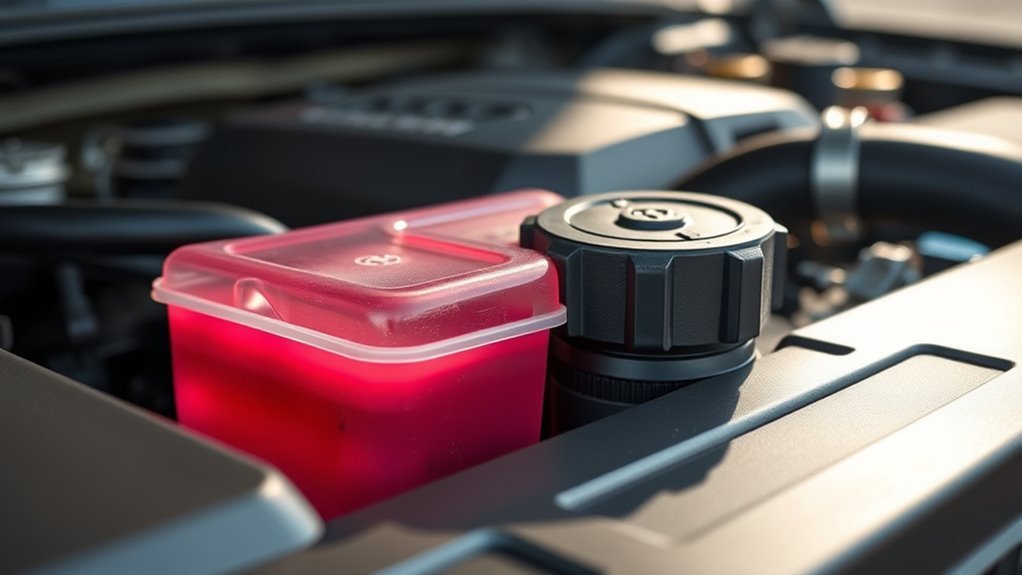
The reservoir is the safest routine level-check point when the engine is fully cool. Follow the labels and diagram in the exact owner’s manual because reservoir names and locations differ by generation and powertrain. If the level is at or below the cold LOW mark, add only the confirmed correct coolant to the corresponding reservoir and stop at the FULL mark.
- Check the level only after the system has cooled completely.
- Confirm that you have the engine, intercooler, or inverter reservoir before adding fluid.
- Use a flashlight to inspect clarity, oil film, particles, and staining.
- Look around hoses, clamps, radiator seams, pumps, caps, and reservoirs for dried residue or wet leaks.
- If the level falls again after a correct top-off, arrange a pressure test or model-specific diagnosis.
Inspect Coolant Color and Condition
Pink fluid may be Toyota SLLC, and red fluid may be older Toyota Long Life Coolant, but dye alone is not a specification. Brown, rusty, cloudy, oily, muddy, or gel-like coolant needs diagnosis before more fluid is added. Oil contamination, repeated bubbling, or unexplained loss can point to a cooling-system or internal engine problem rather than overdue coolant alone.
Note: A basic coolant tester can check freeze protection, but it cannot reliably identify an unknown inhibitor package. Use the manual, service history, product label, or a professional inspection to identify chemistry.
Can You Top Off a Tundra With Aftermarket Coolant?
Yes, but only when the aftermarket product clearly matches the coolant requirement for the exact Tundra. Look for a specific Toyota or applicable Asian-vehicle compatibility statement and the required long-life hybrid organic acid chemistry. Do not rely on “pink,” “red,” “universal,” or “all makes and models” by itself.
For a small top-off, use the same confirmed coolant already in the circuit whenever possible. If you cannot identify the current fluid, do not repeatedly add different products. Correct the level only with a manual-approved product when necessary for safe operation, then have the circuit inspected and reset with the proper coolant if compatibility remains uncertain.
[Products Worth Considering]

This spill-proof radiator coolant filling funnel kit helps you refill cooling systems cleanly while reducing trapped air pockets that can affect heater and engine performance. It includes a 5-inch extension bar and 45-degree elbow for easier access under shrouds or at awkward angles. Color-matched caps for dedicated adapters make setup simpler and more organized.

This versatile automotive funnel kit makes oil and coolant filling cleaner, safer, and more efficient across a wide range of vehicles. With multiple color-coded adapters, secure sealing, and hands-free locking support, it helps prevent leaks, spills, and mismatched fittings during maintenance. The organized magnetic storage and durable heat-resistant construction make it a practical choice for both DIY repairs and professional service work.

This coolant electric water pump is designed as a replacement for select Toyota vehicles, helping maintain proper engine cooling performance and reliable temperature control. Built to OE specifications, it offers fitment support for compatible Avalon, Camry, and RAV4 models with 2.5L L4 engines. It also includes cross-reference part numbers for easier matching and comes with after-sales support for covered defects.
Safe Top-Off Steps
- Park on level ground, switch the truck off, and let every cooling circuit cool completely.
- Use the owner’s manual to identify the correct reservoir and cold-level marks.
- Inspect the reservoir, cap, hoses, clamps, radiator area, and nearby pumps for leaks or residue.
- Confirm the coolant label and whether the product is premixed.
- Add coolant slowly to the correct reservoir without exceeding the FULL mark.
- Secure the cap, clean any spill with water, and record the product, date, and mileage.
- After a normal drive and complete cool-down, recheck the same reservoir. Diagnose any repeated loss.
Pro Tip: Photograph the front and back labels of the coolant bottle. The brand name, specification claim, dilution, lot information, date, and mileage are more useful later than remembering only the fluid color.
Why Tundra Coolant Capacity Varies and Where to Add It
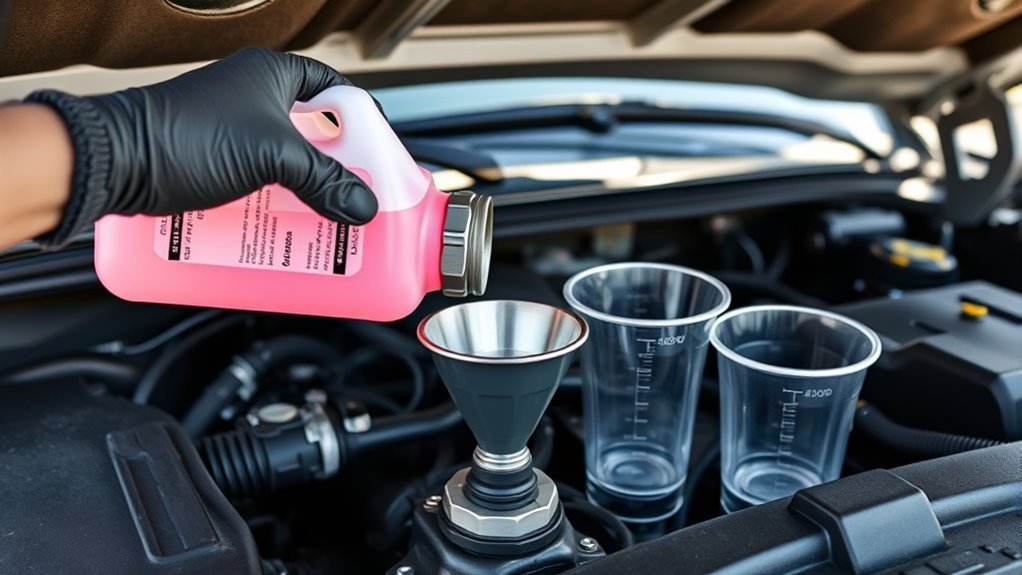
There is no single Toyota Tundra coolant capacity. Total volume changes with model year, engine, cab or heater configuration on some early trucks, and the number of cooling circuits. A simple reservoir top-off does not require the total system capacity. A drain-and-refill does, and the amount drained can be lower than the published total because coolant remains in the block, heater core, hoses, turbo or intercooler plumbing, and other passages.
How to Find the Correct Tundra Coolant Capacity
Use the cooling-system specification and service procedure for the exact model. Do not buy or pour fluid based on a generic web number. For a drain-and-refill, confirm whether the stated figure is total capacity, service fill, or the capacity of one separate circuit. Measure the amount drained only as a cross-check; it does not override the published fill and bleeding procedure.
| Situation | Best Approach |
|---|---|
| Small cold-engine top-off | Fill the confirmed reservoir only to its cold FULL mark |
| Engine-coolant drain-and-refill | Use the exact engine-circuit capacity and bleeding procedure |
| Intercooler-coolant service | Treat it as a separate circuit where equipped |
| Hybrid inverter-coolant service | Use the hybrid-specific procedure and interval; do not confuse it with engine coolant |
| Wrong or unknown coolant added | Stop mixing, identify the circuit, and plan a controlled service |
Which Coolant Circuit Are You Checking?
| Circuit | What It Cools | Key Caution |
|---|---|---|
| Engine coolant | Engine, cylinder heads, heater core, radiator, and related components | Use the engine reservoir and engine-circuit procedure |
| Intercooler coolant | Charge-air cooling hardware on applicable turbo models | Its reservoir and service procedure are separate from engine coolant |
| Inverter coolant | Hybrid power electronics on applicable i-FORCE MAX models | The hybrid circuit has its own reservoir, bleeding method, and maintenance interval |
Where Should You Add Coolant?
For a routine level correction, add coolant only to the reservoir named for the circuit you are checking and only when the truck is cold. Do not assume the largest or most visible tank is the right one. During a full service, the fill point and air-bleeding method vary by generation and circuit, so follow Toyota service information rather than a universal funnel-and-idle procedure.
How Often Should You Check the Coolant Level?
Check all applicable reservoirs during routine maintenance, before a long trip, and after any cooling-system repair. Check sooner if you tow, work in high heat, smell coolant, see residue, receive a temperature warning, or notice the heater or cooling system behaving differently.
- The cold level should remain between the marked LOW and FULL lines.
- A steady drop means coolant is escaping, boiling over, or entering another system.
- A sweet smell, steam, or a rising temperature display needs immediate attention.
- Milky oil, persistent white exhaust after warm-up, or repeated reservoir bubbling needs diagnosis.
What Is the Toyota Tundra Coolant Change Interval?
For many modern U.S.-market Tundras, Toyota schedules the first engine-coolant replacement at 100,000 miles or 120 months, whichever comes first, then every 50,000 miles or 60 months. Toyota’s 2024 Tundra maintenance material uses the same initial schedule for applicable intercooler coolant. Hybrid inverter coolant is a separate service item and Toyota material for the i-FORCE MAX system lists a later initial interval of 150,000 miles or 180 months, followed by 50,000 miles or 60 months. Verify every interval in the guide for the exact model year and market.
| Coolant / Circuit | Verified Modern Guidance | Important Note |
|---|---|---|
| Engine coolant | First replacement at 100,000 miles / 120 months; then every 50,000 miles / 60 months | Applies to many modern Tundras using Toyota SLLC; verify the exact guide |
| Applicable intercooler coolant | 2024 Tundra material lists 100,000 miles / 120 months initially; then 50,000 miles / 60 months | Confirm equipment and model-year wording |
| Applicable hybrid inverter coolant | 150,000 miles / 180 months initially; then 50,000 miles / 60 months | Separate circuit on applicable i-FORCE MAX models |
| Older Toyota Long Life Coolant | Use the schedule in the exact early-model maintenance guide | Do not apply the modern SLLC interval automatically |
| Unknown, mixed, rusty, oily, or sludged coolant | Diagnose and service without waiting for the scheduled interval | Repair the source of contamination or loss first |
The scheduled interval assumes the correct coolant and a healthy system. A leak, overheating event, component replacement, wrong fluid, or contamination can require earlier service. For a deeper interval and service-method explanation, see the site’s Toyota Tundra coolant flush interval guide.
Should You Drain, Flush, or Refill a Tundra Cooling System?
A routine scheduled coolant replacement is usually a controlled drain-and-refill using the correct fluid and model-specific bleeding procedure. A chemical or repeated-water flush is not automatically required at every interval. Consider a targeted flush only when the wrong coolant, rust, sludge, oil, grit, or another contaminant must be removed and the underlying fault has been identified.
Warning: Diagnose the truck before refilling if it has overheated severely, contains oil in the coolant, produces persistent white exhaust after warm-up, or loses coolant with no visible leak. Fresh coolant cannot repair a failed hose, cap, pump, radiator, heat exchanger, gasket, or internal engine fault.
Drain the Correct Circuit
- Confirm the model year, powertrain, circuit, coolant specification, capacity, drain points, and bleeding method.
- Let the truck cool completely and wear gloves and eye protection.
- Place a large, clean drain pan below the specified drain point.
- Open only the drain point identified for that circuit and collect all fluid.
- Inspect the drained coolant for oil, rust, sludge, grit, metal, or gel-like material.
- If the old coolant is clean and due for service, use the specified drain-and-refill process.
- If contamination is present, diagnose its source before using any cleaner or repeated flush procedure.
Refill and Bleed the Correct Circuit
- Close the drain and confirm that plugs, hoses, and clamps are secure.
- Add Toyota SLLC or the verified manual-approved equivalent at the specified fill point.
- Bleed air with the exact procedure for the engine, intercooler, or inverter circuit.
- Monitor temperature, warning messages, heater performance, leaks, and coolant circulation as the procedure requires.
- Let the system cool completely and recheck the correct reservoir.
- Top off only to the cold FULL mark and record the service.
Air trapped after service can cause poor heater output, erratic level changes, pump noise, warning messages, or overheating. Stop if the temperature rises, circulation does not improve, or the level drops sharply. A third-generation hybrid or turbo circuit may require scan-tool activation or a model-specific pump procedure rather than simple engine idling.
What Tundra Coolant Warning Signs Need Immediate Attention?
Coolant protects the engine and, on applicable newer trucks, separate charge-air or hybrid power-electronics circuits. These symptoms are reasons to stop, cool the truck, and diagnose the system rather than keep topping it off:
- Temperature warning, gauge rise, reduced-power message, or steam
- Repeated low level in any coolant reservoir
- Sweet odor, wet spots, or dried pink, red, or white residue
- Rusty, brown, cloudy, oily, sludged, gritty, or gel-like coolant
- Coolant puddles under the truck
- Cabin heater blowing cold while the engine runs hot
- Persistent white exhaust after warm-up or milky engine oil
- Unusual pump noise or poor circulation after coolant service
A Tundra does not normally consume coolant. A falling level means the fluid is leaking, venting, entering another system, or was not filled and bled correctly.
If the temperature rises or a warning appears, pull over safely and shut the truck off. Do not open a hot cap. After the system cools, check the correct reservoir and visible components. Use the dedicated Toyota Tundra overheating guide to separate low coolant, trapped air, fan, thermostat, radiator, pump, and internal-engine symptoms.
How Should You Handle and Dispose of Used Coolant?
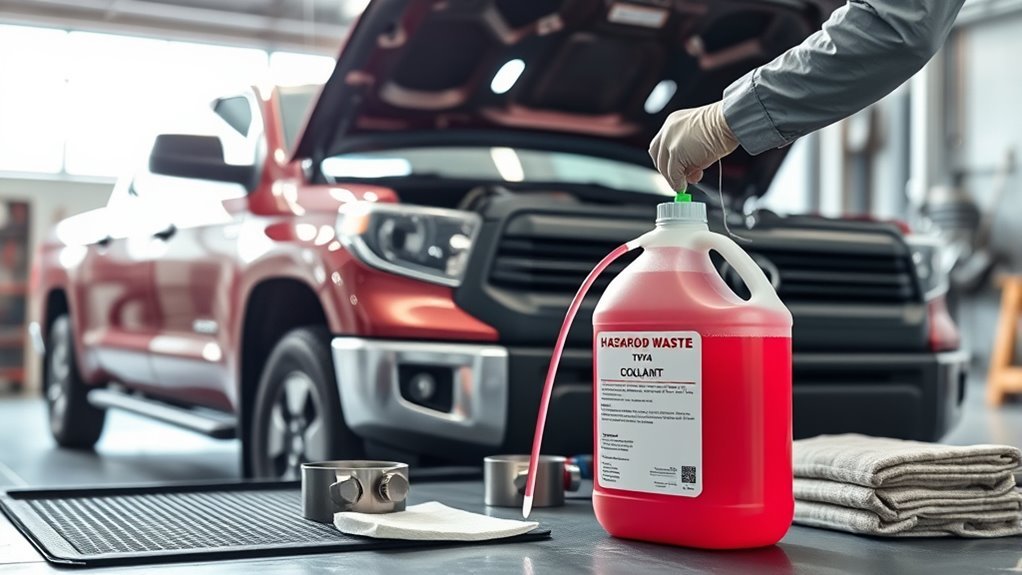
Ethylene-glycol coolant is toxic to people and animals, and used fluid can contain dissolved metals or other contaminants. EPA guidance says not to pour used antifreeze into sewers, floor drains, soil, or regular trash. State and local requirements vary, so use a recycling or disposal facility that accepts used antifreeze.
- Wear gloves and eye protection and avoid skin contact.
- Use a clean drain pan large enough for the circuit being serviced.
- Transfer the fluid to a sealed, labeled container.
- Keep it away from children and animals.
- Do not mix it with oil, fuel, solvents, brake cleaner, or other waste.
- Take it to a household hazardous-waste site, recycler, or repair facility that accepts used coolant.
For a spill, keep the liquid away from drains and soil, absorb it with suitable material, secure the waste, and follow local disposal instructions. Contact the local waste authority for a large spill or uncertain disposal route.
Is OEM or Aftermarket Coolant Better for a Tundra?
Toyota Genuine SLLC is the simplest choice for a truck that specifies SLLC because the chemistry and premix are clear. A high-quality aftermarket coolant can also work when its label specifically matches the Toyota requirement for the model and circuit. A vague universal claim is not equivalent to a documented Toyota compatibility statement.
| Choice | Advantages | What to Verify |
|---|---|---|
| Toyota Genuine SLLC | Clear Toyota application and premix guidance | Correct bottle, market mixture, and circuit |
| Toyota-compatible Asian-vehicle coolant | Can be easier to source and may meet the same chemistry | Specific Toyota compatibility, inhibitor technology, dilution, and interval |
| Unknown universal coolant | Broad availability | Do not use routinely without a clear chemistry match |
Keep the receipt, bottle photos, service date, mileage, circuit name, and amount used. Those records help prevent future mixing and support maintenance or warranty discussions.
Frequently Asked Questions
What kind of coolant does a Toyota Tundra take?
Most verified 2004-and-later U.S. Tundra manuals specify Toyota Super Long Life Coolant or a similar high-quality ethylene-glycol coolant that is non-silicate, non-amine, non-nitrite, and non-borate, with long-life hybrid organic acid technology. A verified 2003 manual specifies older Toyota Genuine Long Life Coolant, so check the exact model-year manual.
Is Toyota Tundra pink coolant premixed?
Toyota Super Long Life Coolant for the U.S. market is premixed with 50% coolant and 50% deionized water. Canadian Toyota guidance commonly lists 55% coolant and 45% deionized water. Read the product label and do not dilute a premixed bottle.
Can you mix Toyota red and pink coolant in a Tundra?
Do not assume they are interchangeable in every Tundra. The verified 2003 and 2004 Tundra manuals specify different Toyota coolant families. Follow the exact manual and known service history. If the current fluid is unknown, stop mixing and use a controlled drain-and-refill with the correct coolant.
How often should Toyota Tundra coolant be changed?
For many modern Tundras using Toyota SLLC, replace engine coolant first at 100,000 miles or 120 months, then every 50,000 miles or 60 months. Applicable intercooler coolant may use the same modern schedule. Hybrid inverter coolant is a separate item and may have a later initial interval. Verify the exact maintenance guide.
Does a 2022-and-newer Tundra have more than one coolant reservoir?
It can. Depending on powertrain, a third-generation Tundra may have separate engine, intercooler, and hybrid inverter coolant circuits. Use the cap labels and exact owner’s manual before adding fluid because the reservoirs, capacities, bleeding methods, and intervals are not interchangeable.
Can you use plain water in a Toyota Tundra cooling system?
Do not use plain water as the normal fill. Toyota requires the correct coolant mixture for freeze protection, corrosion control, lubrication, and heat transfer. Use Toyota SLLC as supplied or a correctly mixed, manual-approved equivalent.
Conclusion
Choose Toyota Tundra coolant by the exact manual, not by reservoir color. A verified 2003 manual specifies Toyota Genuine Long Life Coolant, while the 2004, 2021, and 2024 examples specify Toyota Super Long Life Coolant or a chemistry-matched equivalent. On newer turbo and hybrid trucks, identify the engine, intercooler, or inverter circuit before adding fluid. Check every level cold, do not dilute premixed SLLC, repair repeated coolant loss, and use the model-specific capacity, bleeding method, and maintenance interval.
Sources
- Toyota 2024 Tundra Warranty & Maintenance Guide — engine, intercooler, and applicable hybrid-circuit maintenance intervals
- Toyota Manuals and Warranties — official model-year and VIN-based manual lookup
- Toyota Genuine Super Long Life Coolant — Toyota SLLC product reference
- 2003 Toyota Tundra Owner’s Manual mirror — older Toyota Genuine Long Life Coolant specification
- 2004 Toyota Tundra Owner’s Manual mirror — Toyota SLLC specification and representative capacity data
- U.S. EPA Used Antifreeze Disposal Fact Sheet — toxicity, separation, recycling, and disposal guidance


[…] the Toyota Tundra coolant type guide to understand coolant selection, but verify the final specification in the owner’s manual […]