What’s in This Article
- What Fluid Does a Tundra Transfer Case Use?
- How Much Fluid the Tundra Transfer Case Holds
- Which Oils Work: Toyota WS, 75W, 75W-90, and Alternatives
- Cost, Dealer Practices, and OEM vs. Aftermarket Fluids
- When to Change Transfer Case Fluid
- Tools and Parts for Transfer Case Service
- Step-by-Step: Draining and Refilling
- Common Problems and How to Troubleshoot Them
- Maintenance Tips to Extend Transfer Case Life
- Frequently Asked Questions
A failed transfer case can turn a capable 4WD truck into an expensive repair job. Most Tundra owners never think about the fluid inside it until something goes wrong. The right fluid, the right amount, and a consistent service schedule keep your 4WD system working every time you need it.
Quick Answer
Most Toyota Tundras require Toyota-specified transfer case fluid (typically Toyota Transfer Gear Oil or Toyota WS ATF, depending on your model year — check your owner’s manual). The transfer case holds about 2.2 quarts. Change it every 60,000 miles, remove the fill plug before the drain plug, and torque both plugs to about 29 ft-lb with sealant tape on the threads.
Key Takeaways
- Use the Toyota-specified transfer case fluid for your model year — confirm the exact product in your owner’s manual, not just online forums.
- The Tundra transfer case holds about 2.2 quarts — fill to the level of the fill hole on a level surface.
- Change transfer case fluid every 60,000 miles, or sooner if you tow frequently or drive off-road.
- Always remove the fill plug before the drain plug to confirm you can access the fill hole before the case is empty.
- Torque drain and fill plugs to about 29 ft-lb with sealant tape on the threads to prevent post-service leaks.
What Fluid Does a Tundra Transfer Case Use?
Warning: Using the wrong fluid in your transfer case can cause 4WD engagement failures and accelerate internal wear — always confirm the required fluid in your owner’s manual before purchasing.
This guide applies primarily to second-generation Toyota Tundras (2007–2021). Third-generation owners (2022 and later) should verify fluid specifications in their owner’s manual, as requirements may differ by variant.
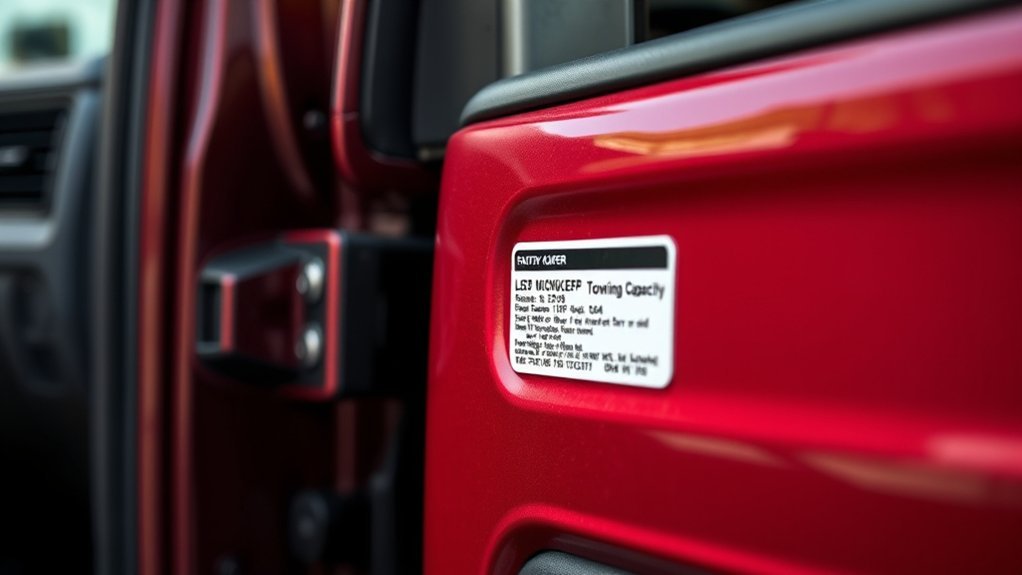
Your Tundra’s transfer case requires the fluid your owner’s manual specifies. For most second-generation trucks, that’s Toyota Transfer Gear Oil (75W-90 GL-5) or a Toyota WS ATF, depending on the specific variant. Check the markings on your filler bolt and cross-reference your manual before buying any fluid.
Don’t substitute one fluid type for the other. Gear oil and ATF have different viscosity profiles and friction modifier packages. Using the wrong type affects shifting behavior, even if the vehicle doesn’t show immediate symptoms.
Some owners use high-quality aftermarket 75W-90 oils from brands like Royal Purple or Mobil 1. These can work when the viscosity and GL rating match your manual’s spec. But some users report mild 4WD engagement issues with non-OEM fluids, so confirm compatibility before making the switch.
How Much Fluid the Tundra Transfer Case Holds (And Why It Matters)
The Tundra’s transfer case holds about 2.2 quarts of fluid. Keep that number in mind during service to avoid underfilling or overfilling. Either condition puts unnecessary strain on the internal gears and seals.
Level the vehicle on a flat surface before you drain and refill. This gives you an accurate fill level and prevents air pockets from forming inside the case. Don’t estimate the level on a slope.
Inspect the drained fluid before discarding it. Dark, gritty, or metallic fluid signals accelerated wear inside the case. Metal particles on the drain plug magnet call for a deeper inspection before putting more miles on the truck.
Which Oils Work: Toyota WS, 75W, 75W-90, and Alternatives
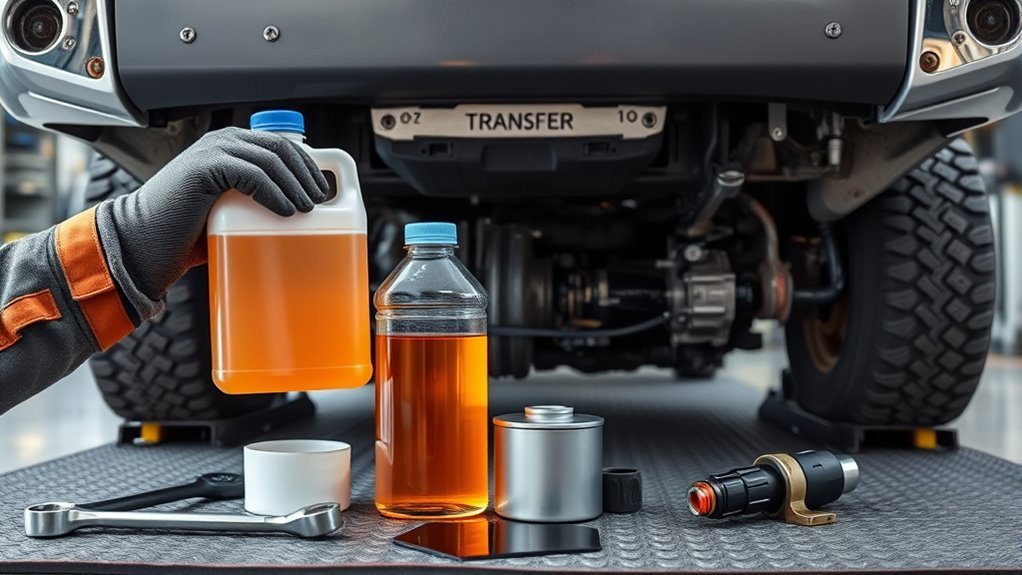
Toyota specifies a particular fluid for each Tundra variant. For most second-generation trucks, that’s a 75W-90 GL-5 transfer gear oil or a Toyota WS ATF. Verify which applies to your truck before you buy.
High-quality aftermarket 75W-90 gear oils from Royal Purple or Mobil 1 Synthetic work as alternatives when they match the required viscosity and GL rating. Check the label for friction modifiers and antiwear additives. An incompatible additive package can cause subtle but persistent shifting problems.
| Choice | Pros | Caution |
|---|---|---|
| Toyota OEM fluid | Exact OEM compatibility | Higher cost |
| 75W-90 Synthetic (Mobil 1, Royal Purple) | Good heat dissipation | Verify additive package |
| ATF (model-specific only) | Smooth shifting on compatible variants | Not a universal fit |
After choosing your fluid, drain the case completely, inspect the drain plug magnet, refill to about 2.2 quarts, and test 4WD engagement before driving on the road.
Cost, Dealer Practices, and OEM vs. Aftermarket Fluids
You’ll weigh upfront cost against long-term reliability when choosing between OEM and aftermarket transfer case fluid. OEM fluid costs more per quart but carries zero compatibility risk. Aftermarket brands cost less and perform well when you confirm the right spec.
Note: Fluid prices vary by region and retailer — treat all figures below as rough estimates and confirm current pricing at your local dealer or auto parts store.
OEM vs. Aftermarket Cost
The core question for many owners is whether Toyota’s OEM fluid justifies the premium over aftermarket alternatives. OEM fluid runs approximately $125 for 2 quarts and uses engineered additives matched to the transfer case’s tolerances. Aftermarket brands like Royal Purple or Mobil 1 cost less and have a solid track record, but some users report intermittent engagement issues.
| Option | Approx. Cost | Risk Level |
|---|---|---|
| OEM fluid | ~$125 / 2 qt | Low (additives matched) |
| Aftermarket 75W-90 | Lower | Medium (confirm additive spec) |
| Regular service interval | Every 60,000 mi | Required regardless of brand |
Choose based on your budget, how you use the truck, and your tolerance for diagnosing potential shifting quirks down the road.
Dealer Fluid Preferences
Dealer recommendations vary by location and service advisor. Some shops use Toyota OEM GL-5 fluid exclusively, while others accept quality aftermarket 75W-90 oils. Ask your service advisor which fluid they plan to use and why before approving the job.
Toyota OEM 2-quart packs cost approximately $125. Alternatives like Royal Purple or Mobil 1 cost less and see wide use without problems. Dealers typically follow OEM guidance to avoid warranty disputes, so most will steer you toward the factory spec.
Document the fluid brand, specification, and service mileage after every transfer case service. That record protects you if a warranty or dispute issue comes up later.
Long-Term Replacement Economics
A single transfer case refill costs around $125 for OEM fluid. A failed transfer case can cost anywhere from $1,500 to $2,800 or more to fix, depending on labor rates and whether the case needs a rebuild or full replacement. Regular fluid changes every 60,000 miles are the cheapest insurance you can buy for this component.
Some dealers and independent shops use alternatives like Ravenol transfer case fluid. Test any new fluid cautiously and monitor for shifting changes in the first few hundred miles. Additive compatibility matters most in solenoid-controlled transfer cases.
| Item | Impact |
|---|---|
| OEM fluid (regular service) | Best spec compliance, lowest repair risk |
| Aftermarket fluid | Variable results — verify spec match first |
When to Change Transfer Case Fluid (Recommended Intervals)
Change the Tundra’s transfer case fluid every 60,000 miles to maintain 4WD engagement and prevent premature wear. Build this into your maintenance schedule alongside your transmission and differential fluid changes.
Drive under severe conditions — frequent towing, off-road use, dusty environments, or extreme temperatures — and you should inspect the fluid earlier. Dark, burnt-smelling, or gritty fluid means it’s time to change it regardless of mileage.
Stick to the Toyota-specified fluid type for your model. Non-matching fluids cause shifting problems for some owners. Many find fluid looks clean at the 60,000-mile mark, but don’t use that as a reason to skip the service — fluid degrades chemically before it shows visible signs of contamination.
Tools and Parts for Tundra Transfer Case Service
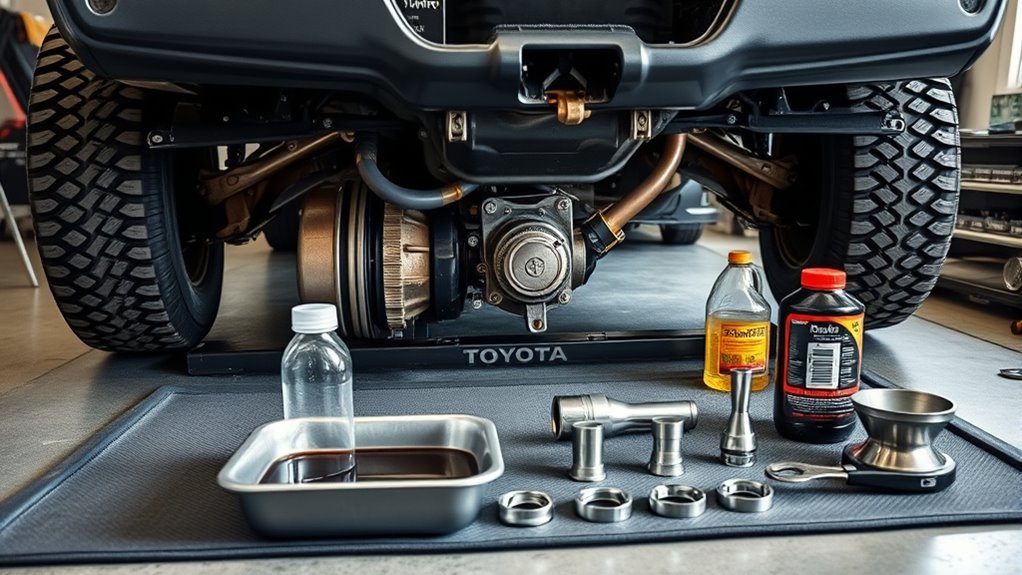
Gather everything before you start. Stopping mid-job to find a missing tool extends the service time and risks leaving the transfer case open too long.
You’ll need: 2.2 quarts of Toyota-specified transfer case fluid, a 3/8″ drive socket for the drain and fill bolts, a 200 cc fluid pump, sealant tape for bolt threads, a torque wrench set to 29 ft-lb, a drain pan, gloves, shop rags, and a jack with stands if you need to lift the truck for access.
Test your fluid pump before starting to confirm the suction works. Apply sealant tape lightly on the bolt threads — enough to seal, not so much that thread material contaminates the fluid. A calibrated torque wrench protects both the bolts and the transfer case housing from over-tightening.
Step-by-Step: Draining and Refilling a Tundra Transfer Case
Estimated time: 30–45 minutes
Pro tip: Always remove the fill plug before the drain plug — if the fill plug is stripped or stuck, you can reinstall the drain plug and avoid leaving an empty, open transfer case.
- Park on a level surface. Let the transfer case cool for at least 30 minutes before touching any plugs.
- Position your drain pan directly under the transfer case.
- Remove the fill plug first using a 3/8″ socket. Confirm you can access it and that it turns freely before proceeding to drain.
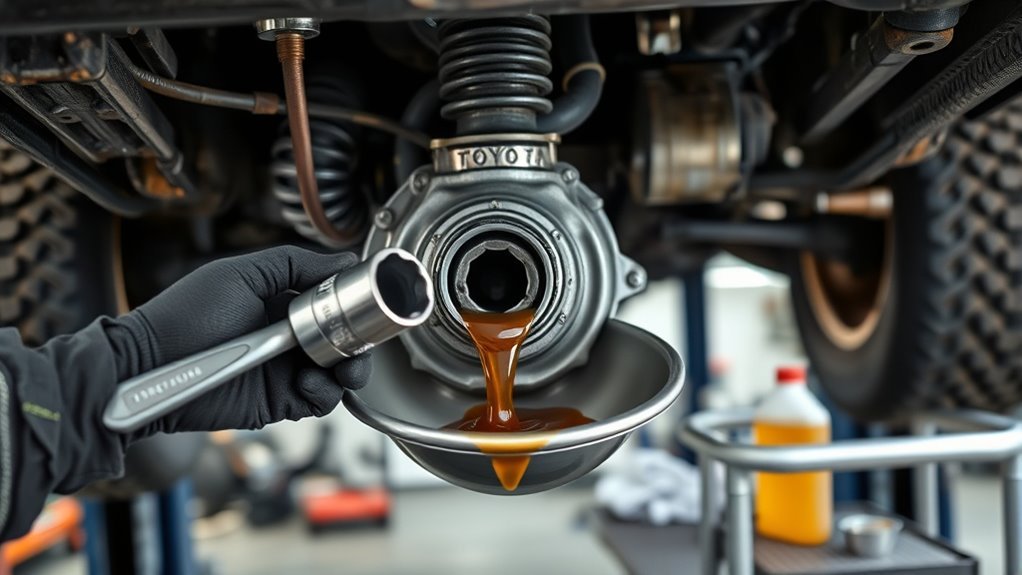
- Remove the drain plug and let the old fluid drain completely into the pan. Allow 5–10 minutes for a full drain.
- Inspect the drain plug magnet. Clean off any metal particles. Light shavings are normal wear; heavy buildup or chunky debris warrants a deeper inspection before continuing.
- Apply sealant tape to the drain plug threads. Wrap lightly — just enough to seal without blocking the threads.
- Reinstall the drain plug and torque to approximately 29 ft-lb.
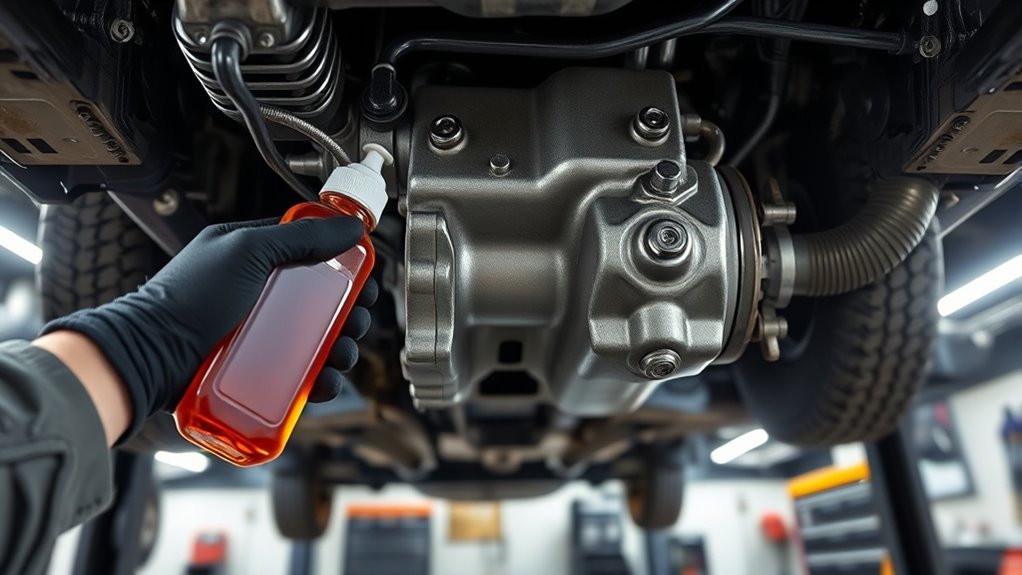
- Pump new fluid into the fill hole until fluid spills from the opening. Overflow signals the correct level.
- Apply sealant tape to the fill plug threads, reinstall, and torque to approximately 29 ft-lb.
- Run the vehicle and shift through 2WD and 4WD modes. Inspect both plugs for seepage after the first short drive.
Common Problems After Fluid Changes and How to Troubleshoot Them
After a fluid change, test 4WD engagement right away. Non-Toyota or incorrect oils can delay or prevent proper transfer case lockup. If you hear clunking, whining, or vibrations, stop and check the fluid type and fill level before driving further.
4WD Engagement Issues
Start by confirming you used the correct fluid and filled it to the proper level on a level surface. This causes most post-service engagement problems. If you switched from OEM to a 75W-90 aftermarket oil and lost responsiveness, consider reverting to the OEM spec.
- Confirm the fluid spec, brand, and viscosity match your owner’s manual.
- Level the vehicle and verify the fill level at the fill hole.
- Test 4WD engagement in a safe area and note shift timing and responsiveness.
Inspect the drain and fill plugs for proper sealing. Apply sealant tape if it’s missing and retighten to spec. Fluid leaking from the plugs causes a level drop and engagement issues within a few hundred miles.
Noisy Transfer Case
Unusual noises after a fluid change usually point to one of three causes: wrong fluid viscosity, trapped air during filling, or a compromised seal. Address each of these before assuming internal damage.
First, verify the fluid viscosity and product match your manual’s spec. Non-Toyota or incorrect grades change lubrication behavior and can cause whining or grinding. If the viscosity is wrong, drain and refill with the correct fluid. Suspect trapped air? Check the breather plug and bleed the system. If noise continues after correct fluid and proper fill level, schedule an inspection of the internal gears and bearings to rule out mechanical wear.
Leaks and Seals
Check that both plugs are torqued to approximately 29 ft-lb and that sealant tape covers the threads without cross-threading. Loose or improperly sealed fasteners cause most post-service leaks.
- Visible fluid pooling under the transfer case within 10–15 minutes of running the vehicle.
- A rapid fluid level drop or wetness around bolt heads and seams.
- Rag test: wipe suspect areas clean, run the vehicle briefly, then check for fresh fluid.
If you find a leak, re-torque to spec, replace any damaged seals or plugs, and retest until the area stays dry.
Maintenance Tips to Extend Transfer Case Life
Change transfer case fluid every 60,000 miles using Toyota-specified fluid or a confirmed compatible synthetic like Mobil 1 Synthetic 75W-90 (where your manual allows). Always remove the fill plug before the drain plug, keep the vehicle level during service, apply sealant tape to both plugs, and torque to about 29 ft-lb.
Check the fluid level and condition during routine oil changes. Dark color, a burnt smell, or a gritty texture means it’s time to service the transfer case early, regardless of mileage. Inspect the case housing and seals for hairline cracks during each visit under the truck.
After every refill, run the drivetrain through 2WD and 4WD modes and recheck for seepage at both plugs. If you find metal particles in the fluid or hear persistent noise after a correct fluid change, pull a sample for analysis and consult a technician. Catching internal wear early keeps a $125 service from becoming a $2,000-plus repair.
Frequently Asked Questions
How Often Should I Change the Transfer Case Fluid in a Tundra?
Change it every 60,000 miles under normal driving conditions. If you tow frequently, drive off-road, or operate in extreme temperatures, inspect the fluid earlier and change it as needed. Check the color and smell at each oil change interval — dark or gritty fluid means it’s time regardless of mileage.
Is Transfer Case Fluid the Same as Transmission Fluid in a Toyota?
No. Transfer case fluid and automatic transmission fluid serve different components with different operating requirements. Some Tundra variants require a 75W-90 GL-5 gear oil for the transfer case, while others use a Toyota ATF. Check your owner’s manual for the specific product your model requires. Using transmission fluid in a transfer case designed for gear oil — or the reverse — can cause shifting problems and internal wear.
What Happens If I Use the Wrong Fluid in My Tundra Transfer Case?
The first symptom is usually delayed or failed 4WD engagement. In worse cases, an incompatible additive package or wrong viscosity accelerates wear on gears and bearings. If you realize you used the wrong fluid, drain and replace it as soon as possible with the correct spec from your owner’s manual.
Can I Mix OEM and Aftermarket Transfer Case Fluid?
Mixing fluids from different product lines isn’t recommended. Different formulations can have incompatible additive packages that reduce performance when combined. When switching from OEM to aftermarket (or the reverse), do a complete drain and refill rather than topping off with a different brand.
Conclusion
Transfer case fluid is one of the easiest maintenance items to ignore — and one of the costliest to neglect. Use the Toyota-specified fluid for your model year, change it every 60,000 miles, and follow the fill-before-drain procedure every time.
If you hear noise or spot a leak after service, check fluid type, fill level, and bolt torque before assuming a bigger problem. Most post-service issues trace back to a fluid mismatch or an undertorqued plug, both of which you can fix in under an hour.
Schedule your next transfer case service alongside your next transmission fluid change. Keeping both on the same interval makes it easy to remember and ensures your entire drivetrain gets attention at the same time.
References
- Toyota Owner Resources and Manuals — Toyota Motor Corporation (consult your specific model year manual for exact transfer case fluid specifications)
- Vehicle Maintenance Recommendations — National Highway Traffic Safety Administration (NHTSA)