What’s in This Article
- What Causes Trailer Sway in Toyota Tundras?
- Weighing: Tongue Weight, GVWR, and Payload
- Which Hitches and Sway-Control Solutions Work for Tundras?
- How to Set Up a Weight-Distribution Hitch Correctly
- Check Tires, Suspension, and Alignment to Reduce Trailer Sway
- Load Placement and Packing Tips to Prevent Sway
- What to Do When Trailer Sway Starts
- When to Upgrade Suspension or Choose a Bigger Tow Vehicle
- Frequently Asked Questions
Your Tundra pulls hard, but when a trailer starts swinging side-to-side at highway speed, confidence disappears fast. Sway can escalate from a wobble to a jackknife in seconds. The good news: the causes are predictable, and the fixes are methodical. This guide walks you through every step, from measuring tongue weight to recovering control when sway hits.
Quick Answer
Trailer sway on a Tundra most often comes from low tongue weight, poor load placement, or a mismatched hitch. Set tongue weight to 12–15% of total trailer weight, place heavy cargo forward of the trailer axle, and fit a properly sized weight-distribution hitch with sway control. If sway starts while driving, ease off the accelerator, hold the wheel steady, and apply trailer brakes gently.
Key Takeaways
- Keep tongue weight at 12–15% of total trailer weight to maintain stable control of the tow vehicle.
- Place the heaviest cargo forward of the trailer axle and distribute weight evenly from side to side.
- Use a weight-distribution hitch sized to your measured tongue weight, not the trailer’s maximum sticker rating.
- If sway starts, ease off the gas and hold a firm, steady grip — do not steer sharply or hit the brakes hard.
- Step up to a 3/4-ton or 1-ton truck when your trailer consistently approaches or exceeds 10,000 lbs.
What Causes Trailer Sway in Toyota Tundras?

Trailer sway on a Tundra traces back to five root causes: load placement, vehicle speed, tire condition, external forces, and hitch setup. Most sway events involve at least two of these working together.
Weight distribution is usually the first thing to check. When heavy cargo sits behind the trailer axles, the imbalance amplifies yaw and reduces the Tundra’s ability to stay in control. Maintain proper trailer tire pressure (often 65–70 PSI for ST-type trailer tires, per the sidewall rating) and inspect tread regularly. Underinflation or uneven wear transmits oscillations straight into the coupling.
Speed matters too. Above roughly 50 mph, aerodynamic forces and yaw inertia grow fast, especially with longer trailers. Side winds, semi-truck slipstreams, and rough pavement can trigger or magnify sway. A working weight-distribution hitch and effective sway control dampen lateral motion. An inadequate setup passes that momentum straight back to the trailer. Address each factor in order, and you’ll get control back.
Weighing: Tongue Weight, GVWR, and Payload
Proper weight distribution directly affects towing stability, so measure tongue weight, Gross Vehicle Weight Rating (GVWR), and payload before every trip. According to standard towing guidelines, tongue weight should land at 12–15% of total trailer weight. That range keeps the Tundra stable and resists oscillation.
Check the truck’s GVWR and Gross Combined Vehicle Weight Rating (GCVWR) against your combined loads. The Tundra’s GVWR varies by cab, bed, and drivetrain configuration, so check the door jamb sticker for your specific truck rather than relying on a general figure. Use a CAT scale to verify curb weight, tongue load, and total trailer mass. Track passenger and cargo weight as part of payload management so you stay inside rated limits.
| Item Checked | Purpose |
|---|---|
| Tongue weight measurement | Guarantees 12–15% balance |
| GVWR / GCVWR | Prevents vehicle overload |
| Payload management | Accounts for passengers, cargo, and trailer weight |
If any number exceeds rated limits, rebalance or reduce load before you tow.
Which Hitches and Sway-Control Solutions Work for Tundras?
Once you’ve confirmed tongue weight, GVWR, and payload, pick hitching and sway-control gear that matches those measured loads. Each system has a different strength, so choose based on your actual numbers, not the trailer’s maximum sticker weight.
The Equal-I-Zer (4-point, 12,000 lb capacity) gives you combined weight distribution and sway control in one package. It delivers a marked reduction in oscillation and works as a solid baseline. The Blue Ox SwayPro is lighter, keeps the trailer level, and suits varied loads where simpler operation matters. For uncompromising stability, the ProPride 3P offers near-elimination of sway at a premium price (around $2,500). Manual friction sway bars add resistance but don’t replace a proper weight-distribution hitch (WDH). Treat them as a supplement, not a solution.
Size your gear to your measured tongue weight and GVWR. Install with a consistent, repeatable procedure every time you hitch up.
How to Set Up a Weight-Distribution Hitch Correctly
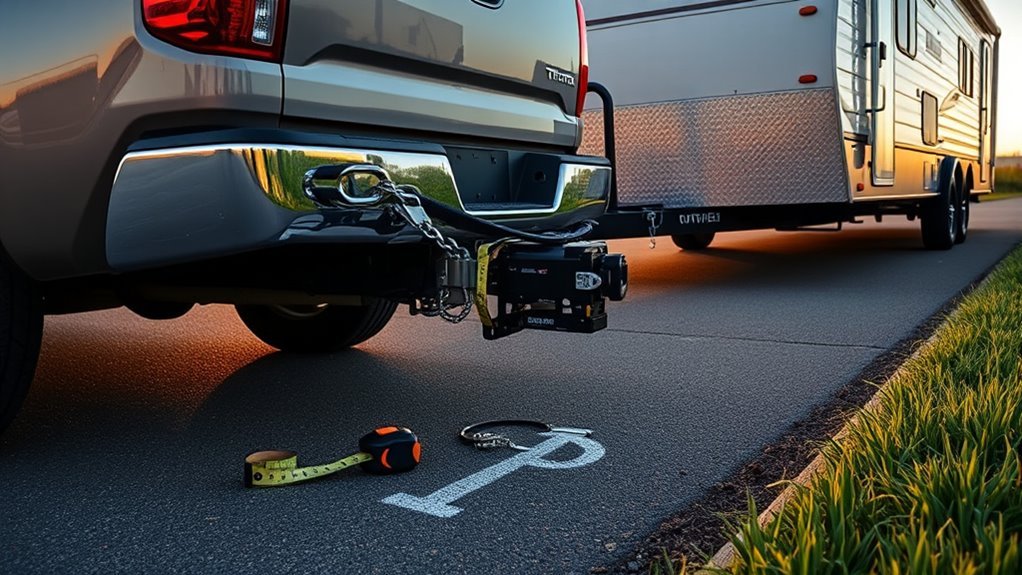
A correct setup takes about 30 minutes and pays off every mile you drive. Start with the truck parked on level ground and the trailer loaded as it will be for towing. An uneven setup skews tongue weight and defeats the hitch’s corrective geometry.
- Level the Tundra and verify load distribution before attaching the trailer.
- Raise or lower the coupler until the weight-distribution hitch head sits level with the trailer coupler. That hitch alignment is critical for predictable leverage.
- Insert the weight-distribution bars into the brackets, secure with pins, and lock them in place.
- Set initial bar tension per manufacturer specs using the provided tool. Preload the bars until the truck rear rises to a slight upward angle. That rise confirms corrective load transfer.
- Recheck tongue weight. Adjust bar tension until the reading sits between 12% and 15% of trailer weight.
- Tighten all fasteners, confirm pin retention, and take a short test drive to verify stability.
Pro tip: After setting bar tension, walk to the rear of the truck and confirm the bumper has risen slightly from its unloaded position. If it hasn’t moved, add more tension in small increments and recheck.
If sway persists after the test drive, increase or decrease bar tension in small steps and re-measure tongue weight each time. Precise setup is what gives you confident towing.
Check Tires, Suspension, and Alignment to Reduce Trailer Sway
Worn tires, soft suspension, or bad alignment can undo every other fix. Inspect and correct these before you hitch up.
Start with a full tire inspection. Check tread depth, look for sidewall cuts or bulges, and confirm pressure is at the recommended spec. Replace any tire showing uneven wear or damage.
Note: The 65–70 PSI pressure range applies to ST-type trailer tires, not the Tundra’s own tires. Check the trailer sidewall and the Tundra’s door jamb sticker separately for the correct spec on each vehicle.
Next, inspect suspension components. Check shocks, bushings, and mounts for wear. Worn parts reduce damping and invite oscillation. Consider upgrades like a TRD rear sway bar or air bags to stiffen rear geometry and resist trailer-induced yaw. These upgrades restore predictability within your truck’s rated limits.
Finally, verify alignment based on any lift or modification your truck has, not factory specs. Incorrect toe or camber amplifies instability. Correct any deviations and recheck after each adjustment.
Load Placement and Packing Tips to Prevent Sway
How you load the trailer matters as much as the hitch you use. Place heavy items close to the axle and slightly forward to hit the 12–15% tongue weight target. Rearward-heavy loads and overpacked rears are a direct cause of sway.
| Position | Action | Result |
|---|---|---|
| Front/axle area | Place heaviest items | Stable tongue weight |
| Center | Medium-weight items | Balanced center of gravity |
| Rear | Light items only | Reduced sway risk |
| Sides | Even spread, left and right | Lateral balance |
| All cargo | Rated straps, tight | No shifting during transit |
Shifting cargo mid-trip changes your weight balance and can trigger sway with no warning. Verify tire pressure and measure tongue weight with a scale before every departure. Move loads forward or backward until you hit the 12–15% target, then strap everything down.
What to Do When Trailer Sway Starts
Sway can feel alarming when it hits at highway speed. Your instinct to steer hard or brake sharply is the wrong move. Here’s what actually works.
Warning: Do not hit the brakes hard or make sudden steering corrections during active sway. Both actions amplify the oscillation and raise the risk of a jackknife.
Step 1: Keep Steady and Reduce Speed
Keep both hands on the wheel and hold a firm, steady grip. Ease off the accelerator and let speed drop gradually. Target around 30 mph or below if conditions allow. Steer gently into the direction of the sway to realign the rig. Avoid sudden lane changes and hold a steady course until the oscillation damps out.
| Action | Purpose | Timing |
|---|---|---|
| Firm grip | Prevent overcorrection | Immediate |
| Ease off accelerator | Reduce speed smoothly | Immediate |
| Steer gently into sway | Realign rig | During sway |
| Apply electric trailer brake | Assist stabilization | As needed |
Step 2: Apply Brakes with Control
Apply brakes gently and steadily to dampen trailer oscillation. Modulate pressure to slow both the truck and trailer without locking wheels. If you have an electric brake controller, use it to apply trailer brakes independently. That gives you more precise deceleration without destabilizing the rig.
Once the sway damps out, pull to a safe location and check your load and hitch setup before continuing. Sway that recurs means something in your setup needs adjustment.
When to Upgrade Suspension or Choose a Bigger Tow Vehicle
If sway persists despite correct setup, or if you’re regularly towing near the Tundra’s limits, the truck itself may be the limiting factor. Start with targeted suspension upgrades. Bilstein shocks and a TRD rear sway bar stiffen damping, reduce body roll, and improve trailer control within rated limits.
Check tongue weight: it should sit at 12–15% of trailer mass. If you can’t hit that target reliably with proper loading, the truck may be undersized for your trailer. Evaluate payload, GCVWR, and expected crosswind exposure together.
When your trailer approaches or exceeds 10,000 lbs, step up to a 3/4-ton or 1-ton platform. Owners who make that move report marked reductions in sway and better high-speed stability. Base that decision on chassis capacity, rear axle rating, and the manufacturer’s recommended towing package.
Frequently Asked Questions
What is the main cause of trailer sway?
Improper weight distribution is the most common cause. When too much cargo sits behind the trailer axle, tongue weight drops below 12–15% of trailer weight, giving the trailer more influence over the tow vehicle. Correct cargo placement, proper hitch setup, and controlled speed eliminate most sway issues.
How do I know if my tongue weight is correct?
Weigh your loaded trailer at a CAT scale or use a dedicated tongue weight scale before every trip. Tongue weight should be 12–15% of total trailer weight. For a 6,000 lb trailer, that means 720–900 lbs of tongue weight. Adjust by moving cargo forward or backward until you hit that range.
Can I use a friction sway bar instead of a weight-distribution hitch?
A friction sway bar adds resistance to lateral movement but doesn’t correct the underlying weight imbalance. Use it as a supplement to a properly set-up weight-distribution hitch, not as a replacement. On trailers approaching your truck’s tow rating, a sway bar alone is not enough.
At what speed does trailer sway become dangerous?
Sway risk increases significantly above 55 mph. Aerodynamic forces and yaw inertia grow with speed, and a minor oscillation can escalate quickly. Drive conservatively and slow down before crosswinds or turbulence from passing trucks have a chance to trigger sway.
Safety Disclaimer: This article covers general towing safety practices and is for informational purposes only. Towing capacity, weight ratings, and hitch specifications vary by vehicle configuration. Always consult your owner’s manual, a certified hitch installer, or a qualified mechanic before towing near rated limits.
Controlling trailer sway comes down to three consistent habits: measure tongue weight every time, set up your hitch precisely, and load cargo with the axle in mind. Do those three things and sway becomes rare. If it does happen, ease off the gas, hold steady, and let speed reduction do the work. The setup is boring on purpose — boring means predictable, and predictable means safe.
References
- Vehicle and Towing Safety Resources — National Highway Traffic Safety Administration (NHTSA)
- Toyota Tundra Specifications and Towing Capacity — Toyota Motor Corporation
- RV Towing and Safety Guidelines — RV Industry Association (RVIA)