You need to know three limits: GVWR is your truck’s max curb weight plus passengers and cargo (check the door‑jamb sticker), GAWR is the max each axle can carry, and GCWR is the combined limit for truck plus trailer. Use curb weight + available payload + trailer GTW to confirm you’re within GCWR and each axle’s GAWR, and keep tongue weight ~10–15% of trailer mass. Follow balance, tire pressure, and hitch guidelines to tow safely — more practical steps follow.
GCWR, GVWR, GAWR: What They Mean for Your Tundra
Understanding GVWR, GCWR, and GAWR is essential when you tow with a Tundra: GVWR (7,365 lbs for the 2024 model) is the maximum curb weight plus passengers and cargo the truck can legally carry, GAWR is the maximum load each axle can support, and GCWR is the combined weight limit for the truck, passengers, cargo, and trailer—calculated by adding your truck’s curb weight and payload to the trailer weight—to guarantee you don’t exceed the vehicle’s towing capacity. You’ll use these ratings to manage towing capacity, align weight distribution, and respect axle limits. Check GAWR to prevent overloading front or rear axles; maintain safety margins so handling and braking aren’t compromised. Employ load balancing and cargo organization to keep center of gravity stable and trailer brakes effective. When you control weight distribution and adhere to GCWR/GVWR/GAWR, you regain freedom to tow efficiently, preserve performance efficiency, and reduce accident risk while asserting authority over your rig.
GVWR, Curb Weight & Payload : Check Your Door Jamb
Start by reading the door jamb sticker on your Tundra—it’s the authoritative source for GVWR, curb weight, and payload for that exact configuration. The 2024 CrewMax Ltd lists a GVWR of 7,365 pounds and a Payload Capacity of 1,330 pounds on that sticker. Curb Weight is the unloaded mass you use as the baseline: subtract it from GVWR to verify available payload. That remaining allowance covers passengers, cargo, and any added equipment.
You’re responsible for confirming numbers for your specific Vehicle Configuration; options and trim change Curb Weight and therefore Payload Capacity. Use the sticker figures to plan loads and keep within limits to preserve Towing Safety. Overloading compromises brakes, suspension, and steering, and restricts escape options on the road. Read the sticker, calculate precisely, and adjust your load or gear to maintain legal, safe operation—freedom on the road depends on disciplined weight management.
Calculate GCWR and Verify Your Truck Can Tow a Trailer
Now that you’ve confirmed GVWR, curb weight, and payload from the door jamb, you need to calculate the Gross Combined Weight Rating (GCWR) to validate the truck can safely tow your trailer. Add curb weight (e.g., 7,365 lbs for a 2024 Tundra), payload (1,330 lbs), and the trailer’s Gross Trailer Weight (GTW). For a 6,500 lb trailer, the GCWR equals 15,195 lbs. Confirm passengers and cargo don’t push the total over GCWR.
| Truck Component | Pounds |
|---|---|
| Curb Weight | 7,365 |
| Payload | 1,330 |
Check door jamb GVWR and GAWR to verify axles and frame can handle loads. Maintain proper weight distribution so braking and steering remain responsive. Towing safety isn’t optional; it’s the key to freedom on the road. If your combined weight approaches or exceeds GCWR, reduce cargo, downsize the trailer, or upgrade equipment. Validate numbers before every trip; liberation depends on disciplined preparation.
Tongue Weight & Payload Math: How Much You Can Carry
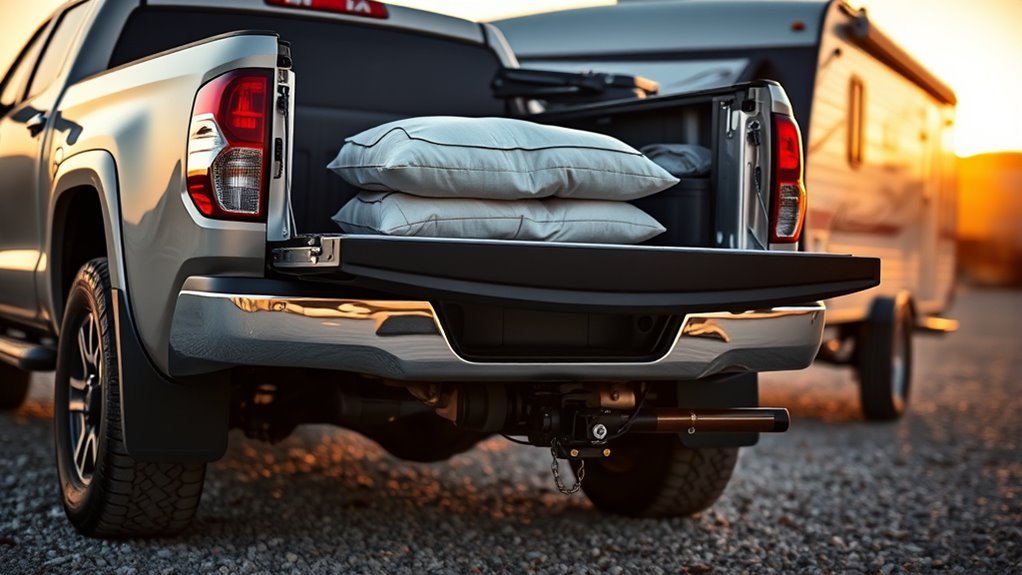
Calculate tongue weight precisely because it directly eats into your truck’s payload and dictates how much passenger and cargo weight you can carry. You should aim for tongue weight at about 10% of the trailer’s total weight to preserve towing stability. For a 2024 Toyota Tundra with a maximum payload capacity of 1,330 lbs, that payload must cover passengers, cargo, and the trailer’s hitch weight.
Work through the numbers: payload equals GVWR minus curb weight, and your total must not exceed the Tundra’s 7,365 lbs GVWR. If your trailer’s dry weight is 5,820 lbs and hitch weight measures 750 lbs, you’re left with roughly 580 lbs for people and gear. That remaining allowance dictates how many passengers you can liberate with equipment.
Also verify GCWR limits so the combined truck, payload, and trailer weight stay within safe bounds. Accurate math preserves control, safety, and your freedom to go where you choose.
Hitch, Ball, and Weight‑Distribution Hitches: What to Use
One clear rule: match the hitch, ball mount, and weight‑distribution system to the trailer’s coupler size and Gross Trailer Weight (GTW) so your Tundra stays safe and predictable on the road. You’ll choose for hitch compatibility first: verify the hitch receiver class and its weight rating exceed GTW. Prioritize towing safety by exceeding required ratings rather than meeting minimums.
- Verify hitch compatibility: confirm receiver class, pin size, and tongue rating exceed GTW and tongue weight.
- Ball mount selection: pick the correct shank drop/rise and ball diameter to level the trailer and match coupler size.
- Weight distribution: use a WDH when GTW and nose‑weight transfer compromise handling; it redistributes load across axles and reduces sway.
- Setup and inspection: set hitch height/angle for a level tow, torque hardware, and recheck before every trip.
Make choices that free you from compromise—rigid, precise gear equals confident, liberated towing.
Example: 2024 CrewMax Towing a 30′ Camper (Step‑By‑Step)
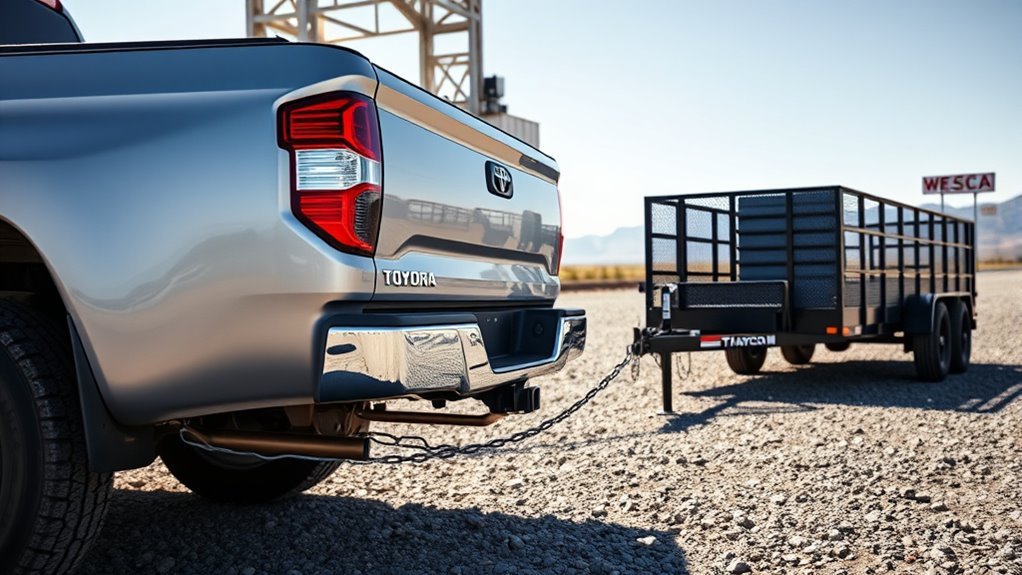
With your hitch, ball, and weight‑distribution gear matched to the trailer, let’s walk through a step‑by‑step example of a 2024 Tundra CrewMax towing a 30′ camper so you can verify limits and set up properly. First, confirm trailer total ≈6,500 lbs and tongue weight ≈650 lbs (10%). Next, note CrewMax GVWR 7,365 lbs and payload 1,330 lbs. Subtract tongue weight and estimated 300‑lb passenger load: remaining payload ≈380 lbs for cargo. Verify vehicle curb weight plus full payload plus trailer weight to calculate GCWR; guarantee the sum stays within the manufacturer GCWR before departure. Check that tongue weight sits on the hitch within recommended percentage and that your weight distribution system is rated for the trailer’s gross and tongue weights. If GCWR and payload constraints are respected and weight distribution equipment is properly adjusted, you’ll tow within safe limits while maintaining freedom to travel without sacrificing control.
Pre‑Trip Checks & Quick Fixes to Prevent Overload and Sway
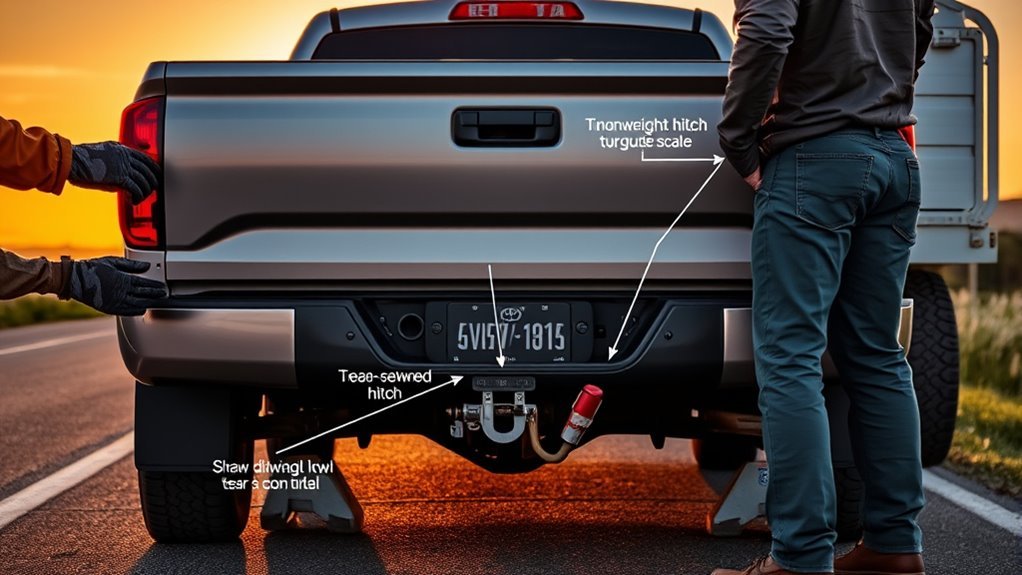
Before you hit the road, check tongue weight to confirm it’s about 10% of the trailer’s loaded mass and won’t push your GCWR/GVWR/GAWR limits. Inspect tire pressures on both truck and trailer to verify correct load ratings and even contact patches. Secure the load and gear with rated straps and safety chains so nothing shifts and induces sway.
Check Tongue Weight
A quick tongue-weight check tells you whether your Tundra and trailer will behave safely on the road, so measure it every time you hitch up. You’ll target 10–15% of trailer mass as tongue weight; exceed your model’s 1,120–1,200 lb limit and you compromise control. Use the door jamb sticker to confirm payload and GVWR before calculating available tongue capacity. A weight distribution hitch (WDH) can restore proper weight distribution across axles and reduce sway when loading shifts forward.
- Weigh trailer and calculate 10–15% target.
- Confirm Tundra tongue limit from spec sticker.
- Adjust cargo fore/aft to meet target.
- Fit and tune WDH to balance axles.
Check and adjust every trip to preserve stopping ability and freedom on the road.
Inspect Tire Pressures
Start by checking tire pressures every time you hook up, since underinflation under heavy loads raises heat buildup and blowout risk. You’ll use a calibrated gauge and the vehicle door-jamb placard to set PSI to manufacturer specifications for towing; highway or unloaded pressures may be wrong. Increase pressure per the sticker or trailer load chart so sidewalls run cooler and bead integrity holds under stress. Monitor pressures during the trip—temperature shifts change PSI—and recheck after the first 50 miles. Improper inflation reduces traction, amplifies sway, and undermines control. As a liberated operator you’ll adopt these safety tips as routine: verify gauge accuracy, adjust cold, and inspect for cuts or bulges. That discipline prevents failures and keeps you sovereign on the road.
Secure Load And Gear
1 clear pre‑trip rule: confirm the trailer and cargo stay within the Tundra’s rated limits and that weight sits where the axles can handle it.
- Verify total trailer+cargo <= GCWR and Tundra GVWR (2024 GVWR 7,365 lb) before you load; this protects structure and liberty to travel.
- Check GAWR limits and distribute mass fore/aft so each axle carries appropriate share; balance prevents handling issues and component wear.
- Use a weight distribution hitch and target tongue weight ≈10% of trailer weight to minimize sway and restore confident control.
- Perform load security and gear organization: fasten items, lock compartments, recheck straps and pressure; quick fixes at the ramp eliminate overload risk.
Act decisively—secure loads, stay within ratings, and tow free from compromise.
Frequently Asked Questions
What Is GVWR Vs Gcwr Vs Gawr?
GVWR’s your vehicle’s max loaded weight; GCWR’s the combined vehicle-plus-trailer limit; GAWR’s each axle’s max. You’ll respect towing terminology and weight ratings, stay within limits, and reclaim freedom by hauling safely and confidently.
Why Is Tundra Towing Capacity so Low?
Like a loaded bridge sagging, the Tundra’s towing capacity’s limited because you’re constrained by towing performance factors and payload limitations: GVWR, payload, curb weight, drivetrain and configuration reduce safe trailer mass, so you’ll tow less.
What Tundra Tows 12000 Lbs?
The Tundra SR5 Double Cab RWD with the proper towing package tows 12,000 lbs; you’ll guarantee Tundra towing limits and towing safety by verifying payload, hitch setup, brakes, and door-jamb ratings before liberating heavy loads.
Conclusion
You’ve got the numbers and checks to keep your Tundra safe and legal—don’t guess. Always confirm GVWR, GCWR and GAWR on the door jamb, calculate payload and tongue weight, and pick the correct hitch and weight‑distribution setup. Do a pre‑trip inspection and fix issues before you roll. Follow these steps like your life — and your camper’s — depends on it (because, frankly, it does). Stay strict, stay within limits, and tow confidently.