
You’ll use the Tundra maintenance schedule as a mileage‑and‑time roadmap that tells you what to service, when, and how to adjust for severe use. Match tasks to odometer or time, group routine items at 5,000‑mile steps, and follow owner’s‑manual exceptions for warranty coverage. Track oil, filters, fluids, tires, and inspections; shorten intervals under severe duty and verify services with receipts and tamper marks. Continue for practical checklists, service hours, and parts guidance.
How to Read Your Tundra Maintenance Schedule

How do you read the Tundra maintenance schedule efficiently? Start by aligning service frequency with your odometer: key items recur every 5,000 miles, so check mileage often and set reminders. Ignore maintenance myths that push arbitrary changes; follow prescribed intervals instead. Scan the schedule for grouped tasks: routine oil changes and tire rotations at 5,000-mile steps, periodic fluid checks, and major milestones at 30,000 and 60,000 miles.
Procedure: 1) Identify current mileage. 2) Cross-reference the schedule for upcoming 5,000-mile tasks. 3) Note fluids requiring extended intervals — brake fluid and transmission oil can mandate replacement at specific high-mileage points, especially if you tow. 4) Flag 30,000- and 60,000-mile thorough inspections (spark plugs, filters, critical components). 5) Verify year-specific exceptions in the owner’s manual to maintain warranty compliance. You’ll gain control, avoid unnecessary work, and keep your Tundra reliable by following this systematic, fact-based approach.
Find Your Tundra Schedule (Manual vs Online)
Where do you find the correct maintenance schedule for your Tundra? Start with manual access: open the owner’s manual in the glovebox to locate year- and generation-specific service intervals and listed maintenance tasks. If the manual’s missing, use digital resources on Toyota’s official site to download the exact owner’s manual for your model year. Verify generation differences—2nd vs 3rd gen—so you’ll follow the right intervals.
Follow this procedural checklist: 1) Identify model year and generation. 2) Retrieve owner’s manual (physical or PDF). 3) Cross-check service intervals for each system. 4) Note any requirements tied to warranty coverage. Use online resources to confirm updates or service bulletins.
This dual approach boosts owner engagement and lets you claim autonomy over maintenance decisions. Consistently consulting both manual and digital sources preserves vehicle reliability and guarantees you perform required maintenance tasks on schedule, protecting performance and warranty standing.
Mileage vs. Time: How Intervals Work
Because the Tundra’s schedule uses both mileage and elapsed time, you must track and act on whichever comes first—typically 5,000-, 10,000-, and 30,000-mile marks or 6-, 12-, and 18-month intervals—so routine services like oil changes and tire rotations happen on time even if you don’t rack up miles. Use a simple log or digital reminder to flag upcoming mileage maintenance and time intervals. Check odometer readings against calendar dates; when either threshold is met, perform the listed routine checks. Prioritize 5,000-mile/6-month tasks for consumables and inspections, escalate to 10,000- and 30,000-mile items for broader system servicing. If you drive rarely, let time intervals drive actions; if you drive heavily, let mileage govern. This dual-trigger method reduces failure risk and preserves performance longevity. Implement a monthly review of indicators, fluid levels, and tire condition, then schedule service when a mileage or time trigger appears. Stay proactive to maintain freedom of mobility and system reliability.
Tundra Maintenance Items: Oil, Filters, Fluids, Tires
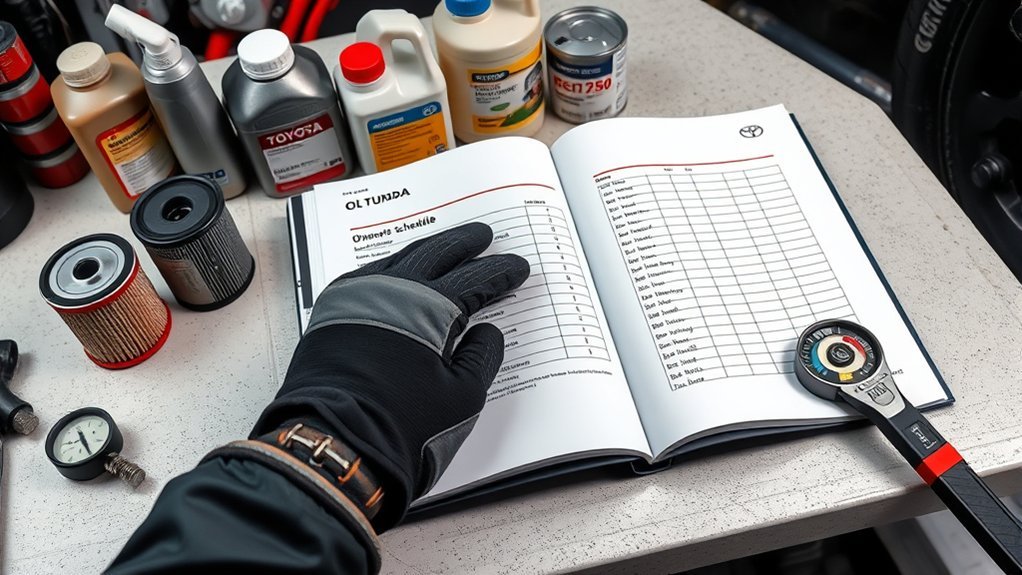
Now that you’re tracking mileage and time triggers, apply them to the Tundra’s primary service items: oil, filters, fluids, and tires. You’ll follow oil change intervals of 5,000 miles for conventional oil or up to 10,000 miles with synthetic—schedule accordingly and log each change. Use filter replacement tips: replace engine air filter every 30,000 miles and cabin air filter every 15,000 miles; inspect visually sooner in dusty conditions. Respect fluid check importance by checking oil, coolant, transmission, and brake fluid levels at service intervals; replace brake fluid every 24,000–36,000 miles or every 2–3 years. Rotate tires every 5,000 miles to equalize wear and extend usable life. Spark plugs need attention only at long intervals—replace at 120,000 miles to preserve efficiency and emissions compliance. Execute these tasks on your timetable to reclaim control of vehicle reliability and avoid reactive repairs.
Maintenance Indicators: “Required” vs. Oil Countdown
When you see the Tundra’s maintenance reminder or oil countdown light, treat them as complementary cues rather than duplicates: the maintenance reminder typically flags service every 5,000 miles for routine checks, while the oil countdown tracks remaining miles to the next oil change (often set to 10,000 miles with synthetic oil). You’ll avoid maintenance confusion by recognizing function: the “Required” alert prompts a multi-point inspection—fluids, filters, tires, and basic systems—at 5,000-mile intervals; the oil countdown gives a running tally toward the oil-service threshold.
Procedure: monitor the odometer and the oil countdown display; schedule a 5,000-mile service when “Required” appears or at each 5,000-mile mark. If the oil countdown approaches zero before routine service, prioritize the oil change per the countdown and log it. Acknowledge both indicators to maintain service clarity, prevent breakdowns, and retain operational freedom over your vehicle maintenance decisions.
Spark Plugs, Emissions, and Warranty Guidance
If you want to keep the Tundra running efficiently and protect your emissions warranty, replace the spark plugs every 40,000 miles as Toyota specifies. You’ll perform spark plug maintenance on a schedule that preserves combustion cleanliness, prevents misfires, and sustains fuel economy. Inspect plugs at intervals; documented owner reports show visible wear at ~40k, so don’t defer replacement. Log the service date and mileage to maintain warranty records.
When changing plugs, use Toyota-approved parts, correct gap, and torque to spec. Clean the plug wells, apply anti-seize only if specified, and replace ignition components showing damage. Adherence to the manufacturer’s interval protects the emissions warranty even in non-emissions states — warranty coverage can depend on following prescribed maintenance, not local regulation.
Follow the procedure, keep receipts, and record inspection notes. This disciplined approach frees you from avoidable engine issues, secures warranty protection, and sustains long-term performance.
Adjusting the Schedule for Severe Duty Use

Because severe duty — like frequent towing, heavy loads, or lots of short trips — accelerates wear, you should shorten several service intervals and add inspections to prevent premature failures. For severe conditions, cut the standard oil change interval to every 2,500 miles; this oil change cadence reduces engine wear and preserves oil detergency under heat and load. Increase inspection frequency for belts, hoses, brakes, and cooling components after heavy-use cycles. Apply towing precautions: verify trailer hookup, monitor transmission and brake temps, and schedule differential service every 15,000 miles when towing to prevent gear fatigue. Execute propeller lubrication every 5,000 miles under severe conditions; check U-joints and slip splines at each service. Use these maintenance tips in a checklist: oil change, fluid levels, differential service, propeller lubrication, and targeted inspections. Maintain a disciplined interval map based on duty type so you control wear, extend service life, and keep your Tundra mission-ready.
Keeping Records: Verifying Oil and Filter Changes
After every service, check the receipt for line-item oil and filter charges and note the odometer reading to confirm the interval. Inspect the filter for a tamper mark or paint dot applied at the head and record that mark in your log. Finally, immediately verify oil level and appearance to confirm the correct oil grade and fill volume were used.
Service Receipt Verification
A clear service receipt and a stamped maintenance log are your primary tools for verifying oil and filter changes; keep each receipt, note the date and mileage, and record the service in your log immediately after the visit. Use receipts to build an auditable service history and apply maintenance tips: retain originals, scan copies, and attach them to the vehicle file. After service, inspect oil level and color to confirm replacement, and run a checklist to verify filter removal, new filter part number, and oil type and volume. Log any discrepancies and refuse incomplete work until corrected. This procedural recordkeeping protects warranty rights, supports resale negotiations, and empowers you to hold shops accountable for following the Toyota Tundra maintenance schedule.
Tamper Marking Techniques
When you want a quick, unequivocal check that an oil service was performed, apply a tamper mark to the filter and document it in your service log; the mark gives you immediate visual confirmation and a traceable record for later verification. You’ll use a paint pen or permanent marker to place a dated, initialed dot spanning the filter edge and adjacent fixed point so any removal breaks the mark. Photograph the mark, enter the date, mileage, and technician initials in your log or app. Tamper marking supports maintenance transparency and protects you from skipped work that can degrade engine performance. Regularly auditing marks against receipts builds a defendable history for warranty and resale, empowering you to hold providers accountable.
Post-Service Oil Check
If you want to confirm a proper oil service, check oil level and filter condition immediately and record the findings—this guarantees no old oil remains and that the filter was actually replaced. You’ll perform filter inspection and filter verification by marking the filter or checking tamper paint, then logging date and mileage in service documentation. Measure oil level at the dipstick, note oil consistency and color, and run basic performance checks to detect engine issues early. Enter maintenance reminders based on the 5,000-mile (10,000 synthetic) interval and update tracking history so you control your schedule. This procedural approach frees you from uncertainty, assures timely interventions, and preserves engine performance after every oil change.
Toyota Service Hours and Genuine Parts Access
Check the service department hours (Mon–Sat 7 AM–7 PM, Sun 8 AM–3 PM) before scheduling to verify the shop and parts counter will be open when you arrive. Use those same hours to plan parts pickup, since genuine Toyota components are available during service times for timely repairs and routine maintenance. For scheduling and directions, call the dealership or use their online scheduler and maps to confirm appointment slots and parking/loading zones.
Service Department Hours
You’ll find Toyota’s service and parts departments open Monday through Saturday from 7:00 AM to 7:00 PM and on Sunday from 8:00 AM to 3:00 PM, so you can schedule maintenance or pick up genuine parts across consistent hours; this alignment helps guarantee timely repairs and reduces downtime by providing predictable access to authorized service and OEM components. Use these service hours to plan preventive maintenance: book weekday slots for routine inspections, reserve Saturdays for limited availability, and keep Sunday for urgent needs. Arrive prepared with your maintenance schedule and VIN to streamline check-in. Staff will verify required services and confirm parts availability. Consistent hours maximize your control over vehicle readiness and reinforce customer convenience while preserving your freedom to operate.
Parts Department Access
Because timely repairs hinge on parts availability, the Parts Department at Toyota of North Miami is open Monday–Saturday 7:00 AM–7:00 PM and Sunday 8:00 AM–3:00 PM so you can obtain genuine Toyota components when you need them. You’ll access genuine parts during posted hours to support scheduled maintenance and urgent repairs, preserving Tundra reliability. Check the official Toyota website for real-time parts availability and service campaign notices before you arrive. When you call or request parts online, provide VIN and part numbers to reduce delays. Technicians and parts staff coordinate to match inventory with maintenance intervals in your schedule. This procedural access model prioritizes customer convenience and operational freedom, letting you control timing and minimize downtime while keeping your vehicle within Toyota specifications.
Scheduling And Directions
When planning service, use Toyota of North Miami’s consistent hours—Mon–Sat 7:00 AM–7:00 PM and Sun 8:00 AM–3:00 PM—to book appointments online for routine maintenance or urgent repairs and to obtain genuine Toyota parts without delay. You’ll use online booking for scheduling flexibility, pick a slot that frees you, and follow procedural directions on the Toyota site to reach the service center. The parts desk matches service hours so replacements’re available when you arrive. Carry vehicle info and desired services; the advisor will confirm scope and lead time. Use the map and step-by-step directions provided online to minimize downtime and reclaim mobility.
| Item | Action |
|---|---|
| Booking | Use online booking |
| Parts | Verify genuine parts availability |
| Directions | Follow site map and steps |
Practical Checklist by Mileage: 0–30K, 30–60K, 60K+
Start with a mileage-based checklist to keep your Tundra reliable and compliant: follow maintenance frequency guidelines to gain clear service benefits. 0–5,000 miles: change engine oil, rotate tires, and run a multi-point inspection; document findings and correct safety items immediately. 5,000–30,000 miles: monitor fluid levels at each service interval; replace cabin air filter at 15,000 miles and the engine air filter at 30,000 miles to sustain air quality and engine efficiency. 30,000 miles: perform an extensive service — inspect transmission for leaks, re-torque propeller shaft bolts, and replace both filters; log torque values and leak checks. 40,000 miles: replace spark plugs to restore fuel economy and preserve emissions compliance, especially if you tow or haul. 60,000 miles+: execute a major service — change transmission fluid, flush brake fluid, and inspect suspension components thoroughly. Use this procedural checklist to take control of maintenance, reduce unexpected downtime, and extend your Tundra’s capability.
Frequently Asked Questions
How to Figure Out What Maintenance Is Required on a Toyota?
Check your odometer, consult the owner’s schedule, and follow intervals: perform oil change and tire rotation every 5,000 miles, replace spark plugs per mileage, monitor alerts, inspect fluids and tires, and document services to preserve freedom.
What Is the 100000 Mile Service on a Toyota Tundra?
You’re getting a ridiculously thorough 100,000-mile service: you’ll perform brake inspection, fluid replacement (coolant, transmission), swap spark plugs, check timing components and hoses, and inspect suspension and drivetrain so your Tundra stays reliably liberated.
What Is the Service on a 60000 Mile Tundra?
At 60,000 miles you’ll replace spark plugs, perform brake inspection and fluid replacement, inspect transmission (change if towing), flush brake fluid, check suspension and drivetrain, and run a basic tune-up to keep performance and emissions compliant.
Conclusion
You now know how to read and follow your Tundra’s maintenance schedule, whether from the owner’s manual or Toyota’s online resources. If you worry it’s too complex, it isn’t—stick to mileage/time intervals and the clear “required” indicators, and log each oil and filter change. For severe-duty use, shorten intervals as instructed. Use genuine parts and Toyota service hours when needed. Follow the checklist by mileage to keep the truck reliable and safe.