Your Tacoma’s parking brake is not just for emergencies. Toyota’s own parking instructions tell drivers to use the parking brake when parking, and that matters most on hills, driveways, loose ground, or anytime the truck could move after you step out. The right habit is simple: stop fully, hold the service brake, set the parking brake, then finish securing the transmission for your model.
Quick Answer
Yes, you should use your Tacoma’s parking brake whenever you park, especially on hills. It helps prevent rollaway, adds a backup to Park or a manual gear, and reduces load on the transmission. In freezing conditions, follow your owner’s manual because Toyota warns the parking brake may freeze.
Key Takeaways
- Set the parking brake before you relax your foot brake so the truck does not settle hard against the transmission’s parking pawl.
- On hills, use the parking brake, turn the wheels correctly, and use wheel chocks when the grade is steep or the surface is loose.
- Manual Tacoma drivers should rely on the parking brake every time they park and when controlling rollback during hill starts.
- Do not drive with the parking brake partly applied; it can overheat brake parts and increase wear.
- In ice, snow, or freezing rain, check the winter-driving guidance in your Tacoma owner’s manual before leaving the parking brake set overnight.
At a Glance
| Time Required | 5–10 seconds each time you park |
| Difficulty | Easy |
| Tools Needed | None for normal parking; wheel chocks for steep grades, trailers, or loose ground |
| Cost | Free, unless inspection or repair is needed |
When to Set Your Tacoma’s Parking Brake
You should set your Tacoma’s parking brake every time you park, not only when you are on a steep hill. Toyota’s parking guidance for the Tacoma says to set the parking brake, shift the vehicle into the proper parked position, and make sure the vehicle does not move before leaving it. For current Tacoma information, check the official Toyota Tacoma driving instructions.
The parking brake is most important when you stop on an incline, park on uneven ground, leave the truck on gravel or dirt, park with a trailer, or load cargo while the truck is stationary. It also gives you a second layer of security on flat pavement. Park alone can hold an automatic Tacoma, but the parking brake helps keep the truck from resting all its weight on the parking pawl.
For older Tacomas with a hand lever or pedal, regular use also keeps the cables and pivot points moving. For newer Tacomas with an electronic parking brake switch, regular use keeps you in the habit Toyota expects: do not leave the truck until the parking brake indicator confirms the brake is set and the vehicle is stable.
Note: Tacoma controls vary by model year. Some use a hand lever, some use a foot pedal, and newer models may use an electronic parking brake switch. The safety habit is the same: stop fully, hold the brake pedal, set the parking brake, and confirm the truck will not move.
How to Engage Your Tacoma’s Parking Brake Step by Step
Use this parking sequence for an automatic Tacoma unless your owner’s manual gives model-specific instructions:
- Stop completely and keep your foot firmly on the brake pedal.
- Set the parking brake. Pull the lever fully, press the pedal fully, or use the electronic switch until the indicator confirms engagement.
- Shift the transmission into Park.
- Slowly ease off the brake pedal and make sure the truck stays still.
- Turn off the engine, lock the truck, and take the key or electronic key with you.
For a manual Tacoma, stop fully, keep the brake pedal pressed, set the parking brake, and leave the transmission in the gear recommended for the situation. On a hill, many owner’s manuals tell manual drivers to use 1st gear or Reverse, depending on the direction of the slope. If your Tacoma is newer, always follow the instructions in your exact model year manual.
Set the parking brake while your foot is still holding the service brake. That keeps the truck from rolling or loading the transmission before the parking brake takes over.
When you leave, reverse the process calmly. Press the brake pedal, start the truck, shift into the proper gear, release the parking brake completely, and then drive away. If the parking brake warning light stays on or the truck feels held back, stop and check it before continuing.
Warning: Never drive with the parking brake partly engaged. Toyota warns that driving with the parking brake set can overheat brake components, reduce braking performance, and increase brake wear.
Using the Parking Brake on Hills and Inclines
On a hill, use the parking brake before you depend on Park or a manual gear. Gravity can move a truck quickly, and even a small roll can damage property or cause injury. The California DMV hill-parking guidance also tells drivers to set the parking brake and leave the vehicle in Park or in gear for a manual transmission.
Set the Brake Before the Truck Settles
The best hill-parking routine is:
- Stop fully and hold the foot brake.
- Set the parking brake firmly.
- Shift into Park on an automatic, or into the correct gear on a manual.
- Ease off the foot brake gently and confirm the truck does not move.
- Turn the front wheels in the correct direction for the hill.
This routine puts the holding job on the parking brake first. That reduces the hard clunk you may feel when an automatic truck rests heavily on the parking pawl and then has to be shifted out of Park later.
Wheel Position and Wheel Chocks
Wheel direction matters because it gives the truck a safer path if something fails. When parking downhill with a curb, turn the front wheels toward the curb. When parking uphill with a curb, turn the wheels away from the curb and let the tire rest lightly against it. When there is no curb, turn the wheels to the right so the vehicle rolls away from traffic if it moves.
Use wheel chocks when the grade is steep, the surface is dirt or gravel, the truck is loaded, or you are parked with a trailer. Place the chocks snugly against the tires in the direction the truck would roll. On very steep grades, chock both sides when possible.
Pro Tip: If your Tacoma rocks after you shift into Park, your sequence is probably backwards. Set the parking brake first, then shift into Park, then release the foot brake slowly.
Automatic vs. Manual Tacomas: What Changes?
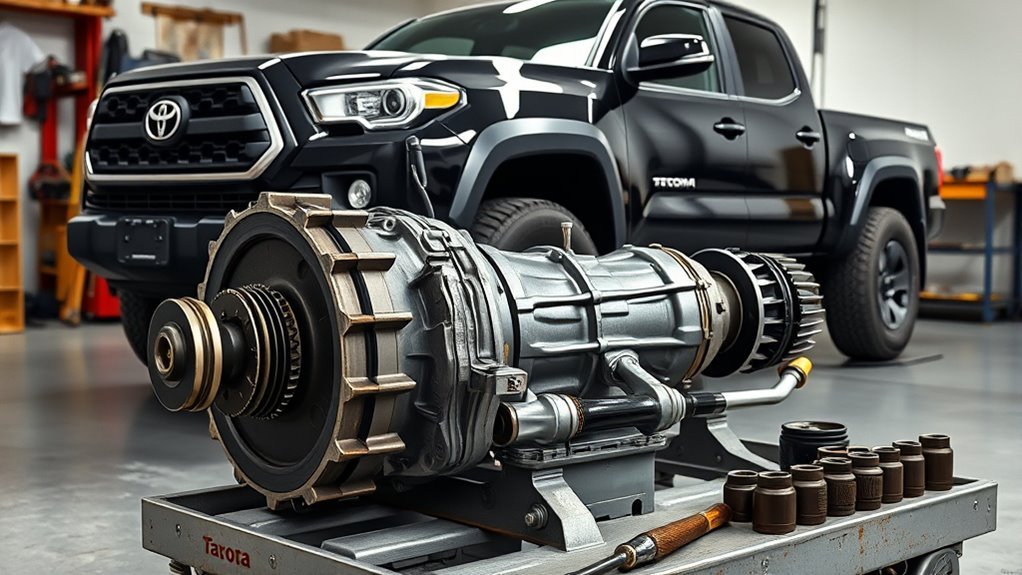
With an automatic Tacoma, Park uses a mechanical parking pawl inside the transmission to help hold the vehicle. That pawl is not meant to replace the parking brake on hills. Set the parking brake first so the brake system holds most of the load instead of letting the truck settle hard into Park.
With a manual Tacoma, the parking brake is even more important because there is no Park position. Use the parking brake every time you park, and leave the transmission in the correct gear for the slope. On hill starts, the parking brake can also help prevent rollback while you move from the brake pedal to the accelerator and clutch.
| Tacoma Type | Best Parking Habit | Why It Matters |
|---|---|---|
| Automatic | Set parking brake, then shift to Park | Reduces pawl load and adds rollaway protection |
| Manual | Set parking brake and leave the truck in gear | Keeps the truck secured without a Park position |
| Newer electronic parking brake models | Use the switch and confirm the indicator | Confirms the system is engaged before you exit |
[Products Worth Considering]

The MaxxHaul Solid Rubber Wheel Chock 2-Pack provides dependable vehicle stabilization for cars, trucks, trailers, and RVs in garages, driveways, job sites, and campgrounds. Its solid rubber construction, non-slip traction surface, and built-in handle make placement easy while delivering long-lasting grip and all-weather durability for safer parking and storage.

Fit for Honda HR-V 2016-2021.
How the Parking Brake Protects Your Transmission
In an automatic Tacoma, Park relies on a small metal part called a parking pawl. It helps lock the transmission, but it should not be treated as the only thing holding the truck on a hill. If the truck rolls back and loads the pawl, shifting out of Park can feel stiff or harsh.
The parking brake helps by holding the wheels first. That means less weight sits on the transmission when the truck is parked, especially on inclines. It is a simple habit that can reduce stress on driveline parts and make the truck feel smoother when you shift out of Park later.
| Benefit | Effect |
|---|---|
| Reduced pawl load | Less binding when shifting out of Park |
| Better rollaway protection | The truck has a second holding system |
| More predictable parking | The truck settles less after you step out |
Preventing Rollaways: Real-World Tacoma Scenarios
A rollaway does not require a dramatic mountain road. A driveway, boat ramp, trailhead, campsite, or loading area can be enough. Use the parking brake in these common Tacoma situations:
- Sloped driveway: Set the parking brake before Park, turn the wheels correctly, and use chocks if the driveway is steep.
- Boat ramp: Use the parking brake and chocks where safe. Wet ramps reduce tire grip and make small movements harder to control.
- Trail parking: Dirt, gravel, and uneven ground can shift under the tires. Set the parking brake and avoid relying only on the transmission.
- Loading cargo: When weight moves in the bed, the truck can rock. Keep it secured before loading or unloading.
- Trailer hookup: Set the parking brake before getting out to connect or disconnect a trailer.
The National Highway Traffic Safety Administration’s recall documents for other vehicles show why “Park” alone should not be treated as perfect protection: when park-lock or pawl systems fail, a vehicle may roll even after the driver selects Park if the parking brake is not engaged. That is why the parking brake is a low-effort backup worth using.
Why Some Owners Skip It — and Why That’s Risky
Some Tacoma owners skip the parking brake because they park mostly on flat ground, trust the automatic transmission, or were taught that the “emergency brake” is only for emergencies. That name is misleading. The better term is parking brake, because parking is its normal job.
| Reason Owners Skip It | Risk | Better Habit |
|---|---|---|
| “Park is enough.” | More load on the parking pawl | Set the brake before Park |
| “I only need it on hills.” | Inconsistent habit and missed slopes | Use it every time you park |
| “It might get stuck.” | Lack of use can let cables corrode on older systems | Use it regularly and inspect it |
| “It is only for emergencies.” | Higher rollaway risk | Treat it as normal parking equipment |
The one real exception is harsh winter parking. Toyota’s winter guidance warns that the parking brake may freeze and recommends parking in Park for automatics or in 1st gear or Reverse for manuals without setting the parking brake in freezing conditions. See Toyota’s official Tacoma winter driving tips for model-specific wording.
Parking Brake Maintenance: What to Check and When
Parking brake maintenance is simple: use it, watch how it feels, and have it inspected when something changes. Toyota’s maintenance guidance says general maintenance should be performed regularly and scheduled maintenance should follow the maintenance schedule for your exact vehicle. You can start from Toyota’s official Tacoma maintenance requirements.
For cable-operated systems, inspect exposed cables and mounting points for rust, fraying, slack, or binding. For a lever or pedal, the travel should feel firm and progressive, not loose, spongy, or jammed. For electronic parking brake models, pay attention to warning messages, indicator lights, and unusual motor noises.
- Inspect: Look for rust, broken cable strands, damaged brackets, or loose hardware.
- Test: On a mild incline in a safe area, confirm the parking brake can hold the truck after you set it.
- Service: Ask a qualified technician to adjust, lubricate, or replace worn parts if the brake feels weak or sticks.
- Verify: Make sure the parking brake indicator turns on when engaged and turns off when fully released.
Troubleshooting: Signs Your Tacoma’s Parking Brake Needs Repair
Do not ignore a parking brake that feels different than usual. The system is there to hold the truck still, so small symptoms matter.
- Loose lever or pedal: A stretched cable, worn adjustment, or worn parking brake shoes may be the cause.
- Brake will not hold on a hill: The system may need adjustment, new shoes, cable repair, or electronic diagnosis.
- Warning light stays on: The brake may not be fully released, or the system may have a fault that needs inspection.
- Grinding, clicking, or scraping: Hardware, shoes, cables, or rear brake parts may be worn or contaminated.
- Burning smell after driving: Stop safely and check whether the parking brake was left partly engaged.
- Frozen or stuck brake: Do not force the truck to move. Let the system thaw safely or call for service.
Warning: If your Tacoma moves with the parking brake fully engaged, treat it as a safety problem. Park on level ground, use chocks if needed, and have the system inspected before relying on it again.
[Products Worth Considering]

【Wide Compatibility】 This rear parking brake hardware kit is specifically designed to fit Toyota Camry 2005-2011, 4Runner 1987-2000, Pickup 1987-1994, T100 1993-1998, Tacoma 1995-2002, and Tundra 2000-2003 models
Smart Parking Habits to Extend Brake Life
Good parking habits protect the brake system, the transmission, and the people around your truck. The routine should feel automatic after a few days.
Use the Parking Brake Regularly
Set the parking brake every time you park unless your owner’s manual says not to because of freezing conditions. Regular use keeps the system part of your muscle memory, which matters when you are tired, parking on a slope, or distracted by cargo, passengers, or a trailer.
Follow the Same Hill-Parking Routine Every Time
On hills, stop fully, keep your foot on the brake, set the parking brake, shift into Park or the correct manual gear, turn the wheels, and confirm the truck stays still. If the slope is steep, add wheel chocks. This routine is fast, repeatable, and safer than guessing each time.
Watch for Cable or Switch Problems
On older cable-operated Tacomas, corrosion and lack of movement can make the brake stiff or weak. On newer electronic systems, warning messages or indicator problems matter. In both cases, repair the issue before it becomes a failure.
- Check exposed cables and anchors for corrosion, fraying, and slack.
- Test lever, pedal, or switch operation for smooth engagement and release.
- Lubricate serviceable pivot points only where appropriate and according to repair guidance.
- Replace damaged cables, worn shoes, or faulty electronic parts promptly.
Frequently Asked Questions
Should I engage the parking brake every time I park my Tacoma?
Yes. Use the parking brake every time you park, especially on slopes, uneven ground, loose surfaces, and when towing or loading cargo. The main exception is freezing weather, when Toyota warns the parking brake may freeze and recommends following the winter parking instructions in your owner’s manual.
Should I use the parking brake before or after shifting into Park?
For an automatic Tacoma, the best habit is to stop fully, keep your foot on the brake, set the parking brake, and then shift into Park. This helps the parking brake hold the truck before the transmission parking pawl takes the load.
When should I not use my Tacoma’s parking brake?
Do not apply the parking brake while driving normally, and do not rely on it if it is malfunctioning. In freezing weather, Toyota warns that the parking brake may freeze, so follow the winter instructions for your exact Tacoma model and use Park, the correct manual gear, and wheel chocks where appropriate.
Can using the parking brake damage my Tacoma?
Using the parking brake correctly should not damage your Tacoma. The risk comes from driving with it partly engaged, forcing a stuck brake, ignoring warning lights, or leaving it set in conditions where it can freeze. If it drags, sticks, or fails to hold, have it inspected.
Do I need wheel chocks if I use the parking brake?
Not for normal flat parking, but wheel chocks are smart on steep hills, loose ground, trail parking, boat ramps, and trailer work. Chocks add a physical backup that helps stop the truck from rolling if the surface shifts or a brake component fails.
Conclusion
Using your Tacoma’s parking brake is one of the easiest ways to make parking safer and reduce stress on the transmission. Set it before the truck settles into Park, use it on hills and loose ground, and pay attention when the lever, pedal, switch, or warning light feels wrong. The only major caution is freezing weather: follow Toyota’s winter guidance so the brake does not freeze in place. Make the habit consistent now, and every stop becomes more controlled.
Sources
- Toyota Tacoma Owner’s Manual: Driving the Vehicle — backs the recommended parking sequence and warning to set the parking brake.
- Toyota Tacoma Owner’s Manual: Parking Brake — backs parking brake use, indicator checks, and malfunction cautions.
- Toyota Tacoma Owner’s Manual: Winter Driving Tips — backs the freezing-weather caution about not setting the parking brake in winter conditions.
- California DMV Driver Handbook: Parking on a Hill — backs wheel direction and hill-parking safety guidance.
- National Highway Traffic Safety Administration Recalls — supports the general safety context that park-lock or pawl defects can create rollaway risks.