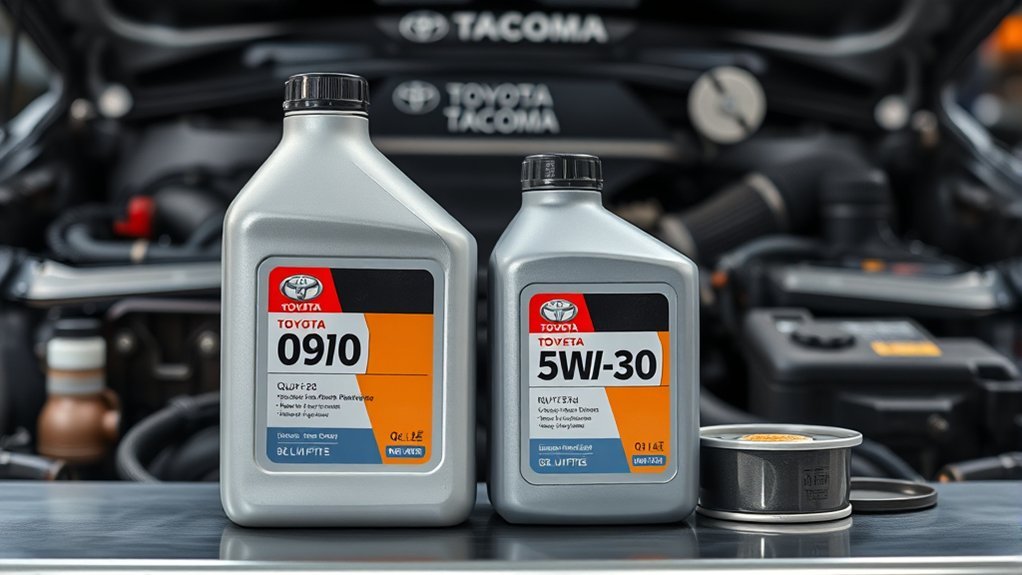
The correct 2009 Toyota Tacoma oil type depends on the engine. Use SAE 0W-20 or 5W-20 in the 2.7L 2TR-FE four-cylinder and SAE 5W-30 in the 4.0L 1GR-FE V6. With a new filter, the factory drain-and-refill reference is 6.1 quarts for the 2.7L, 4.8 quarts for a V6 2WD model except PreRunner, and 5.5 quarts for a V6 4WD or PreRunner. Toyota’s 2009 maintenance guide calls for engine oil and filter replacement every 5,000 miles or six months, whichever comes first. Refill gradually and use the dipstick for the final level.
By: Vance Ashford · Last updated: July 31, 2026
Quick Answer
Use 0W-20 or 5W-20 in a 2009 Tacoma with the 2.7L four-cylinder. Use 5W-30 in a truck with the 4.0L V6. If 5W-30 is unavailable, the owner’s manual permits temporary use of 10W-30 in the V6 and says to return to 5W-30 at the next oil change. Match the refill quantity to the engine and drivetrain, add oil gradually, and confirm the final level on the dipstick.
Key Takeaways
- Check the engine first because the 2.7L 2TR-FE and 4.0L 1GR-FE use different oil grades.
- Use 0W-20 or 5W-20 in the 2.7L four-cylinder. Toyota identifies 0W-20 as the best choice for fuel economy and cold-weather starting.
- Use 5W-30 in the 4.0L V6. If it is unavailable, 10W-30 is a temporary fallback that should be replaced with 5W-30 at the next oil change.
- Plan for 6.1 quarts with a filter in the 2.7L, 4.8 quarts in a V6 2WD model except PreRunner, and 5.5 quarts in a V6 4WD or PreRunner.
- The oil drain plug torque spec is 27 ft-lbs (37 N·m) with a new crush washer (OEM Part #90430-12031).
- The dipstick’s low-to-full range is about 1.4 quarts on the 2.7L and 1.6 quarts on the V6; these are top-off amounts, not full refill capacities.
- Replace the engine oil and filter every 5,000 miles or six months, whichever comes first.
Editorial method: This guide was verified against the 2009 Tacoma owner’s manual, factory technical service bulletins, the lubrication-system service specifications, and Toyota’s scheduled-maintenance guide. It reflects manufacturer service standards and practical vehicle maintenance specifications.
What’s in This Article
- Which Oil Should You Use?
- How to Confirm Your Tacoma Engine
- How 0W-20, 5W-20, and 5W-30 Differ
- Why 0W-20 Helps During Cold Starts
- Why the 4.0L V6 Uses 5W-30
- Oil Filters, Torque Specs & Drain Plug Gaskets
- Should Driving Conditions Change the Oil Grade?
- Switching, Mixing, and Topping Off Oil
- Oil Change Intervals for Normal and Severe Use
- Synthetic and High-Mileage Oil
- How to Reset the “MAINT REQD” Light
- Buying and Refill Checklist
- Warning Signs After an Oil Change
- Frequently Asked Questions
Which Oil Should You Use in a 2009 Toyota Tacoma?
Choose the factory oil grade by engine first. A 2009 Tacoma with the 2.7L 2TR-FE four-cylinder uses 0W-20 or 5W-20. A truck with the 4.0L 1GR-FE V6 uses 5W-30. The V6 may use 10W-30 only as a temporary substitute when 5W-30 is unavailable.
Use this four-step decision process:
- Identify the engine: 2.7L four-cylinder or 4.0L V6.
- Select the listed viscosity: 0W-20 or 5W-20 for the 2.7L; 5W-30 for the V6.
- Identify the configuration: this determines the V6 refill quantity (2WD vs. 4WD/PreRunner).
- Set the final level: add oil gradually and verify it with the dipstick after letting it settle for 5 minutes.
| Tacoma Setup | Correct Oil Grade | With Filter | Without Filter | What to Know |
|---|---|---|---|---|
| 2.7L 2TR-FE four-cylinder | 0W-20 or 5W-20 | 6.1 qt. (5.8 L) | 5.4 qt. (5.1 L) | Toyota identifies 0W-20 as the best choice for fuel economy and cold-weather starting. |
| 4.0L 1GR-FE V6, 2WD except PreRunner | 5W-30 | 4.8 qt. (4.5 L) | 4.4 qt. (4.2 L) | Standard 2WD oil pan configuration differs from the elevated 4WD/PreRunner chassis. |
| 4.0L 1GR-FE V6, 4WD or PreRunner | 5W-30 | 5.5 qt. (5.2 L) | 5.2 qt. (4.9 L) | PreRunner models share the 4WD chassis height and deeper oil pan design. |
These capacities are drain-and-refill reference amounts, not instructions to pour the full quantity at once. The owner’s manual also states that the approximate amount needed to raise the dipstick from low to full is 1.4 quarts for the 2.7L and 1.6 quarts for the V6. Add slightly less than the listed refill amount, run the engine briefly, shut it off on level ground, wait 5 minutes for the oil to drain back to the pan, and add small amounts until the dipstick level sits between the two marks.
[Products Worth Considering]

Phosphorus Replacement Technology to help extend the life of the emission system
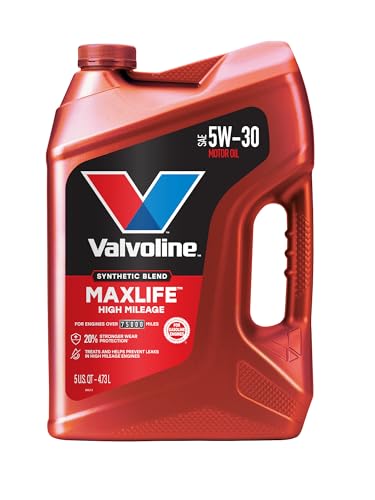
Formulated for engines with 75,000 miles or more, Valvoline MaxLife High Mileage synthetic blend is formulated with seal conditioners to help prevent oil leaks and reduce oil consumption

Formulated for engines with 75,000 miles or more, Valvoline MaxLife High Mileage synthetic blend is formulated with seal conditioners to help prevent oil leaks and reduce oil consumption
How Do You Confirm Which Tacoma Engine You Have?
A 2009 Tacoma may have the 2.7L 2TR-FE four-cylinder or the 4.0L 1GR-FE V6. That difference changes the required oil grade. You can identify the engine through the under-hood emissions label, VIN-based service data, owner’s manual, service records, or a Toyota service department.
Source hierarchy: Start with the under-hood emissions label or the 5th digit of your VIN (which identifies the engine code in Toyota trucks). Use the oil fill cap as a visual reference and third-party lookup tools as secondary confirmation. If sources disagree, confirm the specification with Toyota before changing viscosity.
The 2009 Toyota Tacoma owner’s manual lists 0W-20 or 5W-20 and a 6.1-quart with-filter capacity for the 2.7L. It lists 5W-30 for the V6, with 4.8 quarts for 2WD models except PreRunner and 5.5 quarts for 4WD models and PreRunner. The manual also permits temporary 10W-30 use in the V6 when 5W-30 is unavailable.
Do not copy these specifications to another model year. Tacoma engines and refill quantities changed over time. For broader year coverage, see the Tacoma oil-capacity guide and the Tacoma oil-grade guide.
How Do 0W-20, 5W-20, and 5W-30 Differ?
Oil viscosity describes its flow behavior at low temperatures and its viscosity at normal engine operating temperature. In a multigrade oil, the number before the “W” is the winter grade. The second number is the high-temperature viscosity grade.
The SAE J300 engine oil viscosity classification defines these grades. A 0W oil must meet colder cranking and pumping requirements than a 5W oil. At operating temperature, a 30-grade oil remains more viscous than a 20-grade oil within the limits of the standard.
| Property | 0W-20 | 5W-20 | 5W-30 |
|---|---|---|---|
| Winter grade | 0W | 5W | 5W |
| Operating-temperature grade | 20 | 20 | 30 |
| Correct 2009 Tacoma match | 2.7L four-cylinder | 2.7L four-cylinder | 4.0L V6 |
Warning: Do not use a heavier viscosity as a guesswork fix for oil burning, leaks, engine noise, or low oil pressure. Use only an owner-manual-approved alternative, such as temporary 10W-30 in the V6 when 5W-30 is unavailable, and diagnose the underlying mechanical problem.
[Products Worth Considering]

GENUINE OEM: Original Toyota/Lexus factory oil filter part number 90915-YZZN1, ensuring perfect fit and optimal performance for your vehicle

[Vehicle Fitment-1]: Replacement for Toyota Tacoma 2016-2023, Sienna 2007-2020, Camry 2007-2023, Highlander 2008-2022, Avalon 2005-2022, fit for RAV4 2006-2018, Venza 2009-2016; Compatible with Lotus Evora 2010-2017; Replacement for Scion tC 2011-2016 --- Engine protection for up to 10,000 miles, with 99% filtration efficiency

* 2Pc Oil Filter 04152-YZZA1 * 2PC Drain Plug Washer * Brand: Toyota
Why Does 0W-20 Help the 2.7L During Cold Starts?
0W-20 is one of the listed choices for the 2.7L four-cylinder, and Toyota identifies it as the best choice for fuel economy and cold-weather starting. Its 0W rating means it meets lower-temperature cranking and pumping requirements than a 5W oil. That difference matters most when the truck starts after sitting in sub-freezing temperatures.
Cold-Weather Flow
Oil thickens as its temperature falls. A correctly formulated 0W-20 circulates more readily than a 5W-20 during cold starts, reaching critical valve-train components in the 2TR-FE cylinder head faster. In mild weather, the practical difference is minimal because both oils share the same 20-grade operating-temperature viscosity classification.
When the Difference Matters Most
The lower winter grade is most useful when the truck sits outside in freezing conditions or makes frequent short trips where the engine never fully reaches operating temperature. It does not make 0W-20 suitable for every Tacoma engine; the 4.0L V6 still requires 5W-30 due to internal bearing clearances and hydrodynamic film requirements.
Why Does the 4.0L V6 Use 5W-30?
Use 5W-30 because the 2009 Tacoma’s 4.0L 1GR-FE V6 is engineered specifically for that grade. Its 30-grade operating-temperature classification provides the hydrodynamic film strength needed for the 1GR-FE’s timing chain assemblies and journal bearings. If 5W-30 is unavailable, Toyota permits 10W-30 temporarily and instructs returning to 5W-30 at the subsequent oil change.
The manual notes that higher-viscosity oil may be better suited to high-speed or extreme-load operation, but it does not provide one universal alternate grade for every towing or hot-weather situation. Do not improvise from a generic climate chart; stick with the factory specification.
- 4.0L V6: Use 5W-30; use 10W-30 only as the stated temporary fallback.
- 2.7L four-cylinder: Use 0W-20 or 5W-20.
- High speed or extreme load: Confirm any viscosity change through the owner’s manual or Toyota technical service bulletins.
[Products Worth Considering]

3X Stronger than the leading full synthetic*

Formulated with premium seal conditioners, Valvoline MaxLife High Mileage 150K is formulated with seal conditioners to help prevent oil leaks and reduce oil consumption in older high mileage engines

Phosphorus Replacement Technology helps extend emission system life
Oil Filters, Torque Specs & Drain Plug Gaskets
Performing a proper oil change on a 2009 Tacoma requires knowing the engine-specific filter locations, torque specs, and seal requirements:
- 4.0L V6 (1GR-FE) Oil Filter: Features an inverted spin-on filter mounted on the top-front driver’s side of the engine bay. It sits inside a built-in metal catch basin with a small drain spout underneath. Pro tip: Slip a small plastic bottle or vinyl hose over the drain spout before unscrewing the filter to prevent oil from running down onto the front differential and steering components. OEM Filter: Toyota Part #90915-YZZD3 (or #90915-YZZD1).
- 2.7L I4 (2TR-FE) Oil Filter: Uses a spin-on filter located beneath the vehicle on the driver’s side of the engine block. OEM Filter: Toyota Part #90915-YZZD1 (or #90915-YZZG2).
- Oil Drain Plug Torque: Tighten the 14mm oil drain plug to 27 ft-lbs (37 N·m) on both engines. Do not over-tighten, as the threads can strip.
- Drain Plug Gasket (Crush Washer): Replace the crush washer at every service. Toyota uses a blue/black coated felt-aluminum compression gasket (OEM Part #90430-12031). Installing the new washer flat-side to the pan ensures a leak-free seal.
Should Towing, Hot Weather, or City Driving Change the Oil Grade?

Not automatically. Start with the engine-specific viscosity. The owner’s manual notes that higher-viscosity oil may be better suited to high-speed or extreme-load operation, but it does not name one universal alternate for every workload. For the V6, the stated fallback is temporary 10W-30 only when 5W-30 is unavailable.
- City and short-trip driving: Use the engine-specific grade, check the level regularly, and adhere strictly to the 5,000-mile or six-month oil-and-filter schedule to avoid fuel dilution.
- Towing and heavy loads: Follow Toyota’s additional severe-maintenance schedule (inspect propeller shafts, lubricate drive shaft joints) and confirm any viscosity adjustment through model-specific documentation.
- Long highway trips: Check the dipstick before departure and inspect for leaks if the engine consumes oil over extended high-RPM driving.
- Dusty or off-road use: Keep the listed grade unless Toyota specifies otherwise, and inspect the engine air filter and oil level more frequently.
- Hot climates: Do not select a thicker 40-weight or 50-weight grade from generic advice; use the factory-specified viscosity.
Switching viscosity from one oil change to the next can also make oil-consumption tracking harder. Use one approved grade consistently unless a verified service source gives you a reason to change.
Can You Switch, Mix, or Top Off Different Oils?
Use the same approved viscosity for the full service interval when possible. If the 2.7L already contains 0W-20, top it off with 0W-20. If it contains 5W-20, use 5W-20. Top off a 4.0L V6 with 5W-30. Use 10W-30 in the V6 only as the owner-manual fallback when 5W-30 is unavailable.
When the oil level is dangerously low and the correct oil is unavailable, adding a small amount of compatible gasoline-engine oil is generally safer than continuing to drive with insufficient oil. Treat that as an emergency measure. Return to one correct viscosity at the next service and do not mix grades to create a custom blend.
Pro Tip: Keep one sealed quart of the matching viscosity in your truck’s rear under-seat storage. Label it with the date and use it only for top-offs so you can accurately track consumption between intervals.
How Often Should You Change the Oil?
Toyota’s 2009 Tacoma Scheduled Maintenance Guide calls for replacing the engine oil and oil filter every 5,000 miles or six months, whichever comes first. This is the working schedule for both engines and should not be extended simply because full synthetic oil is used.
The 2009 guide adds inspections and other maintenance items for trucks driven primarily on dirt or dusty roads, while towing, or during repeated short trips under 32°F (0°C). Toyota’s later Oil Viscosity Applicability and Change Interval Guide kept the 2TR-FE Tacoma on a 5,000-mile interval even when 0W-20 was used. The later guide supports the interval context but does not replace the 2009 schedule.
Do not extend the interval solely because an oil bottle claims “10,000-mile extended protection.” The truck’s scheduled-maintenance guide controls the service schedule, and the dipstick should be checked at least once a month.
Should You Use Synthetic or High-Mileage Oil?
Full synthetic oil is suitable and beneficial for both engines when it has the correct viscosity and the ILSAC certification required by the manual. Synthetic oil provides superior resistance to thermal breakdown and cold-flow friction. However, it does not change the engine’s refill capacity or Toyota’s 5,000-mile or six-month service schedule.
High-mileage oil may also be used when it matches the required viscosity and certification. High-mileage formulations include seal conditioners that help reduce minor seepage around valve cover gaskets and crankshaft seals on older 2nd-gen Tacomas. Note that high-mileage oil cannot repair mechanical leaks, failing gaskets, or worn piston rings.
How to Reset the “MAINT REQD” Light on a 2009 Tacoma
The “MAINT REQD” light illuminates on the instrument cluster every 5,000 miles to indicate that scheduled maintenance is due. It flashes on startup starting at 4,500 miles and stays solid at 5,000 miles. It does not indicate an engine error code. Reset it manually after every oil change using this procedure:
- Turn the ignition switch to the ON position (do not start the engine).
- Press the odometer/trip button until the digital display shows Trip A (or total odometer on select cluster versions; Trip A is standard for 2009).
- Turn the ignition switch to OFF.
- Press and hold down the odometer/trip reset button.
- While holding the button down, turn the ignition switch back to the ON position.
- Continue holding the button until the odometer display flashes five dashes, counts down to zeros (
000000), and displays the normal mileage reading. - Release the button and verify the “MAINT REQD” light goes out.
What Should You Check Before Buying and Refilling Oil?
Use the front label to confirm viscosity, but also verify the quantity, filter fit, and service category before beginning the oil change.
- Confirm the engine: 2.7L four-cylinder (2TR-FE) or 4.0L V6 (1GR-FE).
- Match the viscosity: 0W-20 or 5W-20 for the 2.7L; 5W-30 for the V6.
- Confirm the V6 configuration: 2WD except PreRunner (4.8 qt), or 4WD/PreRunner (5.5 qt).
- Check the certification: Look for the API Starburst / ILSAC certification mark (ILSAC GF-5 or GF-6A).
- Buy enough oil: The 2.7L with-filter reference is 6.1 quarts, so one 5-quart jug is not enough; buy a 5-quart jug plus two individual quarts for top-offs.
- Use the correct filter and washer: Toyota OEM filter and a fresh crush washer (#90430-12031).
- Refill gradually: Pour roughly 0.5 quarts less than the rated capacity, let it settle for 5 minutes, then top off using the dipstick marks.
- Torque to spec: Tighten the 14mm drain plug to 27 ft-lbs.
- Record the service: Log the mileage, date, oil grade, and filter brand for maintenance tracking.
What Warning Signs Need Immediate Attention?
Shut the engine off immediately if the red oil-pressure warning light (oil can symbol) remains lit after starting, if a rapid puddle forms underneath, or if the engine produces metallic ticking or knocking noises. Recheck the dipstick if the level is above the top hole or below the lower dot.
The owner’s manual notes that normal oil consumption can reach up to 1.1 quarts per 600 miles (1.0 L / 1,000 km) under severe conditions, but typical consumption on a healthy 2TR-FE or 1GR-FE is significantly lower. A sudden drop in level or excessive blue exhaust smoke should be diagnosed promptly.
A brief burning smell can occur if oil spilled into the 4.0L catch basin runs down onto the exhaust manifold, but it should dissipate quickly. Persistent smoke or puddles indicates a compromised filter O-ring, unseated drain plug washer, or loose filter.
Frequently Asked Questions
Can I use 5W-30 instead of 0W-20 in my Toyota Tacoma?
Use 5W-30 when your 2009 Tacoma has the 4.0L V6. The 2.7L four-cylinder is listed for 0W-20 or 5W-20. Although the manual notes that higher viscosity may suit high-speed or extreme-load operation, it does not provide a blanket 5W-30 substitution for every 2.7L truck.
Does it matter whether I use 5W-20 or 5W-30?
Yes. The 2.7L four-cylinder uses 0W-20 or 5W-20, while the 4.0L V6 uses 5W-30. The grades have different operating-temperature viscosity classifications and are assigned to different engines.
Is 0W-20 better than 5W-20 for cold starts?
Yes. Both grades are allowed in the 2.7L engine, but Toyota identifies 0W-20 as the best choice for fuel economy and cold-weather starting. Both share the same 20-grade operating-temperature classification.
How many quarts of oil does a 2009 Tacoma take?
With a new filter, the 2.7L four-cylinder takes 6.1 quarts. A 4.0L V6 takes 4.8 quarts in 2WD models except PreRunner or 5.5 quarts in 4WD models and PreRunner. Confirm the final level with the dipstick.
How often should I change oil in a 2009 Tacoma?
Toyota’s 2009 Tacoma Scheduled Maintenance Guide calls for replacing the engine oil and oil filter every 5,000 miles or six months, whichever comes first.
What is the torque spec for the 2009 Tacoma oil drain plug?
The factory torque specification for the 14mm oil pan drain plug on both the 2.7L and 4.0L engines is 27 ft-lbs (37 N·m). Always install a new replacement crush washer (OEM Part #90430-12031).
How do I reset the oil maintenance light on a 2009 Tacoma?
Set the odometer display to Trip A, turn the ignition to OFF, hold down the odometer reset button, and switch the ignition back to ON. Keep holding the button until the dashes on the display count down to 000000 and the light turns off.
Can I use synthetic or high-mileage oil?
Yes, when the oil has the correct viscosity and ILSAC certification. Synthetic or high-mileage oil does not change the refill capacity or Toyota’s 5,000-mile or six-month service schedule.
Can I use 10W-30 in a 2009 Tacoma V6?
Only as a temporary substitute when 5W-30 is unavailable. Toyota says to replace the 10W-30 with 5W-30 at the next oil change.
How much oil raises the dipstick from low to full?
The manual lists about 1.4 quarts for the 2.7L and 1.6 quarts for the 4.0L V6. Add less than that first and recheck because the marks are a guide, not a command to pour the full amount.
What if my oil cap and a lookup tool disagree?
Do not guess. Check the owner’s manual and ask a Toyota service department to confirm the specification by VIN. An older truck may have a replacement cap, an engine swap, or incomplete service records.
Can I mix 0W-20 and 5W-20?
A small emergency top-off is generally preferable to driving with dangerously low oil, but mixing grades should not become a routine maintenance practice. Use the same approved viscosity already in the engine whenever possible.
Confirm the engine before buying oil. Choose 0W-20 or 5W-20 for the 2.7L four-cylinder and 5W-30 for the 4.0L V6. Use 6.1 quarts, 4.8 quarts, or 5.5 quarts as the correct with-filter planning reference for the matching configuration, then pour gradually and use the dipstick to determine the final level. Replace the oil and filter every 5,000 miles or six months.
Sources
- 2009 Toyota Tacoma Owner’s Manual — engine-oil selection, refill capacities, dipstick range, consumption guidance, and temporary V6 fallback viscosity.
- Toyota 2009 Tacoma Scheduled Maintenance Guide archive — 5,000-mile or six-month maintenance schedule and condition-specific maintenance items.
- Toyota Oil Viscosity Applicability and Change Interval Guide — later-model 2TR-FE interval context.
- SAE J300 Engine Oil Viscosity Classification — current viscosity-grade classification reference.
- FuelEconomy.gov: Keeping Your Vehicle in Shape — manufacturer-recommended motor-oil guidance.