

Unlocking a Toyota Land Cruiser center differential lock is usually simple, but the exact steps depend on the model year, market, and transfer-case layout. Many modern Land Cruisers use full-time 4WD, so do not assume there is a 2WD mode unless your owner’s manual shows one. The safe goal is to return the center differential to its open/free state before driving on dry, high-grip pavement.
Quick Answer
To unlock a Land Cruiser center diff lock, slow down, drive straight, ease off heavy throttle, and press the center differential lock switch so the indicator turns off. If it keeps blinking, drive straight while gently accelerating or decelerating, or reverse slowly. Stop and use Neutral before changing between H4 and L4.
Key Takeaways
- Use the center diff lock on loose or slippery surfaces, not dry pavement.
- A blinking center diff light means the system is still locking or unlocking; wait for the light to turn solid or go out.
- Current Toyota guidance allows center diff lock switch operation below 62 mph/100 km/h, but H4-to-L4 range changes require the correct stopped/Neutral procedure.
- If the light keeps blinking after safe attempts, stop testing and get the 4WD system inspected.
At a Glance
| Time Required | 30 seconds to 5 minutes for normal unlocking; longer if the system is bound or malfunctioning |
| Difficulty | Easy for normal operation; moderate if troubleshooting a blinking light |
| Tools Needed | Owner’s manual; no tools for normal unlock; basic inspection light and battery tester for troubleshooting |
| Cost | Free for normal operation; diagnostic or repair costs vary if the actuator, wiring, switch, or transfer case has a fault |
Check Your Land Cruiser Model First
Before you press switches or shift the transfer case, confirm which 4WD system your Land Cruiser uses. Toyota’s current U.S. Land Cruiser uses a full-time 4-wheel-drive system, so “shift into 2WD” is not the right instruction for those models. Older Land Cruiser and Prado versions may use H, HL, LL, H4, L4, or part-time 2H/4H/4L layouts depending on market and generation.
Note: Use this guide as a safe general process, then follow your exact Toyota owner’s manual for your year and market. If your Land Cruiser has no 2WD mode, unlock the center diff by returning it to H4 with the center differential open/free.
How to Unlock the Center Diff Lock
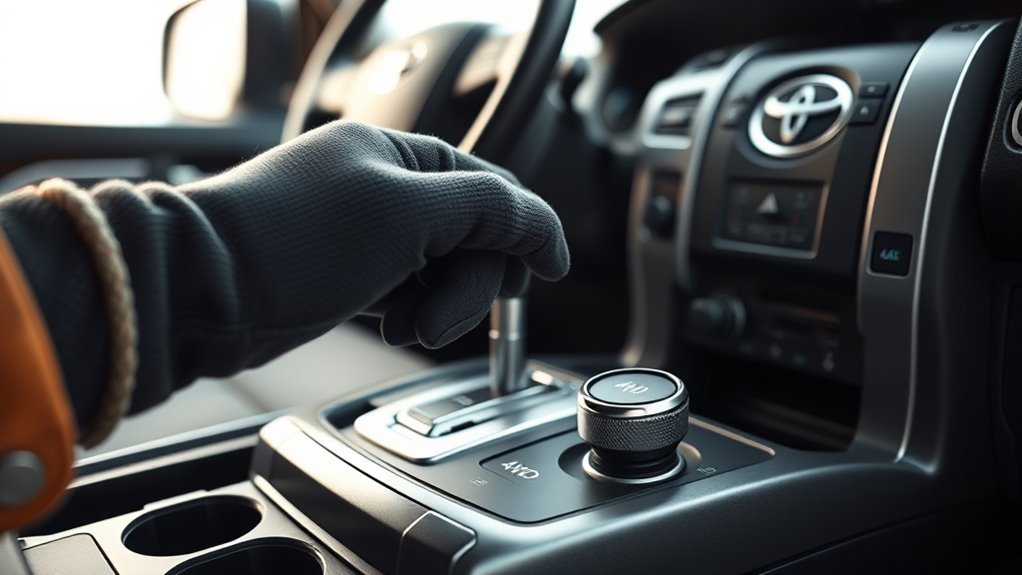
Use these steps when the center diff lock is engaged and you want to release it before returning to normal roads:
- Move to a safe area. Stay off dry pavement if possible, and keep the wheels pointed straight.
- Reduce speed and ease off the throttle. Avoid hard acceleration, braking, or sharp steering while the drivetrain is bound.
- Press the center differential lock switch. On current Toyota systems, the center differential lock indicator blinks while locking or unlocking.
- Wait for the light to go out. A solid light means the center diff is locked. An off light means it is unlocked/open.
- If the light keeps blinking, drive straight ahead gently. Light acceleration or deceleration can help release drivetrain bind. If it still does not release, reverse slowly in a straight line and try again.
- Return to normal driving only after the light is off. Do not continue onto dry, high-traction pavement with the center diff locked.
Warning: Do not force the vehicle through tight turns on dry pavement with the center diff locked. A locked center differential prevents the front and rear axles from rotating at the different speeds they need during turns, which can cause drivetrain bind, tire scrub, harsh steering feel, and possible damage.
How to Engage and Disengage the Center Diff Lock in H4 and L4
For current Toyota Land Cruiser guidance, the center differential lock switch can be operated when the vehicle is powered on and traveling below 62 mph/100 km/h. That does not mean you should shift into low range at speed. Treat the center diff lock switch and the H4/L4 range selector as two different controls.
- For H4 center diff lock use: slow down, drive straight, press the center diff lock switch, and wait until the indicator stops blinking and stays solid.
- For H4 center diff unlock: press the switch again and wait until the indicator goes out. If it keeps blinking, drive straight while gently accelerating/decelerating or reverse slowly.
- For L4 range changes: stop the vehicle, shift the transmission to Neutral, then operate the four-wheel-drive control switch according to the owner’s manual.
- For models with 2H: shift back to 2H only if your exact Land Cruiser has that mode and your manual allows it under the conditions you are in.
Pro Tip: If the center diff lock has not been used for months, test it at low speed on gravel, dirt, snow, or another low-traction surface before a trip. Confirm that the light turns solid when locked and turns off when unlocked.
[Products Worth Considering]

The TOPDON BT100 helps you quickly check the health and charge status of 12V lead-acid batteries with clear analytical results, including state of health, state of charge, voltage, and cranking performance. It supports a wide range of battery types and vehicles, making it a practical tool for diagnosing starting and charging issues at home or in the shop. Compact and easy to use, it provides fast, reliable testing without needing to charge the device first.

Custom-fit floor mats and cargo liner designed to provide edge-to-edge protection for the Toyota Land Cruiser Prado. Made from durable TPE material, they offer all-weather defense against rain, slush, snow, mud, and everyday dirt while remaining easy to install, clean, and maintain. The odorless, non-slip design helps keep your interior safer, cleaner, and more comfortable in every season.

These custom floor mats are designed to fit the Toyota Land Cruiser GX550 with a 5-seat layout for a precise, secure install. Made from durable TPE, they help shield your interior from spills, mud, snow, dirt, sand, pet hair, and everyday debris while making cleanup quick and easy.
What the Center Diff Lock Light Means
The indicator light tells you what the system is trying to do. Read it before you apply more throttle or return to pavement.
| Light Off | Center differential is unlocked/open for normal full-time 4WD operation. |
| Blinking | System is locking or unlocking. Keep driving straight gently and wait for the process to finish. |
| Solid | Center differential is locked. Use only on low-traction surfaces or off-road conditions where wheel slip is expected. |
| Keeps Blinking | Conditions may not be right, the drivetrain may be bound, or the 4WD system may have a fault. Stop repeated attempts if it does not resolve. |
When to Lock or Unlock the Center Diff
Lock the center differential when the surface is loose enough to let the tires slip slightly. Unlock it before the tires return to dry, high-grip pavement.
- Lock it for: mud, snow, loose gravel, sand, ruts, slick climbs, uneven trails, and low-traction off-road sections.
- Unlock it for: dry pavement, parking lots, tight turns on high-grip roads, normal highway driving, and mixed conditions where traction is mostly firm.
- Use L4 carefully: low range is for slow technical driving, steep grades, controlled descents, and obstacles where you need torque and low speed.
- Do not use it as a rescue button after heavy wheelspin: slow down, straighten the wheels, regain control, then engage the lock smoothly.
A center diff lock is for traction, not speed. Engage it before the difficult section, drive smoothly, and unlock it before the surface becomes firm again.
Common Problems When the CDL Won’t Stay Engaged
If the CDL indicator blinks but never turns solid, or if it will not turn off after unlocking, start with safe, simple checks before assuming the transfer case has failed.
- Check the driving conditions. Straighten the steering wheel, reduce load on the drivetrain, and avoid tight turns.
- Try a gentle straight-line release. Drive forward slowly while easing on and off the throttle. If needed, reverse slowly in a straight line.
- Confirm the correct range procedure. If shifting between H4 and L4, stop completely and shift the transmission to Neutral before operating the range control.
- Check battery condition. Low voltage can make electronic actuators and control modules behave unpredictably.
- Inspect visible wiring and connectors. Look for corrosion, damaged insulation, loose plugs, and signs of water or impact damage near the actuator harness.
- Stop repeated attempts if warning lights continue. Persistent blinking can point to a malfunction in the engine, brake, or 4WD system and should be diagnosed properly.
Note: A center diff lock problem is not always a bad actuator. It can also be caused by drivetrain windup, incorrect shift conditions, low voltage, wiring faults, switch issues, control-module logic, or internal transfer-case wear.
[Products Worth Considering]

This keyless entry remote replacement is designed for a wide range of Toyota, Scion, and Lexus-compatible vehicles, offering a convenient way to restore remote locking and unlocking functions. Each fob is pre-tested, comes with the battery and electronics already installed, and is ready to be programmed for supported standard-key vehicles. It is a practical replacement choice for drivers who need a reliable, compatible remote for everyday use.

The ANCEL AD410 PRO combines engine diagnostics and 12V battery testing in one easy-to-use tool, helping you read and clear check engine codes while checking battery health, cranking, and charging performance. It also provides live data, freeze frame details, and I/M readiness checks to help you diagnose issues faster and prepare for emissions testing. With plug-and-play operation, a clear screen, and broad vehicle compatibility, it is a practical solution for home mechanics and everyday drivers.
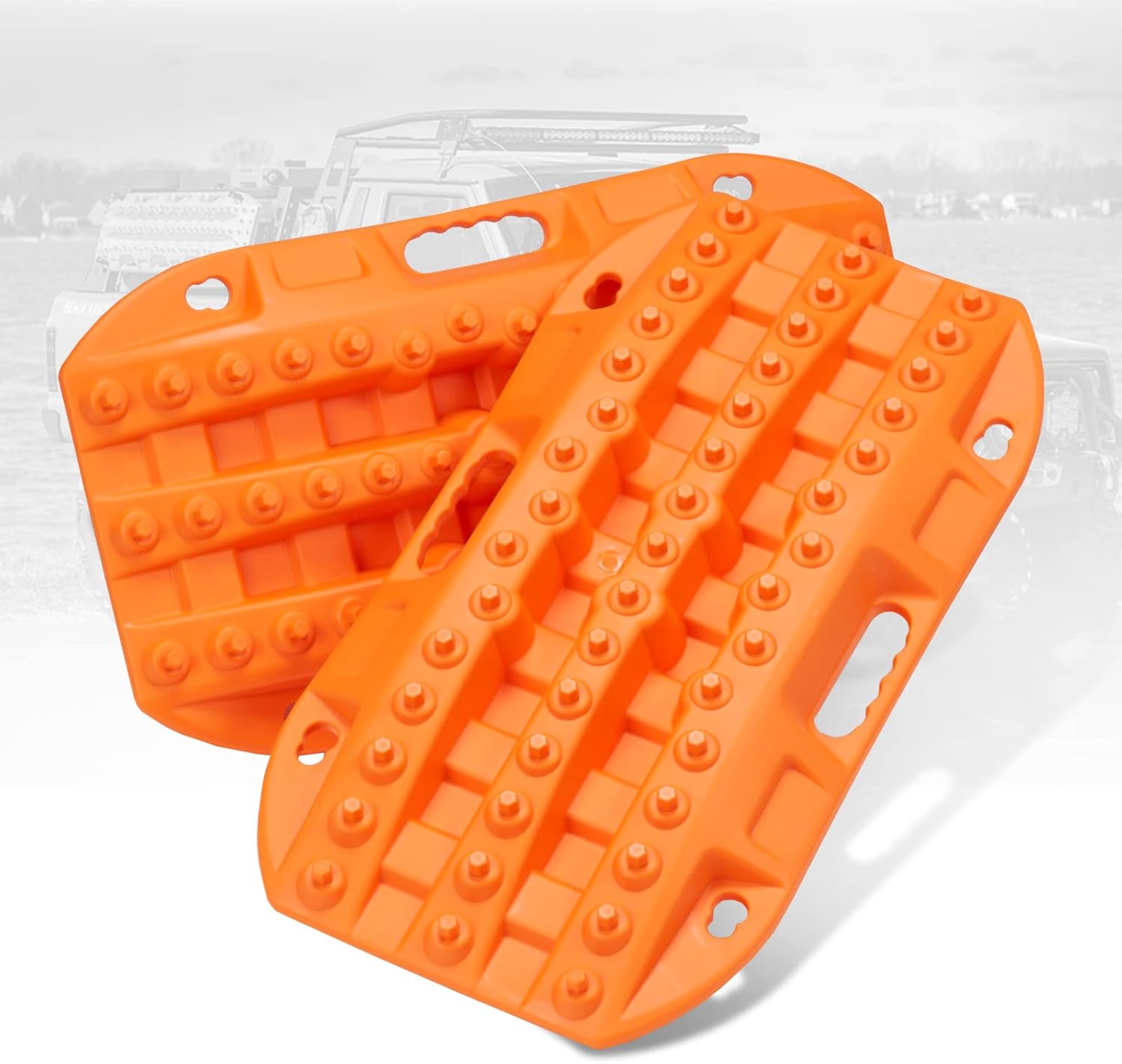
These short off-road traction boards are designed to help ATV and UTV drivers recover from mud, sand, and snow with added convenience and portability. Built with strengthened teeth and a stable bottom channel design, they help prevent wheel slip and improve traction in tough terrain. Made from durable automotive-grade polypropylene, they are lightweight, easy to clean, and suited for year-round use in extreme temperatures. Built-in shovels, ergonomic handles, and nesting storage make them practical for compact vehicle setups.
Maintain the Center Diff Lock: Warm-Up, Cycling, Battery, Actuator

A Land Cruiser center diff lock is most reliable when it is used periodically and serviced with the rest of the drivetrain. Neglect, old fluid, low voltage, and corrosion can all make engagement slower or less predictable.
- Warm the drivetrain first. A short drive can help fluid move through the transfer case before you test the lock.
- Cycle the lock occasionally. Engage and disengage it on a safe low-traction surface so the mechanism does not sit unused for months.
- Service the transfer case and differentials on schedule. Use the fluid type and interval listed in your Toyota maintenance guide.
- Check the battery and charging system. Electric actuators and control modules need stable voltage.
- Inspect after water, mud, or impact. Off-road use can contaminate connectors, damage wiring, or expose actuator seals to debris.
Center Diff Lock vs. Rear Diff Lock
Do not confuse the center diff lock with the rear differential lock. The center lock ties the front and rear driveline together so torque is shared between axles. The rear lock ties the left and right rear wheels together, which is useful for severe off-road traction loss but has stricter speed and steering limits.
On current Land Cruiser materials, Toyota lists center and rear locking differentials as part of the vehicle’s off-road hardware. Treat the rear locker as a separate tool: use it only when needed, at very low speed, and only under the conditions allowed by the owner’s manual.
When to Get Professional Help: Diagnostics and Drivetrain Warning Signs
Stop DIY testing and get professional diagnostics if the center diff lock light keeps blinking after you have tried the safe straight-line release steps. Also get help if the vehicle binds badly, refuses to shift between H4 and L4, makes grinding noises, shows multiple warning lights, or feels like it is stuck in a locked mode on pavement.
A qualified Toyota technician can scan the 4WD, brake, and powertrain systems; test actuator operation; inspect wiring; verify switch inputs; and check for mechanical binding inside the transfer case. Prompt diagnosis protects the center differential, transfer case, tires, and driveline.
[Products Worth Considering]

The ANCEL BA101 helps diagnose 12V batteries quickly with clear readings for battery health, charge level, voltage, CCA, cranking, and charging system performance. Designed for a wide range of vehicles and battery types, it offers easy-to-read results, reliable clamp connections, and built-in protection to make testing safer and more convenient.

This enhanced OBD2 scanner helps drivers quickly diagnose check engine light issues, read and clear trouble codes, and check emissions readiness before a smog test. It also adds EVAP and O2 sensor testing, live data, freeze frame capture, and a one-click battery health check in a simple plug-and-play tool with a bright color screen.

The KONNWEI KW371 is a versatile 2-in-1 diagnostic tool that tests automotive batteries and 4/5-pin relays with fast, accurate results. It supports 6V, 12V, and 24V systems across multiple battery types, and also checks cranking and charging performance to help pinpoint battery, starter, or alternator issues. Built for mechanics and DIY users, it offers clear visual readouts, multiple language support, and convenient vehicle-powered operation with no batteries required.
Frequently Asked Questions
How do you unlock a Land Cruiser center diff lock?
Drive straight at low speed, ease off heavy throttle, press the center diff lock switch, and wait for the indicator to turn off. If it keeps blinking, drive straight while gently accelerating or decelerating, or reverse slowly in a straight line.
Can I use the center diff lock on dry pavement?
No. Unlock it before dry, high-traction pavement. A locked center differential can cause drivetrain bind during turns because the front and rear axles cannot rotate at the different speeds they need.
What does a blinking center diff lock light mean?
It usually means the system is still locking or unlocking. Keep the wheels straight and drive gently until the light turns solid when locked or turns off when unlocked. If it keeps blinking, the system may need inspection.
Can I shift a Land Cruiser into 4Lo while moving?
Do not treat 4Lo as a shift-on-the-fly mode. For current Toyota Land Cruiser guidance, stop the vehicle, shift the transmission to Neutral, and then operate the four-wheel-drive control switch according to the owner’s manual.
Is the center diff lock the same as the rear diff lock?
No. The center diff lock controls torque split between the front and rear axles. The rear diff lock ties the two rear wheels together. The rear locker is for very low-speed off-road use and has separate rules.
Conclusion
To release the Land Cruiser center diff lock, slow down, drive straight, press the center differential lock switch, and wait for the indicator to go out. Use the lock only on loose or slippery surfaces, and unlock it before dry pavement. If the light keeps blinking, do not force the vehicle through turns or keep cycling the switch. Follow your exact Toyota owner’s manual and get professional diagnostics if the system will not unlock cleanly.
Sources
- Toyota Owners — 2026 Land Cruiser Four-Wheel Drive System — center differential lock operation, indicator behavior, H4/L4 guidance, and blinking warning guidance
- Toyota — 2026 Land Cruiser — full-time 4WD system description
- Toyota USA Newsroom — 2026 Land Cruiser — current Land Cruiser off-road hardware and locking differential context
- Toyota Owners — 2026 Land Cruiser Rear Differential Lock System — distinction between rear differential lock behavior and center differential lock behavior
- Toyota Owners — Manuals and Warranties — source for checking the exact owner’s manual by model year


[…] 4WD: May use a center differential or controlled clutch that allows front and rear axles to rotate at different speeds in some modes. […]